
Reviewed · POMPEII & VESUVIUS TOURS
Ercolano: Herculaneum Skip-the-Line Ticket & Audio Guide
Herculaneum is one of Italy’s most powerful ancient sites because it feels less like a field of ruins and more like a Roman town interrupted. The preserved houses, mosaics, frescoes, and wooden furnishings let you look closely at daily life in a way that is difficult at larger archaeological sites.
I like the freedom to set my own pace, and I like having audio commentary without being tied to a group or a live guide. The skip-the-line ticket can also save precious time, especially if you need regular sitting breaks. The main drawback is that the audio guide can be awkward to follow in sequence, and you must download everything before arrival because phone coverage and Wi-Fi may be poor.
Key points before you book

- See remarkably preserved Roman interiors: Frescoes, mosaics, statues, wooden screens, and furniture make Herculaneum feel unusually personal.
- Explore without a fixed group: The downloadable audio guide lets you pause, replay, or move on when you wish.
- Save time at the entrance: The skip-the-line arrangement is useful, though some booking options may still require a quick physical ticket collection.
- Prepare your phone in advance: Download the audio content before visiting, and bring headphones and a charged smartphone.
- Allow around four hours: That gives you time to examine the open buildings instead of rushing from street to street.
- Arrange your own transport: Transfers are not included, and the meeting point can vary with the option you select.
Why Herculaneum feels different from Pompeii
Herculaneum and Pompeii were both buried by the eruption of Mount Vesuvius in 79 A.D., but they offer different visits. Pompeii spreads across a much larger area, while Herculaneum is more compact and often easier to absorb in one outing.
I find Herculaneum especially rewarding for its close-up details. You can walk along ancient alleys, then step into buildings where painted walls, patterned floors, and household objects remain visible. The scale makes it easier to understand how rooms connected and how people moved through the town.
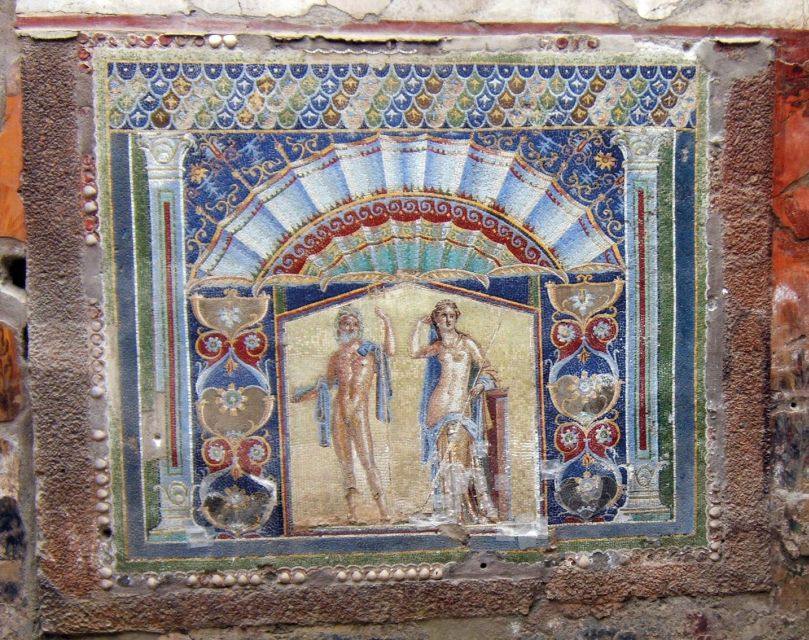
The town was wealthy, and that shows in the decoration. You might find a bright wall fresco, a carefully laid mosaic, or a carved architectural detail only a few steps from an ordinary street. The effect is not just visual. These details help you imagine the Roman city as a lived-in place rather than a collection of broken columns.
The modern rediscovery of Herculaneum is part of the story. After the ancient location faded from memory, a farmer named Ambrogio Nucerino found valuable marble fragments while digging a well in 1710. The pieces were later understood to belong to the ancient theater. Bourbon explorations then helped return the buried city to historical attention.
That background gives the visit extra weight. You are not simply touring a famous ruin. You are walking through a place that disappeared from common memory and was slowly brought back into view.
More Skip-the-Line Tickets in Pompeii
- Pompeii: Skip-the-Line Entrance Ticket with Audio Guide
★ 4.0 · 2,509 reviews - Pompeii: Skip-the-line-Ticket and Guided Tour
★ 4.6 · 1,152 reviews - Pompeii: Guided Tour with Skip-the-Line Entry
★ 4.9 · 812 reviews
Arriving with a skip-the-line ticket
This experience is designed for an independent visit. You do not receive a transfer, and you do not join a live guide. Your meeting point depends on the option booked, so read the final instructions carefully rather than assuming every ticket uses the same entrance procedure.
The ticket and audio instructions are sent by WhatsApp or email the day before the visit. Reservations received after 6 p.m. are processed the following morning after 8 a.m., so do not leave a late booking until the last possible moment if you need quick confirmation.
The skip-the-line benefit is useful, but understand the wording in practical terms. Some booking arrangements may involve collecting a physical ticket first. That collection can be quick, but it means the experience is not always a completely paperless walk straight through the gate.
Have your passport or ID card with you. You should also keep the ticket message easy to find on your phone. If the message does not appear, check spam folders and WhatsApp carefully. The instructions are important, especially because the audio guide is delivered digitally.
Transport is your responsibility. The activity ends back at the meeting point, but no ride to or from Herculaneum is included. If you are coming from Naples, a cruise port, or another town in Campania, allow extra time and money for the journey.
Walking the Roman streets

Once inside, the basic rhythm is simple: follow the alleys, enter the buildings that are open, and use the audio guide when you reach a point of interest. There is no prescribed route stated for the visit, so you can begin with the area that catches your eye and adjust as you go.
The streets are the essential introduction. They show the town’s layout and help you judge its compact scale. Rather than viewing each building as an isolated object, look across the lanes and doorways. The close spacing gives you a better sense of an actual neighborhood.
I would resist the urge to rush through the first few blocks. The most memorable parts may be small: a floor pattern, a doorway, a fragment of painted plaster, or a surviving piece of wood. Herculaneum rewards slow looking more than fast sightseeing.
The audio commentary is most useful when you want context for those details. It can explain the purpose or background of a building while you stand in front of it, making the site easier to read. The phone app is available in various languages, depending on the selected solution.
The audio route is not perfect. It can be confusing if you expect the numbers or stops to unfold in a neat order. You may need to match the commentary to buildings yourself, pause a track, or move between sections rather than follow it blindly.
That inconvenience is balanced by the control you gain. You can stop listening when the site itself has enough to say, replay information, or skip material that does not interest you. A live guide may provide a smoother route, but this format gives you privacy and flexibility.
The preserved interiors are the main event
Herculaneum’s greatest strength is the amount of domestic detail still visible. The experience is not limited to grand public remains. You can look into rooms and see how decoration, building materials, and household objects worked together.
Frescoes and mosaics deserve unhurried attention. Their color and patterns help explain the taste and wealth of the people who lived here. Even when a wall is incomplete, the surviving section can show how carefully Roman interiors were designed.
Wooden screens and furniture are particularly striking. Wood usually disappears at ancient sites, so its survival here gives the visit a different feel. A piece of furniture or a wooden architectural feature can make a room seem far more immediate than a stone wall alone.
Statues and decorative fragments add another layer. They are easy to pass if you are focused only on the larger structures, so use the audio guide as a prompt to look down, across, and into corners.
The preservation also changes the pace of the visit. You are likely to spend more time examining rooms than taking quick photographs from a distance. If you want to see everything that is open, plan for roughly four hours, as one full visit can reasonably fill that amount of time.
Not every area may be open on every day, and the supplied information does not promise access to every building. That is worth keeping in mind if you are planning a tightly timed day around the site.
A few other Pompeii mornings to weigh against this
- Pompeii: Entry Ticket and Guided Tour with an Archaeologist
★ 4.8 · 19,459 reviews - Pompeii: Entry Ticket with Optional Audio Guide
★ 4.2 · 12,360 reviews - Pompeii: Small Group Tour with an Archaeologist
★ 4.8 · 12,264 reviews - Pompeii Small Group Tour with an Archaeologist
★ 5.0 · 6,593 reviews
Getting the most from the audio guide
The audio guide is downloadable to your smartphone. Do this before you arrive. The ruins and museums do not offer free Wi-Fi, and mobile coverage is not always reliable once you are on site.
Bring your own headphones. They are not included, and listening through a phone speaker can be uncomfortable for you and distracting for people nearby. Headphones also make it easier to hear in open areas where other visitors are talking.
Charge your phone fully, then consider carrying a power bank if you have one. Your device is doing several jobs at once: displaying the ticket, running the guide, and possibly taking photographs.
The best way to use the guide is as a helper, not as a strict walking command. Start a track near the matching building, listen for the main point, then look around before moving on. If the sequence becomes confusing, stop following the order and use the information selectively.
The commentary is informative, but the layout can make the route hard to follow. This is the clearest weakness of the experience. You receive the benefits of an independent audio tour, but you also take on the job of managing the app.
For visitors who are comfortable with smartphone apps, that is a small nuisance. If you are not confident with phones, ask someone in your party to download and test the guide before the visit. The instructions arrive the day before, giving you time to prepare.
What the $35 price gets you

At about $35 per person, this is not the cheapest way to see an archaeological site, but it combines admission with a self-guided explanation. The value depends on what you want from the visit.
If your priority is simple entry and the freedom to wander, the ticket is convenient. The skip-the-line feature can matter more than it first appears, particularly during busy periods or for anyone who cannot stand in a queue for long.
The audio guide adds useful structure without the cost or fixed timing of a private guide. You can spend four hours at the site, or less if you have a packed schedule. You are paying for flexibility as much as for commentary.
The price is less attractive if you expect a personal guide, transport, supplied headphones, or a full concierge service. None of those are included. You arrange your own journey, use your own phone and headphones, and work through the digital instructions yourself.
For a visitor comparing Herculaneum with Pompeii, the smaller site may also offer better time value. You can see a great deal without committing an entire day to a huge archaeological complex. That does not make it better for everyone, but it makes the $35 easier to justify for a short Campania visit.
Timing, comfort, and practical limits
The ticket is valid for one day, with starting times based on availability. Check the available time before booking and build in room for transport, ticket collection if required, and the visit itself.
A four-hour stay is a useful planning guide, not a rule. You might want less time if you are combining Herculaneum with another activity. You might want more time if you read every audio stop and pause often.
The skip-the-line arrangement is especially helpful if you need to sit regularly. It can reduce the uncertainty of waiting outside, although it does not remove the walking required inside the site. Wear shoes suited to uneven ancient streets and take breaks when you find suitable places to rest.
There is no transfer included, and the information provided does not promise a café or full refreshment service inside. Bring what you need for the length of your visit, but follow the site’s own entry rules.
Pets are not allowed. Bring a passport or ID card, your charged smartphone, and headphones. Student tickets require EU citizenship and an age between 18 and 24, so check that condition before selecting the reduced fare.
The cancellation policy is non-refundable. I would book only after confirming your date, arrival time, transport plan, and access to the ticket message.
Who will enjoy this format most
This is a strong choice for independent visitors who like to stop often, take photographs, and decide their own order. It also suits people who want history explained but do not want to spend the visit beside a live guide.
Families and mixed-interest groups may appreciate the flexibility. One person can listen closely while another looks around, and you can regroup without holding up an entire tour party.
It also suits anyone trying to fit Herculaneum into a larger Campania itinerary. The compact site can be more manageable than Pompeii, while the skip-the-line element helps keep the day moving.
I would hesitate if you dislike downloading apps, have unreliable access to email or WhatsApp, or want a guide to handle every practical step. The audio sequence may frustrate you, and there is no live person leading you from one building to the next.
Students should check the ticket rule with care. The student rate is only valid for EU citizens aged 18 to 24. Bring ID, since the ticket conditions may need to be verified.
Should you book the Herculaneum audio guide?
Book it if you want close access to preserved Roman homes, the freedom to explore alone, and a practical way to avoid a long ticket queue. The mosaics, frescoes, statues, wooden screens, and furniture give Herculaneum a strong sense of daily life, and the four-hour visit can feel full without becoming overwhelming.
Think twice if you need transport, a live guide, or a foolproof audio route. Download everything before leaving, check your messages and spam folder, bring headphones, and confirm how your chosen option handles ticket collection.
For most independent visitors, the $35 cost is reasonable because it joins admission, queue saving, and commentary in one booking. Just treat the audio guide as a useful companion rather than a perfectly ordered tour.
FAQ
How long is the Herculaneum ticket valid?
The ticket is valid for one day. Check availability for the starting times offered with your selected option.
Is a live guide included?
No. The experience includes a downloadable audio guide on your smartphone, not a live guide.
Are headphones provided?
No. You need to bring your own headphones.
Do I need to download the audio guide before arriving?
Yes. Download all audio content before starting the visit because the ruins and museums do not have free Wi-Fi, and mobile coverage may be unreliable.
What should I bring to Herculaneum?
Bring your passport or ID card, headphones, and a charged smartphone. Keep your ticket and booking instructions available on the phone.
Is transportation included?
No. Transfers are not included. The meeting point may vary according to the option booked, and the activity ends back at that meeting point.
Can I use the student ticket if I am not an EU citizen?
No. The student ticket is only valid for EU citizens aged 18 to 24.
More Audio Tours in Pompeii
- Venice: La Fenice Opera House Entry Ticket with Audio Guide
★ 4.6 · 11,742 reviews - Rome: St. Peter’s Basilica & Dome Entry Ticket & Audio Tour
★ 4.2 · 7,537 reviews - Florence: Cathedral & Brunelleschi’s Dome Ticket & Audio App
★ 4.4 · 6,973 reviews - Florence: Michelangelo’s David Priority Ticket & Audio App
★ 4.4 · 6,812 reviews
More Self-Guided Tours in Pompeii
- Pompeii: Skip-the-Line Entry Ticket with Digital Guide App
★ 4.1 · 770 reviews - Ercolano: Herculaneum Entry Ticket with Optional Audio Guide
★ 4.1 · 581 reviews - Rome: Colosseum & Forum with Audio Guide App -Optional Arena
★ 4.2 · 24,770 reviews - Rome: Pantheon Fast-Track Ticket and Official Audio Guide
★ 4.3 · 21,008 reviews
Fresh on the Pompeii list
- Stories of Pompeii: Small Group tour with archeology expert guide★ 5.0 · 191 reviews
- Mount Vesuvius: Vineyard Tour with Wine Tasting and Lunch★ 4.8 · 193 reviews
- Pompeii: Skip-the-Line Guided Tour with Expert Archaeologist★ 4.8 · 196 reviews
- Pompeii: 2 Hour Private Tour with an Archeologist Guide★ 5.0 · 214 reviews
- Pompeii: Skip-the-Line Entry & Audioguide★ 3.8 · 225 reviews
- Herculaneum: Tickets & Tour with a Local Archaeologist★ 4.8 · 226 reviews
- Pompeii and Mount Vesuvius Small Group Tour★ 4.5 · 233 reviews
- From Naples/Salerno: Pompeii, Sorrento, and Positano Tour★ 4.5 · 250 reviews
Pompeii & Vesuvius Tours, compared.

Entry Ticket and Guided Tour with an Archaeologist
Read our review →




Pompeii Small Group Tour with an Archaeologist
Read our review →
Pompeii, Amalfi Coast and Positano Day Trip from Rome
Read our review →Browse the lists this tour appears in