
Reviewed · POMPEII & VESUVIUS TOURS
Pompeii and Mount Vesuvius Small Group Tour
Pompeii and Vesuvius make a natural pair: one shows the city destroyed by the volcano, and the other lets you walk toward the force that caused it. This eight-hour small-group tour handles the admission tickets, the ride up the mountain, and the change from an archaeology guide to a hiking guide.
I especially like the archaeologist-led Pompeii visit, which gives meaning to plain walls, worn streets, and half-buried homes. I also like the practical minibus transfer to Vesuvius, since reaching the crater independently takes more planning. The main drawback is the schedule: two hours at Pompeii is useful but short, and the volcano walk is steeper and rougher than some visitors expect.
Key points at a glance
- Two major sights in one day: See Pompeii and Mount Vesuvius without arranging separate transport.
- Archaeologist at Pompeii: Guides including Anna, Teresa, Raffaela, and Benedetto have been praised for bringing daily Roman life and current excavations into focus.
- Steep final approach: The first 30 minutes from the Vesuvius entrance involve uphill steps, loose volcanic ground, and exposed weather.
- Small vehicle groups: The minibus carries up to 14 people, while the Pompeii guidance allows up to 20.
- Weather can change the plan: If Vesuvius is closed, the substitute is Herculaneum. A poor-weather visit may also mean little or no crater view.
- Good value for a full day: At $119.77 per person, the fee includes Pompeii and Vesuvius admission, two guides, and transport.
Why pair Pompeii with Mount Vesuvius?
Pompeii can feel like a giant puzzle if you walk through it alone. You see streets, fountains, temples, houses, theaters, and shops, but an archaeologist helps connect those pieces to ordinary Roman life.
Vesuvius supplies the physical explanation. From the crater area, you look back across the Bay of Naples, toward Capri, Ischia, and the Sorrento coast when the air is clear. The pairing also gives the day a strong rhythm: city first, volcano second, or the reverse depending on the day’s operations.
The experience lasts about eight hours, though several descriptions place the active touring time closer to six hours, with transfers and breaks included. This is not a relaxed museum day. You walk on uneven ancient paving at Pompeii, then climb a steep volcanic trail.
The group size matters. The minibus holds no more than 14 people, which keeps the mountain transfer more manageable than a large coach. Pompeii guidance can include up to 20 people, so that portion may feel less intimate than the Vesuvius section.
A few other Pompeii mornings to weigh against this
- Pompeii: Entry Ticket and Guided Tour with an Archaeologist
★ 4.8 · 19,459 reviews - Pompeii: Entry Ticket with Optional Audio Guide
★ 4.2 · 12,360 reviews - Pompeii: Small Group Tour with an Archaeologist
★ 4.8 · 12,264 reviews
Meeting at Porta Marina Superiore
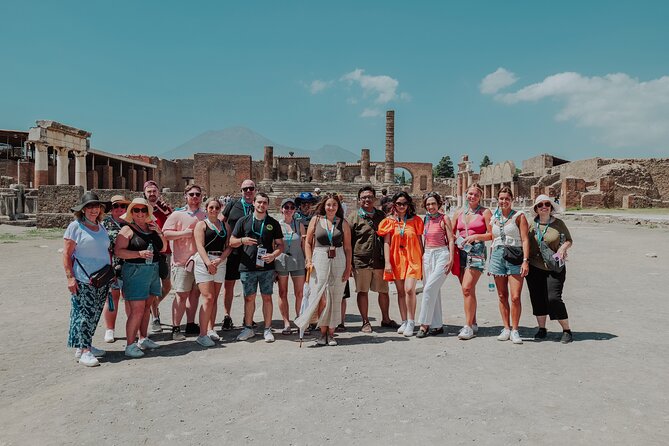
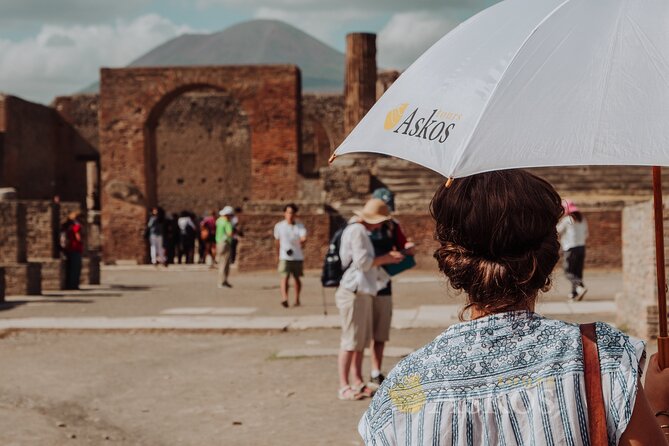
The meeting point is at Via Villa dei Misteri 2, beside Pompeii’s main archaeological entrance, Porta Marina Superiore. Look for the guide holding an Askos Tours sign.
Arrive with enough time to find the entrance. Pompeii has several access points, and the correct one is important here. The day may begin with Pompeii and then continue to Vesuvius, although some departures reverse the order. In either case, the local team directs you between the ruins, minibus, and mountain guide.
A useful practical detail is the return. The stated endpoint is back at the Pompeii meeting point, but some departures have returned people to Naples, including Napoli Centrale. Treat that as a possible convenience, not a guaranteed part of every departure, and confirm the arrangement on the day.
Two focused hours inside Pompeii
The Pompeii portion lasts about two hours with an archaeologist. That is enough time for a strong introduction and several major sights, but not enough to cover the entire site at an unhurried pace.
I see this as a guided highlights walk rather than a complete Pompeii visit. In fact, some departures leave you a little free time after the guided portion, while others move quickly to the Vesuvius transfer. If Pompeii is your main reason for coming, plan to return on another visit or choose a Pompeii-only experience.
The Forum and the city street
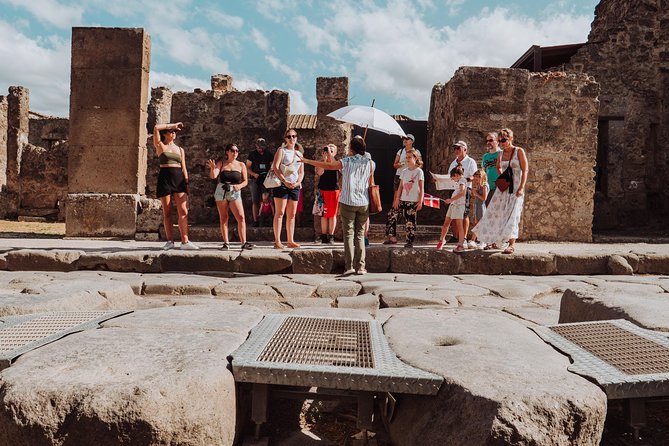
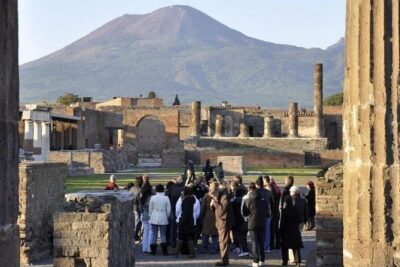
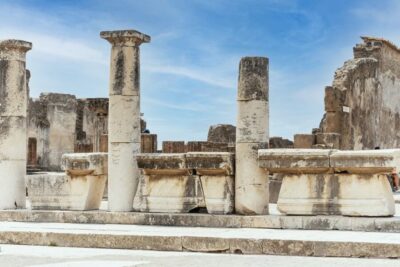
The Forum gives you the clearest sense of Pompeii as a working city. This was the main public square, surrounded by important civic and religious buildings. Your guide can help you read the open space as a place of politics, commerce, ceremony, and public life rather than as a field of broken columns.
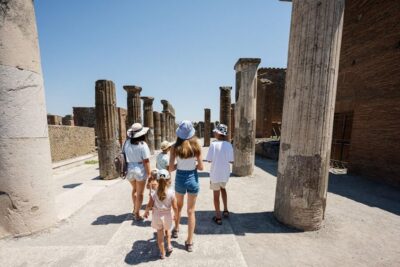
From there, you walk along one of the ancient main streets. Pompeii’s paving stones, raised crossings, and worn surfaces show how people moved through the city. Watch your footing. The stones are uneven, and the route can be tiring in hot weather.
Same city, an entirely different afternoon:
- Pompeii Small Group Tour with an Archaeologist
★ 5.0 · 6,593 reviews - Pompeii: Skip-the-Line Entrance Ticket with Audio Guide
★ 4.0 · 2,509 reviews - Naples: Pompeii and Mt. Vesuvius with Lunch and Wine Tasting
★ 4.5 · 2,454 reviews - Pompeii: Archaeological Park Tour with Ticket on request
★ 4.5 · 2,283 reviews
The Forum granaries
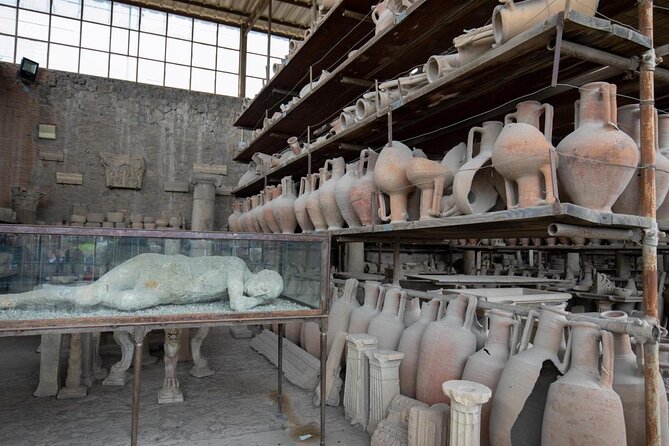
The area known as the granaries now holds marble tables, fountain baths, and casts linked to victims of the eruption. You may also see casts of a dog and a tree.
This is one of the more emotionally difficult parts of Pompeii. The casts are not simply archaeological curiosities. They show the sudden, human cost of the eruption, and a good guide explains what the evidence can and cannot tell us without turning the stop into spectacle.
The House of Menander
The House of Menander is one of Pompeii’s grand private homes. Its architecture, decoration, and contents offer a look at the wealthier end of Roman domestic life.
Here, the value of the guide is especially clear. Without context, a large house can blur into the next large house. An archaeologist can point out how the rooms, decoration, and household design reflected status and social customs.
The Stabian Baths
The Stabian Baths occupy a broad area near the Brothel Lane, the Holconius crossroads, and Via Stabiana. They are considered Pompeii’s oldest thermal complex.
The baths help you picture the city as a place where people spent time washing, exercising, meeting, and socializing. This stop also breaks up the private-home focus of the route and shows a major shared facility.
The Lupanar
The Lupanar is Pompeii’s best-known brothel. Small rooms and painted images make it one of the site’s most talked-about stops, but the guide’s explanation gives it more value than a quick look and a photograph.
Expect a tight space and possibly a slower pace around this popular point. The visit may not suit every young child, and the tour does not allow children under six.
The House of the Faun
The House of the Faun was one of Pompeii’s largest and most impressive private residences. Its scale helps show how wide the gap could be between wealthy households and ordinary city residents.
It is also a useful counterpoint to the smaller homes and public buildings seen earlier. You get a sense of how Roman domestic space could include courtyards, decorative rooms, and a carefully planned entrance sequence.
The theaters
The route includes a look at the Teatro Piccolo, or small theater, and a visit to the Teatro Grande, Pompeii’s main theater. These spaces show another side of city life: entertainment, performance, and communal gatherings.
Ten to 15 minutes at several of these stops may sound brief, but the short pauses keep the day moving. The tradeoff is that you will not have much time to study every wall or wander down every side street.
Why an archaeologist changes Pompeii
The strongest part of the Pompeii visit is the guide’s ability to explain what is still being uncovered. Guides such as Anna Sorrento and Benedetto have worked directly with archaeological excavation, while Teresa, Raffaela, Daniela, Antonella, and others have been praised for clear storytelling and a lively approach.
Guide assignments vary, so you cannot request a particular person with certainty. Still, the standard of the experience depends heavily on who leads the walk. When the guide is easy to hear and explains the site clearly, two hours can be remarkably effective. When headsets fail or communication is poor, the large ruins become harder to follow.
You should expect two separate guiding styles. Pompeii calls for archaeology, architecture, and social history. Vesuvius calls for geology, volcanic activity, local geography, and trail management. That change of guide is a strength, not a flaw, provided the handoff is organized.
The break before the mountain
You usually have a short break between Pompeii and Vesuvius. One account describes about 10 to 15 minutes to buy a sandwich, while other departures allow roughly an hour for lunch.
Do not count on a leisurely restaurant meal. The cafes near the Pompeii entrance can provide a sandwich and drink, but it is smart to bring water and be ready to eat quickly. Food and drinks are not included in the tour price.
This break is also your chance to use the facilities, refill water, and adjust your footwear. Once you reach the volcano, the trail demands your attention.
Riding the minibus up Vesuvius

The transfer from Pompeii to Vesuvius is by modern minibus, with transport included in the price. The mountain road is winding, with tight bends as it climbs toward the upper access point. A skilled driver matters here, and the ride can feel more dramatic than the distance suggests.
Along the way, the hiking guide may explain the volcano, the eruption, and the surrounding area. Mario is frequently assigned to this portion and has been praised for his calm pace, clear explanations, and willingness to stop for breaks.
The minibus does not remove the physical challenge. It simply takes you close to the trailhead, saving you a long approach on foot.
The 500-meter climb to the crater
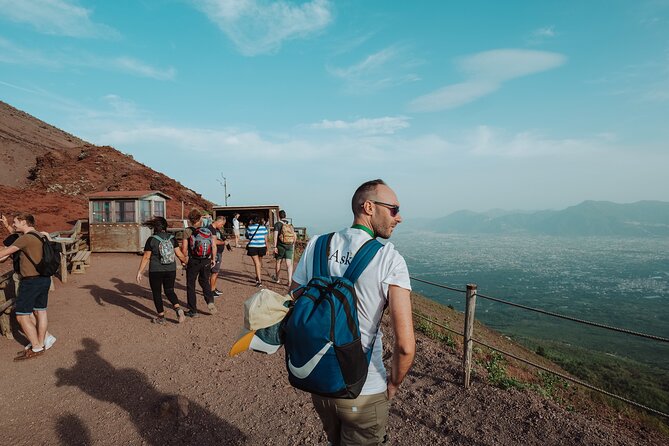
The most important thing to understand is that the Vesuvius section is a hike, not a viewpoint reached by a lift or flat path. From the entrance, the first 30 minutes involve steep uphill walking, and the last 500 meters are specifically described as a very steep climb.
The surface includes loose volcanic sand, steps, and uneven ground. Good walking shoes are essential. In summer, the heat can make the climb much harder, while wind, chill, rain, and fog can appear near the summit even when Pompeii is warm and sunny.
The total walking distance can reach about 2.5 miles, depending on the route taken. The guide normally sets a manageable pace and allows breaks, but the group cannot remove the incline. If you have a mobility issue, walking impairment, or low tolerance for steep paths, this is not the right day trip.
A light jacket is useful at the top. Wear sunglasses and sunscreen in summer, but keep rain protection in mind during unsettled weather. Do not wear smooth-soled shoes.
At the crater edge
At the top, the trail reaches the crater rim. Vesuvius may still release a little smoke, and the volcanic setting gives the Pompeii story a powerful physical link.
Clear weather can open wide views over the Bay of Naples, Capri, Ischia, the Sorrento coast, and the nearby towns. On cloudy days, you may see almost nothing beyond the crater edge. Strong wind, heavy rain, and dense fog can also lead park authorities to close the trail.
That uncertainty is part of the bargain. A volcano is not a scheduled theater show. One departure reached the upper access point only to find the crater path closed because of rain and fog. The guide arranged a visit to Herculaneum instead, which can be an excellent substitute because the smaller site preserves many details in a more compact setting.
Still, you should understand the refund policy before booking if the volcano is central to your plans. The tour information says Vesuvius may be replaced by Herculaneum when force majeure makes the mountain inaccessible. One account also describes disappointment when poor visibility made the climb technically possible but the views nearly useless. Ask the operator how weather substitutions and partial refunds are handled for your specific departure.
Is $119.77 a fair price?
At $119.77 per person, the tour costs more than entering either site alone. The value comes from combining several useful services: Pompeii admission, Vesuvius admission, an archaeologist for the ruins, a hiking guide for the volcano, and minibus transport between locations.
For a first visit, I think the price is reasonable if you want both places in one day and do not want to handle the mountain transport yourself. The transfer is the key saving. Public transport can get you around the Bay of Naples, but coordinating Pompeii, Vesuvius access, tickets, timing, and a return trip takes effort.
The value drops if you only want a slow, detailed Pompeii visit. Two hours can leave you wishing for more, especially if you become interested in a house, theater, or excavation area and have to move on.
The package also makes the most sense for families with older children, couples, and active adults who want history plus outdoor activity. It is less suitable for anyone who wants a gentle sightseeing day.
Weather, changes, and the honest tradeoffs
The tour has a strong weather dependency. Vesuvius may be hidden by clouds, battered by wind, or closed by rain. Even when the tour proceeds, the crater and Naples views may not be visible.
The operator’s backup plan is a Herculaneum visit if Vesuvius cannot be accessed. That is a serious archaeological site, not a filler stop, but it is not the same experience as standing above the crater.
Organization can also vary. Some departures have had confusion over meeting times and the handoff between Pompeii and Vesuvius. Headsets have occasionally been an issue, and a delayed group can reduce the time available to people who arrive promptly.
These are not reasons to reject the tour outright, but they are reasons to arrive early, listen carefully to the meeting instructions, and keep your schedule flexible. Do not book a tight train or flight connection after the stated eight-hour window.
Who should book this day trip?
You should consider booking if you want a well-structured first look at Pompeii, a guided explanation of the ruins, and a chance to hike Vesuvius without arranging the transport yourself.
It is especially good for:
- First-time visitors to Pompeii
- People interested in archaeology, Roman life, or volcanoes
- Families with children six and older who can manage a steep walk
- Visitors staying near Naples, Pompeii, Sorrento, or the surrounding towns
- Anyone who values a guide’s context more than independent wandering
Think twice if you have mobility limitations, dislike uneven ground, or want a slow day indoors. Also reconsider it if your main goal is detailed Pompeii study. In that case, spend a full day at the archaeological park and visit Vesuvius separately.
Booking decision
I would book this tour for the convenience and the quality of the guided interpretation, but I would book it with realistic expectations. Pompeii is the cultural heart of the day, while Vesuvius is the more physically demanding and weather-sensitive half.
Wear proper shoes, carry water, bring a light layer, and leave room in your schedule for a late return. If the volcano is open and the air is clear, the crater walk can be the day’s great payoff. If weather closes the trail, Herculaneum gives you a worthwhile alternative, but the operator should explain any refund arrangement clearly.
At 93 percent recommended and a 4.7 rating from 233 reviews, this is a strong choice for an active visitor who wants both sides of the eruption story in one outing. It is not the best pick for a relaxed stroll or a deep, unhurried examination of Pompeii. Know that before you go, and the tour offers a lot for the price.
FAQ
How long does the Pompeii and Vesuvius tour last?
The experience lasts about eight hours. Some descriptions of the active touring time place it closer to six hours, with breaks and transport included.
Where does the tour start?
The meeting point is Via Villa dei Misteri 2, 80045 Pompei, near Pompeii’s main entrance, Porta Marina Superiore. The guide holds an Askos Tours sign.
What admissions are included?
The tour includes admission to Pompeii, listed as the Pompei Express ticket, and admission to Mount Vesuvius. The information also lists the Vesuvius entry ticket as 11 euros.
How difficult is the Vesuvius walk?
The walk requires moderate physical fitness. The first 30 minutes from the Vesuvius entrance are uphill, the final 500 meters are very steep, and the ground can include loose volcanic sand. Comfortable closed-in walking shoes are essential.
Is food included?
No. Food and drinks are not included. You may have a short break to buy a sandwich and drink near Pompeii, though the length of the break can vary.
What happens if Vesuvius is closed?
If Vesuvius cannot be accessed because of force majeure, the tour includes Herculaneum instead. Weather can also reduce visibility even when the climb goes ahead.
Can children join the tour?
Children under six are not allowed. All participants should be able to handle uneven Pompeii paths and the steep Vesuvius climb, and the tour is not recommended for people with mobility or walking impairments.
Fresh on the Pompeii list
- Stories of Pompeii: Small Group tour with archeology expert guide★ 5.0 · 191 reviews
- Mount Vesuvius: Vineyard Tour with Wine Tasting and Lunch★ 4.8 · 193 reviews
- Pompeii: Skip-the-Line Guided Tour with Expert Archaeologist★ 4.8 · 196 reviews
- Pompeii: 2 Hour Private Tour with an Archeologist Guide★ 5.0 · 214 reviews
- Pompeii: Skip-the-Line Entry & Audioguide★ 3.8 · 225 reviews
- Herculaneum: Tickets & Tour with a Local Archaeologist★ 4.8 · 226 reviews
- From Naples/Salerno: Pompeii, Sorrento, and Positano Tour★ 4.5 · 250 reviews
- Pompeii: Day Tour of Pompeii and Vesuvius with Bus Transfer★ 4.2 · 250 reviews
Pompeii & Vesuvius Tours, compared.
Entry Ticket and Guided Tour with an Archaeologist
Read our review →
Pompeii Small Group Tour with an Archaeologist
Read our review →
Pompeii, Amalfi Coast and Positano Day Trip from Rome
Read our review →Browse the lists this tour appears in