
Reviewed · WALKING TOURS
Verona: History and Hidden Gems Guided Walking Tour
Verona reveals itself best when you stop looking only at Juliet’s balcony. This two-hour walk with Fabio Massimo Rapanà, a licensed Veronese guide, links the Arena and famous squares with old gates, overlooked façades, river views, and quiet lanes that are easy to pass without a guide. He builds the city’s story from Ancient Rome through the medieval age, rather than treating each monument as a separate photo stop.
I like the small group of no more than 10 and the supplied headsets, which let you hear clearly without crowding around a guide. I also like that Fabio was born and raised in Verona, giving the walk a local point of view and practical advice for the rest of your stay. The main drawback is simple: two hours covers a lot, so several stops are brief, and this is not the tour for anyone hoping to enter the Arena or spend long periods inside monuments.
Key details that shape the experience
- A local guide with a personal connection: Fabio grew up in Verona and presents its history with warmth, humor, and clear storytelling.
- The route looks beyond the standard postcard: You see the Arena, Piazza delle Erbe, Juliet’s balcony, and Romeo’s house, but also Roman gateways, side streets, old courtyards, and less noticed buildings.
- The city’s timeline makes sense: Ancient Roman Verona, the early medieval walls, the Scaligery rulers, and later civic buildings all fit into one connected story.
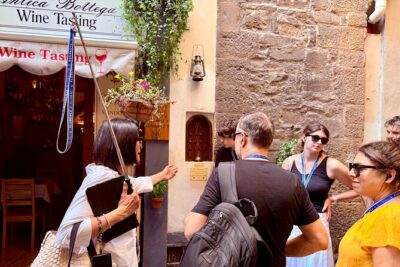
- Headsets help in busy streets: You can listen while walking instead of standing shoulder to shoulder around the guide.
- The tour finishes where it begins: Meet below the Italian flag at Verona’s Town Hall in Piazza Bra, then return to Palazzo Barbieri at the end.
- Bring shoes and water: The route is fully on foot and runs rain or shine.
Starting beneath the Italian flag in Piazza Bra
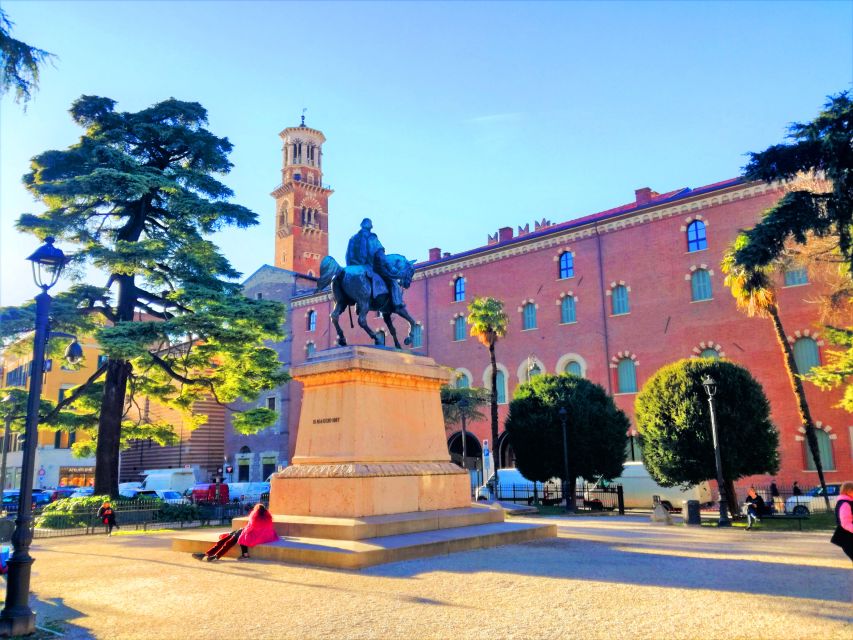
The meeting point is below the Italian flag at the Town Hall, Palazzo Barbieri, in Piazza Bra. This is a sensible place to begin because the square gives you immediate scale: Verona’s Roman Arena dominates the setting, while cafés, arcades, and city traffic show how the ancient monument still fits into daily life.
The opening visit to Piazza Bra is short, about five minutes, followed by roughly ten minutes at the Arena. You get time for photographs and an explanation of the amphitheater’s architecture and gladiatorial past. That balance is useful if you are new to Verona, but remember that the tour does not include entry. If you want to see the Arena from inside, plan a separate visit.
Fabio’s approach is one of the strongest reasons to book this walk. He does not simply point at stones and recite dates. His storytelling connects a building to the period that produced it, then relates that past to the city you see today. Families can benefit from that style too. One parent reported that Fabio kept a teenage participant interested, which is no small achievement on a history walk.
More Walking Tours in Verona
- Verona: Small Group Guided Walking Tour with Arena Tickets
★ 4.9 · 848 reviews - Verona Highlights Walking Tour in Small-group
★ 5.0 · 493 reviews - Verona walking tour:food, wine, legends, lunch/dinner & cable car
★ 5.0 · 386 reviews
From Roman walls to Porta Borsari
After the Arena, the route follows the foundations of Verona’s early medieval walls toward the Corso, described as one of the oldest streets in the city. This section helps you read Verona as a layered place. Roman planning, medieval defenses, later homes, shops, and public buildings all occupy the same compact center.
A brief stop at a less noticed corner comes before Porta Borsari. The gate itself is one of the walk’s most useful Roman landmarks. Its surviving stonework makes Verona’s ancient past feel more immediate than a museum label does, and Fabio explains its place in the old city rather than presenting it as an isolated arch.
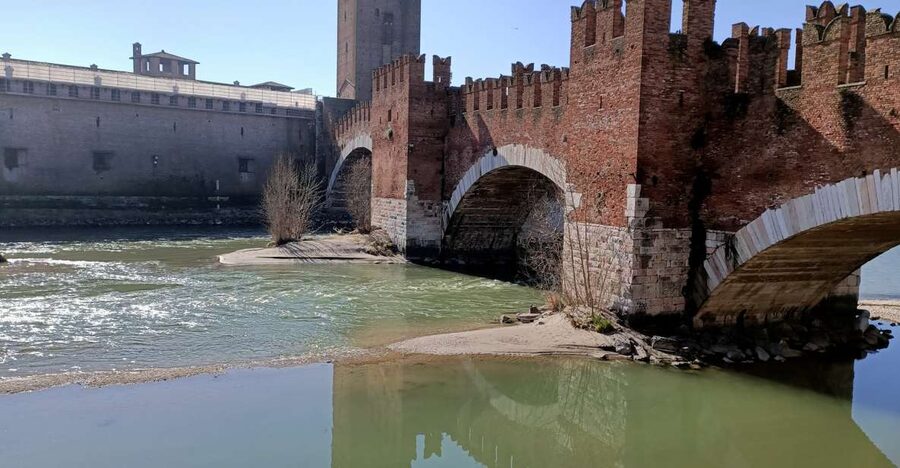
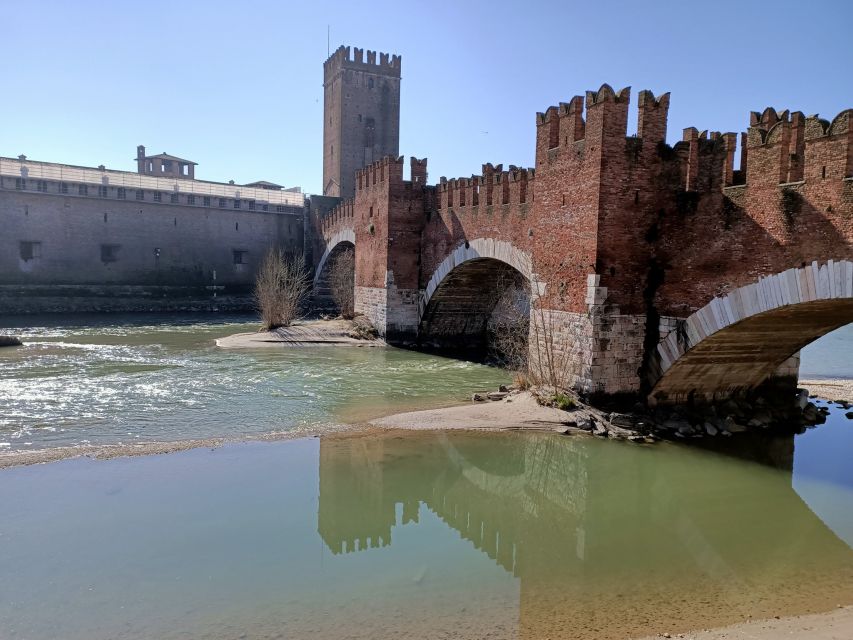
The route then reaches Riva San Lorenzo, where you can look toward Castelvecchio and the Ponte Scaligero across the Adige River. This is a good pause in the sequence because Verona’s story is not only about streets and façades. The river shaped movement, defense, and the city’s visual character. The Castelvecchio and bridge views also give you some of the best photographs of the walk.
Small churches and overlooked streets near the river
Several short stops follow around Riva San Lorenzo, San Giovanni in Foro, Piazzetta Monte, and nearby side streets. These are not long visits. Some take only a couple of minutes, and others are passed on foot with a quick explanation.
That may sound minor, but it is where the tour earns its title. Verona is full of details that disappear when you hurry from the Arena to Juliet’s House. A church façade, an old street alignment, a fragment of a former structure, or a quiet square can reveal how the city grew. Fabio’s strength is drawing your eye to those details before you walk past them.
The supplied headsets matter most here. You can keep moving through narrow streets while hearing the explanation clearly. That is more comfortable than a guide trying to project over conversation and traffic, and it avoids the familiar parade of people clustered around a raised flag.
Piazza delle Erbe and the center of civic life
Piazza delle Erbe receives about ten minutes, making it one of the fuller stops. This is Verona’s best-known market square, framed by historic townhouses and public buildings. Fabio explains the market’s development and points out the city’s oldest fountain, giving you something specific to look for instead of a general instruction to admire the architecture.
I like this part because the square works as both a history lesson and a place to get your bearings. You can see how commerce, public life, and political power met in one space. Look above street level as you walk. The façades are often as interesting as the activity at ground level, and the guide’s commentary helps you notice details you might otherwise file away as mere decoration.
A short stop nearby adds another overlooked detail before the group continues to Piazza dei Signori. The pace is brisk, but not designed as a race. Feedback from the tour indicates that Fabio adjusts to slower walkers and takes care with comfort, including finding shade during hot weather. Still, you should expect steady movement and little time to sit.
More historic sites in Verona:
- Venice: St. Mark Basilica Ticket, Audioguide+History Gallery
★ 3.9 · 4,780 reviews - Venice’s Best: Basilica, Doge’s Palace, Gondola & History Gallery
★ 4.5 · 2,478 reviews - Historic Milan Tour with Skip-the-Line Last Supper Ticket
★ 4.5 · 1,976 reviews - Venice: City Center Historical Guided Walking Tour
★ 4.2 · 1,873 reviews
Piazza dei Signori and the Scaligery age
Piazza dei Signori shifts the focus from Roman Verona to the medieval city. The square is surrounded by important public buildings, including Palazzo della Ragione, Palazzo della Scala, and Palazzo del Capitano. About five minutes is allotted here, enough for an introduction and photographs, though not enough to inspect every façade in detail.
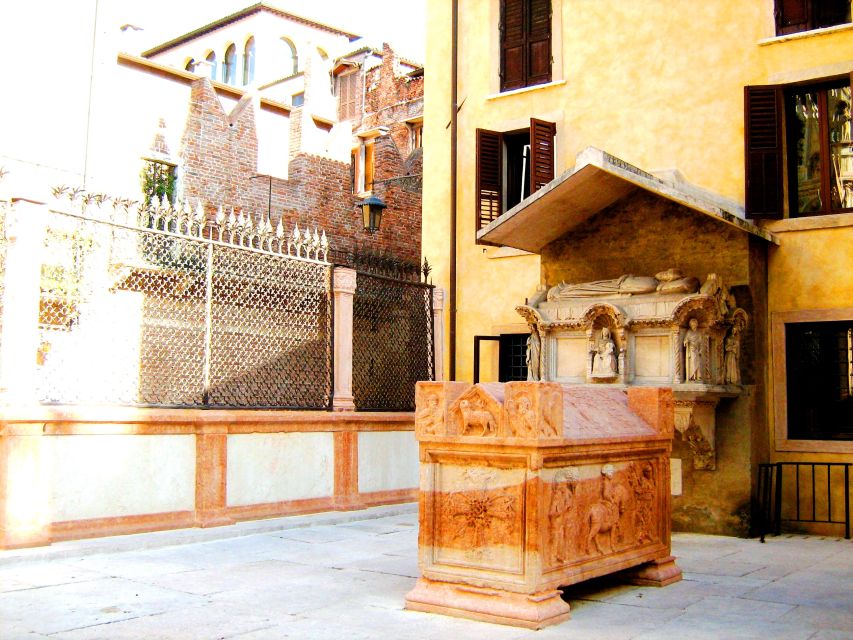
The highest tower in the city is another point of attention. Fabio uses the square to explain the medieval period and the influence of Verona’s ruling families. The nearby Arche Scaligere mausoleums make that power visible in a dramatic way. Their elaborate Gothic forms are among the most memorable sights on the route, even if your stop is mainly outdoors.
The connection between political authority and architecture is a real strength of this walk. Instead of treating the mausoleums as a decorative curiosity, Fabio places them in the story of the Scaligery rulers. That context gives the next few streets more meaning, especially as the route passes through Piazza Indipendenza and the old market courtyard.
Romeo, Juliet, and the stories behind the symbols
The walk includes Casa di Romeo and Juliet’s House, with about five minutes at each. You will see Romeo’s house from the outside and stop for photographs. At Juliet’s House, the focus is also a photo stop, not an included interior visit.
This is a useful distinction. The tour gives you the literary landmarks, but it does not spend the whole morning building Verona around Shakespeare. Fabio explains the historical inspiration behind the tragedy and separates the medieval families and local tradition from the later legend. That makes the Romeo and Juliet story more interesting, not less.
Juliet’s balcony is one of Verona’s busiest attractions, so the five-minute stop may feel short if you want extended photographs or time in the museum. I would treat this as an introduction, then return on your own if it matters to you. The same advice applies to any site you hope to enter. Entry fees are not included, and the walk is built around outdoor interpretation.
Courtyards, old market buildings, and final city details
The route continues through Piazza Indipendenza and the Courtyard of the Old Market, with short photo stops along the way. These spaces help explain how Verona functioned beyond its grand monuments. The old market area, in particular, gives the walk a more everyday feel, even though your time there is limited.
Further stops include the Verona synagogue, the former Convent of Saint Mary della Scala of the Servants of Mary, Via Dietro Anfiteatro, and several unnamed corners. The itinerary lists some of these as pass-bys or two-minute photo stops. You should not expect an in-depth visit to each location. Their value lies in the way Fabio adds small pieces to the larger picture.
This is also where the tour feels most personal. The guide’s work is not limited to famous sights. He points out architecture, street patterns, and historical traces that reward a slower look later. Several visitors have used the rest of their day to return to places Fabio introduced, which is exactly how a good orientation walk should work.
The route eventually returns to Palazzo Barbieri. Because you finish at the starting point, it is easy to continue toward the Arena, make a restaurant plan, or revisit one of the squares while the details are fresh.
What two hours and $41 buy you
At $41 per person, this is not the cheapest way to take a short walk through Verona. It is also not a large-group march with a guide trying to be heard from several yards away. The price includes a professional licensed guide, a group limited to 10 people, headsets, and a route designed around storytelling.
The value depends on what you want. If you need only a quick list of landmarks and photographs, you can walk much of central Verona for free. If you want the city’s Roman, medieval, architectural, and literary threads explained in a clear order, the fee is reasonable, especially for a first visit.
The strongest value comes from Fabio himself. He has been praised for his preparation, warmth, wit, careful answers, and enthusiasm for Verona. He also communicates with participants before the tour and can offer local recommendations. Those touches matter when you have only a short stay and want to use the rest of your time well.
Private groups are available, and the tour can run in English, German, Italian, or Spanish. Small-group and private options may suit families or visitors who want more opportunity to ask questions. The standard format already keeps numbers low, so you do not need to choose private service simply to avoid a crowd.
Walking comfort, weather, and timing
You need comfortable shoes and water. The route covers central Verona on foot, with repeated standing periods and frequent short stops. The activity is listed as wheelchair accessible, but anyone with mobility concerns should still consider the steady walking pace and the mix of streets, squares, and historic surfaces.
The tour operates rain or shine. A light rain jacket, sun protection, and water are practical choices depending on the forecast. In hot weather, Fabio has been attentive about using shade and allowing cooling breaks, but you should still dress for two hours outdoors.
You will not use transport, and food and drinks are not included. The route is best taken early in your Verona stay because it gives you a map in your head. Afterward, you can choose which places deserve a longer visit, including the Arena, Juliet’s House, churches, and museums.
Free cancellation is available up to 24 hours before the start, and you can reserve while paying later. Check the available starting times when booking, since the schedule is not fixed in the information provided.
Who should book this Verona walk?
I would choose this for a first visit, especially if you like architecture, local history, and stories tied to real streets. It works well for couples interested in the Romeo and Juliet tradition, families with older children, and anyone who wants more than a quick circuit of the main square.
It is also a strong fit if you have only one day in Verona. The route covers a lot of ground without requiring separate research, and Fabio’s recommendations can help shape the rest of your visit.
I would hesitate only if you want long interior visits or a relaxed café-style pace. Most stops are outdoors, several are brief, and the tour covers many locations in two hours. For that reason, think of it as a guided foundation, not a substitute for visiting every monument.
Should you book it?
Book this tour if you want Verona to become more than a collection of attractive squares. Fabio’s local background, storytelling, and eye for overlooked details give the walk a clear purpose, while the small group and headsets make it easier to follow than many standard city tours.
Skip it if you prefer exploring alone and already have a strong grasp of Verona’s Roman and medieval story. For most first-time visitors, though, $41 buys useful context, a well-planned route, and a better way to see what is in front of you. Take it near the start of your stay, then return to the places that catch your interest.
FAQ
Where does the Verona walking tour start?
Meet your guide below the Italian flag at the Town Hall, Palazzo Barbieri, in Piazza Bra.
Where does the tour finish?
The route returns to Palazzo Barbieri, the same place where it begins.
How long does the tour last?
The walking tour lasts two hours. Starting times vary, so check availability when booking.
Is entry to the Arena or Juliet’s House included?
No. The tour includes outdoor visits and photo stops, but entry fees are not included.
What languages are available?
The live tour guide is available in English, German, Italian, and Spanish.
What should I bring?
Bring comfortable shoes and water. The tour runs rain or shine, so weather-appropriate clothing is also sensible.
Fresh on the Verona list
- From Verona: Sirmione and Lake Garda Day Tour with Cruise★ 4.6 · 520 reviews
- Verona: Pasta and Tiramisu Cooking Class With Free Flowing Wine★ 5.0 · 575 reviews
- Verona: Classic and Hidden Gems Bike Tour★ 4.9 · 577 reviews
- Verona: Pasta and Tiramisu Cooking Class with Fine Wine★ 4.8 · 633 reviews
- Verona: Arena di Verona Opera Ticket★ 4.6 · 721 reviews
- Verona: Wine Tasting with Snacks and Panoramic Views★ 4.8 · 494 reviews
- From Verona: Valpolicella and Amarone Wine Tasting Tour★ 4.9 · 560 reviews
- Discover Valpolicella Vineyards and Wine Tasting Experience★ 4.5 · 341 reviews
Walking Tours, compared.
Guided Walking Tour & Last Supper Visit with Ticket
Read our review →
Rialto Bridge & Offbeat Unusual Venice Walking Tour
Read our review →
Private 3 hrs Venice Tour: St Mark’s, Walking tour & Boat tour
Read our review →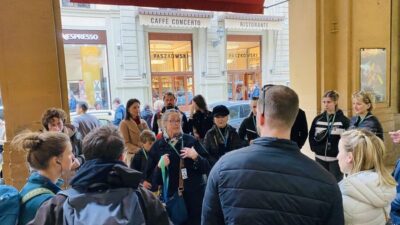
Skip the line: Uffizi and Accademia Small Group Walking Tour
Read our review →Browse the lists this tour appears in