

Reviewed · WALKING TOURS
Verona Highlights Walking Tour in Small-group
Verona’s story is unusually easy to read in its streets. In about two hours, this walk links a Roman amphitheater, a medieval castle, Gothic tombs, lively squares, and the courtyard associated with Juliet. You get a useful first look at the city without spending half a day indoors.
I like the small maximum of 16 people, which gives you a fair chance to hear the guide and ask questions. I also like the mix of famous sights and easy-to-miss details, including Roman remains tucked into the modern city and the rebuilt bridge beside Castelvecchio.
The main limitation is that this is an orientation walk, not a full sightseeing admission tour. Entry to the Arena, Juliet’s House, and the Scaliger tombs is not included, and some people find the pace brisk, particularly when streets are crowded or the group includes older walkers.
Key points to know before booking
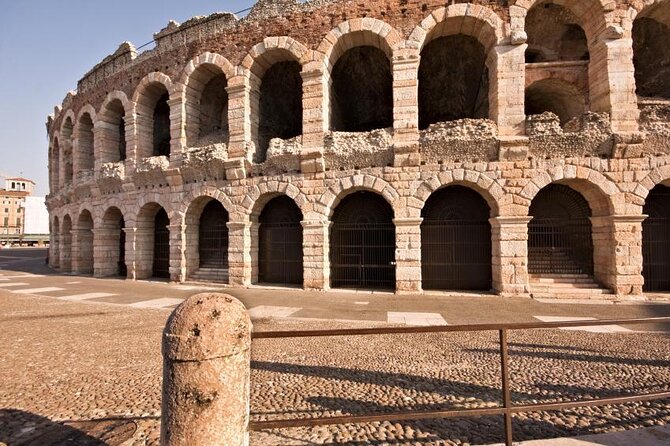
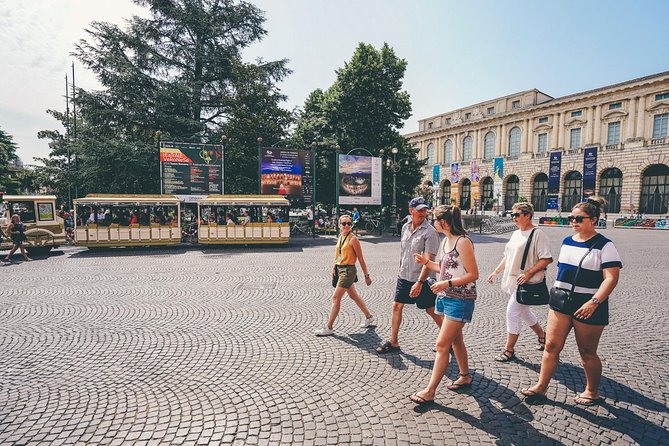
- Two hours from Piazza Bra: The tour starts and ends beside Verona’s largest square, making it easy to fit into a day of sightseeing.
- Roman Verona in the foreground: The Arena, Arch of Gavi, Porta Borsari, and traces of the old Roman city help you see how ancient Verona still shapes the modern center.
- A strong guide makes the difference: Guides including Frank, Isabella, Priscilla, Maria, and Francesco have been praised for clear English, humor, stories, and local insight.
- Famous sights are viewed, not fully toured: Arena and Juliet’s House admission is not part of this booking, so plan extra time if you want to go inside.
- Small-group feel: The group can include no more than 16 people, with the tour guaranteed once at least two participants are booked.
- Rain or shine: Wear shoes suited to city walking and be ready for changing weather.
Why this is a smart first look at Verona
Verona can seem compact on a map, but its historic center packs in more than 2,000 years of change. Roman gates sit beside medieval towers. A Renaissance square opens onto a lane connected with Shakespeare’s most famous lovers. The Arena still hosts performances, while cafés and clothing shops occupy buildings with much older foundations.
This tour gives you a chronological introduction without turning the afternoon into a lecture. Your guide connects the places as you walk, explaining why Verona mattered to Roman rulers, medieval dynasties, and later cultural life. That context is useful because many of the city’s best details are easy to pass without noticing.
The meeting point is Piazza Bra, a practical choice. The square is broad, central, and lined with cafés and restaurants. It also places you beside the Arena from the start, so the city’s most famous building is not something you have to hunt for.
The price is $42.33 per person. For a two-hour walk, that is not the cheapest way to wander Verona, but the value comes from having the city’s layers explained as you move between them. If this is your first visit, the guide can help you decide which places deserve a return visit and which interiors you can reasonably skip.
More Walking Tours in Verona
- Verona: History and Hidden Gems Guided Walking Tour
★ 5.0 · 1,379 reviews - Verona: Small Group Guided Walking Tour with Arena Tickets
★ 4.9 · 848 reviews - Verona walking tour:food, wine, legends, lunch/dinner & cable car
★ 5.0 · 386 reviews
Castelvecchio and the rebuilt Scaligero Bridge
One of the early highlights is Castelvecchio, the late-medieval castle built by Verona’s ruling Scaliger family. The tour focuses on the outside and the setting rather than a full museum visit, but even a short stop helps you understand the defensive character of medieval Verona.
Beside the castle is the Scaligero Bridge, which crosses the Adige to the river’s left bank. It was nearly destroyed in bombing and later rebuilt to match the original design. That detail gives the bridge more meaning than its handsome red-brick appearance alone. You are looking at a reconstruction shaped by a desire to preserve the city’s past.
Do not expect an extended visit inside Castelvecchio on this walk. If you want the museum, its art collection, and a closer look at the bridge, you will need to return on your own. The tour’s job here is to give you a clear sense of the castle’s place in Verona’s story.
Roman traces hiding in the modern center
Verona’s Roman past is not confined to the Arena. The walk can include the Arch of Gavi, a first-century AD monument connected with the Gavia family. It was originally outside the city on the Via Postumia, was demolished during Napoleon’s rule in 1805, and was later reconstructed in its present location.
You may also pass Porta Borsari, the marble-faced remains of a Roman city gate. The stone front survives, while much of the brickwork behind it and the old towers have disappeared. This is a quick stop, but it helps you picture Verona as a walled Roman settlement rather than simply a picturesque Italian town.
One especially memorable detail from the route is the survival of Roman remains inside a modern Benetton store. That kind of sight is exactly why a walking guide can add value. You might walk past the shop without realizing that part of a Roman wall and a section of an ancient home are preserved inside.
These stops also show the limits of a short tour. You will hear about several layers of the city, but you will not have time to study every inscription or archaeological fragment. If ancient history is your main interest, use this walk as a map for a second, slower circuit.
The Arena: Verona’s ancient performance stage
The Arena di Verona is the visual centerpiece of the experience. Built in the first century AD during the Augustan period, it is roughly 2,000 years old and remains remarkably well preserved. The monument predates Rome’s Colosseum by about 30 years, a useful fact to keep in mind when you stand before its massive stone tiers.
The guide explains how the amphitheater once held as many as 30,000 people and how later work helped protect it. The Arena’s role has changed, but it has never become merely a dead monument. It still hosts major concerts and the Verona Arena Festival, the city’s summer opera season.
The scheduled stop is about 10 minutes, and admission is not included. You should therefore expect an explanation and photographs from outside, not a full interior visit. That is important when comparing this walk with a combination ticket or a separate Arena tour.
Several people have paired this walking tour with an Arena visit afterward, sometimes with the same guide. That can work well because the walking tour gives you the historical frame first. If entering the amphitheater is a priority, check the available add-on or book a separate visit rather than assuming it is part of this experience.
Same city, an entirely different afternoon:
- Verona: Hop-on Hop-off Tour 24 or 48-Hour Ticket
★ 4.4 · 2,010 reviews - Verona: Priority Access Arena Guided Tour
★ 4.6 · 1,152 reviews - Verona: Juliet’s House Fast-Track Entry Ticket & Audio Guide
★ 4.2 · 1,121 reviews - Verona: Arena di Verona Opera Ticket
★ 4.6 · 721 reviews
Juliet’s House and the line between legend and place
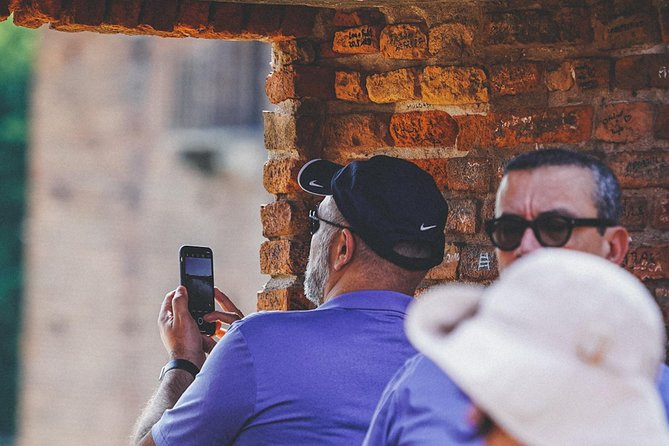
Casa di Giulietta brings the tour into Verona’s best-known literary story. You will see the courtyard associated with the Capuleti family and Juliet, the heroine of Shakespeare’s tragedy. The stop is short, about five minutes, and admission is not included.
The courtyard is appealing partly because it shows how powerful a story can be in shaping a real place. At the same time, you should keep your historical expectations in check. The connection to Juliet is literary and legendary, and parts of the site’s presentation were developed in the modern era.
The tour may also point out Romeo’s house, a medieval palace once associated with the Montecchi family. It is private and inhabited, so you can see it only from the outside. That restriction is worth knowing before you plan a long stop there.
Juliet’s House can be crowded. During the period from December 6, 2025, through January 6, 2026, access to Juliet’s Balcony requires a separately purchased ticket because of high visitor numbers. The tour company can provide information about buying that ticket, but it will not purchase it for you. In all seasons, treat the courtyard as a brief stop unless you arrange admission separately.
Piazza Bra, Piazza delle Erbe, and Piazza dei Signori
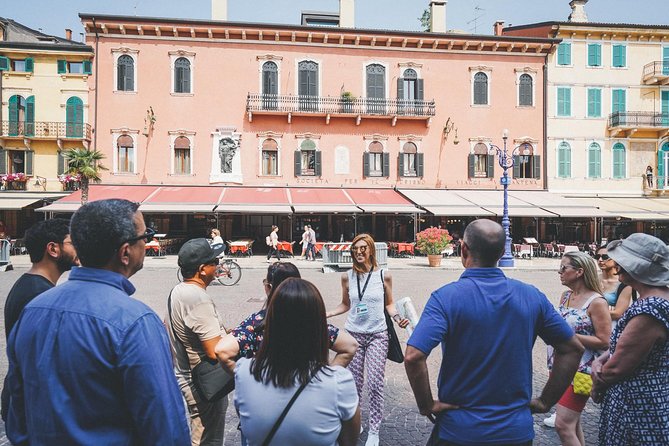
Piazza Bra is more than a meeting point. It is Verona’s largest square, framed by cafés, restaurants, and attractive historic buildings. The guide uses it to explain how the Arena fits into the city’s public life, both in the Roman past and today.
Piazza delle Erbe occupies the site of Verona’s Roman Forum. This was once the center of civic life, and it remains one of the city’s most enjoyable spaces to cross on foot. The fountain at its center dates from the Scaliger period, and the surrounding buildings reflect several periods of rule.
Look upward as you pass through the square. The façades include painted decoration and later architectural changes, details that are easy to miss when you are focused on food stalls, cafés, or the next photograph. The guide’s explanation helps you read the square as a former political and commercial center.
Nearby Piazza dei Signori was Verona’s medieval center of power. Dante’s statue has dominated the square since 1865, giving it the informal name Piazza Dante. The square also offers views of elegant palaces and the entrance to Torre dei Lamberti, whose tower provides a city viewpoint, though tower admission is not included in this walk.
These piazzas are among the best reasons to take the tour early in your stay. Once you understand their layout, you can return for coffee, photographs, or a slower look at the buildings. The walking route is not only about checking off sights. It gives you a working map of the center.
The Scaliger tombs and medieval Verona
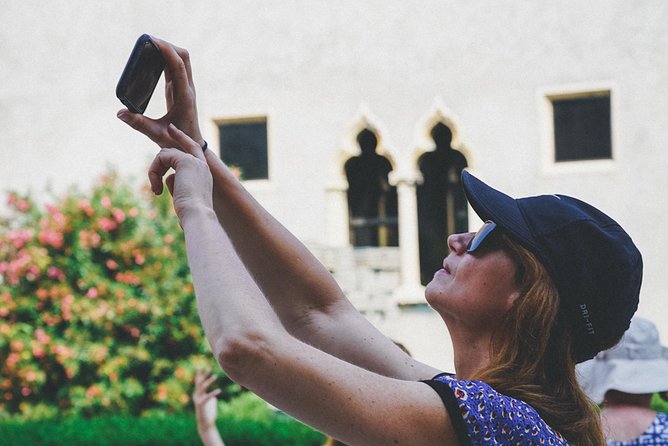
The Arche Scaligere are the outdoor tombs of Verona’s powerful Scaliger family. Their Gothic arches and elaborate sarcophagi are among the city’s most distinctive medieval monuments. The tour points out the memorials of Cangrande I, Mastino II, and Cansignorio.
The stop lasts about five minutes, with admission not included. That is enough to explain who the Scaligeri were and why the tombs matter, but not enough for a detailed architectural study. If you enjoy Gothic sculpture, return later when you can examine the carved figures and ironwork without holding up a group.
This is one of the places where the tour’s broad time span pays off. Within a short walk, you move from Roman civic life to a medieval ruling family, then into the literary world of Juliet and the modern opera tradition at the Arena. Verona’s appeal comes from that close layering.
The guide style and small-group experience
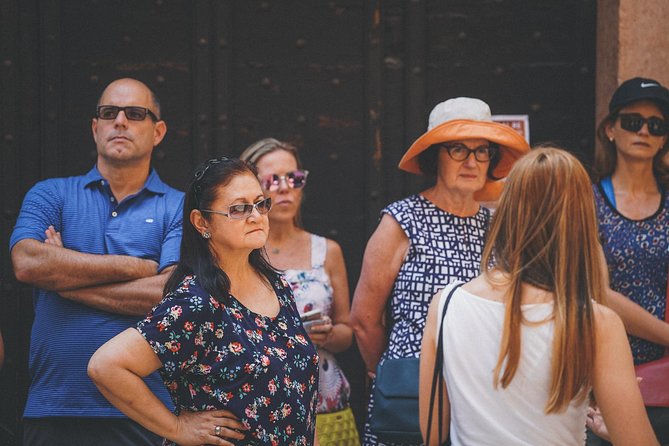
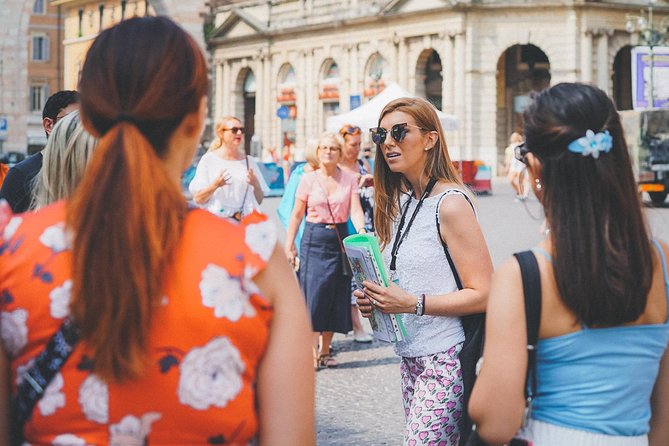
The guide is central to the quality of this tour. Frank is described as funny, friendly, and strong at turning historical facts into stories. Isabella is praised for passion, cultural background, and a knack for adding humor. Priscilla brings local knowledge and fluent English, while Maria and Francesco have also led engaging walks.
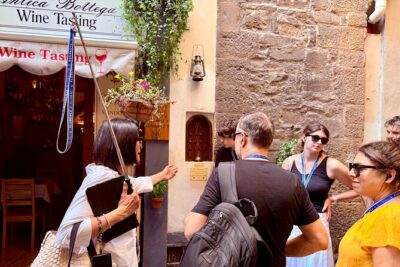
These details matter because a two-hour city tour depends less on equipment and more on explanation. A good guide checks that the group is following, answers questions, and adjusts the amount of detail. One guide was especially attentive to an elderly participant, and another handled a crowded street and a disagreement with a local calmly.
The English offering is useful for visitors who want more than a basic list of dates. You can ask about architecture, legends, food, or what to visit next. One guide also offered suggestions for places to eat and explore after the walk.
The group size is capped at 16, but you should still expect a shared pace. Some parts of the route can feel quick, especially in crowded streets. A walking tour participant noted that you need to walk somewhat briskly, while another found the distance manageable. I would not call this a hard walk, but comfortable shoes are sensible and you should be ready to keep moving.
Timing, weather, and practical value
The tour lasts approximately two hours and runs in rain or shine. Verona’s historic center is best explored on foot, but wet weather can make stone streets less pleasant. Bring a light rain layer when the forecast is uncertain, and avoid shoes with thin, slippery soles.
There is no hotel pickup or drop-off. You meet and finish at Piazza Bra, so you need to reach the center independently. The end point is convenient for continuing toward the Arena, cafés, restaurants, or a second visit to Castelvecchio.
Most people can take part, and service animals are allowed. Some sections are not easy for people with reduced mobility or other disabilities, so contact the provider if you need precise information before booking. Minors must be accompanied by an adult.
The tour is guaranteed with a minimum of two participants. If the minimum is not reached and the company cancels, you are offered another date or experience, or a full refund. You can cancel for a full refund up to 24 hours before the local start time, but cancellations or changes inside that window are not refunded or accepted.
The average booking lead time is 28 days. That suggests you should reserve ahead if your dates are fixed, particularly during busy periods, but the useful point is simple: do not leave it until the last morning if this is your preferred introduction to Verona.
Who should book this Verona walk
I would choose this tour if you are visiting Verona for the first time, have limited time, or prefer to understand a city before choosing which buildings to enter. It is also a good fit if you enjoy history delivered through stories rather than a long indoor lecture.
Families can benefit from the variety. A castle, bridge, Roman arena, dramatic tombs, public squares, and Juliet’s courtyard give children several visual changes during a short walk. Keep in mind that minors need an accompanying adult and that the pace may not suit very young children who tire quickly.
This is less suitable if you want extended time inside the Arena or Casa di Giulietta. Since admission is not included, you will need to budget separately and schedule those visits around the walk. It is also not the best choice for anyone who needs a very slow route or step-free access throughout.
Should you book the Verona Highlights Walking Tour?
Book it if you want a well-paced introduction to Verona’s main sights and value a guide who can connect Roman ruins, medieval power, local legends, and present-day opera. The $42.33 price is fair when you use the tour to plan the rest of your time, especially with a group limited to 16 people.
Skip it if you already know Verona well or want an in-depth museum and Arena visit in one booking. For most first-time visitors, though, this is a practical start. Take the walk early, ask what deserves a return visit, and save time afterward for the Arena interior, Castelvecchio Museum, or a quieter look at the city’s squares.
FAQ
How long does the Verona Highlights Walking Tour last?
The tour lasts approximately two hours.
Where does the tour start and finish?
It starts and ends at Piazza Bra in Verona.
Is the Arena di Verona admission included?
No. The Arena stop lasts about 10 minutes, and admission is not included.
Can I enter Juliet’s Balcony during the tour?
Access to Juliet’s Balcony is not included as part of the standard tour admission. From December 6, 2025, through January 6, 2026, balcony access requires a separately purchased ticket because of high visitor numbers.
What language is the tour offered in?
The tour is offered in English.
How large is the group?
The maximum group size is 16 participants. The tour is guaranteed with a minimum of two participants.
What happens if I need to cancel?
You can cancel up to 24 hours before the experience start time for a full refund. Cancellations or changes made less than 24 hours before the start time are not accepted or refunded.
Fresh on the Verona list
- From Verona: Sirmione and Lake Garda Day Tour with Cruise★ 4.6 · 520 reviews
- Verona: Pasta and Tiramisu Cooking Class With Free Flowing Wine★ 5.0 · 575 reviews
- Verona: Classic and Hidden Gems Bike Tour★ 4.9 · 577 reviews
- Verona: Pasta and Tiramisu Cooking Class with Fine Wine★ 4.8 · 633 reviews
- Verona: Arena di Verona Opera Ticket★ 4.6 · 721 reviews
- Verona: Wine Tasting with Snacks and Panoramic Views★ 4.8 · 494 reviews
- From Verona: Valpolicella and Amarone Wine Tasting Tour★ 4.9 · 560 reviews
- Discover Valpolicella Vineyards and Wine Tasting Experience★ 4.5 · 341 reviews
Walking Tours, compared.
Guided Walking Tour & Last Supper Visit with Ticket
Read our review →
Rialto Bridge & Offbeat Unusual Venice Walking Tour
Read our review →
Private 3 hrs Venice Tour: St Mark’s, Walking tour & Boat tour
Read our review →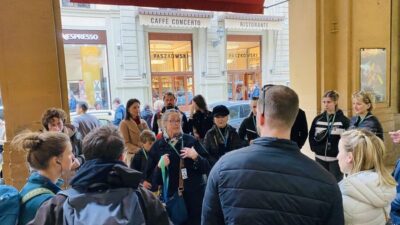
Skip the line: Uffizi and Accademia Small Group Walking Tour
Read our review →Browse the lists this tour appears in