
Reviewed · WALKING TOURS
Trastevere and Rome’s Jewish Ghetto Half-Day Walking Tour
Rome’s ancient Jewish Ghetto and bohemian Trastevere make a fine pair because they show everyday Rome beyond the Colosseum. You begin at Largo di Torre Argentina, walk past ruins linked to Julius Caesar, cross Tiber Island, and finish at Campo de’ Fiori as the city settles into its evening rhythm.
I like the small maximum of 15 people, which gives you room to ask questions, and I like the guides’ mix of Roman archaeology, local life, and humor. Guides including Irene, Paolo, Claudio, and Jeanette have been especially praised for making difficult history clear without turning the walk into a lecture.
The main drawback is that this is a walking tour, not a food tour, and the evening timing can limit what you see inside. The synagogue is an exterior stop, and entry to Santa Maria in Trastevere depends on the church schedule. One past group also found the walk shorter than advertised, so keep an eye on the pace.
Key points to know before booking
- Julius Caesar’s assassination site: Start with the ancient ruins at Largo di Torre Argentina, just below modern street level.
- A serious look at Jewish Rome: Hear about the old Ghetto, its residents, and the neighborhood’s painful wartime history.
- Santa Maria in Trastevere: Visit one of Rome’s oldest churches if its schedule allows.
- Tiber Island views: Cross the island and take in Rome’s bridges before entering Trastevere.
- Small-group format: The tour accepts no more than 15 people and includes headsets.
- Dinner-ready ending: Finish near Campo de’ Fiori, with Trastevere and the Jewish Ghetto both offering places to eat afterward.
Why these two neighborhoods make sense together
Many Rome walks stick to the grand center: the Trevi Fountain, Pantheon, Roman Forum, and Colosseum. This route takes you into two districts where Roman life is easier to read at street level.
The Jewish Ghetto and Trastevere sit on opposite sides of the Tiber, but the river does not separate them from Rome’s larger story. The route connects ancient ruins, medieval churches, Jewish history, Renaissance palaces, bridges, cafés, and evening street life in one compact walk.
That range is the tour’s main strength. You are not simply checking off buildings. You are learning why old Rome looks the way it does, including why ancient remains often sit below the pavement you are walking on.
The guide is central to the experience. A good guide can point out a detail you would pass without noticing, explain a church facade in plain language, and connect a quiet lane to the city’s larger past. The strongest guide names associated with this walk include Irene, Paolo, Claudio, and Jeanette. The praise for them centers on humor, warmth, passion for Rome, and the ability to answer questions.
More Walking Tours in Rome
- Rome: Trastevere & Campo de Fiori Street Food Walking Tour
★ 4.9 · 2,768 reviews - Rome: Paranormal Night Walking Tour & Secret Backstreets
★ 4.9 · 1,921 reviews - Rome by Night Walking Tour – Legends & Criminal Stories
★ 4.5 · 1,003 reviews
Starting at Largo di Torre Argentina
The meeting point is Largo di Torre Argentina, at 6 pm. Give yourself extra time to find the square. One person had trouble locating the exact meeting area, and the guide may not always be easy to spot among the traffic and footfall.
Largo di Torre Argentina is an excellent place to begin. Its sunken ruins mark four Republican-era temples and part of the ancient city, while modern Rome continues around them. This is also the place traditionally linked with Julius Caesar’s assassination.
The ruins are viewed from above rather than explored as an independent paid visit, and admission is not included. That is not a major issue, since the guide’s explanation is the real point here. You get the setting, the historical connection, and a useful reminder that Rome’s past often lies under your feet.
The walk then heads toward the old Jewish quarter. Along the way, your guide helps you spot layers from different periods, including ancient Roman fragments and later medieval, Renaissance, and baroque work.
Piazza Mattei and the Jewish Ghetto
The route enters the Ghetto through Piazza Mattei, one of the prettiest small squares in this part of Rome. Its Fontana delle Tartarughe, or Turtle Fountain, is the visual centerpiece.
The fountain is worth a close look. Its design includes three types of colored marble, and the guide explains the romantic story tied to its creation. This is exactly the kind of stop that works better with a guide than with a quick photograph. Without context, it is a lovely fountain. With context, it becomes a small piece of Roman social and artistic history.
The old Jewish Ghetto deserves more than a quick pass on the way to dinner. The walk explains how Jewish residents lived within the district and how their story became interwoven with that of Rome as a whole. You will also hear about the area’s difficult modern history, including the suffering of Jewish Romans during World War II.
This part may be the most serious section of the tour. The subject is not treated as decoration. Jeanette, in particular, has been praised for explaining the history of the Ghetto and helping people notice details they might otherwise miss.
You should expect a neighborhood walk, not an entrance to a museum or a formal memorial visit. The value comes from the guide’s storytelling and from seeing the streets where these events unfolded.
Seeing the synagogue from the outside
The route passes the Synagogue of Rome, one of the largest synagogues in Europe. The building dates from the early 1900s and is seen from the exterior only.
This is an important limitation to understand before you pay. The tour does not include an interior synagogue visit, and you should not book it expecting a tour of the sanctuary. Instead, the guide discusses the building and the Jewish community in the setting of the old quarter.
For some people, the outside view will feel too brief. For others, it will be enough when combined with the Ghetto’s streets, stories, and other landmarks. If the synagogue interior is a priority, you will need to make separate plans.
A few other Rome mornings to weigh against this
- Hadrian’s Villa and Villa d’Este Half-Day Trip from Rome
★ 3.5 · 808 reviews - Rome Golf Cart Tour : Half-Day Private or Small Group Sightseeing
★ 5.0 · 528 reviews - From Rome: Ostia Antica Guided Half-Day Trip by Train
★ 4.8 · 486 reviews - Catacombs and Roman Countryside Half-Day Walking Tour
★ 4.5 · 411 reviews
Crossing Isola Tiberina
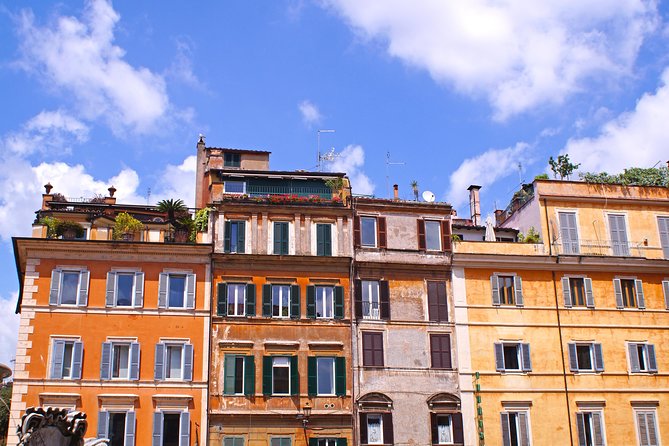
From the Ghetto, the group continues toward Isola Tiberina, the small island in the Tiber. The crossing gives you a change of pace after the close streets of the Jewish quarter.
This is one of the route’s pleasant visual moments. You get views toward Rome’s bridges and the river, along with a chance to see how the city’s districts connect. The island stop is free, and it does not require a separate ticket.
The walk across the Tiber also helps the itinerary feel like a proper neighborhood route rather than a series of isolated monuments. You move from the Jewish quarter into Trastevere on foot, as Romans have done for centuries, with the river acting as a natural marker between districts.
The guide continues to explain what you are seeing rather than letting the crossing become dead time. Headsets are included, which should help you hear the commentary in a group of up to 15 people.
Entering Trastevere and Santa Maria in Trastevere
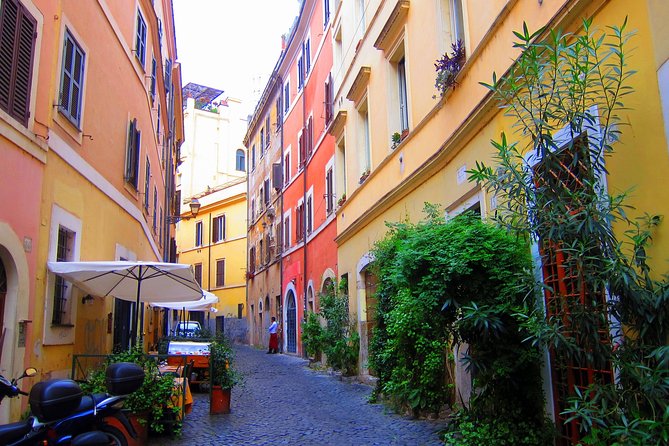
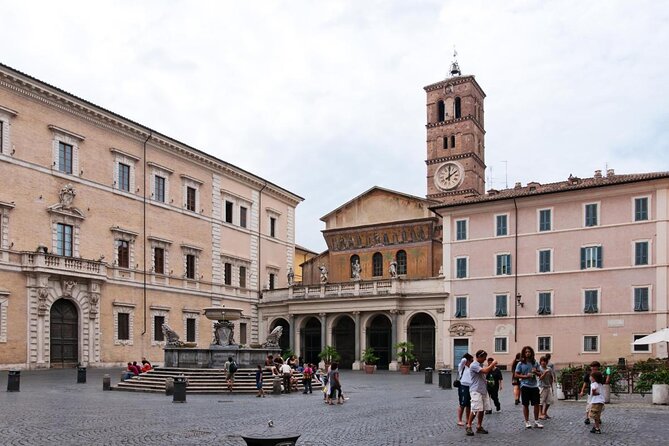
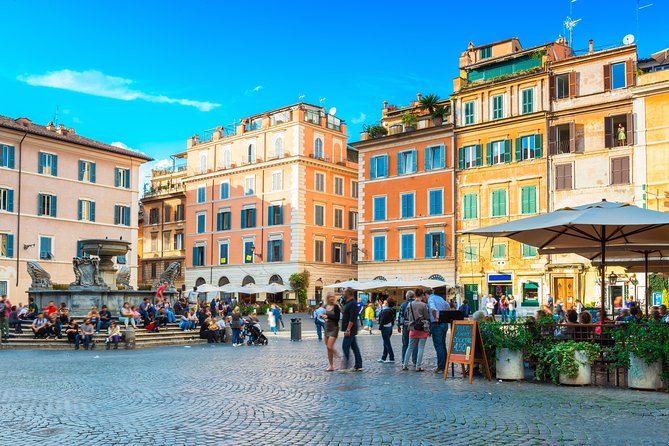
Trastevere is one of Rome’s best areas for wandering. Its name means across the Tiber, and the district is known for narrow lanes, old buildings, artists, writers, cafés, and evening life.
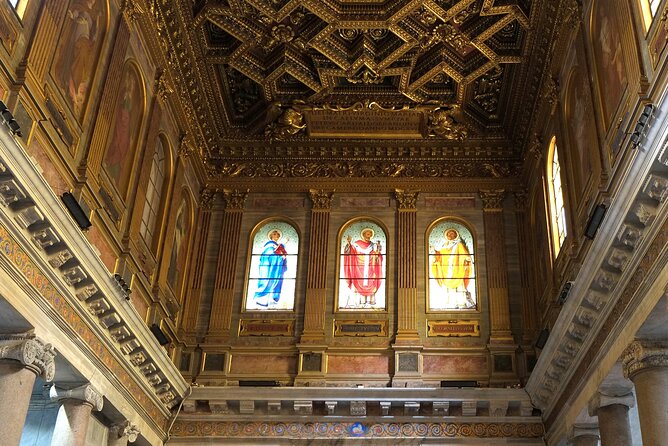
The tour brings you to the Basilica of Santa Maria in Trastevere, one of the oldest churches in Rome. Its story reaches back to the 340s AD, giving your guide plenty to explain about the church’s place in the city.
An interior visit is included when the church schedule permits it. This condition matters. Churches in Rome are active places of worship, and opening hours can change for services or other religious functions. You may see the interior, but you should not treat entry as guaranteed.
If you do get inside, the visit adds a welcome architectural and artistic layer to the street walk. If you cannot enter, the guide still gives you the church’s history and helps place it within Trastevere’s identity.
I especially like this portion for people who have already seen Rome’s major sights. Trastevere feels less formal than the central archaeological zones, and you can watch the city shift from daytime sightseeing to dinner and nightlife.
The pace is meant to be leisurely, according to the tour details and several accounts of the experience. That is good news on uneven Roman streets, though one past group felt rushed and another said the walk ended earlier than expected. If your guide is moving quickly, ask questions and make clear that you would like the full route.
Ponte Sisto, Farnese Palace, and Campo de’ Fiori

The final section crosses back over the Tiber by Ponte Sisto. The bridge leads you toward the Piazza Farnese area and the exterior of Palazzo Farnese before the tour ends at Campo de’ Fiori.
Ponte Sisto is a useful final crossing because it brings you back toward Rome’s historic center without retracing the route. It also gives you another angle on the river and the bridges.
Piazza Farnese adds Renaissance grandeur to a tour that has already covered ancient ruins, Jewish history, and medieval church art. Palazzo Farnese is viewed from outside, and entry is not included. You should think of it as a short architectural stop, not a palace tour.
The walk ends at Campo de’ Fiori, one of Rome’s best-known squares. By evening, cafés, street artists, live music, and people out for dinner give the square a different feel from its daytime market hours.
This is a practical ending. You are not dropped at an isolated bus stop or sent back to the starting point. From Campo de’ Fiori, you can continue exploring, find dinner, or walk back toward the center.
The guide makes or breaks the walk
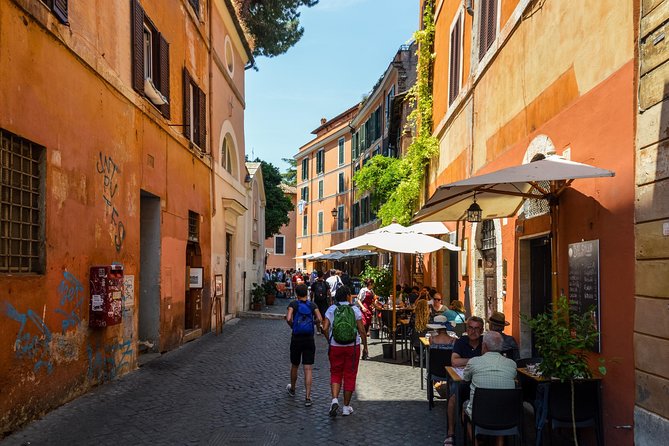
The subject matter is strong, but the guide determines how much you take away. The best accounts single out Irene, Paolo, Claudio, and Jeanette for humor, strong command of Roman history, personal warmth, and a clear love of the city.
That praise is consistent with what you want from this kind of experience. A guide should connect the assassination of Caesar to the ruins, the Ghetto to the people who lived there, and Trastevere to present-day Roman life. The strongest guides also offer useful food suggestions, not just dates and architectural terms.
There are a few cautions. A guide may be American or another English-speaking resident rather than Italian, which some people will prefer and others may find less connected to the local experience. One past participant also disliked political comments during the commentary. That is not a problem reported by everyone, but it is worth knowing that guide style can vary.
The tour is offered in English. Headsets are included, and the small group makes it easier to ask for clarification than on a large coach tour.
Is $66.38 a fair price?
At $66.38 per person, this is not the cheapest way to walk through Rome. You can visit both neighborhoods on your own for the price of transportation and a guidebook.
The question is what you want from the three hours. If you are happy to read plaques, look up church details, and research the Ghetto in advance, the price may not feel necessary. If you want the stories connected as you walk, the fee is more reasonable.
The tour includes a professional guide and headsets. It does not include food, drinks, hotel pickup, entry to the synagogue, or access to Palazzo Farnese. The church visit depends on its schedule, so do not count every possible interior as part of the guaranteed value.
The small-group limit helps justify the price. A maximum of 15 people is much easier to manage than a large crowd, especially in narrow lanes and busy squares. You are also paying for local orientation and dinner suggestions, not just transportation between sights.
I would consider it good value for a first or second visit to Rome, particularly if you want history with your neighborhood wandering. It is less useful if you have already researched the Jewish Ghetto and Trastevere closely or prefer to set your own pace.
Timing, walking effort, and useful preparation
The listed start time is 6 pm, with a duration of about three hours. That puts the finish around 9 pm, making dinner planning easy. You could eat afterward in or near Campo de’ Fiori, or return toward Trastevere for more evening atmosphere.
The route requires a moderate level of fitness. You will be on foot for the full experience, crossing bridges and walking over old city streets. Wear comfortable shoes, bring water, and avoid carrying luggage because no luggage storage is available.
The tour is near public transportation, and the starting point can be reached without hotel pickup. If you arrive by bus from Termini, check the payment rules before boarding. One person was helped by a local after not realizing payment was required before getting on.
The afternoon and evening setting can be a plus. Several people liked the cooler air and the way Trastevere comes alive after dark. In late autumn or winter, though, an evening start can mean less daylight for the final stops. One past participant wanted an earlier start so there would be more time to see Trastevere before it became dark.
The tour requires a minimum number of people to operate. If that minimum is not met, you are offered another date or experience, or a full refund. You can cancel for a full refund up to 24 hours before the local start time. Changes or cancellations inside that window are not accepted.
Who should book this Rome walking tour?
I would recommend it to you if:
- You want Rome’s Jewish history explained with care and context.
- You have already seen the major monuments and want quieter streets.
- You like walking tours that mix archaeology, churches, neighborhoods, and current city life.
- You want dinner ideas and local orientation without committing to a food tour.
- You prefer a small group and an English-speaking guide.
- You are comfortable walking for about three hours.
I would hesitate if you need guaranteed church entry, an interior synagogue visit, a meal included in the price, or a precise sightseeing schedule. I would also skip it if walking is difficult or if you want to spend most of the evening inside museums.
Final verdict: book it for context, not just sights
This tour earns its place on a Rome schedule because it gives meaning to places you might otherwise pass in a hurry. Largo di Torre Argentina, Piazza Mattei, the Synagogue of Rome, Isola Tiberina, Santa Maria in Trastevere, Ponte Sisto, and Campo de’ Fiori form a varied route with very little repetition.
Book it if you want a guide who can make Rome’s side streets speak, especially if you are lucky enough to get someone with the warmth and humor associated with Irene, Paolo, Claudio, or Jeanette. Go in knowing that the synagogue is exterior only, the church visit depends on the schedule, and the pace or ending may vary.
For a first visit, it is a useful way to get your bearings. For a repeat visit, it can show you a Rome that the major sights leave out.
FAQ
Where does the tour begin?
The tour begins at Largo di Torre Argentina in Rome’s historic center.
What time does the tour start?
The listed start time is 6 pm.
How long does the walking tour last?
The experience lasts approximately three hours.
Is the synagogue visited inside?
No. The tour includes an exterior visit to the Synagogue of Rome, but internal synagogue entry is not included.
Can I enter Santa Maria in Trastevere?
An interior visit is offered subject to the church schedule. Entry is not guaranteed if services or other scheduling issues prevent access.
Where does the tour end?
The tour ends at Campo de’ Fiori. From there, you can continue exploring or arrange your own dinner plans.
Fresh on the Rome list
- Rome: Guided Catacombs Tour & Capuchin Crypt (Audio Guide)★ 4.3 · 191 reviews
- Guided tour of the Colosseum, Roman Forum and Palatine in Spanish★ 4.5 · 191 reviews
- Rome: Borghese Gallery Guided Tour with Skip-the-Line Ticket★ 4.5 · 192 reviews
- Rome: Arena Colosseum Tour with Arena Access★ 4.6 · 193 reviews
- Rome: Colosseum & Roman Forum Guided Tour★ 5.0 · 194 reviews
- Colosseum, Forum, Palatine Hill with audio guide and Arena or Bus option★ 4.0 · 193 reviews
- Rome: Domus Aurea Guided Tour and Virtual Reality Experience★ 4.7 · 194 reviews
- Rome Vintage Fiat 500 car Tour With Photographer★ 5.0 · 194 reviews
Walking Tours, compared.
Guided Walking Tour & Last Supper Visit with Ticket
Read our review →
Rialto Bridge & Offbeat Unusual Venice Walking Tour
Read our review →
Private 3 hrs Venice Tour: St Mark’s, Walking tour & Boat tour
Read our review →
Skip the line: Uffizi and Accademia Small Group Walking Tour
Read our review →Browse the lists this tour appears in