

Reviewed · UFFIZI & ACCADEMIA GALLERY TOURS
Florence: Uffizi Priority Ticket & Masterpieces Audio App
The Uffizi is where Florence’s greatest paintings come together, from Botticelli’s Birth of Venus to Leonardo’s Annunciation and Caravaggio’s Medusa. This experience gets you past the ticket-buyers’ queue, then lets you explore with a self-guided audio app rather than keeping you tied to a group.
I like the easy handoff at the entrance and the freedom to spend ten minutes on one painting or four hours in the gallery. I also like that the audio content points you toward the major works without trying to explain every object in the building. The catch is that priority entry does not mean skipping the mandatory security check, and the app works only if you arrive with a charged phone, headphones, and the download already sorted.
Key points at a glance
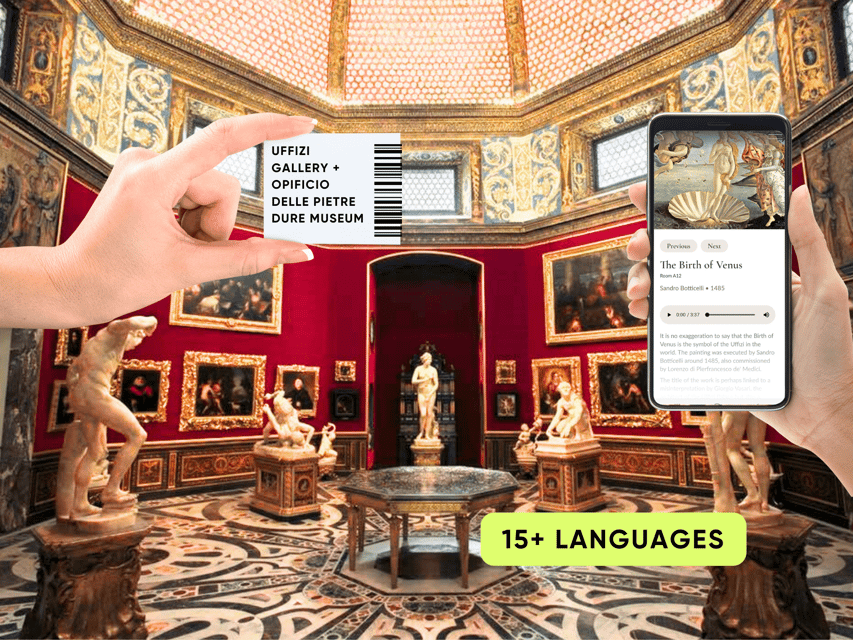
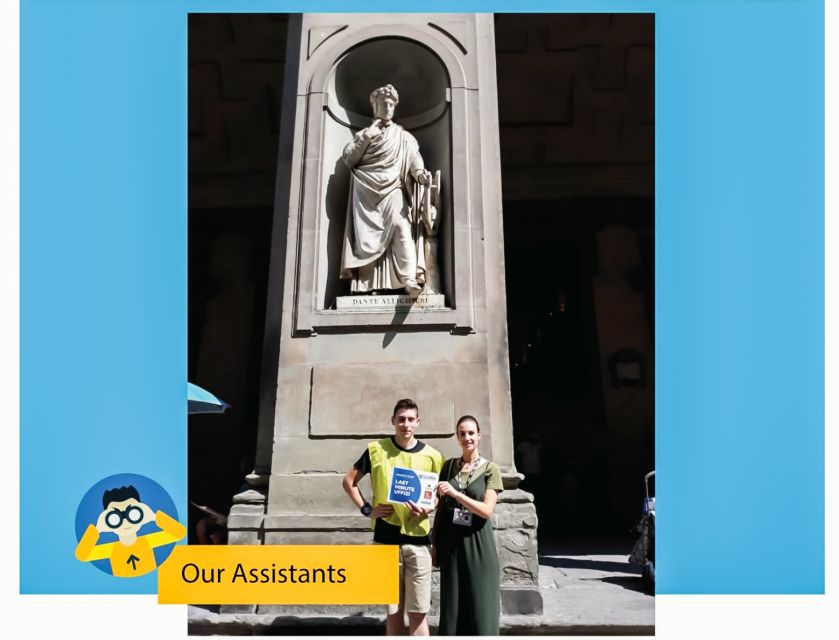
- Meet beneath Benvenuto Cellini’s statue: Find the ACCORD host in a yellow vest near the corner of the Uffizi ticket office and Via Lambertesca.
- Enter with a reserved time: Your host provides the ticket and directs you to Door No. 1, bypassing the ordinary ticket-purchase and ticket-pickup lines.
- Follow art from the Middle Ages to the Renaissance: The app focuses on works by Giotto, Leonardo da Vinci, Botticelli, Michelangelo, Caravaggio, and other Italian masters.
- Use your own phone at your own speed: Audio and written content are available in many languages, but you must bring headphones.
- Expect a large museum visit: Two to four hours is a sensible target, while art lovers can spend much longer.
- Pay for convenience as well as admission: At about $31, the price is close to the regular adult ticket price, with the extra cost covering timed priority arrangements, host assistance, and the audio app.
Meeting the host near the Benvenuto Cellini statue
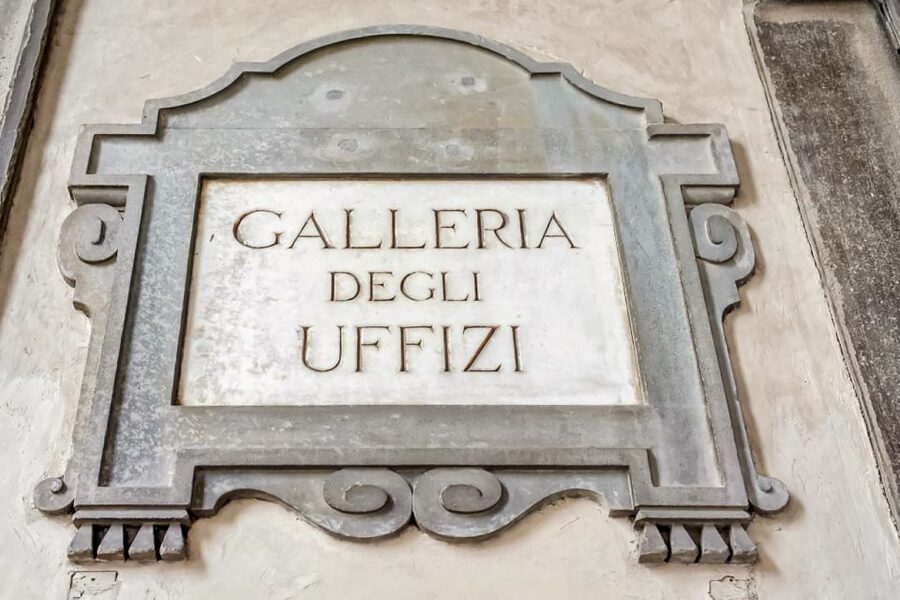
Start at the corner of the Uffizi Gallery ticket office and Via Lambertesca, beside the statue of Benvenuto Cellini under the Loggia. Look for an ACCORD staff member wearing a yellow vest. Arrive 15 minutes before your scheduled time, since the host needs to locate your booking, hand over the ticket, and point you toward the correct entrance.
This meeting point matters. The Uffizi sits in a busy part of central Florence, and its several doors and ticket areas can be confusing when you are watching the clock. Having a person in a clearly marked vest removes much of that guesswork.
The host is not your museum guide. The on-site support is there to handle the ticket and entry process, with English and Italian assistance available. Once you pass into the gallery, you continue independently with the audio app.
A few people have found the staff especially helpful when problems came up, including guests who arrived late or needed help with their phones. Still, do not plan on being late. Your reserved time is useful, but it is not a license to wander into the area at the last minute.
A few other Florence mornings to weigh against this
- Florence: Skip-The-Line Uffizi Gallery Timed Entry Ticket
★ 4.5 · 27,832 reviews - Florence: Timed Entrance Ticket to Michelangelo’s David
★ 4.6 · 16,983 reviews - Florence: Michelangelo’s David Skip-the-Line Entry Ticket
★ 4.5 · 12,764 reviews
What priority entry really saves
The main benefit is avoiding the line for people who still need to buy tickets and the separate ticket-pickup process. At busy times, that can be a meaningful saving, especially in summer or around the middle of the day.
You may still wait for security. Every visitor must pass through the museum’s check, and this can take about 10 to 15 minutes at the busiest periods. Some people also report a short wait in the priority entrance line itself. In other words, fast track means a quicker, organized route into the museum, not instant passage through every checkpoint.
That distinction is important when comparing prices. You are paying around $31 per person, while the stated official adult Uffizi ticket is €29. Visitors aged 18 to 25 who qualify for the European Union reduced rate pay €2, and children from 0 to 17 enter free under the listed museum prices. If you qualify for one of those lower rates, this package may be poor value unless the priority handling and app are worth the added cost to you.
For a regular adult visiting Florence during a crowded period, I think the small premium can be sensible. You are buying less uncertainty, not only a piece of admission paper.
Getting the mobile audio app ready

The audio guide arrives as an app or download instruction connected to your voucher. You should install it the day before, using reliable Wi-Fi, rather than waiting beside the gallery. You will also receive a WhatsApp reminder with meeting instructions and download details.
Bring:
- A fully charged smartphone
- Your own earphones or headphones
- Your passport or ID card
- Identification for children
- A phone power bank if you have one
The app is available in English, Italian, Turkish, Spanish, French, German, Chinese, Portuguese, Polish, Japanese, Russian, Dutch, Korean, Hungarian, Greek, Croatian, Romanian, and Ukrainian. That language range is useful for mixed-language families and groups.
The app is designed around selected masterpieces. It gives you more context than the short labels beside the paintings, then lets you pause, replay, or skip sections. Some people find this format ideal because it leaves them free to look around. Others find the commentary basic or wish it followed the museum’s physical route more closely.
I would treat it as a guided shortlist, not a full scholarly tour. You get help with the headline works, but you will still need to read labels and follow the gallery signs for everything else.
The Uffizi’s first great stretch: medieval art and Giotto
The Uffizi tells the story of Italian art in a broad sequence, beginning with medieval works and moving toward the Renaissance. The early rooms can seem quieter than the famous Botticelli galleries, but they explain the change that makes Florence’s art so important.
Giotto and other early masters moved painting toward stronger human expression, more solid figures, and a greater sense of space. The audio app can help you notice those changes instead of seeing the rooms as a parade of gold backgrounds and solemn faces.
Take your time here if you want to understand how the later Renaissance paintings came about. If your schedule is tight, listen to the recommended pieces and keep moving. The gallery contains far more than anyone can absorb in one visit.
Same city, an entirely different afternoon:
- Tuscany Day Trip from Florence: Siena, San Gimignano, Pisa and Lunch at a Winery
★ 5.0 · 21,634 reviews - The Best tour in Florence: Renaissance & Medici Tales – guided by a STORYTELLER
★ 5.0 · 12,316 reviews - Florence: Leonardo Interactive Museum Entry Ticket
★ 4.5 · 11,763 reviews - The Best Tour in Florence: Renaissance and Medici Tales
★ 5.0 · 10,810 reviews
Botticelli’s Venus and the Uffizi’s headline rooms
The great crowd pull is Botticelli’s Birth of Venus. You may have seen it reproduced on posters, clothing, and travel books, but the original has a different effect. Its scale, pale colors, flowing hair, and delicate figure reward a slower look than a quick photograph.
The audio app helps you focus on details that are easy to miss when the room is busy. Look at the figures around Venus, the movement of the fabric, and the way the painting turns a mythological subject into a polished image of beauty.
Botticelli’s Primavera is another essential stop. It is dense with figures and symbols, so an explanation is useful if you do not already know the painting. The app cannot replace a live art historian’s conversation, but it can give you enough structure to avoid simply admiring the surface and walking on.
These rooms can be crowded. Early morning is a good choice if you want more breathing room, and a 9:30 entry has worked well for some visitors. Even with priority admission, expect other people around the major works.
Leonardo, Michelangelo, and Caravaggio
Leonardo da Vinci’s Annunciation is one of the key stops. It shows the young Leonardo working within a tradition while already pushing toward close observation, atmospheric space, and natural movement. The app draws your attention to the painting’s details and gives you a starting point for looking beyond the famous name.
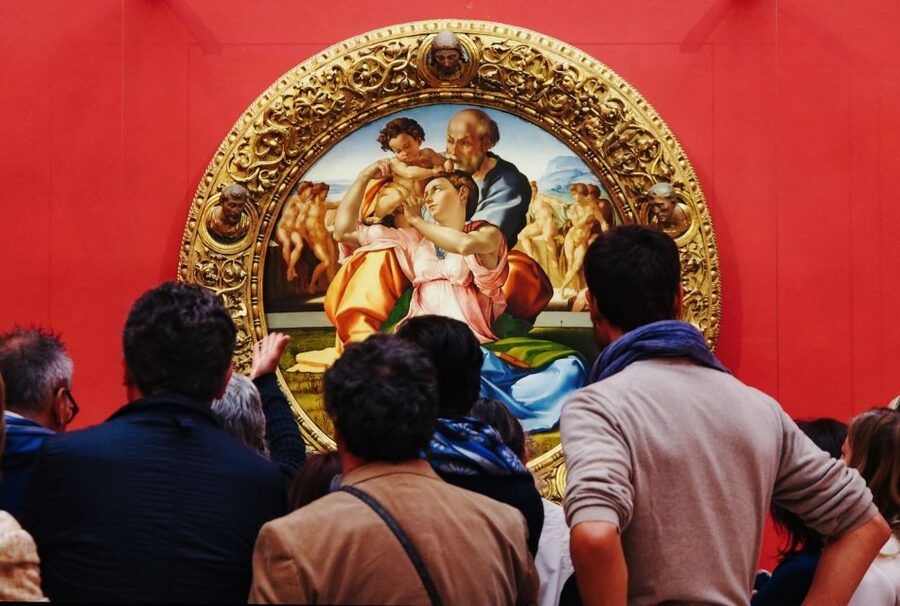
The Uffizi also contains Michelangelo’s Doni Tondo, his only surviving finished panel painting on wood. Its round format and tightly grouped figures make it unlike the wall frescoes most people associate with Michelangelo. It deserves a quiet pause, even if your main reason for visiting is Botticelli.
Caravaggio’s Medusa changes the mood. The violent expression and dramatic lighting are a sharp break from the controlled elegance of earlier rooms. The audio commentary is most useful here when it explains how Caravaggio made the image feel immediate and unsettling.
You will also find works connected to many other major Italian artists. The strength of the Uffizi is not a single room but the way the collection lets you watch artistic ideas change over several centuries.
Ancient statues along the Medici corridors
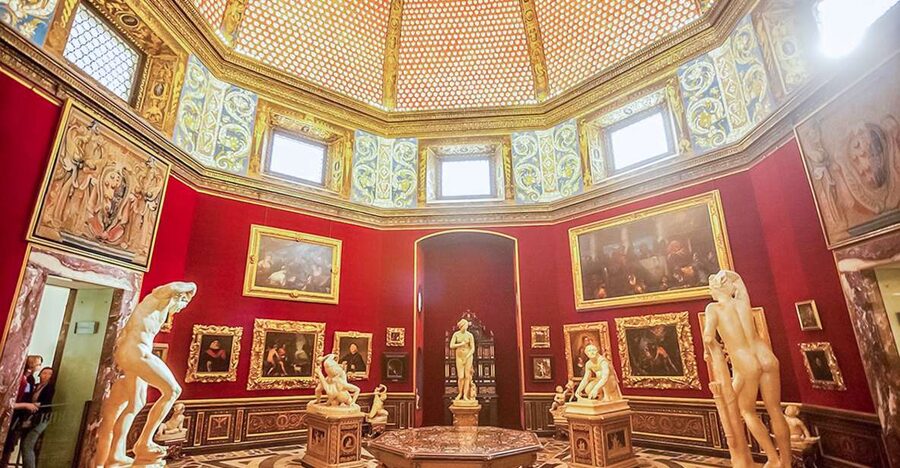
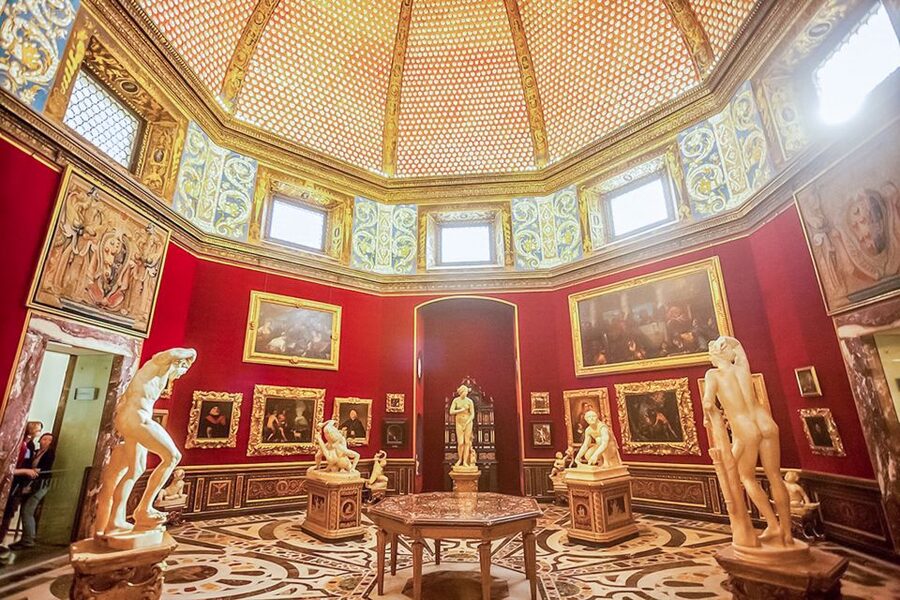
Do not stare only at the paintings. The long corridors are lined with ancient statues and busts collected by the Medici family. Many are Roman copies of Greek sculptures that no longer survive in their original form.
These sculptures give the building a different rhythm. You walk through painted rooms, then pass rows of marble figures looking down from the walls and alcoves. They also show how the Medici shaped the museum’s identity: this was not just a collection of paintings, but a display of classical culture and family power.
The corridors can become a practical part of the route as well. Arrows above doorways help you follow the main direction, and the museum naturally leads you from one room to another. Still, several people have wished for a clearer map. If you like planning your route, download or check the museum layout before you arrive, and do not assume the audio app will solve all navigation questions.
How long to allow inside
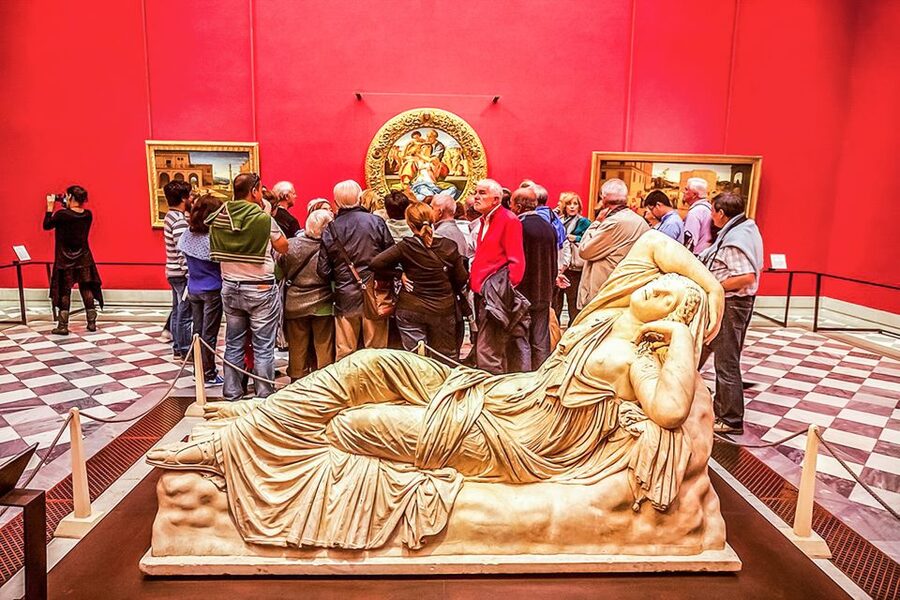
The advertised duration is one day because your ticket gives you access for the date and time you select, not because the guided portion lasts a full day. Plan on two to four hours for a satisfying visit.
Two hours works if you concentrate on the best-known works and use the app selectively. Three hours gives you time for the medieval rooms, Renaissance highlights, sculpture corridors, and a few pauses. Four hours is reasonable if you read labels, listen to most of the audio, and return to favorite paintings.
Art lovers could stay much longer. The Uffizi is large enough that rushing through every room can leave you tired and less attentive. I prefer choosing a manageable set of must-sees, then allowing room for unexpected paintings that catch my eye.
There is a small cafeteria on a terrace inside, and one point in the route gives you the choice of leaving or continuing. Be prepared for stairs. One part of the visit includes roughly 120 steps to reach the starting point, while an elevator may be available for the descent. The museum is listed as wheelchair accessible, but anyone with mobility concerns should confirm the current route with staff on arrival.
The Vasari Corridor from the outside

After leaving, take a walk along the outside of the Vasari Corridor. This historic passage connects the Uffizi with the Pitti Palace and offers views of Florence’s streets and architecture.
The corridor itself is not part of your Uffizi admission or audio tour. Think of this as a useful after-visit suggestion, not another museum room included in the ticket. It adds a little context to the Medici story and helps you see how the Uffizi fits into the city’s network of palaces and riverfront routes.
It is an easy way to extend the outing without committing to another ticket. If you are tired after several hours indoors, even a short walk around the exterior can reset your attention.
Food tasting bonus and practical limits
The package includes a bonus selection of Tuscan food tastings, such as extra-virgin olive oil, truffle specialties, schiacciata, and cantuccini. Check the voucher for the exact redemption instructions and location, since the supplied details do not specify where or when the tasting takes place.
Inside the Uffizi, large bags and luggage are not allowed, and pets are not permitted. You may bring one bottle of water per person, with a maximum capacity of 500 milliliters. These rules are easy to overlook, especially if you are moving around Florence with day bags.
The audio app is the most avoidable source of trouble. A few people arrived without earphones or had difficulty getting the download to work. Do the installation before reaching the Uffizi, use Wi-Fi, test the audio, and keep your phone charged. That simple preparation can make the difference between a useful guide and a silent screen.
Who gets the best value from this visit
This experience suits you if you want to see the Uffizi independently but do not want to handle the museum’s ticket process alone. It works especially well for first-time visitors who want pointers toward Botticelli, Leonardo, Michelangelo, and Caravaggio without committing to a live group tour.
It is also a good fit for families or couples with different interests. One person can listen to the app while another studies a nearby sculpture, and nobody has to keep pace with a guide.
You may prefer a live tour if you want questions answered on the spot, a clear explanation of the entire museum layout, or stories connecting each room. The included host is an entrance assistant, not a live museum guide. The app gives you privacy and control, but it does not provide conversation.
The $31 price makes the most sense for regular adult visitors during a busy period. For anyone eligible for the €2 reduced ticket or free child admission, compare the savings carefully before booking. The priority arrangement may still be helpful, but the price difference is much larger for those categories.
Should you book the Uffizi priority ticket and audio app?
Book it if your Florence schedule is tight, you want help finding the correct entrance, and you are comfortable exploring from your own phone. The best features are practical: a reserved entry time, a visible host, faster handling of the ticket process, and audio that keeps you focused on the Uffizi’s most important works.
Do not book it expecting a private guide or a completely queue-free arrival. Security checks remain, the app needs preparation, and the commentary is selective rather than exhaustive.
For most adult first-time visitors, I would consider it a sensible way to see the Uffizi, especially in high season. Download the app early, bring headphones, arrive at the Cellini statue 15 minutes ahead, and allow at least three hours if you want the museum to feel like more than a checklist.
FAQ
Where is the meeting point for the Uffizi ticket?
Meet at the corner of the Uffizi Gallery ticket office and Via Lambertesca, beside the Benvenuto Cellini statue under the Loggia. Look for an ACCORD staff member in a yellow vest.
How early should I arrive?
Arrive 15 minutes before your reserved entry time. The host must locate your booking, provide the ticket, and direct you to Door No. 1.
Does priority entry skip the security check?
No. All visitors must pass through security. At busy times, the security wait can take about 10 to 15 minutes.
Is there a live museum guide?
No. The experience includes English-speaking on-site staff for entry support and a multilingual mobile audio app. It does not include a live guide inside the gallery.
What languages are available in the audio app?
The app is available in English, Italian, Turkish, Spanish, French, German, Chinese, Portuguese, Polish, Japanese, Russian, Dutch, Korean, Hungarian, Greek, Croatian, Romanian, and Ukrainian.
What should I bring to the Uffizi?
Bring your passport or ID card, identification for children, headphones, and a charged smartphone. Install the audio app before arrival with a Wi-Fi connection. Large bags, luggage, and pets are not allowed, and only one water bottle of up to 500 milliliters is permitted per person.
More Audio Tours in Florence
- Florence: Eco-Friendly Golf Cart City Tour with Audio Guide
★ 4.6 · 1,094 reviews - Florence: Uffizi Skip-the-Line Ticket & Digital Audio Guide
★ 4.2 · 1,044 reviews - Florence Duomo Cathedral with Host & Audio Guide (Interior Only)
★ 3.5 · 702 reviews - Florence: Accademia Gallery Ticket with Optional Audio Guide
★ 4.3 · 586 reviews
More Self-Guided Tours in Florence
- Florence: Cathedral & Brunelleschi’s Dome Ticket & Audio App
★ 4.4 · 6,973 reviews - Florence: Michelangelo’s David Priority Ticket & Audio App
★ 4.4 · 6,812 reviews - Florence: Michelangelo’s David Entrance Ticket and Audio App
★ 4.3 · 1,901 reviews - Florence: Uffizi & Accademia Priority Tickets with Audio App
★ 4.4 · 1,253 reviews
Fresh on the Florence list
- Florence: Uffizi Guided Tour with Skip-the-Line Entry Ticket★ 4.8 · 499 reviews
- The Best of Florence Walking Tour in a Small Group★ 5.0 · 503 reviews
- Florence: Uffizi Gallery Tickets with Optional Audio Guide★ 4.1 · 503 reviews
- Premium Pasta and Gelato Cooking Class in Florence★ 5.0 · 508 reviews
- From Florence: Tuscany & San Gimignano Tour with 2 Tastings★ 4.8 · 511 reviews
- Florence: Guided Tour of Medici Family Secrets and Chapels★ 4.7 · 512 reviews
- Tuscany Vespa Tours Through the Hills of Chianti★ 5.0 · 515 reviews
- Pasta and Tiramisu Cooking Class with optional Local Market Tour★ 5.0 · 515 reviews
Uffizi & Accademia Gallery Tours, compared.

Skip-The-Line Uffizi Gallery Timed Entry Ticket
Read our review →
Timed Entrance Ticket to Michelangelo’s David
Read our review →
Michelangelo’s David Skip-the-Line Entry Ticket
Read our review →
Cathedral & Brunelleschi’s Dome Ticket & Audio App
Read our review →
Michelangelo’s David Priority Ticket & Audio App
Read our review →
Florence Accademia Gallery Tour with Entrance Ticket Included
Read our review →

Browse the lists this tour appears in