Reviewed · ROME TOURS
Rome: Welcome To Rome Immersive Multimedia Show
Rome is a city you usually meet one monument at a time. Welcome To Rome flips that order, showing how the whole city changed across 2,700 years through moving images, sound, and a glowing model beneath your feet. In about 27 minutes, you fly over ancient streets, enter monuments, and watch Rome grow from its earliest days into the modern capital.
I like the clear timeline, which helps you connect scattered ruins, churches, palaces, and busy streets. I also like the four hands-on models, especially if you want to understand what the Imperial Forum, Augustus Forum, Hadrian’s Mausoleum, and St. Peter’s Basilica once looked like. The main caution is value: at $21 per person, this is a short indoor presentation, not a full sightseeing tour.
- A 27-minute citywide history show: Large projections bring Rome’s changing buildings and streets into view.
- A glowing model of Rome: Watch the city develop across different periods from an overhead perspective.
- Four major monuments explained: Explore models of the Imperial Forum, Augustus Forum, Hadrian’s Mausoleum, and St. Peter’s Basilica.
- A smart first stop: The timeline can make later visits to the Colosseum, Forum, churches, and squares easier to understand.
- Flexible entry during opening hours: The presentation runs continuously, so you do not need to arrive for one fixed performance.
- Nine audio-guide languages: Choose Italian, English, Spanish, French, German, Russian, Chinese, Croatian, or Japanese.
Why Rome’s 2,700 Years Make More Sense Here
Rome can be confusing at first. One street may show a Roman column, a medieval church, a Baroque fountain, and a modern traffic lane within a few minutes of walking. Welcome To Rome gives you the broad picture before you tackle those details in person.
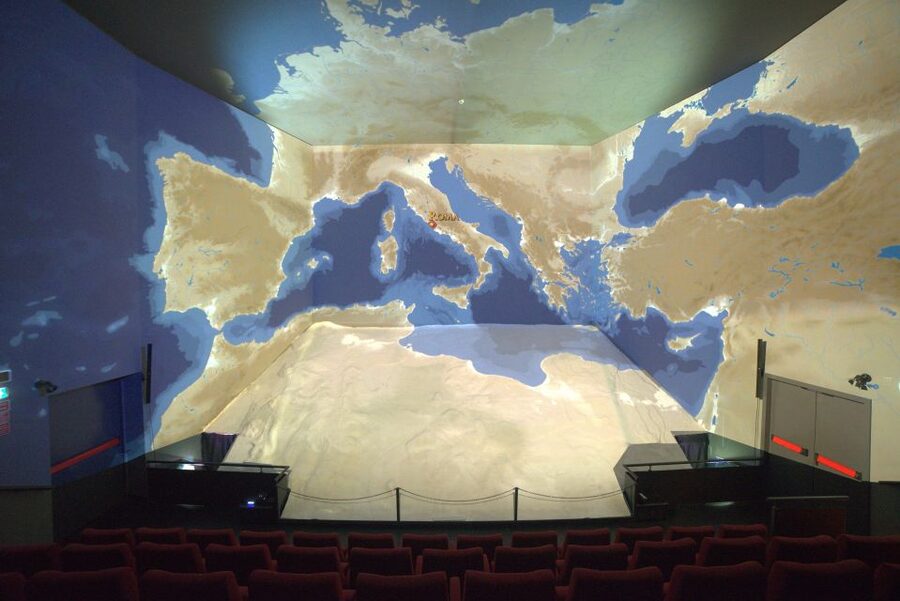
The central presentation moves through the major ages that shaped the city. Rather than asking you to study a wall of dates, it uses projections across the walls and ceiling, plus a large model on the floor, to show Rome changing over time. You get the sense of the city spreading, rebuilding, and layering itself over earlier foundations.
That is the real value. The show does not replace the Colosseum or the Roman Forum. It helps you look at them with a better mental map. After seeing the Forum in projection, you can more easily picture how the ancient buildings related to one another instead of seeing each ruin as an isolated pile of stone.
The presentation is also a useful introduction if you have limited time. You get a quick outline of Rome’s development in less than half an hour, followed by interactive exhibits that add detail. Allow roughly an hour for the whole visit, depending on how long you spend with the models.
Entering the Former Cinema Augustus
The experience is inside the former Cinema Augustus at Corso Vittorio Emanuele II, 203. The entrance is a few hundred meters from Piazza Navona, making it easy to pair with a walk through central Rome.
You enter an indoor attraction rather than an open-air archaeological site. That matters on a hot afternoon, during a rainy spell, or when you need a break from Rome’s hard pavement and crowded streets. One visitor specifically found it useful as a cooler place to sit during a summer day, though seating may not be available in every exhibit area.
The visit is designed for a flexible schedule. The show runs continuously during opening hours, and you can begin at any time. The last show starts one hour before closing, so do not arrive right at the end of the day.
The ticket includes the multimedia show and an audio guide. There is no named live guide to follow, which keeps the visit simple but also means you will not have a person on hand to answer historical questions as you go.
A few other Rome mornings to weigh against this
- Glass Blowing Show Visit Murano Glass Factory & Showroom OMG
★ 4.2 · 679 reviews
The Main Projection: Rome From Its Earliest Days to Today
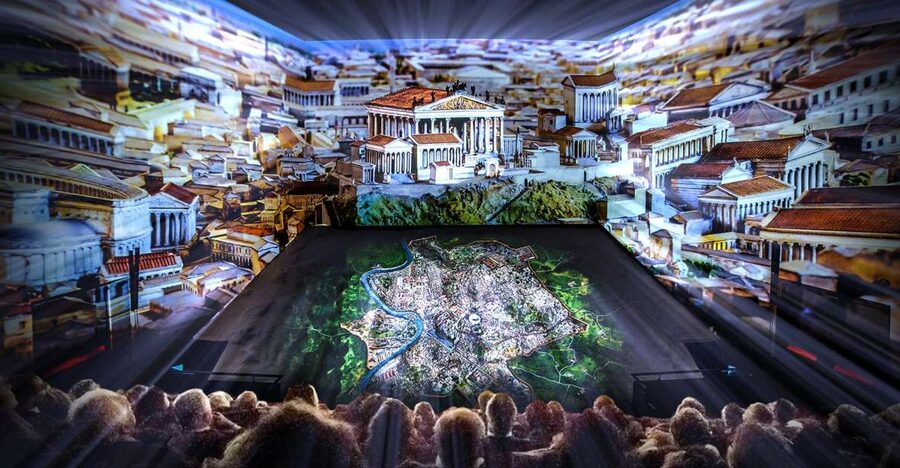
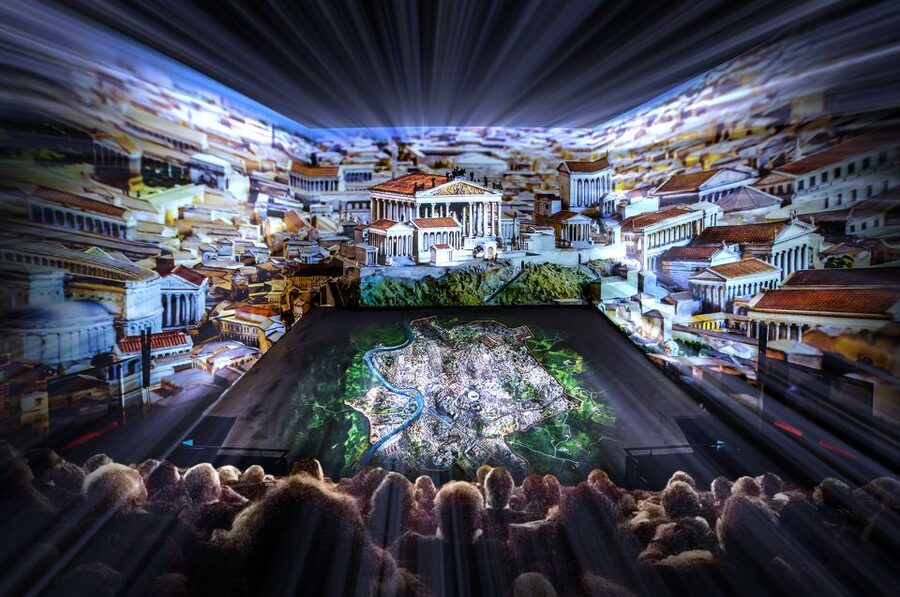
The heart of the experience is a 27-minute projection. Walls and ceilings come alive around you while the large city model lights up below. The presentation gives you a sense of flying over Rome and moving through monuments, palaces, churches, and public squares across the centuries.
The visual approach is particularly helpful for ancient Rome. Ruins often show you only fragments: a few columns, a foundation, or a section of wall. The projection fills in the missing shape and places the buildings within the wider city. You can better picture the scale of Roman construction and the relationship between major sites.
The sequence follows a chronological order, which keeps a large subject manageable. You move through the city’s different eras instead of jumping randomly from one famous building to another. That structure makes this a good first-day activity, especially if you have never studied Roman history.
Do not expect a full academic lecture. The show is a brisk orientation, not a detailed course on politics, architecture, or archaeology. Its job is to give you the framework. You will still need a real visit to the Forum, Colosseum, Pantheon, Vatican, and other sites to see the materials, spaces, and surviving details up close.
The production uses large-scale animation and 3D-style imagery. The moving pictures are the main attraction, and they are likely to hold the attention of older children better than a traditional museum display. The material is accessible for a mixed-age group, from children around school age to older adults, but very young children may not stay focused for the full presentation.
The City Model and Rome’s Changing Shape
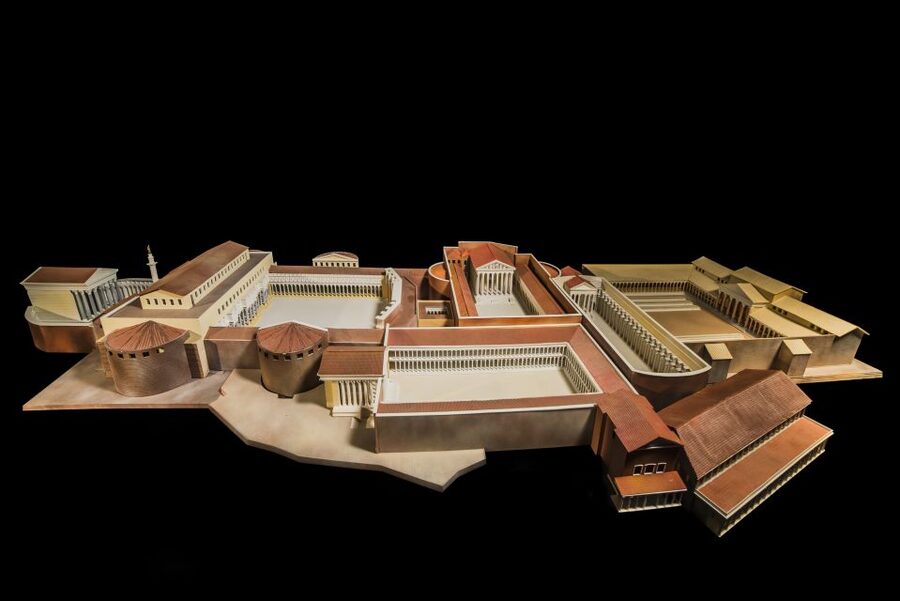
The model on the floor is more than decoration. It gives you a bird’s-eye view of Rome, allowing the city’s growth to register as a physical pattern rather than a list of dates.
As the projection advances, the model lights up to show development across the centuries. This helps explain why modern Rome feels layered. Ancient roads and foundations did not simply vanish when new rulers, religions, and building styles arrived. Later streets and structures often grew around what came before.
I find this view especially useful before visiting the Roman Forum. On site, it is easy to focus on individual temples and arches while losing track of the overall setting. Seeing the city from above gives you a clearer idea of how the Forum fitted into Rome’s larger civic center.
The model also helps with orientation beyond ancient Rome. Rome’s monuments are spread across a large area, and the presentation gives you a broad sense of how the historic center developed. It cannot substitute for a street map, but it makes the city’s shape easier to grasp.
Four Interactive Models Worth Extra Time
After the projection, you can examine four large interactive models. These focus on specific masterpieces and add a closer look at buildings that can be difficult to understand from ground level.
Same city, an entirely different afternoon:
- Vatican Museums & Sistine Chapel Tour with Optional Basilica
★ 4.3 · 67,413 reviews - Colosseum, Roman Forum & Palatine Guided Tour
★ 4.7 · 63,148 reviews - Vatican Museums, Sistine Chapel & St Peter’s Basilica Guided Tour
★ 4.5 · 39,149 reviews - Rome: Colosseum, Palatine Hill and Roman Forum Guided Tour
★ 4.8 · 32,814 reviews
The Imperial Forum
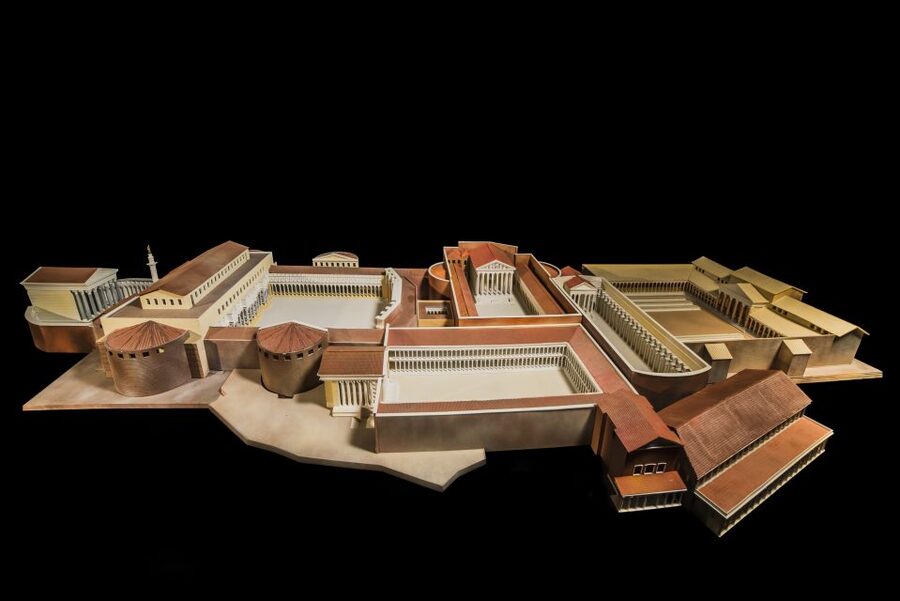
The Imperial Forum model helps you see the series of monumental public spaces built by Roman emperors. At the actual site, broken columns and partial walls can make it hard to understand how the separate forums connected.
The model gives you a more complete picture of the buildings and their arrangement. It is a useful preview if the Roman Forum and Imperial Fora are on your itinerary.
The Augustus Forum
The Augustus Forum receives its own model because it shows how architecture and political power worked together in ancient Rome. A model can reveal the original scale and layout more clearly than the remains beside a modern road.
Use this stop to look for the relationship between public space, monuments, and the emperor’s image. The point is not just what survived, but how the space worked when it was complete.
Hadrian’s Mausoleum
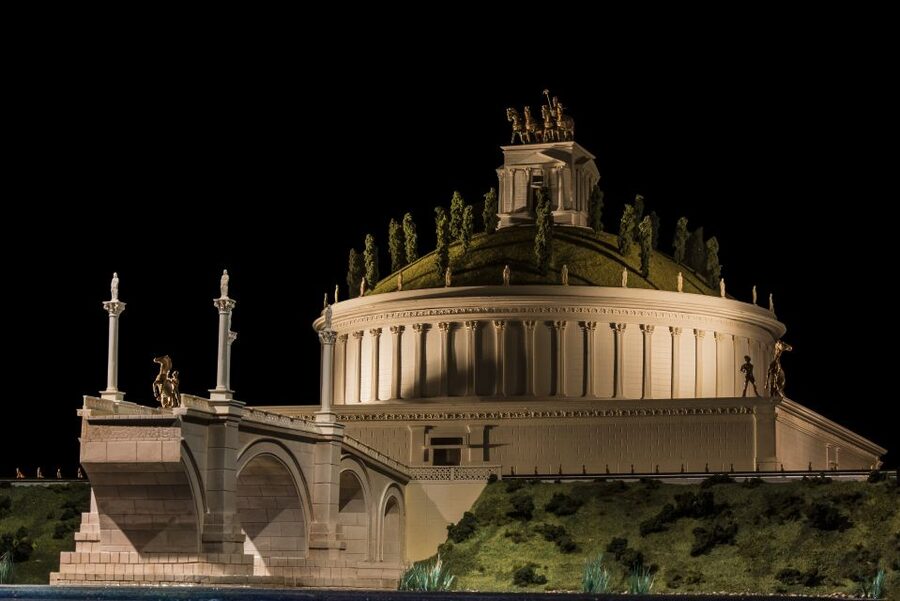
The model of Hadrian’s Mausoleum helps explain a building whose appearance changed greatly over time. Today, the structure is best known as Castel Sant’Angelo, but its original purpose was a monumental tomb.
The model gives you a useful bridge between the ancient building and the later Roman landmark you see today. If Castel Sant’Angelo is part of your walking route, this preview adds context.
St. Peter’s Basilica
The St. Peter’s Basilica model brings the later religious chapter of Rome into the picture. It is a good reminder that Rome’s identity did not end with the emperors. The city continued to change through the Christian and papal eras.
Seeing the basilica as a model can also help you appreciate its scale before you enter the real building. St. Peter’s is vast, and a small-scale view makes its layout easier to read.
The models are the part of the visit where you can slow down. The projection moves at its own pace, but the interactive displays let you spend more time with the subjects that interest you. Instructions about the order of the exhibits could be clearer, so pay attention to the layout rather than wandering without a plan.
Audio Guides in Nine Languages
The audio guide is available in Italian, English, Spanish, French, German, Russian, Chinese, Croatian, and Japanese. This is important because the show covers a lot of material quickly, and listening in a familiar language makes the timeline easier to follow.
The multilingual setup also makes the experience practical for families and groups who do not share one first language. You can focus on the visuals while following the historical explanation in your chosen language.
The audio guide is included in the admission price. Since there is no live guide, the audio track supplies the narration and structure. If you prefer to ask questions or hear personal stories from a local expert, this will feel more like a museum presentation than a guided tour.
Who Will Get the Most From This Visit
I would put Welcome To Rome near the beginning of a first visit. It works particularly well before the Colosseum, Roman Forum, Pantheon, Vatican Museums, or a guided walk through central Rome. Once you know the basic sequence of events, the city’s remains become easier to read.
Families can also use it as a gentle introduction. The projections and models give children something visual to follow, and the show is short enough to fit into a busy sightseeing day. Keep expectations realistic for toddlers and very young children, since the historical content may not hold them for long.
It is also useful for repeat visitors. Rome reveals new connections each time you return, and a quick citywide review can help tie familiar sights together. If you already know Roman history well, you may find the presentation basic, but the visual reconstructions can still provide a fresh angle.
The attraction is wheelchair accessible, including the projection and interactive exhibits. For anyone who cannot stand for long periods, check the seating situation when you arrive, since seating may not be provided throughout the exhibit spaces.
Is $21 a Fair Price for About an Hour?
The listed price is $21 per person. That is not a bargain admission for a 27-minute show, and it is worth asking what you want from the visit.
The price makes more sense if you use the attraction as a city orientation, not as a replacement for major Roman sights. You are paying for a polished visual production, the city model, four monument models, and a multilingual audio guide. The experience can save you time later by giving you a working outline of Rome before you start touring individual sites.
If you are visiting Rome for only a short stay, the cost may be easier to justify. You get a compact explanation of a very large subject, and the indoor setting gives you a useful pause between outdoor visits.
If you are traveling on a tight budget or already have several history-focused tours booked, the price may feel high. The show is concise, and some of the exhibits are best understood as an introduction rather than a detailed museum collection. Your personal interest in Roman history will decide the value.
Flexible cancellation up to 24 hours before the visit and the option to reserve now and pay later reduce the risk of fitting it into a changing itinerary. The ticket also lets you skip the ticket line.
How to Fit It Into a Rome Day
For first-time visitors, schedule Welcome To Rome on your first day or early in the trip. Afterward, visit a major site while the timeline is still fresh. A walk toward the Roman Forum or central Rome can turn the presentation into a practical orientation exercise.
You can also place it after several sightseeing days. This works well if the ruins and churches have begun to blur together. The projection can help you connect what you already saw and clarify how ancient and later Rome occupy the same city.
Because the entrance is near Piazza Navona, it pairs naturally with a central Rome walking route. You can visit the show, continue toward the square, and then explore nearby streets and monuments. The exact order depends on your opening hours and other reservations, but the flexible start time makes it easier to slot into the day.
Allow about an hour rather than planning only for the 27-minute projection. That gives you time for the four models and avoids rushing through the building. Arrive no later than one hour before closing if you want to see the final show.
Should You Book Welcome To Rome?
Book it if you want a fast, visual explanation of Rome before exploring the real monuments. It is especially useful for first-time visitors, families with older children, short stays, and anyone who finds Roman history hard to place in chronological order.
Think twice if you want a live guide, detailed archaeology, or a full museum visit. At $21, the show needs to serve a purpose in your itinerary. For me, that purpose is simple: it gives you the city’s big picture so the ruins, churches, and streets make more sense afterward.
If you do book, go early in your Rome visit, allow roughly an hour, and spend a few extra minutes with the four models. That is when this compact presentation pays off best.
FAQ
Where is Welcome To Rome located?
The entrance is at Corso Vittorio Emanuele II, 203, in Rome. It is a few hundred meters from Piazza Navona.
How much does admission cost?
The listed price is $21 per person.
How long does the main show last?
The main multimedia projection lasts 27 minutes.
How long should I allow for the full visit?
The presentation lasts 27 minutes, and the full visit may take about an hour when you include the interactive models.
Can I start the show at any time?
Yes. The show runs continuously during opening hours, so you can begin at any time while it is open.
What are the four interactive models about?
The models cover the Imperial Forum, Augustus Forum, Hadrian’s Mausoleum, and St. Peter’s Basilica.
What languages are available for the audio guide?
The audio guide is available in Italian, English, Spanish, French, German, Russian, Chinese, Croatian, and Japanese.
Is the experience wheelchair accessible?
Yes. The projection and interactive exhibits are accessible to people with disabilities.
What happens if I need to change my plans?
You can cancel up to 24 hours in advance for a full refund. You can also reserve now and pay later, subject to availability. The last show begins one hour before closing.
Fresh on the Rome list
- Exclusive Golf Tour Private VIP with Local & Gelato o Wine★ 5.0 · 500 reviews
- Colosseum, Palatine Hill and Roman Forum with Guided Tour★ 5.0 · 500 reviews
- Rome Trastevere Pasta Making Class with Eating Europe★ 5.0 · 505 reviews
- Rome by Night Walking Tour★ 4.5 · 506 reviews
- Rome: Colosseum Express Tour with Forum & Palatine Access★ 4.5 · 511 reviews
- Rome Food Experience Max 6 People Group Tour | w/Private Option★ 5.0 · 516 reviews
- Rome: Navona Square Underground Ticket with Audio Guide★ 4.0 · 518 reviews
- Rome: Escorted Papal Audience Experience with Entry Ticket★ 4.4 · 518 reviews
Rome Tours, compared.
Vatican Museums & Sistine Chapel Tour with Optional Basilica
Read our review →
Colosseum, Roman Forum & Palatine Guided Tour
Read our review →
Vatican Museums, Sistine Chapel & St Peter’s Basilica Guided Tour
Read our review →
Colosseum, Palatine Hill and Roman Forum Guided Tour
Read our review →
Guided Tour of Colosseum, Roman Forum & Palatine Hill
Read our review →
Colosseum & Forum with Audio Guide App -Optional Arena
Read our review →
Colosseum, Roman Forum and Palatine Hill Guided Tour
Read our review →