
Reviewed · MUSEUMS
Rome: Gladiator Show and Museum Tickets
Rome’s modern roads give way to an evening of gladiator combat, Roman dances, Vestal rites, and pantomime at the Gruppo Storico Romano’s arena. The setting is built for atmosphere, with music, lights, incense, costumes, weapons, and sound effects. It is not a performance inside the Colosseum, but it gives you a lively sense of how popular Roman spectacle might have felt.
I like the way the 90-minute event combines a small museum visit with entertainment, rather than offering only a staged sword fight. I also like the friendly, hands-on approach: you can take photographs, inspect armor, join audience activities, and enjoy Roman-style snacks and drinks. The main drawback is the location. It is about 3.5 kilometers from the Colosseum, and public transport may be finished by the time the event ends.
Key points to know
- The evening begins with a museum and armory visit, including Roman weapons and armor you may be able to handle or try on.
- The program includes more than fighting, with ancient dances, Vestal rituals, comedy, pantomime, training, and audience participation.
- The event runs in a purpose-built arena at the Roman Gladiator School, not at the Colosseum itself.
- Roman-style refreshments are included, such as simple snacks and drinks, with some visitors receiving wine with honey.
- The late finish affects your ride home, so arrange a taxi or confirm your return plan before the show.
- The experience is best for families and history fans who enjoy theatrical fun more than a formal museum lecture.
What the Rome Gladiator Evening Actually Is
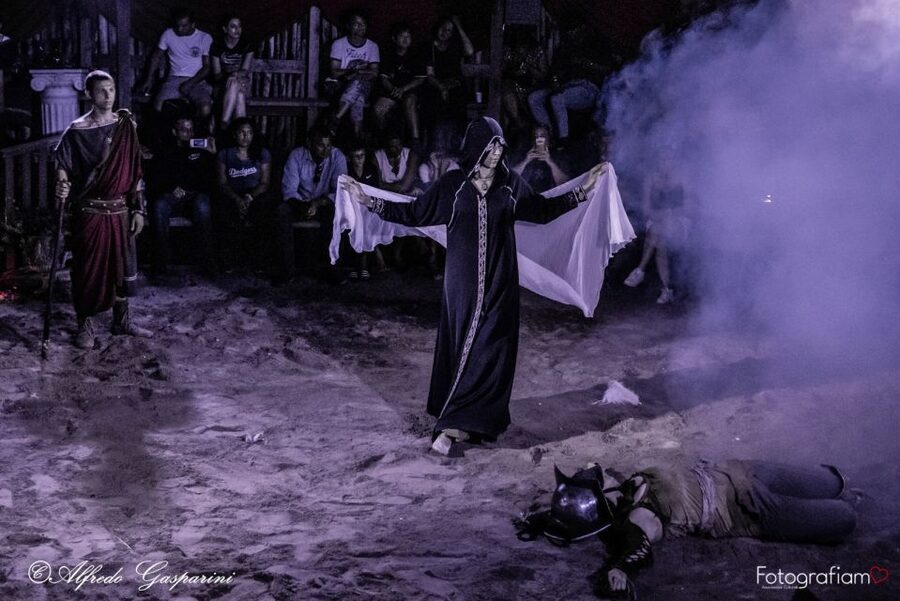
This experience is a theatrical re-creation of ancient Roman entertainment. It takes place at the headquarters of the Gruppo Storico Romano, also identified as the Rome Gladiator School, in an equipped outdoor arena roughly 3.5 kilometers from the Colosseum.
You are not watching a modern sports match or a museum demonstration with quiet labels and glass cases. The performers use real weapons and armor, though the fights are presented as historical reenactment. Music, lighting, visual effects, costumes, and a forceful presenter create the feeling of an evening show in ancient Rome.
That distinction matters. If you want a carefully academic discussion of Roman combat, this may feel too theatrical. If you want to see Roman customs brought to life and have some fun with your family or friends, the format works well.
The program lasts about an hour and a half. Arrival is listed for 8:45 p.m., with the museum and introductory activities before the main performance. The show itself is described as running from about 9:00 to 10:00 p.m., with the full event ending around 10:00 p.m.
More Museums in Rome
- Vatican Museums & Sistine Chapel Tour with Optional Basilica
★ 4.3 · 67,413 reviews - Vatican Museums, Sistine Chapel & St Peter’s Basilica Guided Tour
★ 4.5 · 39,149 reviews - Rome: Vatican Museums, Sistine Chapel & Basilica Tour
★ 4.3 · 13,872 reviews
The Small Museum Before the Arena
Your visit starts with the Museo storico-didattico del legionario romano, a small teaching museum devoted to the Roman legionary. It is not a major archaeological museum, and you should not arrive expecting the scale of the Colosseum, the Roman Forum, or the Capitoline Museums.
Its value is more direct and practical. You get close to the objects linked with Roman soldiers and gladiators, including ancient-style weapons and armor. The material helps explain what you are about to see, especially if Roman military terms and costume details are unfamiliar to you.
The museum area also gives you time to get comfortable before the show. You can take photographs and, depending on the flow of the evening, handle or try on pieces of armor. That hands-on element is particularly useful for children, who may understand the weight and shape of Roman equipment better by seeing it up close than by reading a display panel.
The museum can feel crowded if the group is large. There is limited time and space, so you may not be able to examine every item slowly. I would treat it as an introduction to the performance, not as a stand-alone museum visit.
Roman Snacks, Wine, and the Armory
Before the fighting begins, you are offered simple refreshments in the armory area. The food is described as Roman-style nibbles rather than a full meal. Some of the refreshments include wine, and the experience has featured wine with honey, a drink connected with the evening’s Roman theme.
This is a pleasant addition, but plan dinner separately. You should eat beforehand or arrange a meal for after the event, since the included food is an appetizer and not a substitute for dinner. The venue is also in an isolated area with no nearby restaurant service within easy walking distance.
The refreshments serve a second purpose. They slow the evening down and give you time to meet the performers, ask questions, and look around before the louder arena program. The cast is known for welcoming photographs and conversation, which makes the event feel more personal than a standard seat-and-watch show.
An on-stage character introduces the evening and explains the action. The presenter’s strong voice and energetic style help carry the group through the different sections. One guide named Dafydd has received particular praise for making the evening special, while other guides and performers also help visitors understand the Roman setting.
A Show With More Than Swordplay
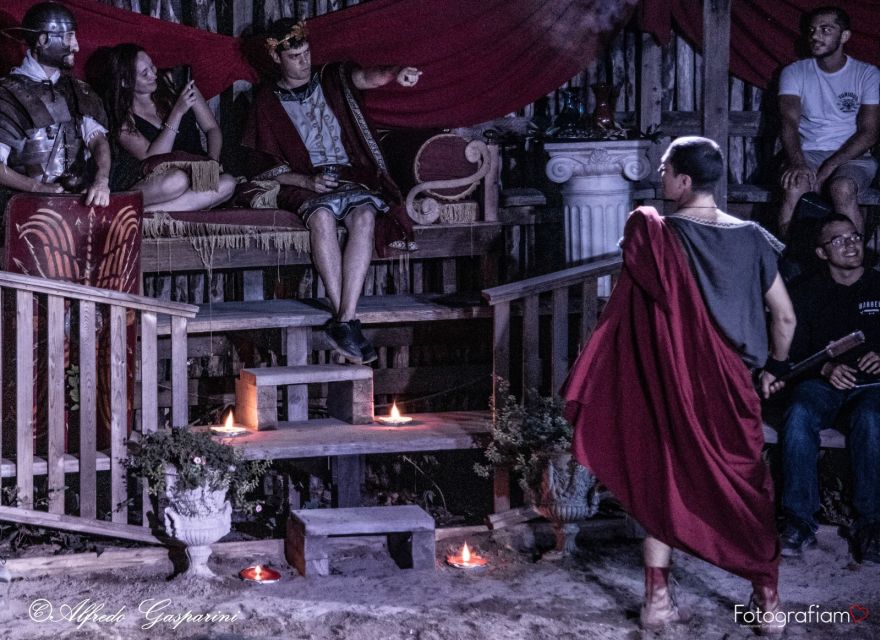
The main performance is varied. Gladiator fights are the obvious centerpiece, but they are only one part of the program. You may see ancient dances, Vestal rites, Roman training, comedy, pantomime, and other short scenes built around Roman life.
That variety keeps the 60-minute show moving. A program made only of sword fights would soon become repetitive, especially for younger children. The changes in pace give you moments of humor, ceremony, music, and crowd involvement between the combat scenes.
Some people find the show deliberately cheesy. That is a fair description, and it is best to know this before booking. The presentation aims for excitement and participation, not strict historical restraint. The costumes and weapons look convincing, but the performance also uses broad comedy and theatrical exaggeration.
I see this as part of the appeal. You are being invited to play along. If you take the evening as a lively stage show with Roman subject matter, the tone makes sense. If you expect a sober reconstruction based only on documented ancient sources, you may find the pantomime and crowd work less satisfying.
Same city, an entirely different afternoon:
- Colosseum, Roman Forum & Palatine Guided Tour
★ 4.7 · 63,148 reviews - Rome: Colosseum, Palatine Hill and Roman Forum Guided Tour
★ 4.8 · 32,814 reviews - Rome: Guided Tour of Colosseum, Roman Forum & Palatine Hill
★ 4.7 · 27,897 reviews - Rome: Colosseum & Forum with Audio Guide App -Optional Arena
★ 4.2 · 24,770 reviews
The Gladiator Fights and Safety Question
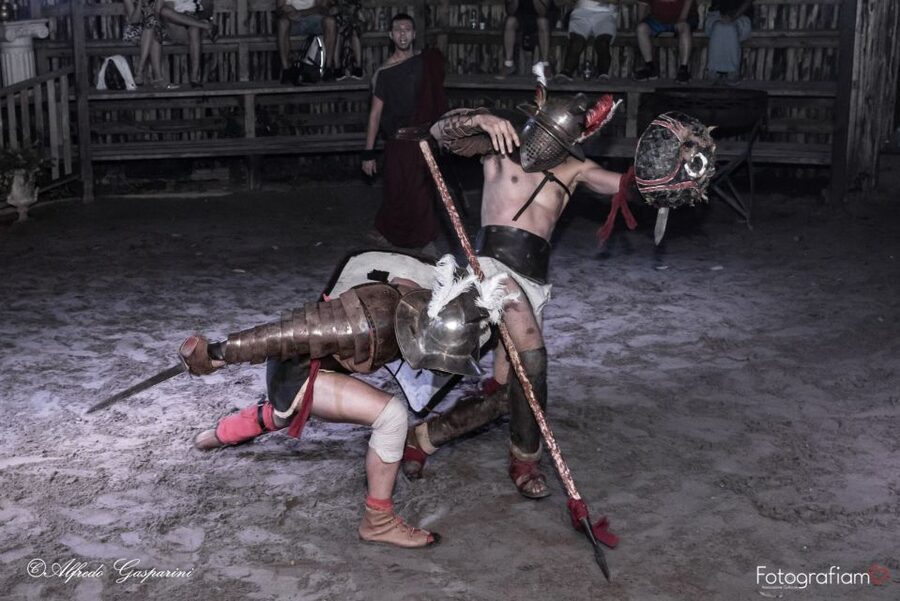
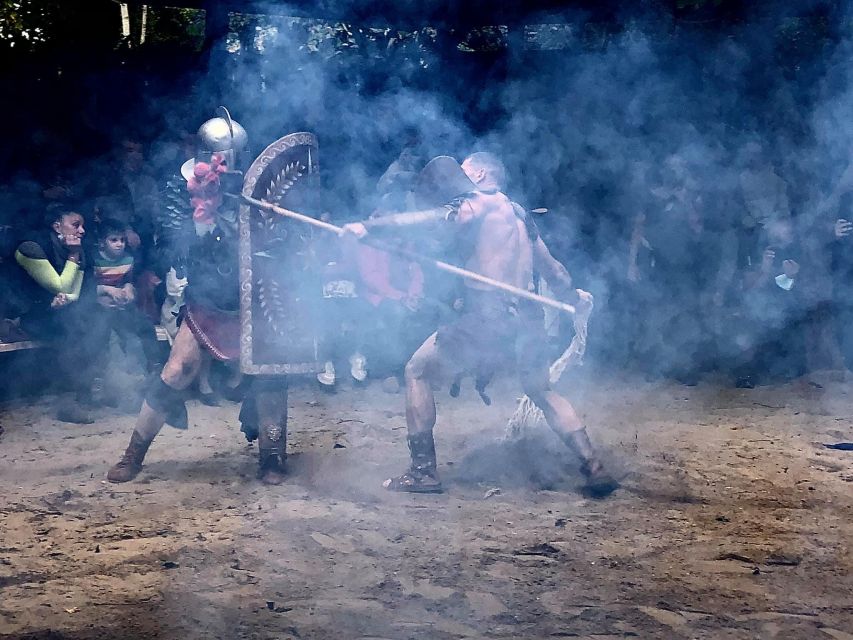
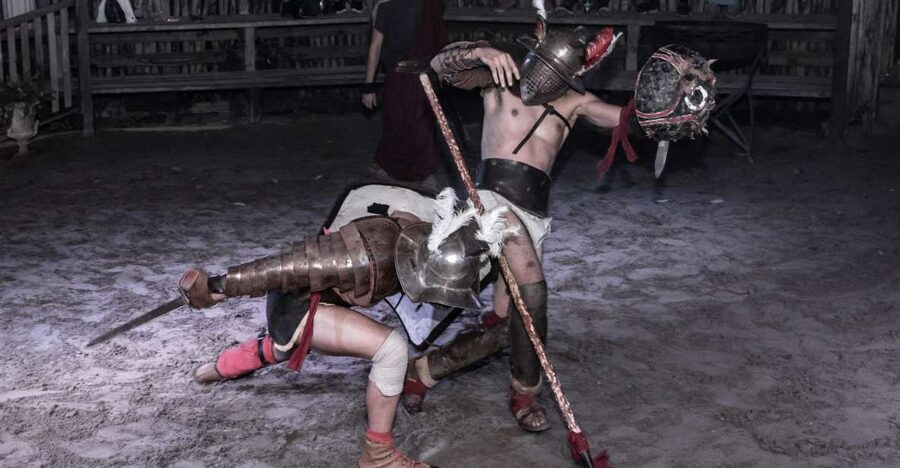
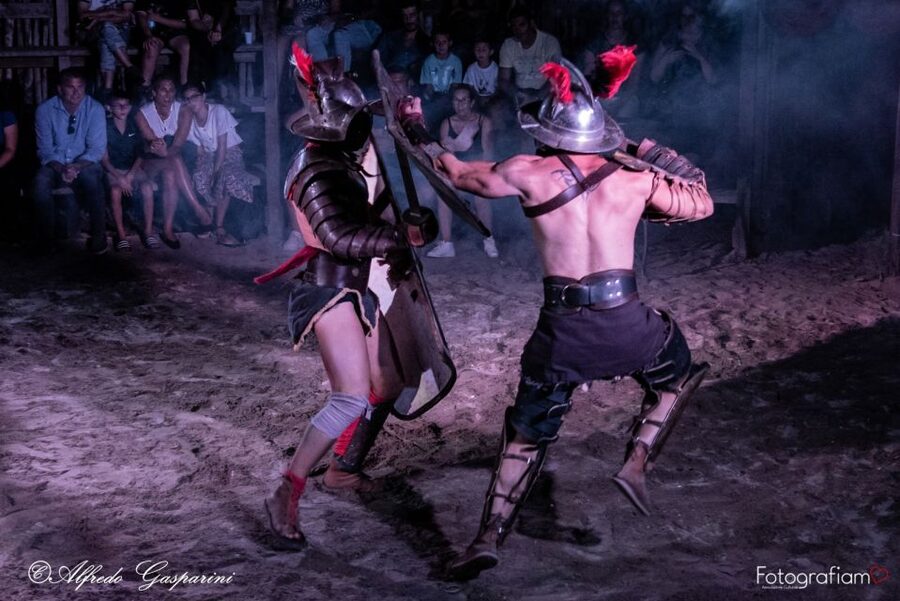
The historical reenactors use real weapons and armor, which gives the fights physical weight and visual interest. The swordplay is quick, dramatic, and designed to create suspense. Performers fall into the dirt, and the action can look convincing enough to make you wonder for a moment if someone has been hurt.
The combat is a staged demonstration, not an uncontrolled fight. Still, the use of real equipment makes it more striking than a purely symbolic performance with plastic props. You can see how shields, helmets, and blades shape the movement of the fighters.
Some scenes are violent. Parents should consider the age and temperament of their children, particularly if they are sensitive to staged injuries or loud action. The program is family-friendly in its general tone, but it is not a quiet children’s show.
The fights also work best when you participate in the atmosphere. The presenter may involve the crowd, encourage reactions, and draw people into the action. You might be asked to join in, pose, or respond to what is happening in the arena. You can watch without taking part, but the event is designed to be more fun when you do.
Roman Dances, Vestals, and Comic Relief
The dances and religious scenes widen the picture beyond the gladiator. Roman public entertainment was not only about combat, and the inclusion of Vestal rites and ancient dances gives the evening a stronger sense of ceremony.
These scenes also provide a useful change from the battles. Young performers and dancers add movement and color, while the music and lighting help create a ritual atmosphere. Incense and tranquil Roman music have been part of the welcome, setting a mood before the arena becomes noisy and theatrical.
Comedy is another important piece. A warm-up act and comic scenes help keep the event approachable for people who may not know much about Roman history. The humor is broad and interactive rather than subtle, but it gives children and mixed-age groups something to enjoy while the more historical sections unfold.
For me, this mix is the main reason to choose the experience over a simple gladiator demonstration. You receive a full evening program, not just a line of fighters entering the arena for a few staged clashes.
Getting to the Arena 3.5 Kilometers From the Colosseum
The venue is outside the historic center, although not far from the Colosseum in distance. Buses including routes 118 and 218 have been used to reach the area, with a walk of about five minutes from the stop according to the available directions.
A taxi is the simpler choice, especially for a late evening arrival. The return journey needs more thought. The event ends around 10:00 p.m., and public transport may no longer be running conveniently. One practical solution is to ask the organizers to help arrange a taxi in advance.
Several accounts describe the staff helping with taxis after the show, including making sure people could return safely. That is reassuring, but I would still plan your ride before arrival rather than rely on finding a car at the last minute.
Do not walk from central Rome unless you have checked the route carefully. One visitor found the walk from Termini took about an hour and included stretches with poor sidewalks and passing traffic. Rome’s distances can look manageable on a map, but a late walk through areas without comfortable pedestrian paths is not a good holiday plan.
The setting’s distance from the center is both a drawback and part of the atmosphere. You are away from the busy tourist core and at a dedicated gladiator headquarters, but you give up the convenience of restaurants, metro access, and an easy stroll back to your hotel.
Is $29 a Fair Price?
At $29 per person, the price is reasonable if you use all parts of the evening. You are paying for the museum visit, the arena performance, the cast, the costumes, the equipment, the interactive presentation, and light refreshments.
It is less attractive if you think of the purchase as a museum ticket. The museum is small, and you will not spend hours studying a major collection. The real value lies in the combined program and the effort involved in staging a 90-minute evening show.
For a family, the price can compare well with several separate attractions, especially if everyone enjoys participation rather than passive sightseeing. Children can see armor, watch fights, meet performers, and take part in activities. Adults receive a playful Roman theme and a different kind of evening from the usual churches, ruins, and formal museums.
Solo visitors and couples can also enjoy it, especially if they like live performance. The atmosphere depends partly on the audience joining in, so a small group is not necessarily a problem. The important thing is to accept the event’s light, theatrical tone.
The experience allows free cancellation up to 24 hours before the start, and you can reserve with payment later. Those policies are useful if your Rome schedule is still changing. Wheelchair accessibility is listed, though you should confirm any specific mobility needs before booking.
Who Will Enjoy This Most?
I would recommend the show to families with school-age children, visitors who want an evening activity, and anyone who enjoys costume performances with audience participation. It also suits first-time visitors who want a basic introduction to gladiators without spending another day inside a museum.
It is a good choice after a day of ancient Roman sights. The Colosseum and Forum explain the remains; this event gives you a more physical, theatrical sense of weapons, rituals, and public spectacle. Do not treat it as a replacement for the real archaeological sites. Treat it as a playful companion to them.
The show may not suit you if you dislike staged combat, comedy, audience involvement, or late-night transport. Serious classical historians may also want something more exact and less showy.
English ability should not be a major barrier to enjoying the action. Much of the communication comes through gestures, movement, costumes, and visual scenes. Still, the guide’s explanations add context, so check the available language information when booking if that matters to you.
Practical Timing for Your Rome Evening
Allow the full 90 minutes, even though the central show lasts about an hour. Arriving at 8:45 p.m. gives you time for the museum, refreshments, photographs, and the introduction before the arena program begins.
Do not schedule a major dinner at the venue. The included snacks are described as simple but tasty, and one account specifically advises treating them as appetizers. Eat in advance, or plan a meal after you have arranged your ride back.
Bring a phone or camera if photographs matter to you. The performers welcome pictures, and the costumes, armor, and arena setting provide the sort of scenes that are hard to recreate at the Colosseum itself.
Wear something comfortable for an evening away from central Rome. The supplied information does not specify seating or weather arrangements, so it is sensible to check the conditions and venue details before the date. The performances take place from May through September, with dates listed for 2026.
Should You Book the Gladiator Show?
Book it if you want fun, interaction, and Roman atmosphere rather than a formal historical lecture. The combination of a small museum, real armor, Roman refreshments, dances, rituals, comedy, and staged combat gives you plenty for the $29 cost.
I would be especially happy recommending it to a family or a group with mixed interests. The children can watch the fights and try equipment, while adults can enjoy the setting, presenter, and historical themes. Just keep your expectations in the right place: this is a theatrical reenactment, sometimes cheesy, and not a substitute for the Colosseum.
The key decision is transport. If you arrange a taxi or confirm a late bus before the show ends, the distance becomes manageable. If you want to walk out of an attraction and find dinner and a metro station nearby, choose something closer to central Rome.
FAQ
Where does the gladiator show take place?
It takes place at the Rome Gladiator School, the headquarters of Gruppo Storico Romano, in an equipped arena about 3.5 kilometers from the Colosseum.
How long does the experience last?
The full event lasts about one and a half hours. Entrance is listed for 8:45 p.m., and the evening ends around 10:00 p.m.
What is included in the ticket?
The ticket includes the Museo storico-didattico del legionario romano visit and the gladiator show. Snacks and drinks have also been provided during the evening.
Is this a real fight?
The event is performed by historical reenactors using real weapons and armor. The combat is a staged historical demonstration designed for an audience.
What else happens besides gladiator fighting?
The program can include ancient dances, Vestal rites, pantomime, comedy, gladiator training, and audience participation.
Is the experience suitable for children?
The show is designed for families and includes interactive activities that can interest children. It does include staged combat and violence, so parents should consider their child’s comfort with those scenes.
How can I get to the venue?
Buses 118 and 218 have been used to reach the venue, followed by a walk of about five minutes. A taxi is another option, particularly for the return journey.
Is the experience wheelchair accessible?
Wheelchair accessibility is listed for the activity. If you have particular mobility requirements, confirm the arrangements with the provider before booking.
More Show in Rome
- Rome: Welcome To Rome Immersive Multimedia Show
★ 4.6 · 3,161 reviews - Glass Blowing Show Visit Murano Glass Factory & Showroom OMG
★ 4.2 · 679 reviews - Murano Island Glassblowing Show – Made in Italy Art & Walk
★ 4.5 · 227 reviews
Fresh on the Rome list
- Rome: Guided Catacombs Tour & Capuchin Crypt (Audio Guide)★ 4.3 · 191 reviews
- Guided tour of the Colosseum, Roman Forum and Palatine in Spanish★ 4.5 · 191 reviews
- Rome: Borghese Gallery Guided Tour with Skip-the-Line Ticket★ 4.5 · 192 reviews
- Rome: Arena Colosseum Tour with Arena Access★ 4.6 · 193 reviews
- Colosseum, Forum, Palatine Hill with audio guide and Arena or Bus option★ 4.0 · 193 reviews
- Rome: Colosseum & Roman Forum Guided Tour★ 5.0 · 194 reviews
- Rome: Domus Aurea Guided Tour and Virtual Reality Experience★ 4.7 · 194 reviews
- Rome Vintage Fiat 500 car Tour With Photographer★ 5.0 · 194 reviews
Museums, compared.
Vatican: Museums & Sistine Chapel Entrance Ticket
Read our review →
Vatican Museums & Sistine Chapel Tour with Optional Basilica
Read our review →
Vatican Museums, Sistine Chapel & St Peter’s Basilica Guided Tour
Read our review →
Skip-The-Line Uffizi Gallery Timed Entry Ticket
Read our review →
Vatican Museums, Sistine Chapel & Basilica Tour
Read our review →
Vatican Museums & Sistine Chapel Skip-the-Line Entry Ticket
Read our review →Vatican Museums, Sistine Chapel & Basilica Tour
Read our review →
Vatican Museums & Sistine Chapel Guided Tour
Read our review →Browse the lists this tour appears in