
Reviewed · POMPEII & VESUVIUS TOURS
Pompeii Skip-the-line Tour with Archaeologist Guide
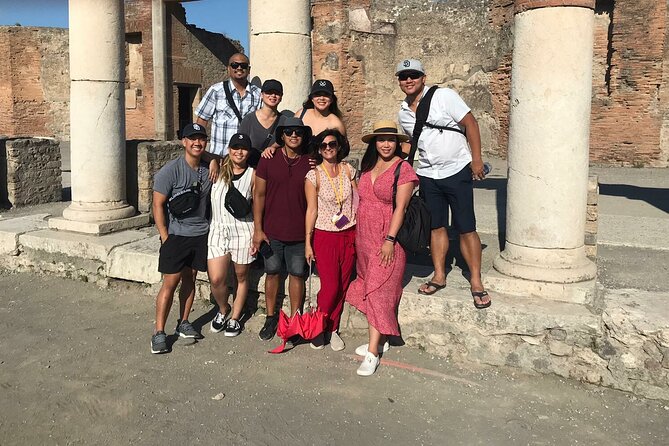
Pompeii is far more than a field of broken walls. It is a Roman city you can walk through, complete with wagon-rutted streets, bathhouses, food shops, theaters, temples, and a brothel. The best part of this tour is the archaeologist guide, with guides such as Lello and Italo bringing small details to life, from daily routines to the clues that reveal how the eruption unfolded.
I like the small group of up to 16 and the focused two-hour route. I also like that admission is included and that you can reach the site easily from Naples or Sorrento by train. The main limitation is time: Pompeii is enormous, so this gives you a strong introduction, not a full-day exploration.
Key points at a glance
- Archaeologist-led visit: Guides such as Lello, Italo, Leonardo, and Cela explain details that are easy to miss alone.
- Two-hour highlight route: Expect the forum, theaters, baths, shops, Gymnasium, House of Menander, gladiator barracks, and Lupanare.
- Small group format: The maximum group size is 16, with earsets provided on some tours so you can hear the guide.
- Easy rail access: Pompei Scavi station is close to the archaeological entrance and is reached from Naples or Sorrento on the Circumvesuviana line.
- Ancient streets underfoot: Comfortable shoes matter because you walk on original cobbles and lava rock.
- Useful first visit: The tour gives you a clear plan for returning to Pompeii on your own after the guided portion.
Why a guide changes Pompeii
Pompeii can be confusing at first. You see walls, doorways, columns, and paving stones, but without context it is easy to walk past the most important clues. A guide explains what each space did and how the pieces fit together.
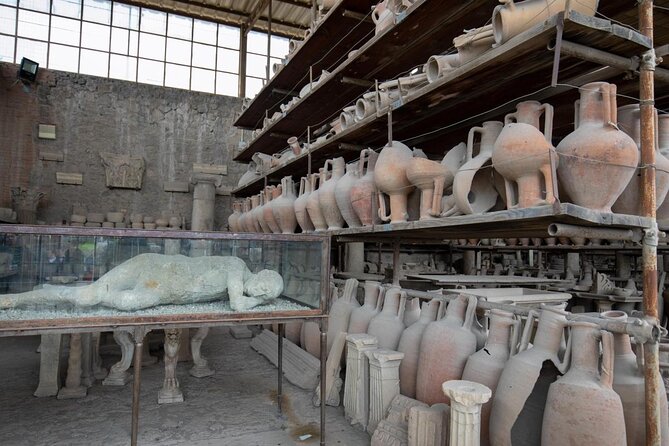
That matters because Pompeii was not just a collection of grand public buildings. It was a working town. You pass the places where people bathed, shopped, ate, worshipped, worked, watched plays, trained as gladiators, and conducted civic business.
I especially like the way this tour connects ordinary life with the disaster of AD 79. The eruption of Mount Vesuvius buried Pompeii and helped preserve it, but the real interest is in the city’s human scale. Wagon grooves in the road, counters in food shops, and marks in the stone make the past feel practical rather than distant.
The guide’s background is a major reason to book this format. Several named guides, including Lello and Italo, have been praised for archaeological experience, strong English, humor, and the ability to point out features you might otherwise miss. One guide, Lello, is described as having worked on the excavations for years. That sort of site familiarity can make a big difference in a place this large.
More Skip-the-Line Tickets in Pompeii
- Pompeii: Skip-the-Line Entrance Ticket with Audio Guide
★ 4.0 · 2,509 reviews - Pompeii: Skip-the-line-Ticket and Guided Tour
★ 4.6 · 1,152 reviews - Pompeii: Guided Tour with Skip-the-Line Entry
★ 4.9 · 812 reviews
Meeting the guide near the Pompeii entrance
You make your own way to the meeting point at Hotel Vittoria on Piazza Esedra in Pompei. The tour does not include hotel or port pickup, so plan your route before leaving Naples, Sorrento, or your accommodation.
The simplest public transport option is the Circumvesuviana train to Pompei Scavi. The station is close to the archaeological park, making this a practical choice for a half-day visit. Give yourself extra time. Missing the start is costly because late arrivals and no-shows are not refunded.
At the meeting point, look for the guide and the group before heading inside. The confirmation is a guided tour reservation, not a standalone ticket you can use whenever you wish. You need to enter with the guide at the scheduled time.
This arrangement works well if you are already touring the Bay of Naples independently. It keeps the price lower than a private car service and lets you combine Pompeii with other plans. It also means you are responsible for getting there on time and finding your way back afterward.
Walking the streets of an ancient city
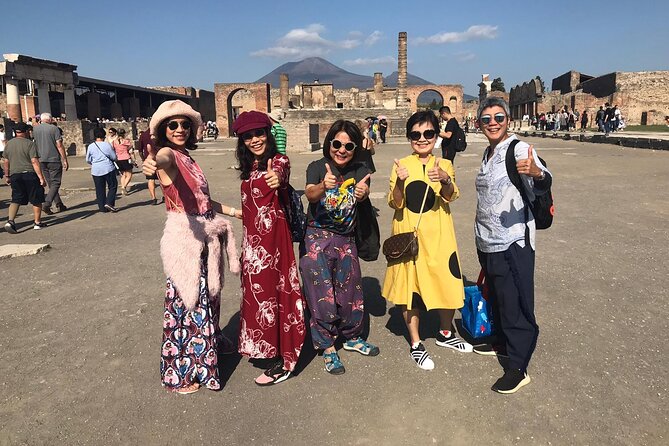
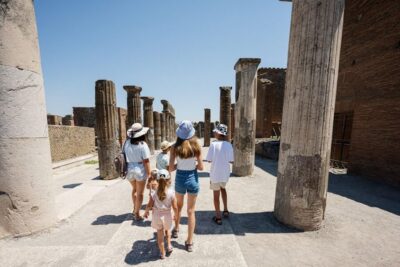
Once inside, the experience becomes a walking tour over original Roman streets. These are not smooth modern paths. You will cross uneven paving, step over raised stones, and walk on volcanic rock, so sturdy, comfortable shoes are essential.
The grooves worn into the road by wagon wheels are among the most memorable sights. They show that Pompeii was a lived-in town, not a ceremonial showpiece. Your guide can help you read the street itself and explain how people moved through the city.
Summer sun is another practical concern. Bring a hat, especially for the later morning and afternoon departures. Shade can be limited, and the pale stone reflects heat.
The route is described as suitable for most people, with service animals allowed and public transportation nearby. Still, the ground is uneven and the tour lasts about two hours. If walking on rough surfaces is difficult for you, that is worth considering before booking.
The forum, where Pompeii conducted public life
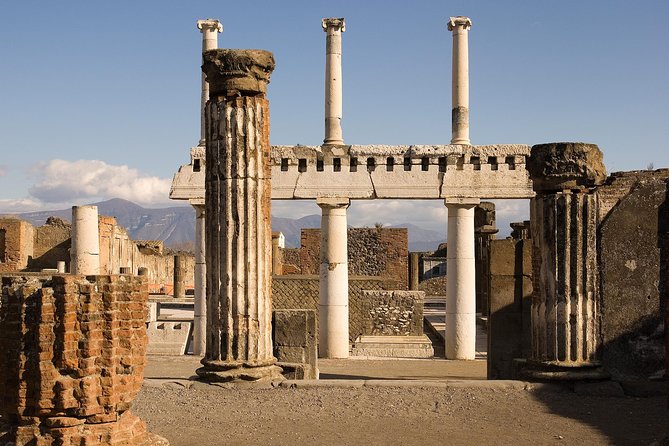
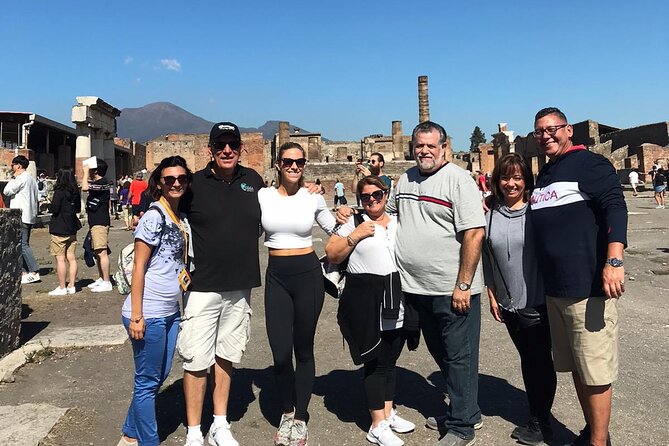
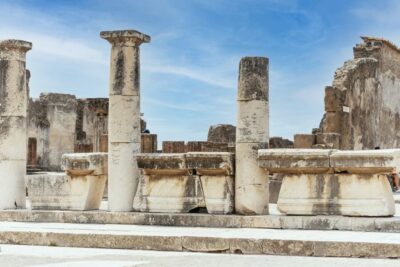
The forum was the center of civic, religious, and commercial life. Here, you see the remains of temples and government buildings, the spaces where priests performed duties and politicians handled public business.
I find the forum more rewarding after seeing some of the ordinary streets first. You understand that this was not an isolated monument. It was the city’s shared meeting place, tied to the shops, homes, bathhouses, and theaters around it.
A guide also helps separate religious buildings from civic ones. To an untrained eye, several ruins can look alike. With an expert explanation, the forum becomes a diagram of Roman public life, showing how government and religion worked side by side.
The drawback is that the forum can feel exposed and crowded, especially during busy periods. A good guide helps by choosing a sensible position and keeping the group moving, but you should not expect a quiet private visit.
A few other Pompeii mornings to weigh against this
- Pompeii: Entry Ticket and Guided Tour with an Archaeologist
★ 4.8 · 19,459 reviews - Pompeii: Entry Ticket with Optional Audio Guide
★ 4.2 · 12,360 reviews - Pompeii: Small Group Tour with an Archaeologist
★ 4.8 · 12,264 reviews - Pompeii Small Group Tour with an Archaeologist
★ 5.0 · 6,593 reviews
The theaters and Pompeii’s social side
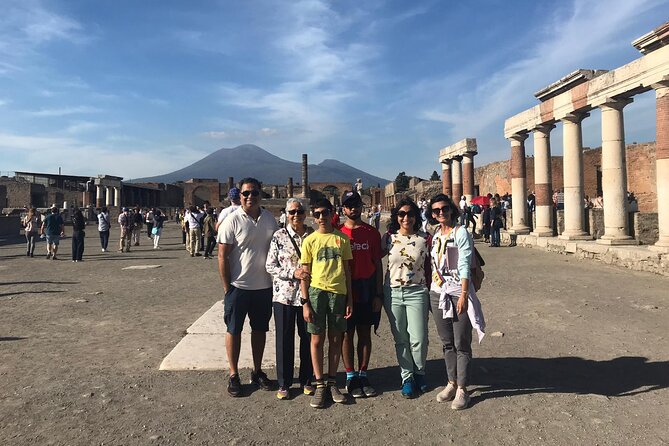
The small theaters are part of the route and offer a glimpse of Pompeii’s entertainment culture. Tragedies and comedies once played here, drawing residents away from their daily work.
The theaters are useful for understanding that Roman life was not only about politics and military power. People gathered for performances, gossip, and shared leisure, much as you might spend an evening at a local theater today.
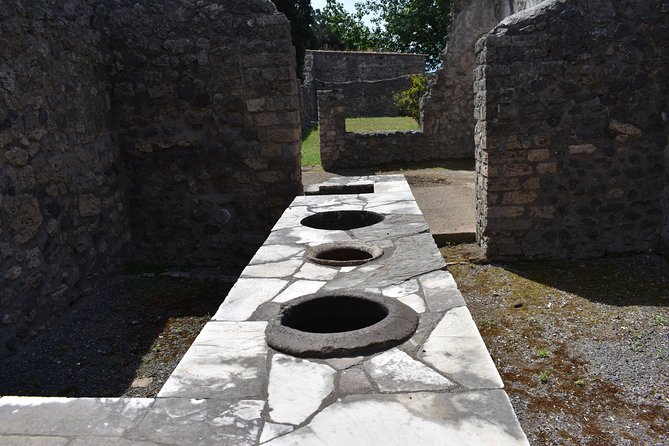
The tour also takes you through spaces connected with food, clothing, and trade. You might see remains of restaurants, bars, and shops, including counters and work areas that reveal how commerce operated.
These modest places are often more telling than a grand temple. They show what people bought, ate, and did during an ordinary day. I like that the route does not treat Pompeii as only a disaster site. It presents a functioning community first, which makes the eruption more meaningful.
Baths, the Gymnasium, and everyday Roman routines
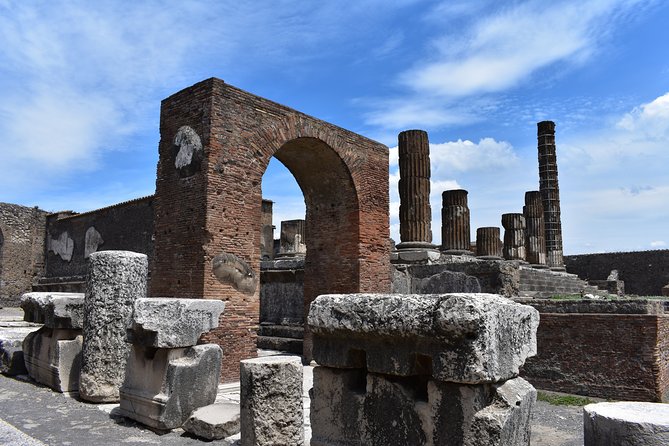
Pompeii’s thermal bathhouse shows how important public bathing was. Residents went to bathe, exercise, meet friends, and gossip. The baths were social centers, not simply places to wash.
Your guide can explain how the various rooms worked and why the bathhouse mattered to city life. The Gymnasium adds another piece to the picture, showing the role of exercise and physical training in Roman society.
The House of Menander is another named stop on the route. Along with the baths and smaller buildings, it helps you see how private homes, public spaces, and commercial activity sat close together.
Because the tour is only two hours, you will not study every room or house in detail. That is the trade-off for a brisk highlight visit. The guide’s job is to select the best stops and give you enough context to continue exploring after the tour.
Gladiators and the Lupanare
The route includes the barracks where gladiators trained and lived. This stop adds a sharp reminder that entertainment in Pompeii could involve dangerous public combat, not only theater.
You also visit the rebuilt Lupanare, commonly known as Pompeii’s brothel. It is one of the site’s most popular attractions, partly because its small rooms and surviving images offer a direct look at a less polished side of Roman life.
The Lupanare is not simply a sensational stop. It gives you a chance to discuss social customs, commerce, and the way archaeologists interpret evidence. A guide can keep the subject grounded in the site rather than reducing it to a quick curiosity.
Families should know that this part of the tour deals with adult subject matter. The experience has worked well for families with older children, including children from around age nine upward, but parents should decide if the content fits their group.
What the two-hour format really gives you
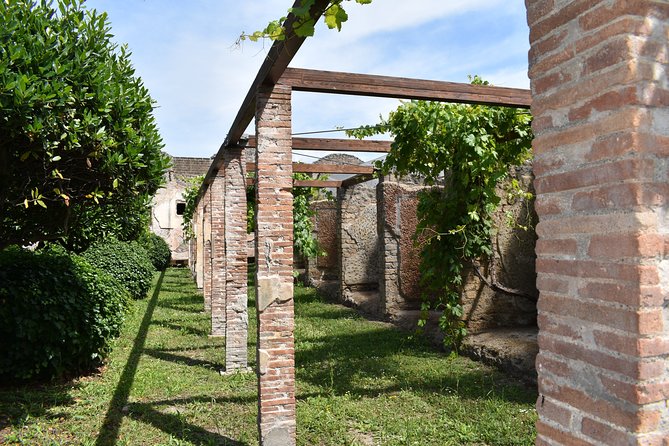
Two hours is enough to understand Pompeii’s basic structure and see many major highlights. It is not enough to cover the entire archaeological park, which is huge.
That makes the tour a good choice if you have limited time or want an introduction before exploring alone. Guides often point you toward additional areas to visit after the formal tour, giving you a useful plan rather than leaving you at the exit with no idea where to go next.
I would treat the tour as a guided orientation. Pay attention to the route, note the buildings you want to revisit, and stay afterward if your schedule allows. One guide may help you continue with practical suggestions once the group portion ends, but the included service itself lasts about two hours.
The pace is usually steady rather than rushed. Reports describe guides answering questions, including questions from younger members of the group, while keeping the group ahead of heavier crowds when possible. That balance is valuable at Pompeii, where stopping too long in one narrow street can slow everyone down.
Group size, sound, and guide quality
The maximum group size is 16, which is a useful middle ground. You get the cost advantage of a group tour without the feel of a large procession of 25 or more people.
Guide quality is central here. The strongest guide names associated with the experience include Lello, Italo, Leonardo, and Cela. You cannot assume which person will lead your departure, but the guide is an archaeologist and the experience is built around expert interpretation.
Several guides are described as warm, witty, energetic, and easy to understand. That combination matters. Pompeii demands facts, but a dry list of dates will not help you remember how the city worked.
Earsets are provided on some departures, making it easier to follow commentary when other groups are nearby. Ask about the equipment at the start if you have trouble hearing. In a place with open courtyards and narrow lanes, staying close to the guide still matters.
Is $71.35 a fair price?
At $71.35 per person, this is not the cheapest way to enter Pompeii. You are paying for admission plus a two-hour guided walk, not just access to the ruins.
For a first visit, I think the price can be justified. Without a guide, you may spend much of your time trying to identify buildings and understand their purpose. The archaeological expertise, route planning, and chance to ask questions add real value.
The price works best for visitors with limited time, families, and anyone who prefers history explained in plain language. It is less compelling for repeat visitors who already understand the site and want to wander slowly through less visited areas.
Group discounts may be available, which can improve the value for larger parties. Since the group is capped at 16, you are not paying for a private tour, but you also avoid the scale of a mass-market outing.
Timing, cancellation, and practical planning
The tour is offered in English and lasts approximately two hours. The 5 pm departure also lasts two hours, so check your onward transport and closing-time plans before choosing it.
You need to provide a mobile number with the country code at booking in case of an emergency. Food is not included, and there is no hotel or port transfer.
Free cancellation is available up to 24 hours before the local start time. Changes or cancellations inside that window are not refunded. The experience requires suitable weather and a minimum number of participants. If the operator cancels for either reason, you are offered another date or experience, or a full refund.
The tour is recommended by 99 percent of bookers and carries a 4.9 rating from 559 reviews. Those figures suggest very consistent satisfaction, but I would still focus on fit: this is a brisk, guided introduction on uneven ground, not a leisurely private archaeology lesson.
Who should book this Pompeii tour?
I would book it if you are visiting Pompeii for the first time, have only half a day, or want the site explained by someone with field experience. It is especially useful for families with older children, couples, and small groups who want a clear route and room for questions.
It also suits you if you are traveling from Naples or Sorrento by train. The nearby station and included admission keep the plan straightforward, though you must handle your own transport and arrive promptly.
I would skip it if you want to spend a full day examining every house at your own speed. In that case, use the tour as a starting point only if you can remain afterward, or choose independent admission and build your own route.
Should you book it?
Book this tour if you want Pompeii to make sense quickly. The strongest reasons are the archaeologist guide, the small group, the included entrance, and the mix of major monuments with ordinary shops, baths, streets, and homes.
The main caution is the short format. Pompeii is too large for two hours to cover everything, and the original paving can be hard on your feet. Arrive early, wear proper shoes, carry a hat in summer, and plan extra time if you want to explore beyond the guided route.
For a first visit, $71.35 is a sensible investment in understanding what you are seeing. You will leave with a map of the city in your head, plus enough context to make the remaining ruins worth your own time.
FAQ
How long does the Pompeii tour last?
The tour lasts approximately two hours, including the 5 pm departure.
What is included in the price?
A local guide and admission tickets are included.
Is this a standalone ticket to Pompeii?
No. This is a guided tour confirmation and can be used only with the guide.
Where does the tour start?
The meeting point is Hotel Vittoria on Piazza Esedra in Pompei, Italy.
Where does the tour end?
The activity ends back at the meeting point.
How do I reach Pompeii from Naples or Sorrento?
You can take the Circumvesuviana train to the Pompei Scavi station, which is near the archaeological entrance.
What should I wear?
Wear comfortable shoes because you will walk on original ancient streets, uneven paving, and lava rock. A hat is useful during summer.
How large is the group?
The tour has a maximum of 16 participants.
Can I cancel for a refund?
You can cancel at least 24 hours before the local start time for a full refund. Cancellations or changes made less than 24 hours before the start are not refunded.
Fresh on the Pompeii list
- Explore Pompeii with an Archaeologist★ 5.0 · 511 reviews
- Pompeii Private Tour with an Archaeologist and Skip The Line – 3 hours★ 5.0 · 564 reviews
- Ercolano: Herculaneum Entry Ticket with Optional Audio Guide★ 4.1 · 581 reviews
- Pompeii private tour with an Official Guide★ 5.0 · 631 reviews
- Pompeii: Exclusive Tour with Archaeologist and Entry Tickets★ 4.9 · 634 reviews
- Pompeii Ticket + Tour with Optional Tasting Experience at Pompeii★ 5.0 · 663 reviews
- From Naples: All-Inclusive Mount Vesuvius Half-Day Tour★ 4.2 · 674 reviews
- From Pompeii: Bus Transfer to Vesuvius with Park Entry Fee★ 4.2 · 700 reviews
Pompeii & Vesuvius Tours, compared.

Entry Ticket and Guided Tour with an Archaeologist
Read our review →


Pompeii Small Group Tour with an Archaeologist
Read our review →
Pompeii, Amalfi Coast and Positano Day Trip from Rome
Read our review →Browse the lists this tour appears in