
Reviewed · WALKING TOURS
Discover the Charm of Palermo: A 3-Hour UNESCO Sites Walking Tour
Palermo’s story is written in stone, mosaics, markets, and street corners. In three hours, this walking tour links the grand Teatro Massimo with Norman-Arabic churches, noisy food markets, Baroque squares, the Cathedral, and the Palace of the Normans. It is a fast way to understand why Palermo feels like several civilizations sharing one city.
I like the strong first-day orientation and the way the guide connects major monuments with ordinary city life. I also like the practical finish: you enter the Cathedral, then enjoy a Sicilian cannolo or granita. The main drawback is that the Palatine Chapel and other major interiors are viewed from outside, and the pace can feel brisk in heat or rain.
- Teatro Massimo begins the walk with one of Europe’s largest opera houses and its famous acoustics.
- Open-air markets add local texture, especially along Via Bandiera and around Piazza Caracciolo.
- La Martorana and Piazza Pretoria show Palermo’s Greek-Byzantine, Arab-Norman, and Baroque layers.
- Cathedral entry is included, while admission to the Palace of the Normans and Palatine Chapel is not.
- A cannolo or granita ends the tour, giving you a useful taste of Sicily rather than another museum stop.
- Groups are limited to 20 people, and guides may use an amplification system so you can hear in busy streets.
Why Three Hours Works Well in Palermo
Palermo can be hard to read at first. Streets change names, architectural styles overlap, and a grand church may sit beside a market stall or a half-restored building. This tour gives you a framework before you begin exploring on your own.
The route covers a large stretch of the historic center on foot. You will not linger inside every monument, but you will see enough to decide where you want to return. That is the right purpose for a short city walk: not to replace several days in Palermo, but to help you use them better.
The tour is especially useful on your first morning. Guides such as Valeria, Renata, Fabio, Laura, Simone, Debbie, Giada, Lara, and Roberta have been praised for clear English, local insight, and practical suggestions about food and places to visit later. The exact guide varies, so book this for the format and route rather than one guaranteed individual.
The price is about $31.88 per person. For three hours with a licensed English-speaking guide, Cathedral admission, and a Sicilian sweet or granita, that is a fair deal. You are mainly paying for orientation and interpretation. If you want long interior visits at the Palatine Chapel or Palace of the Normans, you will need a separate plan and likely extra admission.
Starting at Teatro Massimo on Piazza Verdi
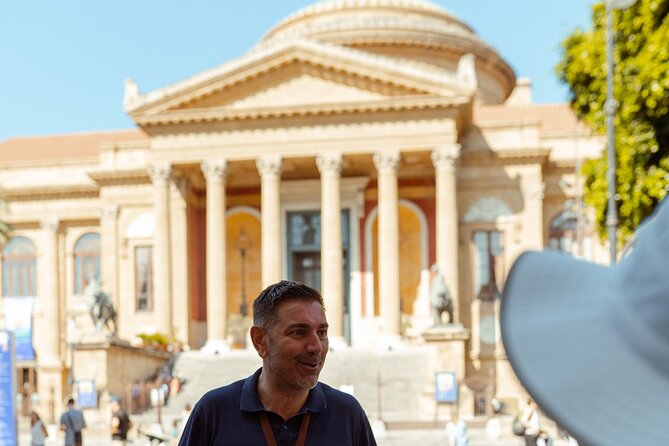
The meeting point is Via Volturno 44, near Teatro Massimo. The opera house is a fitting place to start because it immediately shows Palermo’s grand public face.
Teatro Massimo Vittorio Emanuele is Italy’s largest opera house and one of Europe’s largest. When it opened, its 7,730 square meters made it the third-largest opera house in Europe, after the Palais Garnier in Paris and the Vienna Court Opera. It is also famous for its acoustics.
The stop is brief, about five minutes, and admission is free. You should expect an exterior introduction rather than an opera-house visit. That keeps the tour moving, but it also means you should return later if the interior matters to you.
From here, the route shifts quickly from monumental Palermo to less polished corners of the center. That contrast is one of the pleasures of the walk.
More Walking Tours in Palermo
- Palermo: NO Mafia Walking Tour
★ 4.8 · 2,431 reviews - Palermo Original Street Food Walking Tour by Streaty
★ 5.0 · 2,105 reviews - Palermo: Street Food and History Walking Tour
★ 4.9 · 1,294 reviews
Via Maqueda, the Galleria delle Vittorie, and Market Life
The Galleria delle Vittorie was built as a five-story commercial mall with an entrance on Via Maqueda. It has deteriorated over time, although restoration has been attempted. This is not a polished attraction, and that is precisely why it helps explain Palermo’s layered character.
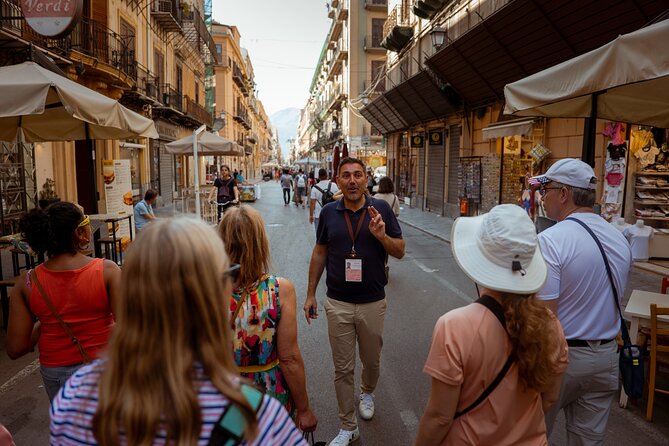
You then cross Via Bandiera, where a typical open-air market brings food, noise, and movement into the route. The guide’s role here is useful. Instead of passing through a market as a sightseeing backdrop, you get clues about how the street fits into Palermo’s daily life.
The market section is not a shopping break. One account specifically found the pace too quick for browsing, even though the food stalls were fascinating and inexpensive. If you want to buy ingredients, street food, or souvenirs, note the places you like and return after the tour.
San Domenico and Palermo’s Public Memory
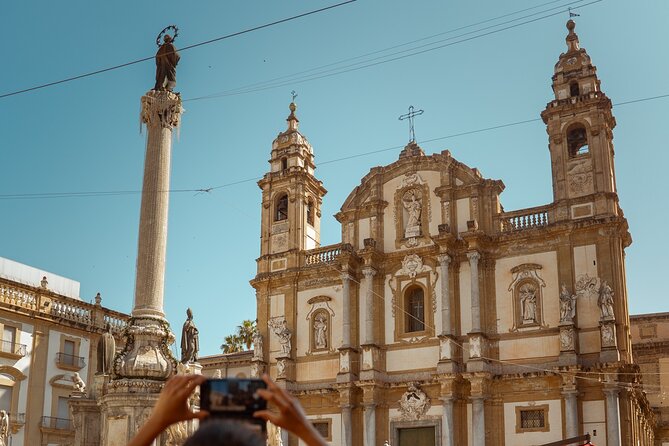
Chiesa di San Domenico is one of Palermo’s most important churches. In size and cultural importance, it comes just after the Cathedral, and its square gives the church room to make an impression.
The visit lasts about ten minutes, with free admission. San Domenico is often called the Pantheon of Sicily because it holds the remains of many notable Sicilians. It is also linked with the city’s fight against the Mafia, adding a modern civic meaning to an older religious building.
This is a good place to pay attention to the guide’s storytelling. Palermo’s past is not presented as a clean sequence of kings and buildings. It includes power, religion, public memory, organized crime, and the daily struggle to maintain a historic city.
The brief stop cannot cover every tomb or chapel. Think of it as a clear introduction, not a full church tour.
Piazza Caracciolo and the Bucceria Market
The market around Piazza Caracciolo winds through lanes and adjoining streets. It was once called la Bucceria, from the French word boucherie, because it began as a place for selling meat.
The area offers a direct look at Palermo’s food culture. The route brings you close to the energy of the market without turning the tour into a dedicated food walk. You may see street food and busy stalls, but the schedule keeps the group moving.
I would mark this section mentally for a return visit. The tour is most valuable here as a preview. You can later come back when you have time to eat, shop, or simply watch the city operate without trying to keep up with a group.
A few other Palermo mornings to weigh against this
- Discover Palermo in 3 hours. Art, history, markets and street food
★ 5.0 · 352 reviews - Eat Like a Local: Venice 3-Hour Small-Group Food Tasting Tour
★ 5.0 · 3,137 reviews - Jewish Ghetto and Synagogues with Jewish Roman Guide 3 Hours
★ 5.0 · 907 reviews - Naples: The Holy Mile 3-Hour Guided Tour
★ 4.9 · 711 reviews
Garraffo Fountain and the Old Financial District
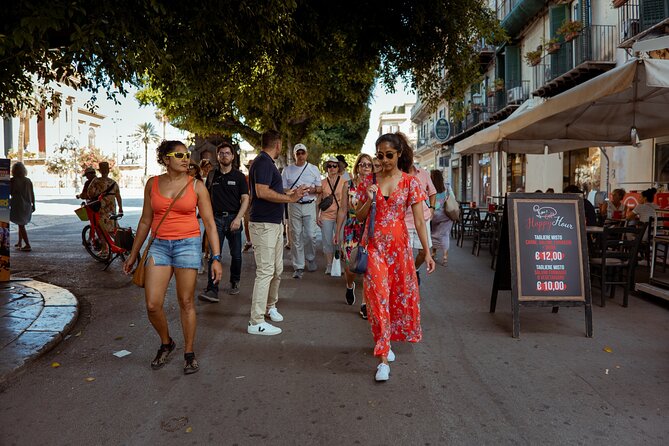
The Garraffo Fountain is a Baroque fountain in Piazza Marina, near the ancient Cassaro, now called Via Vittorio Emanuele. It is another reminder that Palermo’s most interesting sights often appear in public spaces rather than behind ticket barriers.
The route also passes the former Palermo Stock Exchange. Palermo’s exchange began trading in 1845 and was once the second most important in the Kingdom of the Two Sicilies after Naples. It remained in the city’s Palazzo delle Finanze for about a century.
That detail gives the walk welcome variety. You are not only looking at churches and royal buildings. You are also seeing the commercial city, its old institutions, and the role Palermo played in Sicily’s economy.
The descent of the Judges leads from Piazza Sant’Anna toward Piazza Bellini. Its name recalls the judges of the Praetorian Court, who once lived in the nearby monastery of Santa Caterina. The street is a small detail, but it shows how civic history survives in Palermo’s street names.
La Martorana and Piazza Bellini
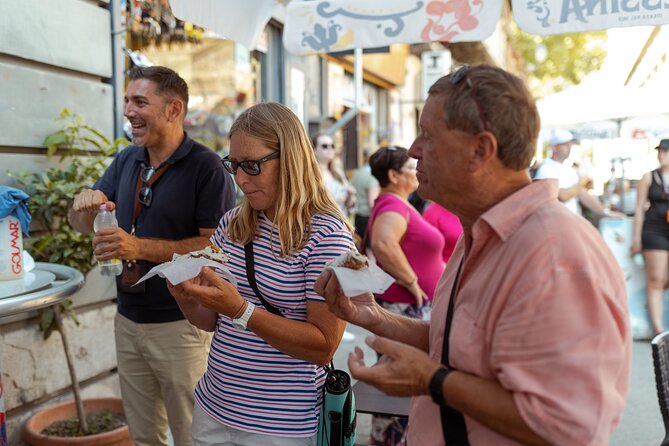
Santa Maria dell’Ammiraglio, better known as La Martorana, sits above Piazza Bellini. The church was built between 1143 and 1185 by the Greek admiral George of Antioch, who dedicated it to the Virgin Mary.
Its name recalls Goffredo and Eloisa de Marturano, founders of a nearby Benedictine convent. The church still belongs to the Italo-Albanian Catholic tradition, and ceremonies may be held in ancient Greek or Albanian.
This is one of the most important cultural points on the walk. Palermo was shaped by Greek, Arab, Norman, Byzantine, Latin, and later European influences. La Martorana makes that mixture visible in one building.
The itinerary gives you an exterior view rather than a full interior visit. That is a real limitation because the church is famous for its mosaics. If sacred art is a priority, plan a separate visit and check opening hours.
Piazza Pretoria and the Fountain of Shame
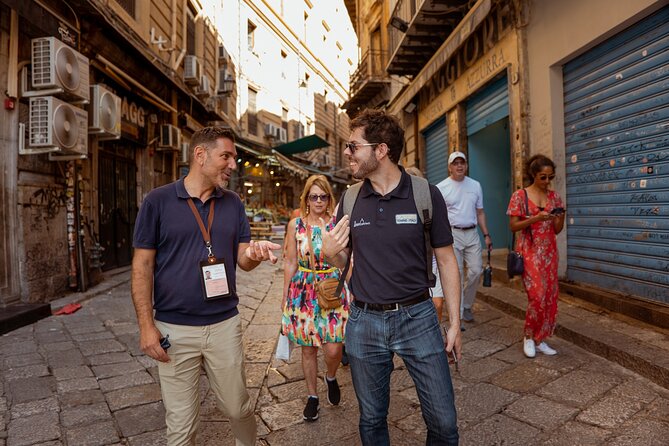
Piazza Pretoria is one of Palermo’s most dramatic public squares. Its large fountain was made for a garden belonging to Don Luigi de Toledo in Florence before being moved to Palermo. The Florentine sculptor Francesco Camilliani created it, with work completed in the sixteenth century.
The square’s later nickname, the Fountain of Shame, is tied to the statues’ nudity and to the public reaction they provoked. The surrounding setting gives the fountain an especially strong effect, with the city’s Baroque and civic buildings gathered close around it.
You have about 20 minutes here. That is enough time to look carefully, listen to the explanation, and take photographs without being rushed from one corner to the next.
The square sits near the Kalsa district, the Cassaro, and Via Maqueda. Its location also makes clear how compact the old center is. Several major sights are close together, but the route between them can be crowded and uneven.
Quattro Canti, Palermo’s Baroque Crossroads
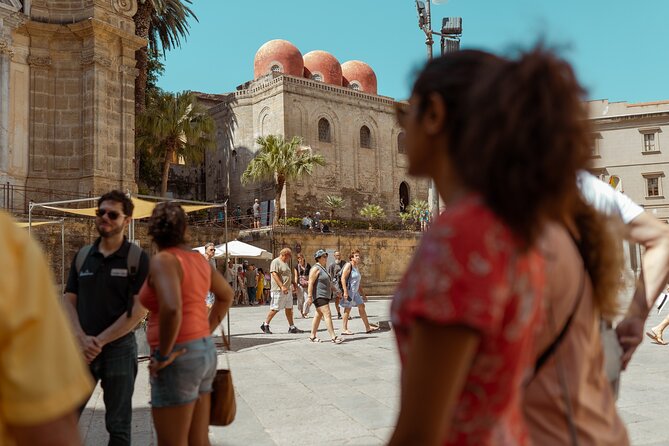
Quattro Canti is the intersection where Palermo’s four old quarters meet. Its formal name is Piazza Vigliena, though most people use Quattro Canti, meaning the Four Corners.
The four curved buildings were built between 1608 and 1620. Their statues and decorative elements were completed in 1663. Each corner presents a carefully arranged Baroque scene, with levels of sculpture and ornament rising above the traffic.
The tour allows about 20 minutes here. That is worthwhile because Quattro Canti can look like a traffic junction at first glance. From the center, you can study the four facades and see how the city’s historic avenues radiate outward.
This is one of the best orientation points in Palermo. I like arriving here with a guide because the square becomes more than a photo stop. You understand its role as the meeting point of the old districts and as a practical reference for later walks.
Palermo Cathedral and Its Many Building Styles
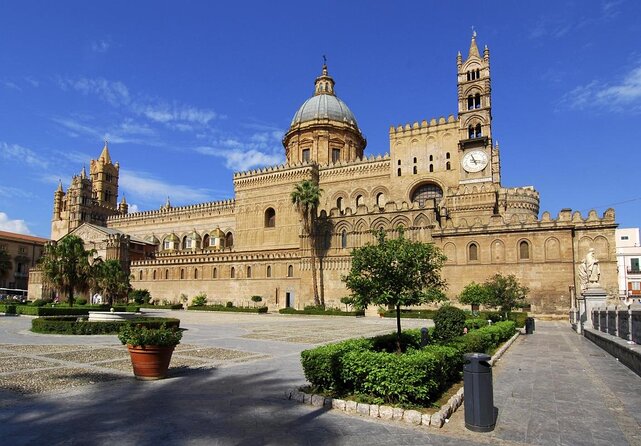
The Cathedral receives the longest interior-focused stop, about 30 minutes, and admission is included. Built by the Normans in 1184 on the site of a Muslim mosque, which itself had replaced an earlier Christian basilica, it carries several eras in one structure.
You will see Norman, Gothic, Arab, medieval, and Neoclassical elements. The building changed over centuries, so it does not present one pure architectural style. That mixture is exactly what makes it useful for understanding Palermo.
A passage from the Koran is still engraved on one of the columns, another small but striking sign of the city’s religious and political changes. The Cathedral was also built in competition with Monreale, with the aim of surpassing that church in beauty. The result is architectural ambition on a large scale.
The guide explains the important areas, but 30 minutes is not enough for every chapel, tomb, roof area, and treasury. If you want the full Cathedral experience, return on your own. The included entry is still valuable because it gives you a proper look inside rather than limiting the tour to photographs from the square.
Villa Bonanno and the Norman Palace Area
Villa Bonanno is a public garden built in 1905 by mayor Bonanno. It sits in Victory Square behind the Palace of the Normans and includes palm trees, statues, and busts of notable Palermo figures.
Roman patrician houses with mosaics were found here. The mosaics of the seasons and Orpheus are now held in the National Archaeological Museum, so you should not expect to see those original works in the garden.
The stop lasts about ten minutes and admission is not included. It works mainly as a transition into Palermo’s royal quarter. The nearby fountain and monument to Philip V add another layer to the area’s long building history.
Palazzo dei Normanni and the Palatine Chapel Question
The Palace of the Normans is the final major sight. It is also where you need to read the tour description carefully. The route includes an explanation of the palace and Palatine Chapel area, but admission to the palace is not included.
The Palatine Chapel is the great prize inside. Its mosaics are a major expression of Arab-Norman art, and the chapel has UNESCO World Heritage status as part of Palermo’s Arab-Norman sites. On this walking tour, you should expect to learn about the chapel from outside rather than enter it.
That distinction disappointed some people who expected to see the mosaics. I understand why. The tour title points toward UNESCO sights, and the chapel is the most famous interior on the route. If you want to go inside, arrange a separate ticket and visit, or confirm current entry arrangements before booking.
The tour normally ends back at the starting point, although the listed route finishes in the Norman Palace area. The stated duration is about three hours. One scheduled tour ended roughly ten minutes early because a last admission time at the Royal Palace changed at short notice. That appears to have been an unusual timing problem, but it is worth keeping in mind if you have a tight onward connection.
Guides, Pace, Weather, and Group Size
The guide makes a large difference on this experience. Strong guides have included Valeria, Renata, Fabio, Laura, Simone, Debbie, Giada, Lara, and Peter. The most useful qualities are clear English, a local view of Palermo, and the ability to connect political history with food, neighborhoods, and everyday life.
Several guides have been praised for answering questions and recommending restaurants and pastry shops. One guide used an amplification system, which made it easier to follow explanations near traffic and crowded streets. That is a small feature, but it matters in an open-air tour.
The group can include up to 20 people. That is not a private walk, yet it is small enough to stay together if everyone keeps moving. The pace has been described as quick, with regular rest stops. Slow walkers should consider that carefully, especially in hot weather.
The tour runs in all weather. You should bring comfortable shoes and dress for the forecast, since much of the experience takes place outdoors. On a rainy day, the route can still work, but wet pavement and crowded streets may make the walk more tiring. In heat, shade breaks become important, and guides may adjust the route when possible.
Pets are not permitted, although service animals are allowed. Most people can participate, but you should notify the operator in advance about mobility needs or other special requirements.
Who Gets the Most Value From This Walk
I would choose this tour if you have just arrived in Palermo, have limited time, or want a human guide to explain the old center before exploring alone. It is also a good fit if architecture interests you but you want markets and street life included.
The walk suits curious first-time visitors who enjoy moving between many sights. It is less suitable if you want extended shopping time, a relaxed pace, or long visits inside every church.
Families and mixed-age groups may appreciate the variety, though young children could tire during the three-hour route. People with limited mobility should ask about accommodations before booking rather than assuming every street and stop will be easy.
The 95 percent recommendation rate and 4.8 rating from 264 ratings indicate consistently strong satisfaction, but the less positive experience is useful too. One participant found the guide repetitive, disorganized, and too quick, while another felt the walk ended early. Most of the strongest praise centers on guide quality, local stories, clear English, orientation, and the final cannolo.
Booking Timing, Meeting Point, and Cancellation
The walk is often booked about 36 days ahead, so it is sensible to reserve early if your schedule is fixed. You receive confirmation at booking, and the tour is offered in English with a mobile ticket.
There is no hotel pickup or drop-off. You need to reach Via Volturno 44 yourself, and the activity ends back at the meeting point according to the stated meeting details. Allow extra time to find the start, since arriving late could be difficult once the group has moved into the center.
Free cancellation is available up to 24 hours before the start time for a full refund. Cancellations or changes made inside that window are not refunded or accepted.
Should You Book the Palermo UNESCO Walking Tour?
Book it if you want a lively first look at Palermo’s center, especially on your first day. The route covers an impressive number of important places, and the best guides turn a string of facades into a story about conquest, religion, trade, food, and modern Sicily.
Do not book it expecting a full Palatine Chapel visit. The Cathedral is included, but the Palace of the Normans and its chapel are not. If the mosaics are your main reason for booking, make a separate visit or confirm exactly what your departure time includes.
At $31.88, I consider the tour good value for orientation, local advice, Cathedral entry, and the cannolo or granita. Wear good shoes, keep your shopping list for later, and take notes when the guide points out places worth returning to. That is where this short walk pays off.
FAQ
How long is the Palermo UNESCO Sites Walking Tour?
The tour lasts approximately three hours.
Where does the tour start?
The meeting point is Via Volturno 44, 90138 Palermo, Italy.
Where does the tour end?
The activity is scheduled to end back at the meeting point.
Is the tour offered in English?
Yes. The tour includes a licensed English-speaking guide.
Is admission to Palermo Cathedral included?
Yes. Entrance to the Cathedral is included.
Can I enter the Palatine Chapel on this tour?
Admission to the Palace of the Normans and Palatine Chapel is not included. The tour explains the site and views the main monuments from outside.
Is Teatro Massimo admission included?
The Teatro Massimo stop is listed with free admission, but the tour provides a short exterior stop rather than a specified interior visit.
Are food or drinks included?
You receive a typical Sicilian cannolo or granita. The tour also includes the listed food treat, but other food and drinks are not specified as included.
How many people can join the tour?
The maximum group size is 20 travelers.
Can I cancel for a full refund?
Yes, if you cancel at least 24 hours before the experience start time. Cancellations made less than 24 hours in advance are not refunded.
Fresh on the Palermo list
- Palermo: Full-Day Snorkeling Boat Tour with Lunch and Wine★ 5.0 · 196 reviews
- Wanna be Sicilian: Palermo Cooking Class and Market Tour★ 5.0 · 197 reviews
- From Palermo: Erice and Marsala Day Trip with Lunch★ 4.8 · 199 reviews
- Sicily: Etna Volcano & Taormina Tour★ 4.4 · 199 reviews
- Palermo: Cappella Palatina and Palazzo dei Normanni Tour★ 4.8 · 214 reviews
- Palermo Half Day Boat Tour with Palermo Experiences★ 5.0 · 224 reviews
- Palermo : Private Custom Walking Tour with a Local Guide★ 4.5 · 237 reviews
- Palermo: Markets and Monuments City Center Walking Tour★ 4.9 · 238 reviews
Walking Tours, compared.
Guided Walking Tour & Last Supper Visit with Ticket
Read our review →
Rialto Bridge & Offbeat Unusual Venice Walking Tour
Read our review →
Private 3 hrs Venice Tour: St Mark’s, Walking tour & Boat tour
Read our review →
Skip the line: Uffizi and Accademia Small Group Walking Tour
Read our review →Browse the lists this tour appears in