
Reviewed · POMPEII & VESUVIUS TOURS
Pompeii: Entry Ticket and Guided Tour with an Archaeologist
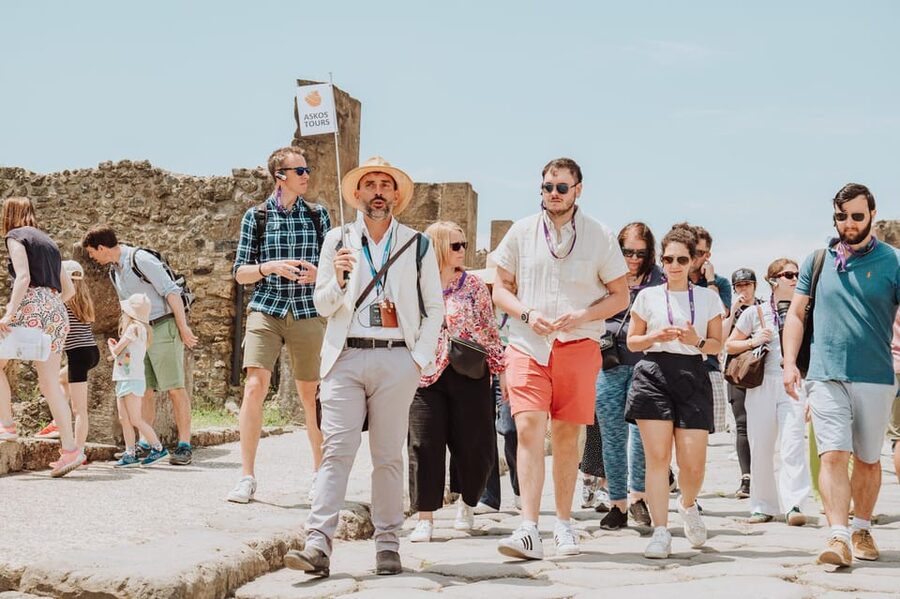
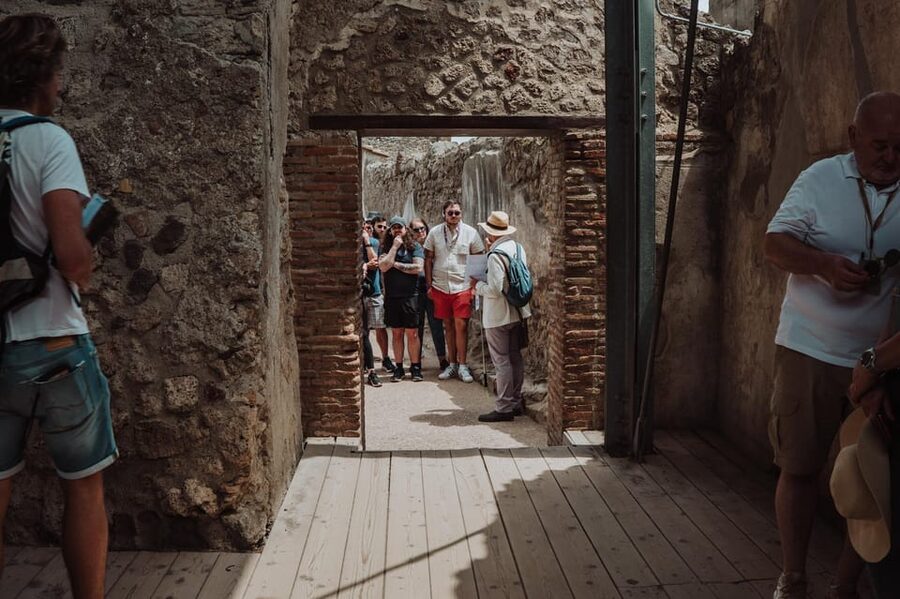
Pompeii is easier to understand when someone points out what the stones once meant. In two hours, this archaeologist-led walk takes you from city gates and temples to homes, shops, baths, theaters, and the haunting plaster casts of people caught by the eruption of Mount Vesuvius in 79 AD.
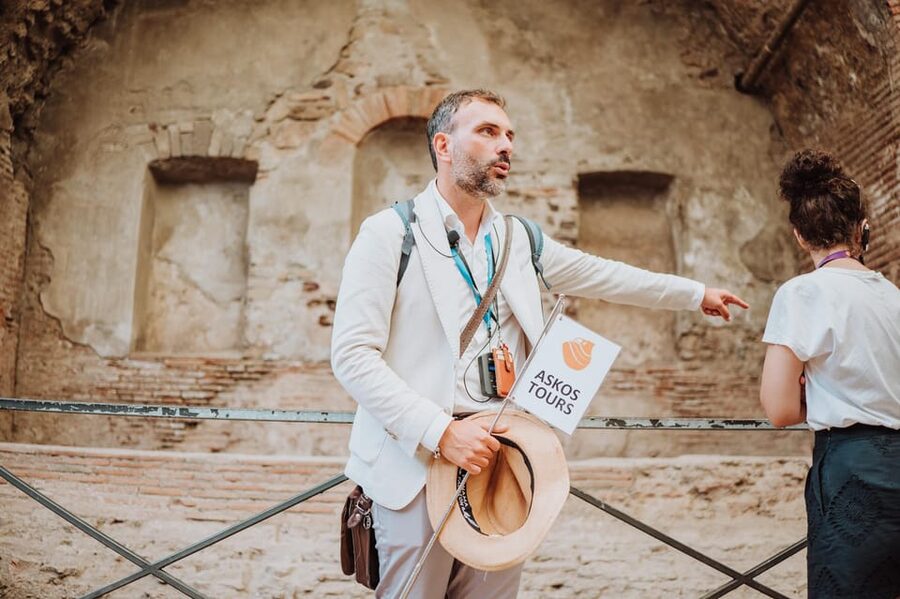
I like the skip-the-ticket-line entry, which saves precious time at a major attraction. I also like the small group, capped at 20, and the way guides such as Teresa, Anna, Alfredo, and Sergio bring ordinary Roman life into the story, not just emperors and volcanoes.
The main drawback is the ground. Pompeii has uneven ancient paving, steps, and long stretches of walking, so this is not suitable for wheelchair users, people with mobility impairments, or anyone using a mobility scooter. Bring water, too. The site can leave you thirsty and hungry before you realize how far you have walked.
Key points to know before you book
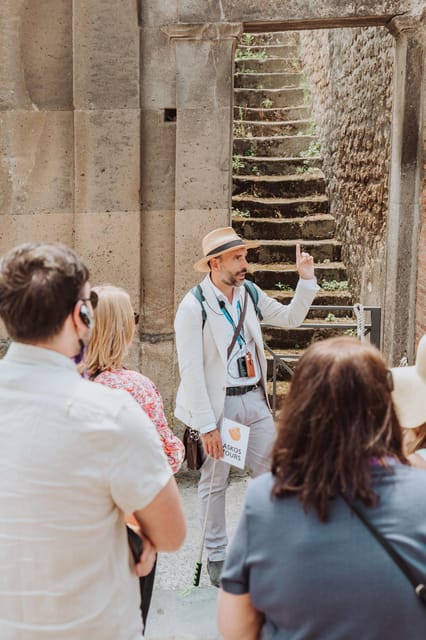
- Two hours with an archaeologist: You get context for the ruins instead of simply walking past unidentified walls.
- The route covers major Pompeii sights: Expect the Forum, Temple of Apollo, House of the Faun, Lupanar, House of Menander, Macellum, and Forum Baths.
- Small group of up to 20: This is easier to follow than a large crowd, though busy areas can still make headsets useful.
- Skip-the-ticket-line entry: Your Pompei Express admission is included, but you still need to arrive at the correct meeting point.
- Several language choices: Tours are offered in English, Spanish, French, Italian, Portuguese, and German.
- Time to continue alone: Guides offer suggestions for seeing more of Pompeii after the formal two-hour route.
Why Pompeii works better with a guide
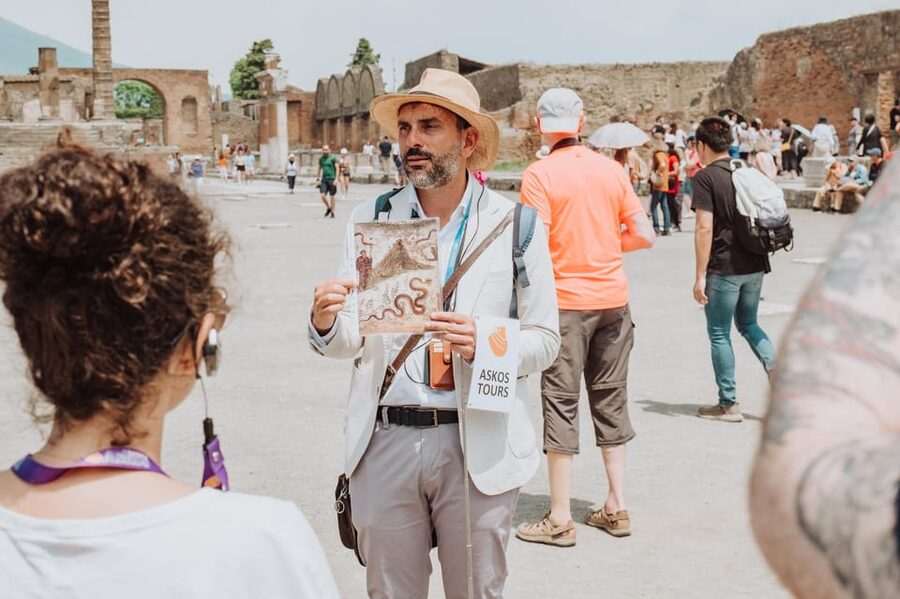
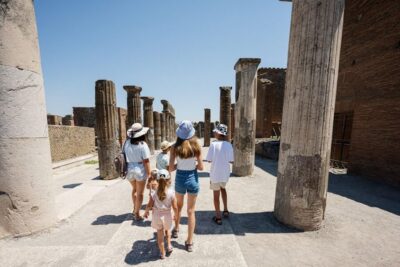
Pompeii is not a single monument that you can grasp in half an hour. It is a full ancient city, with streets, public buildings, private houses, businesses, religious spaces, and entertainment venues spread across a large area.
That scale creates a problem. On your own, you may admire a painted wall or a line of stepping stones without knowing why it mattered. A good guide gives each place a purpose and helps you picture the people who used it.
The strongest part of this tour is its focus on daily life. Guides explain homes, food shops, baths, commerce, social classes, religion, and public life alongside the famous eruption. That approach gives the ruins human scale.
The archaeologist guides also help you read details that are easy to miss. A doorway, floor pattern, counter, courtyard, or worn road can tell you something about how Pompeiians lived. The best guides, including Teresa, Anna Sorrento, Raffaella, and Alfredo, are praised for making those details clear without turning the walk into a dry lecture.
The group size matters here. With no more than 20 people, you have a better chance of hearing the guide and asking a question. For groups of 10 or more, headsets are supplied. They help in crowded areas, although one person found the earpiece awkward and had to hold it close to hear clearly.
A few other Pompeii mornings to weigh against this
- Pompeii: Entry Ticket with Optional Audio Guide
★ 4.2 · 12,360 reviews - Pompeii: Small Group Tour with an Archaeologist
★ 4.8 · 12,264 reviews - Pompeii Small Group Tour with an Archaeologist
★ 5.0 · 6,593 reviews
Starting at Porta Marina and the Temple of Apollo
The tour begins at one of three possible starting arrangements near Via Villa dei Misteri, 2, so check your booking carefully for the exact meeting point. The route then passes Porta Marina, one of Pompeii’s principal entrances.
The gate is a useful opening because it frames Pompeii as a functioning city rather than a collection of ruins. Your guide can explain how people entered, moved through, and connected with the city beyond the walls.
The Temple of Apollo follows as a brief stop. This religious building gives you an early sense of Pompeii’s sacred life and the importance of public worship before the tour moves toward the civic center.
These first sections are listed as pass-by portions rather than full guided visits, with about 10 minutes at each. That keeps the route moving, but it also means you should not expect a long examination of every monument along the way.
The Forum and Pompeii’s civic center
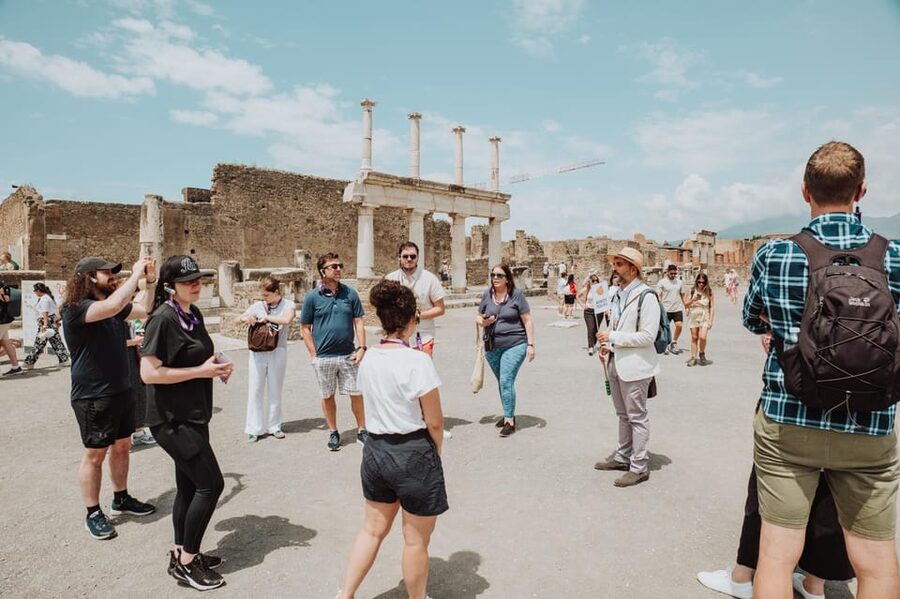
The Foro Civile di Pompei, or Forum, receives about 20 minutes on the route. This is one of the most important stops because it was the center of public life.
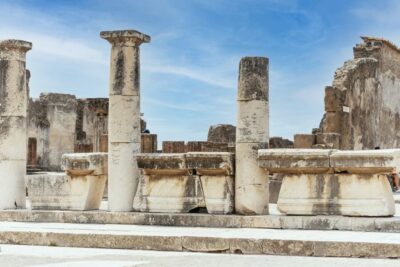
The Forum can look like a broad field of columns and foundations until someone explains how it worked. Here, your guide helps connect temples, civic buildings, commerce, ceremony, and politics. You begin to see Pompeii as a busy Roman town with rules, status, and public routines.
I like that the route puts the Forum early enough to give you a framework for the rest of the walk. Afterward, the houses, shops, baths, and food counters make more sense because you have seen the city’s public heart.
The open setting can be hot in strong sun and exposed in bad weather. Several tours still went ahead in rain, and guides worked to keep the route useful, but comfortable clothing and weather protection will make a real difference.
House of the Faun and the world of wealthy Pompeii
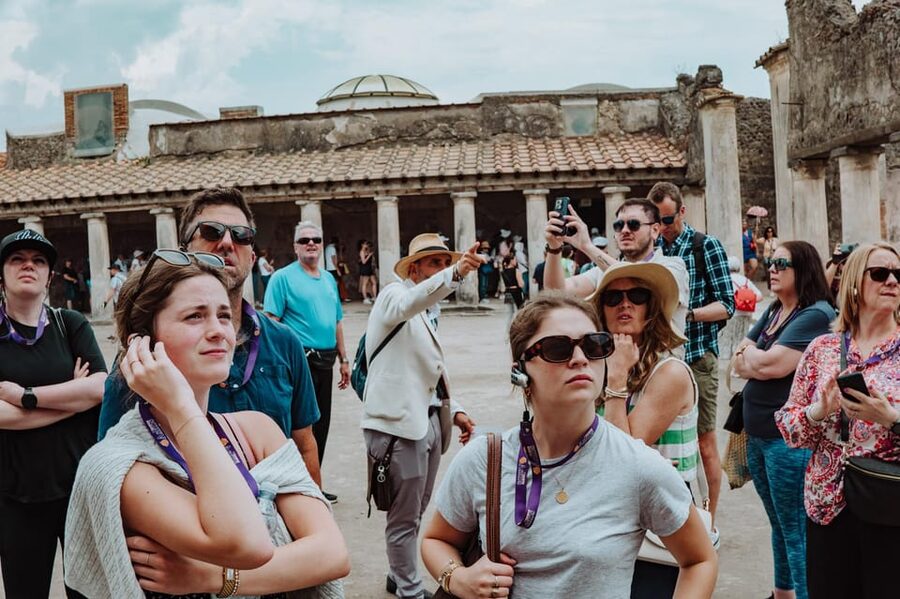
The House of the Faun gets about 20 minutes of guided attention. It is one of Pompeii’s most celebrated residences and a useful contrast to the streets and public buildings.
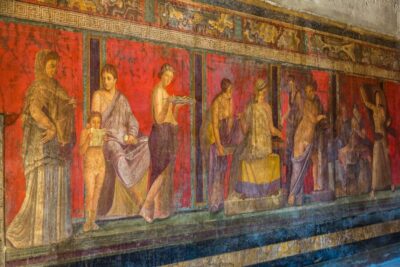
The house lets you think about wealth, space, decoration, and status. Instead of seeing a Roman home as a simple shelter, you can consider how courtyards, rooms, artworks, and mosaics communicated the owner’s position.
This is exactly the kind of stop where an archaeologist adds value. You might notice the grand scale, but the guide explains how to read the layout and why the house is important. Guides also put the home into the wider setting of Pompeii’s social structure.
Do not expect every room to be open or every object to be viewed at leisure. The benefit of the stop is the explanation and the carefully chosen highlights, not an exhaustive inspection of the entire house.
Same city, an entirely different afternoon:
- Pompeii: Skip-the-Line Entrance Ticket with Audio Guide
★ 4.0 · 2,509 reviews - Naples: Pompeii and Mt. Vesuvius with Lunch and Wine Tasting
★ 4.5 · 2,454 reviews - Pompeii: Archaeological Park Tour with Ticket on request
★ 4.5 · 2,283 reviews - Discover the Ancient Ruins of Pompeii: Day Trip from Rome
★ 3.5 · 2,247 reviews
Lupanar, food counters, and ordinary routines
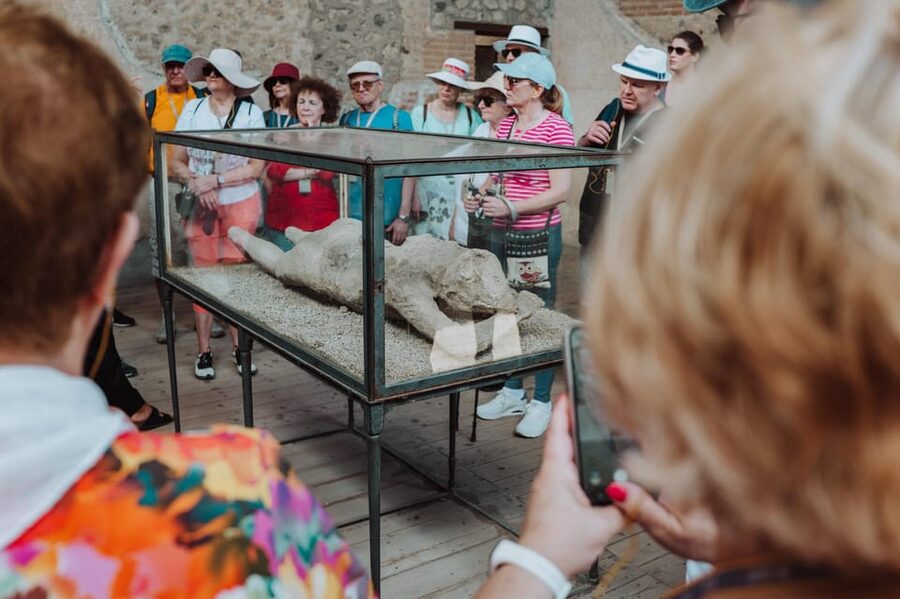
The Lupanar, Pompeii’s brothel, is another 20-minute guided stop. It is famous, but the guide’s context is more useful than the novelty of the subject.
The building offers a window into the less polished side of Roman urban life. Your guide can help you understand how commercial activity fitted into the city and why this small structure has become one of Pompeii’s best-known sights.
The route also includes the Termopolium, an ancient food counter, during the broader walk. This is one of the most engaging details for anyone interested in ordinary routines. It helps you picture people buying prepared food rather than thinking only about villas, temples, and public monuments.
Some parts of Pompeii deal with sex, death, and disaster in a direct way. Families should decide in advance how comfortable they are with the Lupanar and the plaster casts. The tour is educational, but it does not turn these places into light entertainment.
House of Menander and the private city
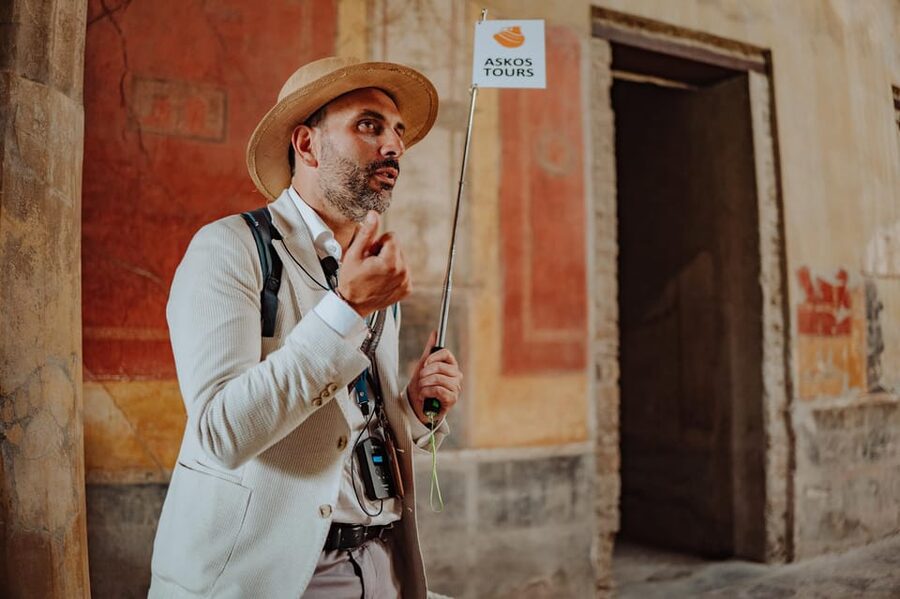
The House of Menander receives another 20-minute guided visit. Like the House of the Faun, it helps you understand domestic life, but it adds another angle on the people who lived and worked inside Pompeii’s homes.
The name refers to Menander, a Greek comic playwright, and the house is associated with high-status domestic space. Your guide uses the building to explain architecture, decoration, household activity, and the relationship between public appearance and private life.
I especially like this part of the route because it slows the experience down. Pompeii can become a blur of walls and doorways, but a focused visit to a house gives you time to consider how a family and its workers moved through the rooms.
The houses also show why comfortable shoes matter. Ancient paving is uneven, and you may need to step up or down in places. The ground is part of the experience, but it can be tiring and awkward.
Macellum and the Forum Baths
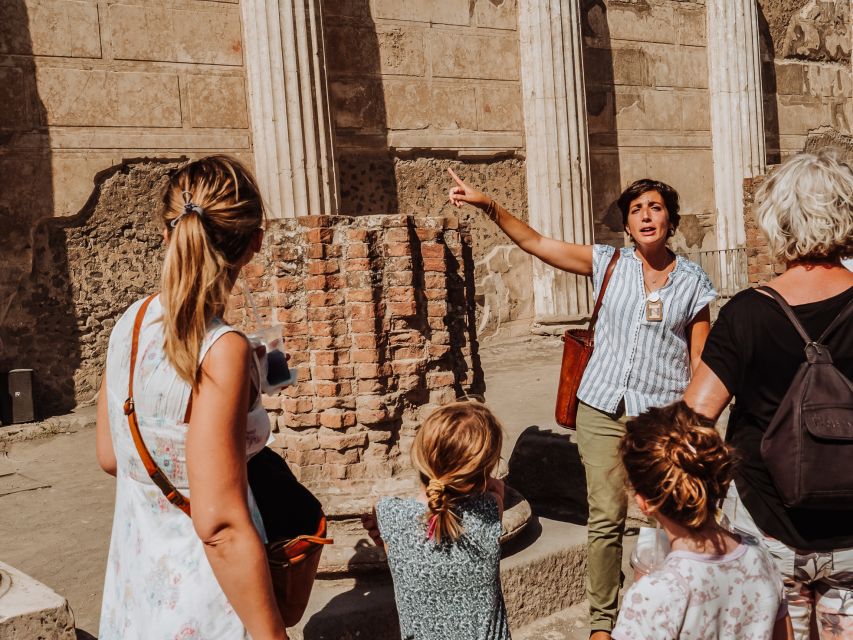
The Macellum, the city market, receives about 10 minutes of guided attention. It adds food, trade, and public commerce to the picture of Pompeii.
A market is valuable because it shifts the story away from grand homes and elite culture. You can think about how supplies entered the city, how people bought food, and how commercial space fitted into the civic center.
The Forum Baths follow with another 10-minute guided stop. Roman baths were not just places to wash. They were part of the social life of the city, and the remains help explain Roman engineering, public habits, and shared spaces.
These shorter stops work well as pieces of a larger story. They may feel brief if you want detailed architectural study, but they give you several different views of Pompeii without allowing one monument to consume the whole tour.
The plaster casts and the human cost of 79 AD
The plaster casts of victims are among the most affecting things you may see at Pompeii. They can make the eruption feel immediate in a way that walls and columns cannot.
Your guide provides the historical setting, but you should take a moment to look quietly. The casts are not simply archaeological objects. They represent people caught in a catastrophe, and the scene can be difficult for children or anyone sensitive to human remains.
The tour connects these victims with the wider city. You see where people lived, worked, worshipped, ate, and relaxed, then confront the sudden end of that life. That contrast is one reason a guided visit can feel more meaningful than a fast walk through the ruins.
The exact access and display arrangements can change within an archaeological site. Still, the route specifically includes the plaster casts as one of its key points, so you should expect the subject to be part of the experience.
Theaters, streets, and what happens after two hours
The historic theaters and main streets are also part of the walk. These areas show Pompeii as a place of performance and movement, not just a town frozen by disaster.
The streets are often where the city becomes easiest to picture. You can follow the worn paving, notice how buildings meet the road, and understand how homes, shops, and public spaces were linked.
Two hours is a sensible introduction, but it is not enough to see everything. Several guides, including experienced leaders such as Sergio and Alfredo, give suggestions for continuing after the formal tour. That advice matters because Pompeii is large and easy to lose your way in.
Plan to stay longer if you can. One person continued alone for more than two hours and still became lost before finally finding the exit. Take water with you, and keep enough energy for the extra walking if you plan to explore beyond the guided route.
Is $35 a fair price?
At $35 per person, this tour sits in a useful middle ground. You receive the Pompei Express entrance ticket, skip-the-ticket-line access, and a two-hour guided visit with an archaeologist.
The value comes less from the ticket itself than from the structure. Pompeii is a large site, and a guide steers you toward major buildings while explaining what you are seeing. For a first visit, that can prevent hours of wandering past important places without context.
A self-guided visit may suit you if you want to move slowly, study every wall, or spend most of the day photographing details. But you would need to organize your own route and supply your own explanations.
This tour is a good buy for a first visit, especially if your time in Campania is limited. It is also useful before a longer independent walk because you finish with a basic map in your head and suggestions for what to see next.
Timing, transport, and practical limits
The activity lasts two hours, with starting times available according to the date you choose. You must make your own way to Pompeii because hotel pickup, drop-off, food, drinks, and transportation are not included.
The meeting point can vary by the option booked. Read the confirmation closely, especially if you are arriving from Naples or another town. One delayed train caused a late arrival, and the booking was rescheduled to a later time slot, but you should not count on every delay being handled the same way.
Wear firm, comfortable shoes. Pompeii’s routes can be long, uneven, and stepped, and one guide-led walk may cover much more ground than you expect.
Carry water and consider a snack for after the tour. Food and drinks are not included, and the scale of the ruins can make a short visit feel physically demanding.
The tour is not suitable for wheelchair users, people with mobility impairments, mobility scooter users, or unaccompanied minors. Dogs are allowed only if they weigh no more than 10 kilograms and measure no more than 40 centimeters in height. They must be leashed, carried inside buildings, and cleaned up after.
Children under 18 are advised to bring a passport or identity card to qualify for free admission. Confirm the exact arrangements when booking, since the tour price is listed per person and the entrance rules may require proof of age.
Free cancellation is available up to 24 hours before the start time, and you can reserve now and pay later. Those options are helpful if your Campania plans are still shifting.
Who should book this Pompeii walk?
Book it if you want the main sights explained in plain language and prefer a clear route through a very large archaeological area. It suits first-time visitors, history fans, families with older children, and anyone who would rather understand a building than simply photograph it.
It is especially useful for people who enjoy human stories. The guides regularly connect architecture with food, work, religion, entertainment, family life, and social status. Teresa, Raffaella, Anna, Alfredo, Paolo, and Sergio are among the guides praised for clear explanations, humor, and a strong sense of place.
Think twice if you need step-free access, dislike long walks, or want to explore at your own pace from the first minute. The group can still feel crowded in popular sections, and headsets may not suit everyone.
For most first visits, I would book it. The price is reasonable for admission plus a focused archaeologist-led route, and the chance to continue alone afterward gives you both structure and freedom.
FAQ
How long does the Pompeii guided tour last?
The tour lasts two hours. You can check available starting times for your chosen date.
What does the $35 price include?
The price includes the Pompei Express entrance ticket, an archaeologist guide, a small group tour, and headsets for groups of 10 or more.
Which Pompeii sights are included?
The route includes Porta Marina, the Temple of Apollo, the Forum, House of the Faun, Lupanar, House of Menander, Macellum, Forum Baths, main streets, theaters, the Termopolium, and plaster casts of victims.
Is skip-the-line entry included?
Yes. The activity includes skip-the-ticket-line access.
What languages are available?
Guided tours are available in English, Spanish, French, Italian, Portuguese, and German.
Is the tour suitable for wheelchair users?
No. The activity is not suitable for wheelchair users, people with mobility impairments, or people using mobility scooters. The ancient paths can be uneven and include steps.
Fresh on the Pompeii list
- Explore Pompeii with an Archaeologist★ 5.0 · 511 reviews
- Pompeii Skip-the-line Tour with Archaeologist Guide★ 5.0 · 559 reviews
- Pompeii Private Tour with an Archaeologist and Skip The Line – 3 hours★ 5.0 · 564 reviews
- Ercolano: Herculaneum Entry Ticket with Optional Audio Guide★ 4.1 · 581 reviews
- Pompeii private tour with an Official Guide★ 5.0 · 631 reviews
- Pompeii: Exclusive Tour with Archaeologist and Entry Tickets★ 4.9 · 634 reviews
- Pompeii Ticket + Tour with Optional Tasting Experience at Pompeii★ 5.0 · 663 reviews
- From Naples: All-Inclusive Mount Vesuvius Half-Day Tour★ 4.2 · 674 reviews
Pompeii & Vesuvius Tours, compared.


Pompeii Small Group Tour with an Archaeologist
Read our review →
Pompeii, Amalfi Coast and Positano Day Trip from Rome
Read our review →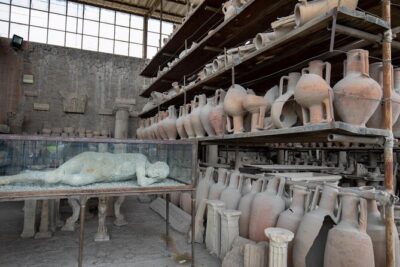
Pompeii and Mount Vesuvius Day Trip from Rome with Pizza Lunch
Read our review →Browse the lists this tour appears in