
Reviewed · POMPEII & VESUVIUS TOURS
Pompeii: Tour with Archaeologist Guide & Skip-the-Line Entry
Pompeii is far more than a field of broken walls. Its streets, homes, shops, theaters, baths, and public squares still show how an ancient Roman town worked before Mount Vesuvius buried it in AD 79. A guide helps you read details that are easy to miss, from road design to horse tie points and the layout of a neighborhood shop.
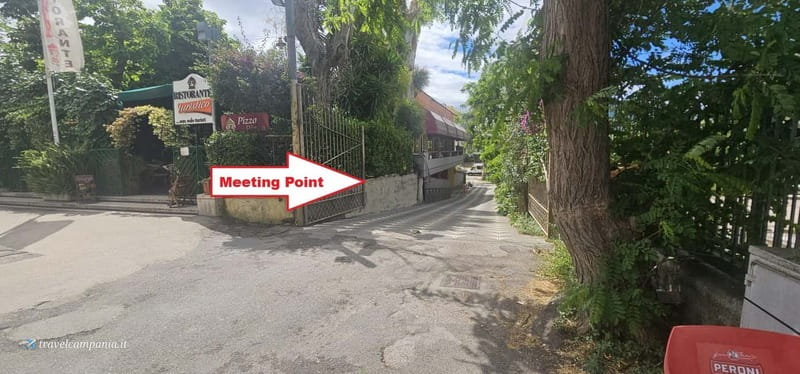
I especially like the archaeology-focused guide and the priority entrance, which saves time at a site where every minute counts. Guides such as Angelo, Teresa, Lilian, Paolo, and Mario have been praised for making the past clear and entertaining. The main caution is that the meeting point can be hard to find, and the tour is not suited to wheelchair users or people with mobility impairments.
Key points to know before booking
- The two-hour route covers Pompeii’s main sights: You see the theater district, House of Menander, Thermopolium, Stabian Baths, Lupanare, and Forum.
- A guide adds meaning to plain-looking ruins: Expect explanations of daily life, art, trade, roads, customs, and building design.
- Priority entry saves valuable time: The Pompeii Express ticket is included, so you avoid the regular ticket queue.
- The tour ends with free time: After the guided visit, you get about 10 minutes at the Forum and may continue exploring on your own.
- Audio equipment is used for larger groups: A radioguide is included when the group passes eight people.
- The $57 price is reasonable for a short guided visit: It includes site entry and an authorized archaeology guide, but not transport, food, or tips.
Why Pompeii makes more sense with a guide
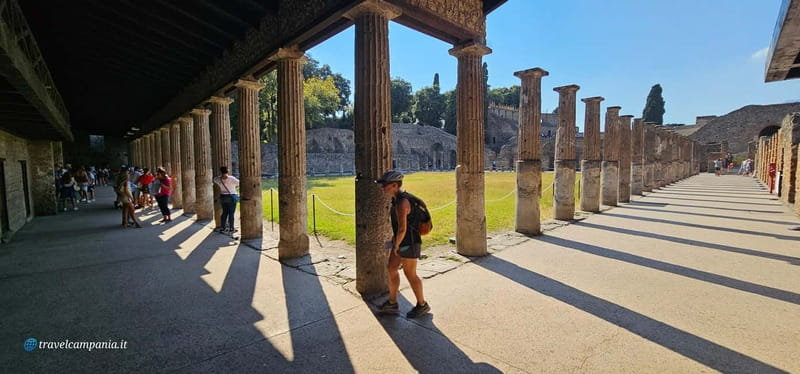
Pompeii can be confusing at first. You walk past walls, doorways, worn paving stones, and fragments of decoration, but the original purpose of each space is not always clear. A guide turns those remains into a town with shops, homes, public buildings, entertainment, and routines.
That matters here because Pompeii is preserved in an unusual way. The eruption covered the city in ash and debris, protecting much of its street plan and buildings from later development. You are not simply looking at isolated ruins. You are walking through an ancient city that was founded as early as the seventh century BC and destroyed in AD 79.
The best explanations focus on ordinary life. You hear about crafts, household habits, commerce, art, customs, and the way people moved through the town. Small features, such as road construction and places where horses could be tied, become useful clues rather than random pieces of stone.
I would choose a guide for a first visit, especially if you have only two hours. You can return to the site afterward and explore more slowly once you understand what you are seeing.
More Skip-the-Line Tickets in Pompeii
- Pompeii: Skip-the-Line Entrance Ticket with Audio Guide
★ 4.0 · 2,509 reviews - Pompeii: Skip-the-line-Ticket and Guided Tour
★ 4.6 · 1,152 reviews - Pompeii: Guided Tour with Skip-the-Line Entry
★ 4.9 · 812 reviews
Entering through Porta Marina
The tour begins at the Welcome Box near the Pompeii meeting point, then moves toward Porta Marina. This gate is a fitting start because it introduces Pompeii as a functioning city with connections to the outside world, not simply a disaster site.
The guided explanation here lasts about 10 minutes. Your guide sets out the basic story: the city’s long development, its Roman character, and the eruption that stopped daily life in a single catastrophic event.
This opening is useful for orientation, but pay close attention to the meeting instructions. One of the few complaints about the experience concerned the check-in point being difficult to identify. I would allow extra time to locate the Welcome Box rather than arriving at the last moment.
The meeting point is also where the activity ends. Transport to Pompeii is not included, so you need to arrange your own way to the site.
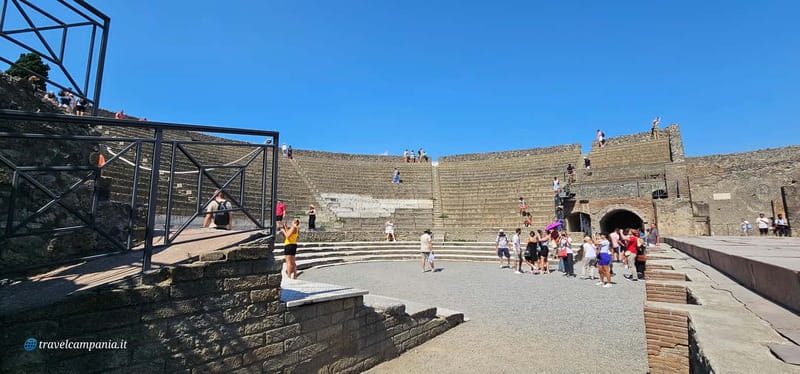
Teatro Piccolo and Pompeii’s public life

The route continues to Teatro Piccolo, or the Small Theater, for about 10 minutes. The theater helps explain that Pompeii was not only a place of business and domestic life. Public performance and shared entertainment were part of the city’s daily rhythm.
A guide is helpful here because an empty theater can be hard to interpret. The shape of the building, its seating, and its position within the city become easier to understand when someone explains how the space functioned.
The stop is brief, so you should not expect a long theatrical or architectural lecture. It works best as part of the larger story of Pompeii’s public life. You get a clear introduction, then move on before the pace slows.
House of Menander and life behind the walls
The House of Menander receives about 15 minutes. This is one of the stops where the tour shifts from public buildings to private life.
The name comes from a famous Greek playwright, and the house offers a way to discuss domestic space, decoration, and the social world of an affluent Pompeian household. Your guide helps you look beyond the surviving walls to the people who used the rooms and the purposes behind the layout.
This is the kind of stop that rewards an expert explanation. Without context, a grand Roman house can seem like a series of empty rooms. With a guide, the decoration, arrangement, and scale begin to suggest status, taste, and household activity.
The visit does not attempt to cover every house in Pompeii. That is a fair trade for a two-hour tour, but you should plan to stay afterward if domestic architecture is your main interest.
A few other Pompei Campania mornings to weigh against this
- Pompeii: Entry Ticket and Guided Tour with an Archaeologist
★ 4.8 · 19,459 reviews - Pompeii: Small Group Tour with an Archaeologist
★ 4.8 · 12,264 reviews - Naples: Pompeii and Mt. Vesuvius with Lunch and Wine Tasting
★ 4.5 · 2,454 reviews - Pompeii: Small-Group Tour of Pompeii and Herculaneum
★ 4.8 · 867 reviews
Thermopolium and the taste of everyday Pompeii

The Thermopolium gets another 15 minutes. These ancient food shops offer a direct link to everyday eating and commerce.
The stop is valuable because it brings Pompeii down to street level. Public forums and large houses can make the city feel grand, but a shop shows how people bought food and interacted during ordinary days. The guide’s job is to explain what the counter, containers, and surrounding space reveal about trade and habits.
This is also a good example of why the tour is more than a quick walk past famous ruins. The route gives attention to practical places that help you picture the city as a lived-in community.
Do not expect a meal or food tasting. Lunch is not included, and the tour remains focused on archaeology and interpretation.
Terme Stabiane, the Stabian Baths
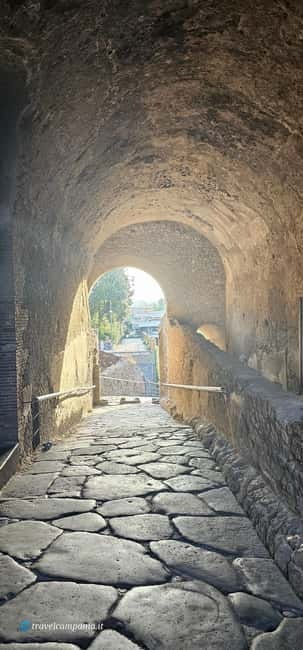
The Stabian Baths are covered in about 15 minutes. Roman baths were important social and public buildings, not just places to wash. This stop lets the guide explain how architecture supported communal routines and how different parts of a bath complex fitted together.
The baths also show the range of buildings preserved at Pompeii. In a single morning or afternoon, you move from theater to home, shop, and public bathing complex. That variety is one reason the guided route works well for a first visit.
The time here is enough to understand the role of the baths and notice key features, but not enough for a full study of the entire complex. If you enjoy Roman engineering or public architecture, use the guide’s suggestions to decide what deserves a closer look after the tour.
Lupanare and the less polished side of the city
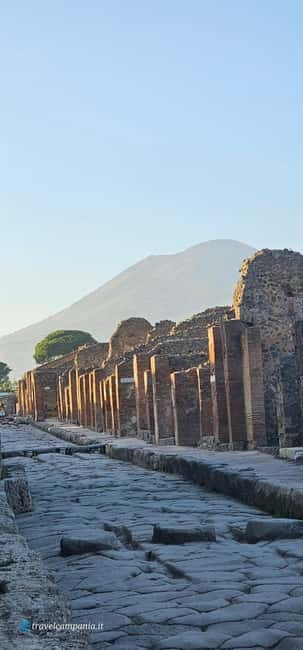
The Lupanare receives the longest stop, about 20 minutes. It is one of Pompeii’s most recognizable buildings and often one of the most crowded.
This stop can be more sensitive than the others, since it concerns prostitution and commercial sex in the ancient city. A good guide gives the building social and historical context instead of treating it as a novelty. The point is not simply to see the painted rooms. It is to understand one part of the city’s commercial and social life.
Crowds can gather here, so the audio system becomes particularly useful. One guide was praised for choosing less crowded spots when possible, and that sort of route management makes a real difference in narrow or busy areas.
If you are visiting with children, be prepared to explain that this is an adult subject. The supplied information does not set a child age limit, but the activity requires the names and ages of all participants.
The Civil Forum, Pompeii’s great public center

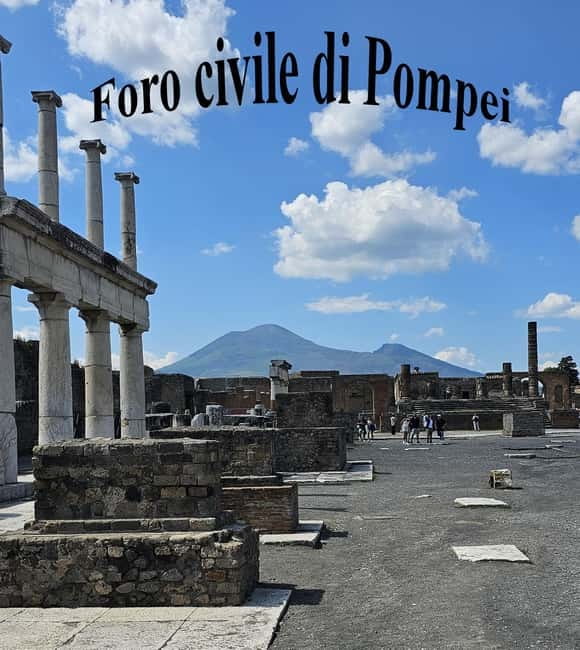
The route finishes at the Civil Forum, with about 15 minutes of guided explanation followed by approximately 10 minutes of free time.
The Forum brings the separate pieces together. After seeing homes, shops, baths, and entertainment spaces, you can now place them within the city’s main public center. Your guide explains the role of the Forum and points out details that help you understand how Pompeii organized civic life.
The final free-time period is short, but useful. You can take photographs, look again at a detail, or ask your guide what to see next. Several guides have also given practical suggestions for continuing through Pompeii after the formal tour ends.
The activity officially finishes back at the meeting point, but the advice from guides makes it clear that the archaeological site deserves more time if your schedule allows. Two hours is a strong introduction, not a complete visit.
What the archaeology guide adds
The best part of this experience is not simply getting through the gate. It is having someone explain what the remains mean.
Guides have been praised for being clear, patient, humorous, and able to handle groups with different ages and nationalities. Teresa is described as professional and funny. Lilian is noted for clear explanations and a well-functioning audio system. Paolo is praised for leading the group well, while Mario helped a family that was running late and was remembered for his warmth and strong command of the subject.
Those details matter because Pompeii is not a site where a guide can coast on a list of names and dates. You need someone who can point out small clues and connect them to daily life. The strongest guides do that while keeping the group moving.
In groups larger than eight, a radioguide is included. This is important in a busy archaeological site, where standing close to the guide is not always possible. One person found the earpieces too loud, but also considered them necessary in crowded areas. If you are sensitive to audio volume, adjust the device early.
When the group has no more than four people in the same language, the format may combine an audio guide with a live guide in English. That is worth knowing if you are expecting a fully spoken small-group tour in another language.
Is $57 good value for two hours?
The $57 price includes the Pompeii Express entrance ticket and an authorized guide with archaeology expertise. Transport, lunch, and tips are extra.
For a short first visit, I find that fair value. You are paying not only for entry but also for help making sense of a large and sometimes bewildering site. The priority access is useful during busy periods, since standing in a ticket line takes time away from the ruins.
The value is strongest if you are visiting Pompeii for the first time, coming on a tight schedule, or traveling from farther away for a day trip. One family made the journey from Rome by fast train, so a two-hour guided visit can fit into a wider day if you plan carefully.
The value is weaker if you want a very long archaeological study or prefer to wander without a set route. The tour has a defined path and only a short period of free time. You may need to pay separately for transport and food, and the guide does not replace a full day at Pompeii.
Free cancellation up to 24 hours before the activity and the reserve-now, pay-later option make booking less risky. Train delays and bad weather have caused problems for some visitors, and the local team has sometimes helped move people to another departure or arrange general access. That flexibility is useful, though you should still contact the provider promptly if you are delayed.
Practical details for a smoother visit
The tour is available in Italian, Spanish, French, English, and German. Check the available starting times for your date, since the duration is fixed at two hours but the departure time changes with availability.
Bring a passport or ID card for every participant, including children. A copy of a passport or ID card is accepted. You should also write the names and ages of everyone taking part when booking.
Bags are not allowed, and bikes, alcohol, and drugs are prohibited. The activity information also says it is not suitable for wheelchair users, people with mobility impairments, or people over 95 years old.
Wear practical shoes and prepare for a lot of walking over an archaeological site. That advice is sensible even though the listing does not specify footwear. Pompeii is an outdoor site, and weather can affect the experience. A guide has helped groups adjust plans after thunderstorms and rain, but no tour can remove the need to prepare for changing conditions.
There are free lockers at the gates for backpacks, and water fountains can be found inside the site, though they may not be clearly marked. Those two details can make the visit easier, especially if you are carrying luggage or spending the rest of the day in Pompeii.
Who should book this Pompeii tour?
I would recommend it to first-time visitors, families who want clear explanations, and anyone with only a short window in Pompeii. It is also a good choice if you want the main sights without spending time working out the site map on your own.
The route suits you if you care about daily life as much as famous monuments. The Thermopolium, House of Menander, baths, and Lupanare give the visit variety, while the Forum and Porta Marina provide the wider civic story.
I would think twice if you use a wheelchair, have limited mobility, or want to explore at a very slow pace. The two-hour route is not rushed according to the supplied details, but it is still a guided walk with a fixed itinerary. Visitors seeking a full-day examination of Pompeii will need more time after the tour.
Should you book it?
Yes, if your goal is to understand Pompeii rather than simply enter it. The combination of priority entry, a two-hour route, and an authorized archaeology guide gives you a useful first look at the city’s homes, shops, baths, theaters, and public center.
Book it with enough time to find the Welcome Box, bring the required identification, and plan to stay afterward if possible. The strongest value comes from using the tour as an introduction, then following the guide’s suggestions for your own extra wandering. That way, you get both the human explanation and the freedom to explore Pompeii at your own pace.
FAQ
How long does the Pompeii tour last?
The guided tour lasts approximately two hours. The route includes about 10 minutes of free time at the Civil Forum before the activity ends back at the meeting point.
What is included in the price?
The price includes a Pompeii Express entrance ticket and an authorized guide who is an expert in archaeology.
Is transportation included?
No. Transportation to and from Pompeii is not included. The activity begins and ends at the meeting point.
Which languages are available?
The live tour is available in Italian, Spanish, French, English, and German.
Do I need identification?
Yes. Each participant should bring a passport or ID card, including children. A copy of a passport or ID card is accepted.
Are bags allowed inside the site?
No. Bags are not allowed. Free lockers are available at the gates for backpacks.
Can I cancel the booking?
You can cancel up to 24 hours in advance for a full refund. The reserve-now, pay-later option lets you hold a place without paying at the time of booking.
More Skip-the-line Tickets in Pompei Campania
- Pompeii: Skip-the-Line Entry Ticket with Digital Guide App
★ 4.1 · 770 reviews - Pompeii: Skip-the-Line Entry & Audioguide
★ 3.8 · 225 reviews - Florence: Skip-The-Line Uffizi Gallery Timed Entry Ticket
★ 4.5 · 27,832 reviews - Vatican Museums & Sistine Chapel Skip-the-Line Entry Ticket
★ 4.4 · 13,838 reviews
Fresh on the Pompei Campania list
- Pompeii: Skip-the-Line Entry & Audioguide★ 3.8 · 225 reviews
- From Naples/Salerno: Pompeii, Sorrento, and Positano Tour★ 4.5 · 250 reviews
- Pompeii: Day Tour of Pompeii and Vesuvius with Bus Transfer★ 4.2 · 250 reviews
- Discover Pompeii: French Walking Tour of the Buried City★ 4.8 · 253 reviews
- Pompeii: Afternoon to Sunset Guided Tour with Ticket★ 4.9 · 484 reviews
- Pompeii 3hours Villa of Mysteries tour with an Archaeologist★ 4.8 · 486 reviews
- From Pompeii: Bus Transfer to Vesuvius with Park Entry Fee★ 4.2 · 700 reviews
- Pompeii: Small-Group Tour of Pompeii and Herculaneum★ 4.8 · 867 reviews
Pompeii & Vesuvius Tours, compared.

Entry Ticket and Guided Tour with an Archaeologist
Read our review →


Pompeii Small Group Tour with an Archaeologist
Read our review →
Pompeii, Amalfi Coast and Positano Day Trip from Rome
Read our review →Browse the lists this tour appears in