
Reviewed · POMPEII & VESUVIUS TOURS
Pompeii: Small Group Tour with an Archaeologist
Pompeii is far too large and detailed to understand by simply wandering in. This $40 archaeological tour gives you a clear route through the Roman city, with an archaeologist pointing out details you could easily miss, from cart tracks in the streets to handprints on fountains and clues that separate a shop from a private home.
I like the chance to choose between a small group and a private visit, and I like that your ticket lets you stay inside the site after the guided portion. The guides, including Roxanne, Paolo, Nicoletta, Teresa, and Alessandra, are praised for bringing ordinary Pompeian life into the story rather than reciting dates. The main tradeoff is time: two hours covers the essential sights, but Pompeii is enormous, and a later start may leave little time before parts of the park close.
Key points at a glance
- An archaeologist leads the route: Expect context about Roman homes, shops, temples, baths, theaters, graffiti, and the eruption of Mount Vesuvius in 79 AD.
- Two tour lengths are available: Choose the two-hour Pompeii route or the three-hour version, which adds the Villa of the Mysteries.
- The Forum anchors the visit: You see the civic heart of Pompeii with views toward Mount Vesuvius.
- Small details make the ruins human: Look for road tracks, plaster casts, painted walls, mosaics, bakery equipment, and household layouts.
- You can keep exploring afterward: The guided tour gives you a starting map, then you can visit other parts of the archaeological park at your own pace.
- Uneven ground matters: Steps, ramps, slopes, and rough paving make this a poor fit for wheelchair users and people with serious mobility limits.
Why a guided start helps at Pompeii
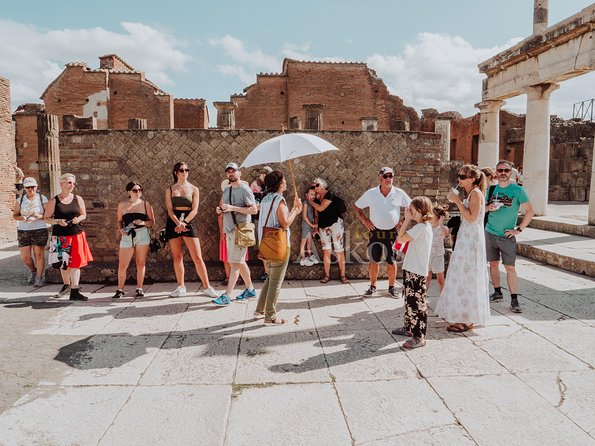
Pompeii is not a compact set of ruins arranged around one grand monument. It is a buried Roman city, with streets, homes, businesses, public buildings, temples, baths, theaters, and smaller details spread over a huge area. You can spend hours here and still walk past something important without realizing what it was.
That is why I think this tour works best as an introduction rather than a complete visit. In two hours, your archaeologist gives you the basic map of the city and explains how its parts fit together. You learn where public life happened, how homes were arranged, what the streets reveal, and how the eruption preserved both beauty and tragedy.
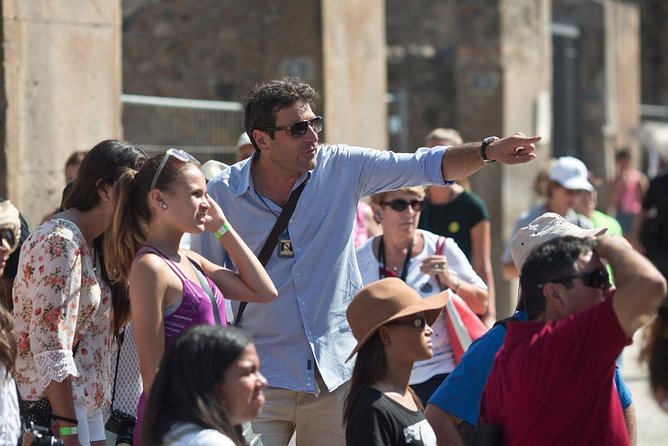
Guides are the heart of the experience. Paolo has been praised for his energy and enthusiasm, while Roxanne is known for humor and an easy way with groups. Nicoletta often adjusts the route to avoid packed areas and harsh sun, and Teresa has personal excavation experience that adds a useful connection between current archaeology and the ancient remains.
The quality of spoken English is generally strong, though one person found an accent difficult at times. The guide in that case checked for questions and made sure the group could follow along. Headsets are supplied for groups of 16 or more. In a smaller group, you will usually hear the guide directly, but crowd noise can still affect how easy it is to follow every word.
A few other Pompeii mornings to weigh against this
- Pompeii: Entry Ticket and Guided Tour with an Archaeologist
★ 4.8 · 19,459 reviews - Pompeii: Entry Ticket with Optional Audio Guide
★ 4.2 · 12,360 reviews - Pompeii Small Group Tour with an Archaeologist
★ 5.0 · 6,593 reviews
Entering through Porta Marina Superiore
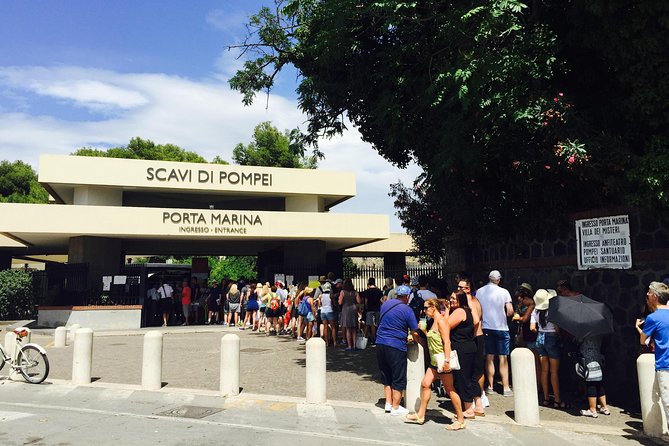
The tour begins at one of the entrances near Pompeii, with the exact meeting point depending on the option you book. Several possible starting spots are listed around Via Villa dei Misteri, Via Roma, and the Hortus Pompei restaurant area, so read your confirmation carefully rather than heading to the first Pompeii entrance you see.
The route enters through Porta Marina Superiore, one of the ancient city’s seven gates. This is a fitting start because it puts you onto the old street grid right away. You are not beginning with a modern museum display or a broad historical lecture. You are standing where people once entered the city, then walking along the same network of roads.
Allow time to find the meeting point and complete check-in. One person had a problem when staff failed to mark the arrival properly, and the group left without them. The practical lesson is simple: arrive early and make sure your name has been checked before the tour begins.
There is no transportation included, so you must reach Pompeii on your own. Food, drinks, and personal expenses are also separate. Large bags and luggage are not allowed, although a free cloakroom near Porta Marina Superiore may be available.
The Forum, temples, and the public face of Pompeii
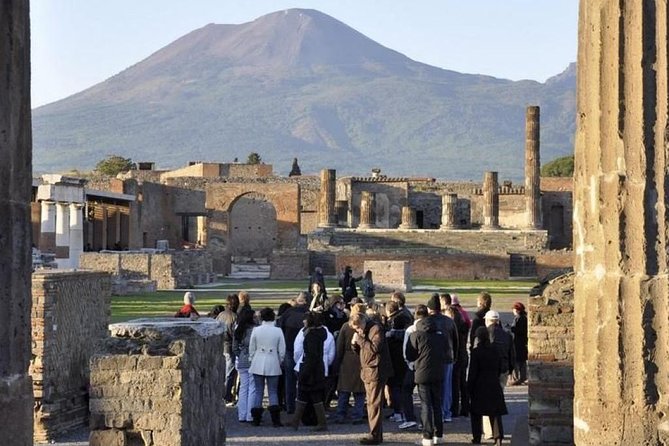
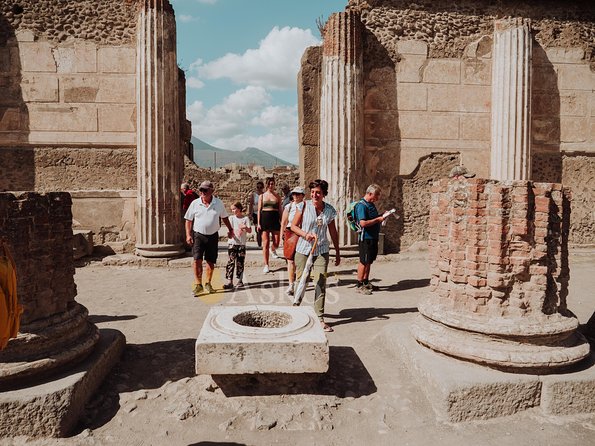
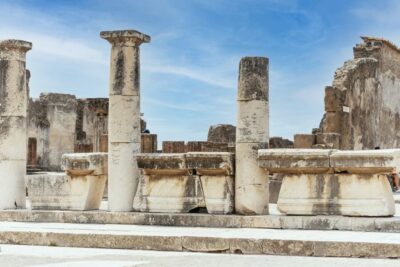
The Forum was the old center of civic life, and it gives you the best first sense of Pompeii as a functioning city rather than a collection of ruins. From here, Mount Vesuvius rises beyond the ancient buildings, a quiet reminder of the event that ended the city’s daily life in AD 79.
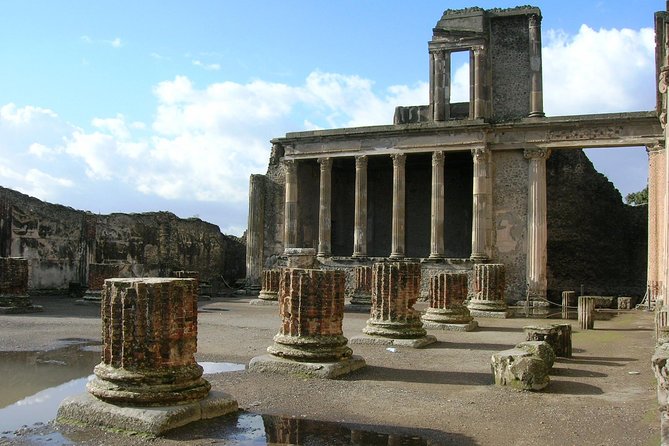
The Temple of Apollo and Temple of Jupiter help explain the religious side of the Forum. The Basilica, meanwhile, served as a business and legal center. Your guide connects these buildings to the people who used them, so the stones are not left as isolated architectural fragments.
The Forum can be crowded, especially around the most famous viewpoints. A good guide may shift the order slightly to avoid a dense cluster of groups. That flexibility matters because it lets you hear the explanation instead of trying to listen while people stream past.
You will also see the remains of public infrastructure, including the Forum Baths. These spaces help explain how Roman life depended on shared facilities and carefully organized civic services. At the same time, Pompeii is not a polished museum. Walls are weathered, paving is uneven, and some areas may close temporarily, so the precise route can change.
Shops, houses, and clues in the street
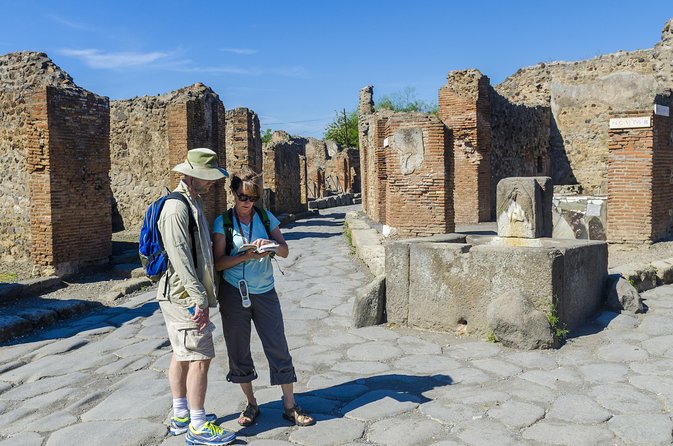
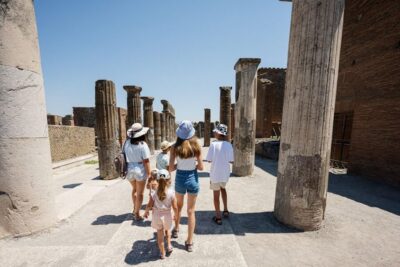
Some of the best moments come from small observations. Guides point out cart tracks worn into the road and marks on fountains that make the streets feel used rather than merely preserved. You may also learn how the entrance details of a building can indicate a commercial space or a private residence.
The bakery is another useful stop because it shifts attention away from emperors and temples. Pompeii becomes easier to picture when you think about bread production, household work, trade, and the routines of people who lived ordinary lives before the eruption.
The House of Menander and House of the Faun show the scale and variety of Pompeian homes. The House of Menander is associated with an elegant domestic setting, while the House of the Faun is one of the site’s major residences. Your guide helps you read the courtyards, rooms, decoration, and layout instead of treating each doorway as just another doorway.
The House of the Vettii is especially important for its preserved decoration. Frescoes and mosaics offer more than visual appeal. They show how Roman owners used art to signal taste, status, mythology, and wealth.
Still, do not expect every room to be open. Pompeii changes as conservation work, crowd control, and temporary closures affect access. The guide will usually adjust, but no walking tour can promise every building on every date.
Same city, an entirely different afternoon:
- Pompeii: Skip-the-Line Entrance Ticket with Audio Guide
★ 4.0 · 2,509 reviews - Naples: Pompeii and Mt. Vesuvius with Lunch and Wine Tasting
★ 4.5 · 2,454 reviews - Pompeii: Archaeological Park Tour with Ticket on request
★ 4.5 · 2,283 reviews - Discover the Ancient Ruins of Pompeii: Day Trip from Rome
★ 3.5 · 2,247 reviews
Frescoes, mosaics, and the Lupanar
Pompeii’s artwork is one of the strongest reasons to visit with an archaeologist. Frescoes can look like colorful wall decoration until someone explains what you are seeing, why it was placed in a particular room, and what it says about Roman society.
Mosaics work in the same way. Patterns, thresholds, and floor scenes can reveal how a household presented itself and how rooms were used. Your guide may also draw your attention to details that are easy to overlook when you are busy taking in the larger remains.
The Lupanar, Pompeii’s famous brothel, adds a more awkward but memorable part of the route. Its name, preserved stone beds, and erotic frescoes raise adult themes that are part of the site’s evidence. The subject is handled as history rather than spectacle, but parents should know that some graffiti and imagery are not aimed at children.
One family found that a 10-year-old was mostly unaware of the adult context, but that will depend on your child. I would prepare older children briefly and use your judgment for younger ones.
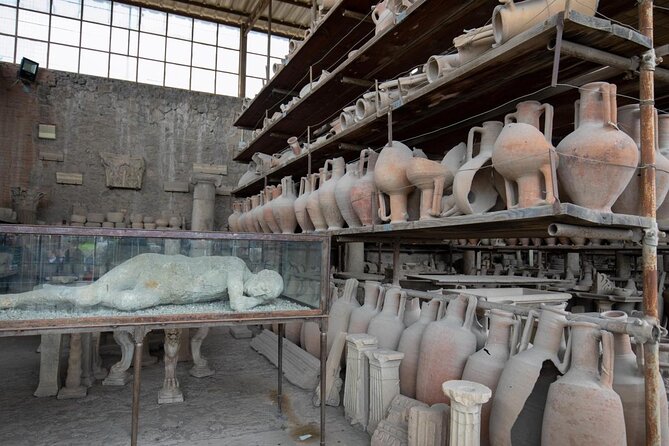
Plaster casts are another emotionally powerful feature. These casts preserve the shapes of people caught in the eruption. Their display arrangements can change. One recent account noted that casts were no longer placed inside dwellings and that three were displayed in sealed glass cases instead. If seeing them is important to you, ask your guide what is currently open.
The Great Theater and the final stretch
The Great Theater provides one of the tour’s strongest visual moments. Walking into the theater makes the size and organization of Pompeii easier to grasp, and it offers a break from the narrower streets and enclosed houses.
The theater also shows that this was a city with entertainment and shared public life, not simply a settlement frozen by disaster. Guides often use the space to explain how performances fit into Roman society and how the building related to nearby public areas.
The route covers a lot of ground. One person found the walking manageable, but also pointed out that Pompeii takes about half an hour to cross from one side to the other. You cannot see the entire park in one short guided visit, and even a full day may not be enough for every open building.
That is not a flaw in the tour so much as a fact you should plan around. The two-hour version is a strong orientation. The three-hour option gives you more time for interpretation and adds one of Pompeii’s most important artistic sites.
Why the Villa of the Mysteries is worth the extra hour
The three-hour tour includes the Villa of the Mysteries, located beyond the main core of the city. Its frescoes are the main attraction, and the extra hour makes sense if you want more than a quick overview of central Pompeii.
The villa is particularly valuable because the paintings reward explanation. Mario, who has led the three-hour route, has been praised for explaining the frescoes in expert detail while keeping the discussion lively enough for teenagers as well as adults. The Villa of the Mysteries is not simply an extra building to tick off. It gives you a focused look at Pompeian wall painting and the questions raised by its imagery.
Choose the three-hour option if art is high on your list, if this is your main Pompeii visit, or if you prefer a slower pace. Choose two hours if you want a useful introduction and plan to spend the rest of the day exploring independently.
Two hours or three, and what time should you book?
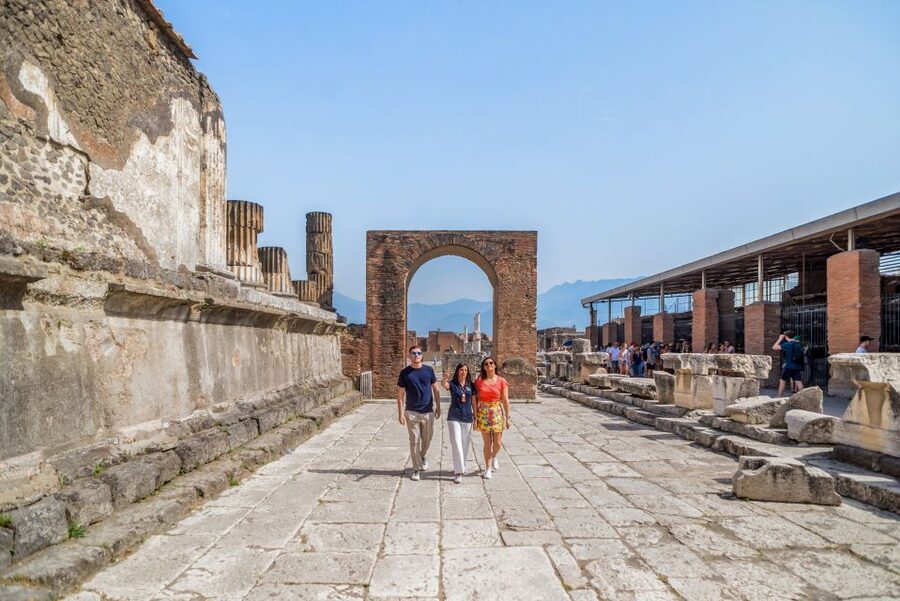
The two-hour tour is the better value for a tight schedule. At $40 per person, the price includes the Pompei Express entry ticket and the guided service, so you are paying for both access and a structured introduction. The real value comes from not wasting your first hour trying to work out what each building was.
The three-hour version costs more if that option has a different price at booking, but the extra time is worthwhile for the Villa of the Mysteries and a less hurried visit. One person said the additional hour was worth it, while others wished they could have spent three or four hours with the guide. That is a fair warning: the site rewards time.
Book an earlier start if you want to keep exploring after the tour. A 2 pm tour can finish around 4 pm, leaving only about an hour before a 5 pm closing time, and some areas may shut before the official closing hour. Morning and midmorning visits also give you a better chance of avoiding the strongest heat and the thickest crowds.
At the end, the guide gives suggestions for other parts of the park. This is one of the tour’s most useful features. You can continue to the buildings that match your interests instead of retracing the route or wandering without a plan.
Who will get the most from this Pompeii tour?
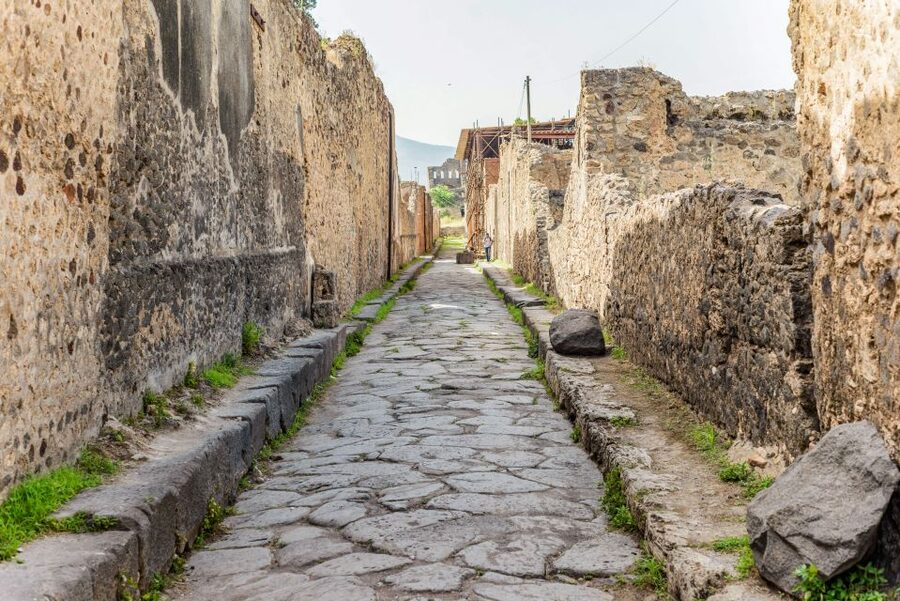
I would recommend it to first-time visitors, families with older children, history fans, and anyone who wants a human explanation of the ruins. It is also useful if you have only half a day and want to make sure you see the Forum, theaters, major homes, baths, and decorated rooms.
The private option suits a group that wants to ask many questions or move at its own pace. A shared small group is likely the better buy if you want expert guidance without paying for a tour reserved only for your party.
This is not a good choice for wheelchair users or people with significant mobility impairments. The site includes steps, ramps, uneven surfaces, inclines, and declines. Mobility scooters are not allowed, and dogs over 10 kilograms cannot enter.
Bring a passport or identity card, though a copy is accepted. Do not bring large luggage, and do not plan to smoke inside the site. Children must be accompanied by an adult.
Should you book this Pompeii experience?
Book it if you want Pompeii to make sense rather than simply look impressive. The archaeologist guides are the main reason to choose this visit, and the strongest guides combine facts with stories about homes, work, religion, entertainment, and the people caught in the eruption.
Choose the two-hour route for a solid introduction followed by independent exploring. Choose three hours if you want the Villa of the Mysteries and more time with the art. Arrive early for check-in, choose a morning start when possible, wear practical shoes, and keep your afternoon open for the rest of the park.
At about $40 including entry, this is a strong deal for a first visit. It will not cover all of Pompeii, but it gives you the context and direction needed to make the much larger site rewarding.
FAQ
How long is the Pompeii archaeologist tour?
You can choose a two-hour guided tour or a three-hour option. The three-hour version includes a visit to the Villa of the Mysteries.
Is entry to Pompeii included?
Yes. The Pompei Express entry ticket is included, along with the guided tour and the option to remain inside the archaeological site afterward.
Can I explore Pompeii after the guided tour?
Yes. You are free to stay inside the archaeological site and continue exploring on your own after the tour. The guide also provides suggestions for what to see next.
Is the tour available in languages besides English?
Yes. The listed languages are English, Italian, French, Spanish, German, and Portuguese. Shared and private options may not offer the same languages, so check the selected option carefully.
Is the Pompeii site suitable for wheelchair users?
No. The tour is not suitable for wheelchair users or people with mobility impairments because of uneven ground, steps, ramps, slopes, and a short steep climb.
What should I bring to the tour?
Bring a passport or identity card. A copy is accepted. Large bags and luggage are not allowed, and a free cloakroom near Porta Marina Superiore may be available.
Fresh on the Pompeii list
- Explore Pompeii with an Archaeologist★ 5.0 · 511 reviews
- Pompeii Skip-the-line Tour with Archaeologist Guide★ 5.0 · 559 reviews
- Pompeii Private Tour with an Archaeologist and Skip The Line – 3 hours★ 5.0 · 564 reviews
- Ercolano: Herculaneum Entry Ticket with Optional Audio Guide★ 4.1 · 581 reviews
- Pompeii private tour with an Official Guide★ 5.0 · 631 reviews
- Pompeii: Exclusive Tour with Archaeologist and Entry Tickets★ 4.9 · 634 reviews
- Pompeii Ticket + Tour with Optional Tasting Experience at Pompeii★ 5.0 · 663 reviews
- From Naples: All-Inclusive Mount Vesuvius Half-Day Tour★ 4.2 · 674 reviews
Pompeii & Vesuvius Tours, compared.
Entry Ticket and Guided Tour with an Archaeologist
Read our review →


Pompeii Small Group Tour with an Archaeologist
Read our review →
Pompeii, Amalfi Coast and Positano Day Trip from Rome
Read our review →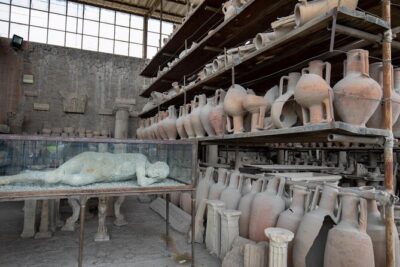
Pompeii and Mount Vesuvius Day Trip from Rome with Pizza Lunch
Read our review →Browse the lists this tour appears in