
Reviewed · WALKING TOURS
Walk the magic of Rome at night
Rome makes a strong first impression after sunset. The Colosseum glows, the Trevi Fountain sparkles, and the broad streets around Piazza Venezia feel grand and theatrical. This 2.5 to 3-hour walking tour links several of Rome’s biggest sights without asking you to spend the evening inside a single monument.
I like the small group, limited to 12 people, and the guide-led storytelling. Guides such as Isuf, Joseph, Drita, and Rita have been praised for keeping the history lively with quizzes, jokes, local suggestions, and well-timed photo stops. I also like the route’s practical value: you see where the major sights are, then can return to the ones that deserve a daytime visit.
The tradeoff is simple: you walk a lot, sometimes at a brisk pace, and you do not enter the monuments. Wear good shoes, allow extra time to find the starting point on Via del Monte Oppio, and think of this as an atmospheric orientation tour rather than a detailed interior visit.
Key points about Rome after dark
- The route covers six major sights, including the Colosseum, Pantheon, Trevi Fountain, and Spanish Steps.
- The group is capped at 12 people, making it easier to hear the guide and stay together.
- The tour stays outside the monuments, so no admission tickets are included or needed.
- Guides add practical help, including restaurant, coffee shop, bar, and sightseeing suggestions.
- Photo stops are part of the experience, especially at crowded places such as the Trevi Fountain.
- The pace is active, with breaks for a bathroom stop or coffee reported on some outings.
Why Rome works so well at night
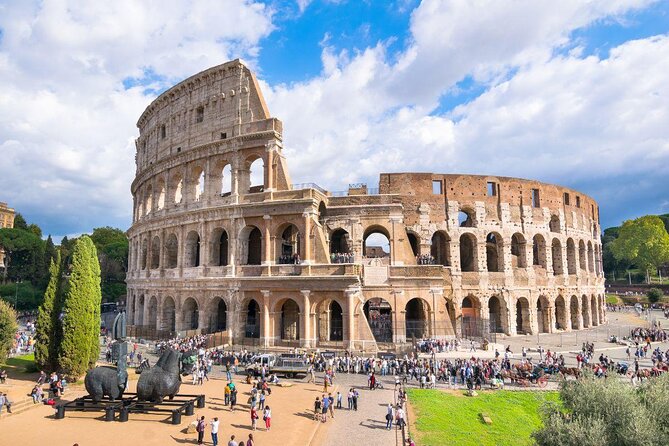
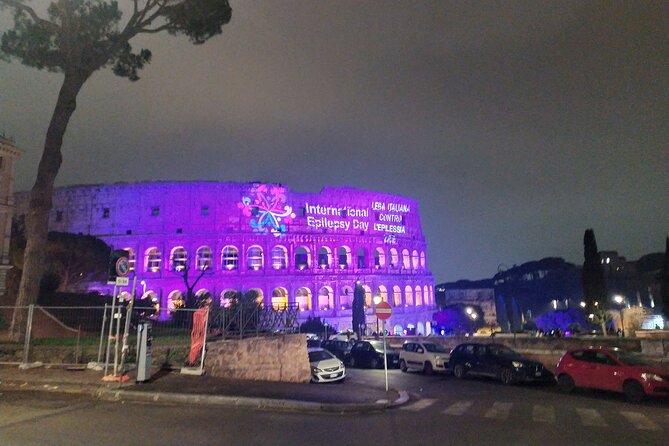
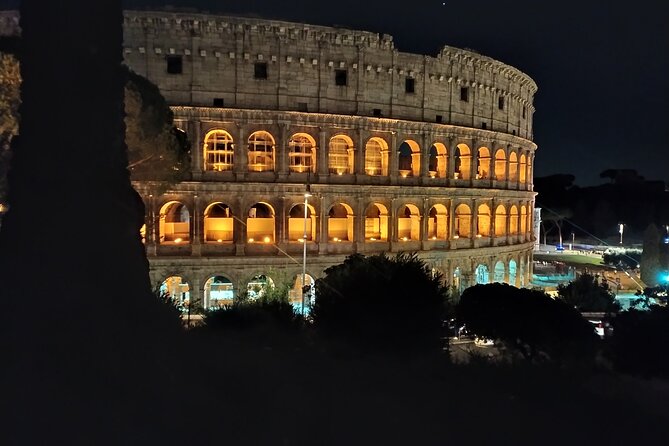
Rome’s famous monuments change character after dark. In daylight, the Colosseum can feel like one stop among many. At night, its lit arches have more drama, and the surrounding traffic and stone ruins create a memorable opening to the walk.
The tour also gives you a useful first look at Rome’s layout. You move from the ancient center toward Piazza Venezia, then continue through the historic core to the Pantheon, Trevi Fountain, and Spanish Steps. That progression helps you understand how close many major sights are on foot, even though the city can feel confusing when you first arrive.
I would especially consider booking this early in your stay. The route acts as a visual guide to central Rome, and the advice at the end can help you decide which areas, restaurants, coffee shops, or viewpoints to revisit. If you book it on your final night, it still works as a farewell stroll, but you lose some of its value as a planning tool.
More Walking Tours in Rome
- Rome: Trastevere & Campo de Fiori Street Food Walking Tour
★ 4.9 · 2,768 reviews - Rome: Paranormal Night Walking Tour & Secret Backstreets
★ 4.9 · 1,921 reviews - Rome by Night Walking Tour – Legends & Criminal Stories
★ 4.5 · 1,003 reviews
Beginning near the Colosseum on Via del Monte Oppio
The meeting point is at Via del Monte Oppio, 3, near the Colosseum area. Give yourself time to find it. One of the clearest practical warnings from the experience is that the start can take effort to locate, so do not cut it close.
From there, the walk reaches the Colosseum. You discuss the amphitheater from outside, including its form and place in Roman history, but you do not go through the entrance. That distinction matters. If seeing the arena interior is a priority, you need a separate timed ticket and a separate visit.
Still, an exterior stop at night has real value. You can study the illuminated arches, take photos, and hear the guide explain what you are seeing without using up the evening in a long indoor visit. The stop is scheduled for about 15 minutes, so expect an introduction and photo time rather than an exhaustive lecture.
The tour then follows Via dei Fori Imperiali, the grand avenue associated with Mussolini’s redevelopment of this part of Rome. This is one of the more interesting parts of the walk because the road itself carries modern political history, while the Roman Forum and imperial remains sit nearby. You get a quick look at the layers of Rome: ancient ruins, twentieth-century urban planning, and the modern city moving around them.
Piazza Venezia and the Vittoriano
At Piazza Venezia, the guide explains why the square carries the name Venice. The stop itself is brief, but the setting is not. This is one of central Rome’s major junctions, and it gives you a wide view of the Altar of the Fatherland, also called the Vittoriano.
The monument is huge, bright, and hard to miss. The tour pauses for photos in front of it and explains its symbolic importance to Italy. You should expect to admire it from outside. The listed time at the monument is about 10 minutes, and admission is not included because the walk does not take you inside.
This is a good example of the tour’s approach. It gives you the story and the best general view, then moves on. That keeps the evening flowing, but it also means you will not examine every detail or spend time inside each site.
The Gregorian University and the route through central Rome
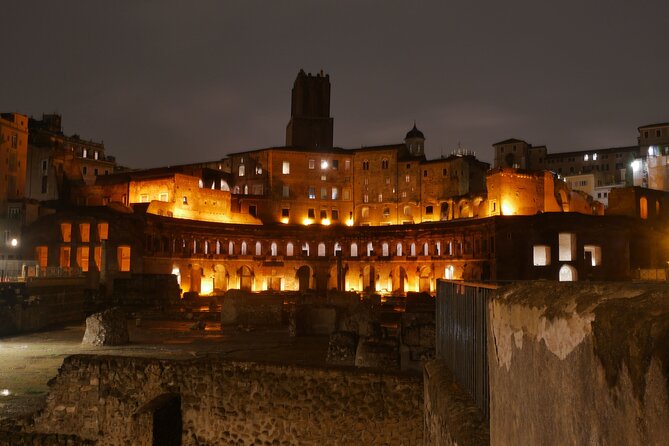
The walk passes the Pontifical Gregorian University, identified as the first university founded by Jesuits. The stop lasts about nine minutes, giving the guide room to explain its place in Rome’s religious and educational life.
This section helps prevent the tour from becoming only a checklist of famous fountains and monuments. You get smaller historical reference points along the way, the sort of details that make the streets feel less like a string of photo backdrops.
The route is also social. The group size is limited to 12, and the guides work to keep people involved. Isuf, also called Joseph in some tour settings, has been praised for using questions and simple memory quizzes to make historical details stick. That style suits you if you enjoy a guide who talks with the group instead of delivering a long speech.
Same city, an entirely different afternoon:
- Vatican Museums & Sistine Chapel Tour with Optional Basilica
★ 4.3 · 67,413 reviews - Colosseum, Roman Forum & Palatine Guided Tour
★ 4.7 · 63,148 reviews - Vatican Museums, Sistine Chapel & St Peter’s Basilica Guided Tour
★ 4.5 · 39,149 reviews - Rome: Colosseum, Palatine Hill and Roman Forum Guided Tour
★ 4.8 · 32,814 reviews
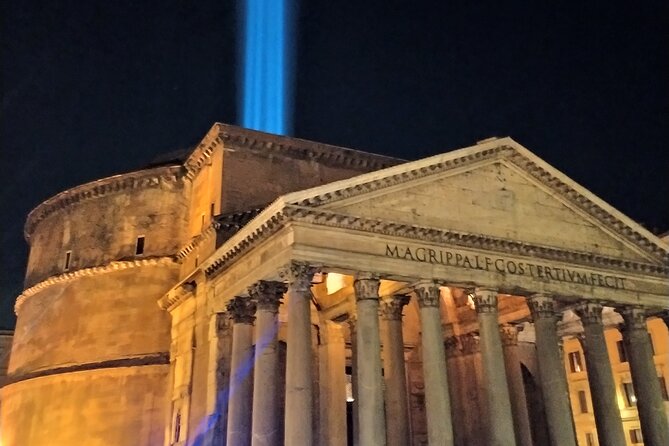
The Pantheon from the outside
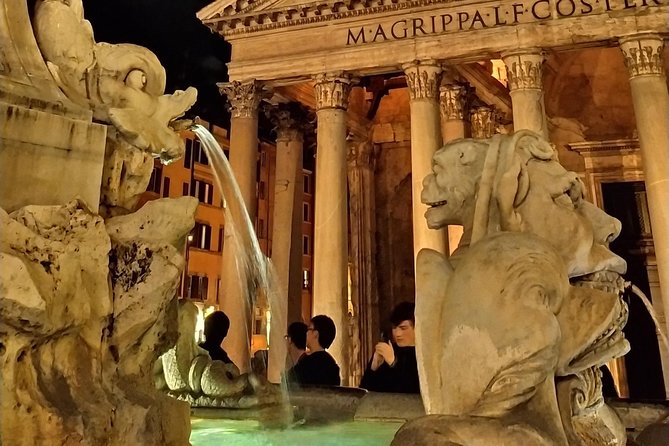
The Pantheon is one of the most important stops on the route. The building is among the best-preserved monuments from ancient Rome, and the guide spends roughly 10 minutes discussing it from the square.
At night, the surrounding piazza gives the Pantheon a more intimate setting than the Colosseum. You can look up at the massive front and columns, take in the stonework, and hear the basic story without dealing with a full museum-style visit.
Again, the tour does not include entry. That is both a limit and a benefit. You will not see the interior dome or the famous opening in the roof on this outing, but you also avoid turning the evening into a series of ticket checks. If the Pantheon is high on your list, mark it for a separate visit during the day and use this stop to get oriented.
Trevi Fountain needs patience and good photo timing
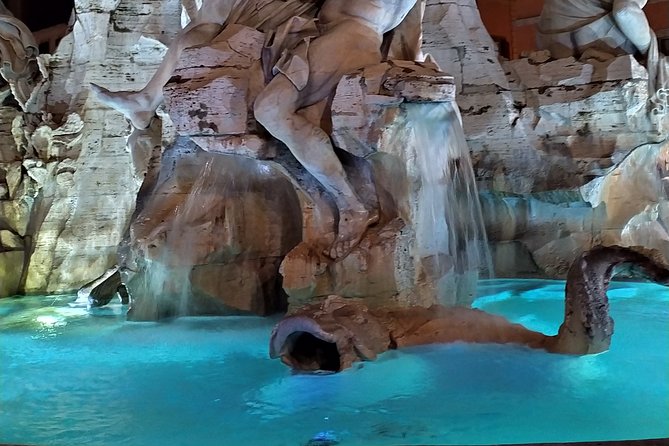
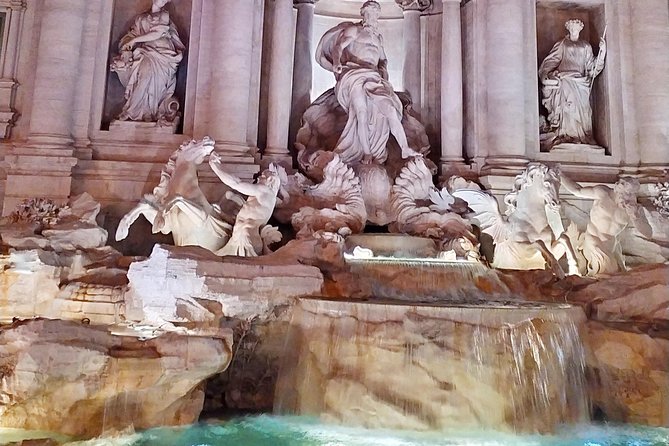
The Trevi Fountain receives about 15 minutes, and this is one of the evening’s main moments. The fountain is especially photogenic under the lights, with water and stone creating the theatrical effect that makes it one of Rome’s essential sights.
It can also be crowded. The guide’s role here is more than explaining the fountain. Isuf and other guides have been praised for finding workable photo positions and helping create clear pictures despite the people around the basin. That is useful because the Trevi Fountain is not an easy place to photograph casually.
You should not expect a quiet, private experience. The point is to see the fountain at night, hear its story, and get a good look without wasting time trying to work out the best position alone. Keep your belongings secure in the crowd and stay close to the group when the guide moves on.
The photo help is one of the tour’s strongest extras. Guides have taken pictures at several important stops, which is handy if you are traveling as a couple or family and usually end up with one person missing from every image.
Ending at the Spanish Steps
The final destination is Piazza di Spagna and the Spanish Steps. The steps are known for their distinctive design, formal elegance, and romantic setting, and the tour allows about 10 minutes here.
Ending in this part of Rome makes practical sense. You finish in a central area with places to continue your evening, and the tour ends at Piazza di Spagna, 77. One rating specifically notes that taxis are available near the finishing point, though you should still arrange your own return plans.
The Spanish Steps are not just a photo stop. They offer a good place to review the route, ask for suggestions, and decide what to see next. Guides have provided lists of restaurants and other local recommendations after the walk. That can be more useful than another ten minutes of formal history, especially if this is your first night in Rome.
The guide makes the biggest difference
The experience has earned a 5 out of 5 rating from 279 ratings, with 100 percent of participants recommending it. The strongest praise centers on the guides rather than on the fixed route alone.
Isuf and Joseph are names that appear repeatedly in the feedback, with Drita and Rita also praised for their warm, energetic approach. The names may vary by departure, so you should not assume a specific guide is guaranteed. What you can reasonably expect is a guide-led walk built around history, humor, questions, and conversation.
The best guides on this route do several things well:
- They explain Rome’s past in short, memorable sections.
- They keep the group moving without making the walk feel like a race.
- They pause for photographs at the main sights.
- They add suggestions for food, coffee, bars, and later sightseeing.
- They adjust to practical needs, including a bathroom or coffee break when possible.
One important point is the range of guide styles. Drita and Rita have been described as friendly and engaging, while Isuf and Joseph are often singled out for jokes, quizzes, stories, and a lively pace. If you prefer a quiet, highly academic lecture, this may feel informal. If you want history that is easy to follow after a long day of sightseeing, it should suit you well.
How much walking should you expect?
The walk covers a broad stretch of central Rome, from the Colosseum to the Spanish Steps. The stated duration is approximately 2 hours 30 minutes to 3 hours, though some outings have lasted closer to four hours.
That variation may come from photo stops, crowd conditions, questions, breaks, and the guide’s pace. Plan your evening around at least three hours, and do not book a tight dinner reservation immediately afterward.
The route requires moderate physical fitness. You should be comfortable walking on Rome’s hard streets and staying with a group as it moves between sights. Good walking shoes are essential. A small umbrella or rain jacket can also help, since one outing continued in light rain with umbrellas and rain gear.
The evening timing is a real advantage in warm weather. You avoid the strongest daytime heat, and the monuments can look more dramatic under artificial light. The drawback is that darkness limits your view of some architectural details, and crowds do not disappear entirely.
Price, group size, and what you receive
At $42.34 per person, the tour is fairly priced for a guided evening introduction, especially with a maximum of 12 people. You are paying for the guide’s route planning, explanations, group management, photo assistance, and local suggestions.
You are not paying for monument entry, transportation, food, or drinks. That keeps the cost clear, but you should budget separately if you want to enter the Colosseum or Pantheon later.
The value is strongest for a first visit. In one evening, you get exterior views of the Colosseum, Vittoriano, Pantheon, Trevi Fountain, and Spanish Steps, plus Piazza Venezia, Via dei Fori Imperiali, and the Gregorian University. You also receive a useful map in your head of central Rome.
The value is weaker if you already know the city well or want long visits inside monuments. In that case, a private guide or an interior-focused tour may better match your needs. This experience is about connections, context, and atmosphere.
Who should book this evening walk?
I would recommend it to first-time visitors who want to see the major central sights before deciding where to spend more time. It also suits couples, families with older children, and solo visitors who like the ease of joining a small group.
The minimum age is 11, while babies under two are free. Since the walk is active and includes no monument entry, it is best for people who can manage several hours on foot and do not need a slow, highly accessible route.
It is also a good choice if you want help with photographs. The guides have a knack for finding useful angles and creating pictures at crowded sights, particularly the Trevi Fountain. That small service can make a big difference when you want a record of the evening.
I would hesitate if you dislike group walking, need guaranteed indoor access, or want a detailed study of every monument. The route is broad and fast-moving by design. You will see many highlights, but each stop receives a limited amount of time.
Practical details before you book
Confirmation is provided when you book, and the tour is offered in English with a mobile ticket. It begins on Via del Monte Oppio and ends at Piazza di Spagna, so plan your transportation around two different locations.
The experience requires a minimum number of participants. If the operator cancels because that minimum is not reached, you are offered another date or experience, or a full refund. For your own cancellation, the booking is non-refundable and cannot be changed, so choose your date carefully.
The tour is generally booked 26 days ahead on average. That does not guarantee every date will sell out, but it is sensible to reserve early if your Rome schedule is fixed, especially if you want a particular evening.
Should you book it?
Book this tour if you want Rome’s greatest night views in one organized walk, with a guide who adds stories, humor, photo help, and food suggestions. It is an excellent first-evening orientation and a strong value at $42.34 when you make use of the guide’s local advice.
Skip it if entering the monuments is your main goal or if a long walk sounds tiring. For most first-time visitors who can handle the pace, the route offers a memorable way to meet Rome after dark and decide what deserves a closer look the next day.
FAQ
How long does the Rome night walking tour last?
The stated duration is approximately 2 hours 30 minutes to 3 hours. Some outings have lasted about four hours, depending on the pace, stops, photos, questions, and breaks.
Where does the tour begin?
The meeting point is Via del Monte Oppio, 3, 00184 Roma RM, Italy. Allow extra time to find it.
Where does the tour end?
The tour ends at Piazza di Spagna, 77, 00187 Roma RM, Italy, at the Spanish Square near the Spanish Steps.
Does the tour enter the Colosseum, Pantheon, or other monuments?
No. The monuments are viewed from outside, and admission tickets are not included.
What sights are included?
The route includes the Colosseum, Via dei Fori Imperiali, Piazza Venezia, the Vittoriano, the Pontifical Gregorian University, the Pantheon, Trevi Fountain, and the Spanish Steps.
Is the tour suitable for children?
Participants must be at least 11 years old. Babies under two are free.
How large is the group?
The tour has a maximum of 12 participants. It is offered in English and includes an official tour guide.
More Evening Experiences in Rome
- Rome: City Highlights Open-Top Bus Night Tour
★ 4.1 · 2,038 reviews - Vespa Sidecar Tour By Night with Pickup
★ 5.0 · 1,803 reviews - Rome by Night – Ebike Small Group Tour – Food and Wine (Option)
★ 5.0 · 1,275 reviews - Colosseum Sunset Tour with Entry
★ 4.5 · 1,230 reviews
Fresh on the Rome list
- Rome: Guided Catacombs Tour & Capuchin Crypt (Audio Guide)★ 4.3 · 191 reviews
- Guided tour of the Colosseum, Roman Forum and Palatine in Spanish★ 4.5 · 191 reviews
- Rome: Borghese Gallery Guided Tour with Skip-the-Line Ticket★ 4.5 · 192 reviews
- Rome: Arena Colosseum Tour with Arena Access★ 4.6 · 193 reviews
- Colosseum, Forum, Palatine Hill with audio guide and Arena or Bus option★ 4.0 · 193 reviews
- Rome: Colosseum & Roman Forum Guided Tour★ 5.0 · 194 reviews
- Rome: Domus Aurea Guided Tour and Virtual Reality Experience★ 4.7 · 194 reviews
- Rome by Night Private Walking Tour★ 5.0 · 194 reviews
Walking Tours, compared.
Guided Walking Tour & Last Supper Visit with Ticket
Read our review →
Rialto Bridge & Offbeat Unusual Venice Walking Tour
Read our review →
Private 3 hrs Venice Tour: St Mark’s, Walking tour & Boat tour
Read our review →
Skip the line: Uffizi and Accademia Small Group Walking Tour
Read our review →Browse the lists this tour appears in