
Reviewed · UFFIZI & ACCADEMIA GALLERY TOURS
Skip-the-Line Accademia Tour – See Michelangelo’s David!
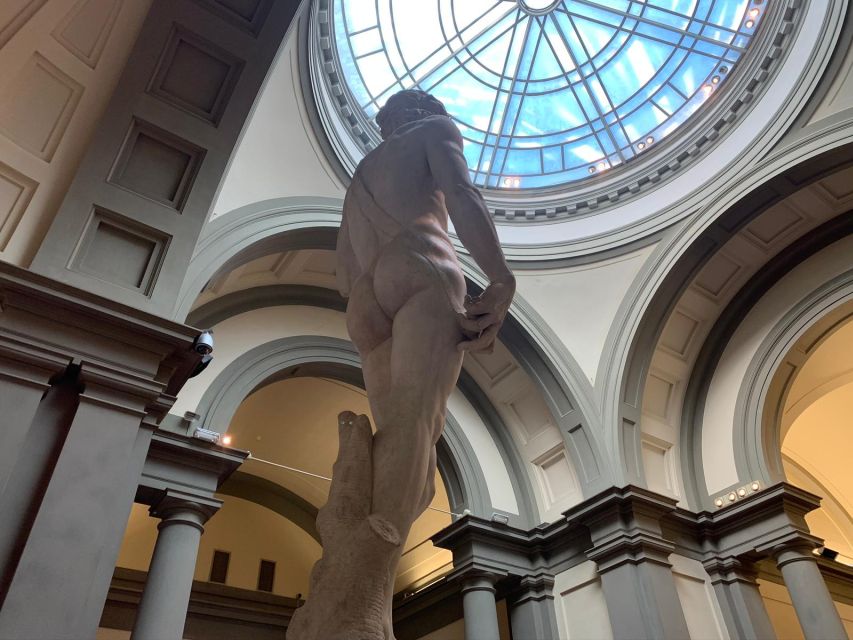
Michelangelo’s David is the clear star here: a 5-meter marble figure that feels even more impressive when a guide explains why Florence placed so much meaning on it. This tour gets you into the Accademia Gallery through a separate entrance, then gives you a focused hour with David and the museum’s main rooms.
I like the small groups of up to nine, which make it easier to hear and ask questions. I also like the guides’ strong storytelling, especially on Michelangelo, Florence’s politics, and the unfinished Prisoners. The main consideration is price: at $70 per person, you pay a sizeable premium for the reserved entry and live explanation, and you may still wait 10 to 15 minutes before entering.
Key points to know before booking
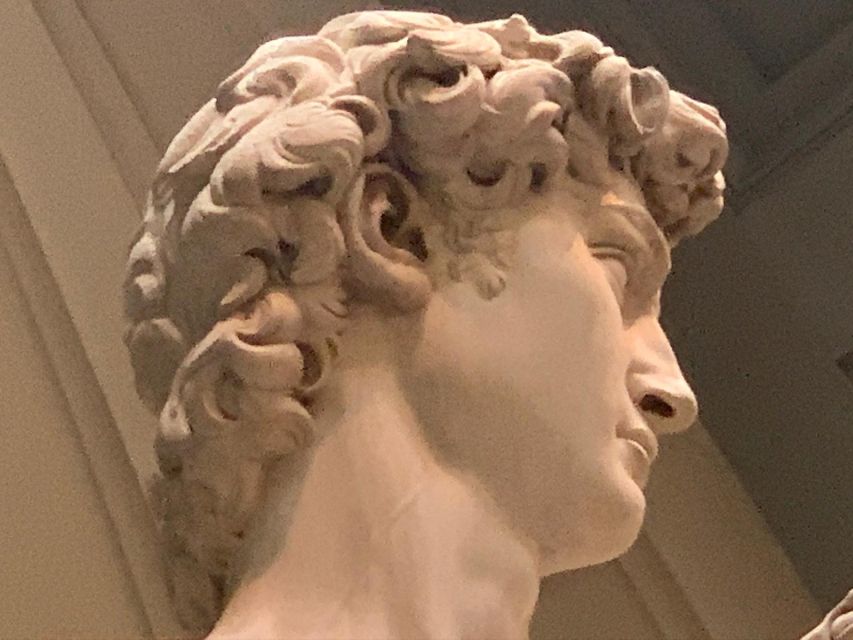
- David gets the attention he deserves: The guide explains its symbolism, commission, creation, and place in Florence.
- The Hall of Prisoners comes first: Michelangelo’s unfinished figures show the sculptor’s work emerging from the marble.
- A five-minute walk starts the visit: Meet at Via Cavour 21 red, then walk to the Accademia Gallery.
- The group is limited to nine: This is a more personal setup than a large museum crowd.
- You see more than one famous statue: The route includes Medici musical instruments, Byzantine-style paintings, and altarpieces.
- The tour lasts one hour: You can remain inside afterward and look around at your own pace.
Meeting near Via Cavour and reaching the museum

The meeting point is at Via Cavour 21 red. Florence uses two number systems on some streets, so the red number matters. The address is between 11 black and 13 black, and the red number is marked for the tour office, Florence Tours, Enjoy Biking.
From there, the group walks for about five minutes to the Accademia Gallery. That short walk is useful because it gives the guide a chance to gather everyone and explain the entry process before you reach the museum’s narrow, crowded street.
Arrive early. One past booking had a delayed start because tickets were not ready at the original time, and another group waited 10 to 15 minutes at the entrance. Skip-the-line means you avoid the regular public queue. It does not promise that security, ticket checks, or the museum’s tour entrance will take no time at all.
You receive audio equipment so you can hear the guide over the noise around David and the other visitors. This is a real help in a small but often crowded museum. One useful caution: interference with the listening equipment was reported on one tour, so keep your guide in sight and say something promptly if the sound cuts out.
More Skip-the-Line Tickets in Florence
- Florence: Skip-The-Line Uffizi Gallery Timed Entry Ticket
★ 4.5 · 27,832 reviews - Florence: Michelangelo’s David Skip-the-Line Entry Ticket
★ 4.5 · 12,764 reviews - Florence: Skip-the-Line Uffizi Small Group Tour
★ 4.6 · 5,926 reviews
Getting past Florence’s Accademia queue
The Accademia is one of Florence’s most popular stops, largely because it houses David. The regular line can stretch along Via Ricasoli, and the street outside is not a pleasant place to spend a large part of your morning or afternoon.
This tour uses a separate entrance for booked groups. That is the practical reason to pay more than the museum’s basic admission price. You are buying time as well as a ticket, which matters when your Florence schedule includes the Duomo, Uffizi Gallery, Santa Croce, or a train departure.
Do not read skip the line as a guarantee of instant entry. The group must still arrive at the right place, collect or verify tickets, pass through the museum’s controls, and enter as a unit. The separate entrance is a major advantage, but a short wait remains possible.
The staff at the meeting point also help organize late or confused arrivals. One booking arrived late, and the group operator made an effort to get the person inside and reunited with the tour. Still, I would not rely on that. Florence’s old center is easy to walk but full of wrong turns, and missing a timed museum entry can be costly.
The Hall of Prisoners: Michelangelo’s work in progress
Inside, the route begins with the Hall of Prisoners, one of the Accademia’s most rewarding rooms. The unfinished sculptures appear to be struggling out of blocks of marble. Their rough surfaces let you see the contrast between stone still waiting for the sculptor’s chisel and Michelangelo’s finished forms.
This is where a guide adds real value. On your own, you can admire the unusual figures, but you may not know how they help explain Michelangelo’s method. Guides commonly connect the Prisoners to the larger idea of liberation from stone, while also placing them in the setting of Michelangelo’s commissions and artistic career.
The room also prepares you for David. You see the labor before you encounter the polished result. Guides such as Julia, Elizabeth, Francesca, Elia, Irina, Laura, and Rosa have received especially strong praise for explaining the statues in clear, lively terms. Your guide will not necessarily be one of these people, but the company has a deep bench of English-speaking guides.
Give the Prisoners your attention rather than treating them as a quick passage to David. They are not secondary decorations. For many people, they are the best way to understand what makes Michelangelo’s sculpture different from a simple display of ideal beauty.
David up close, with context instead of a quick photograph
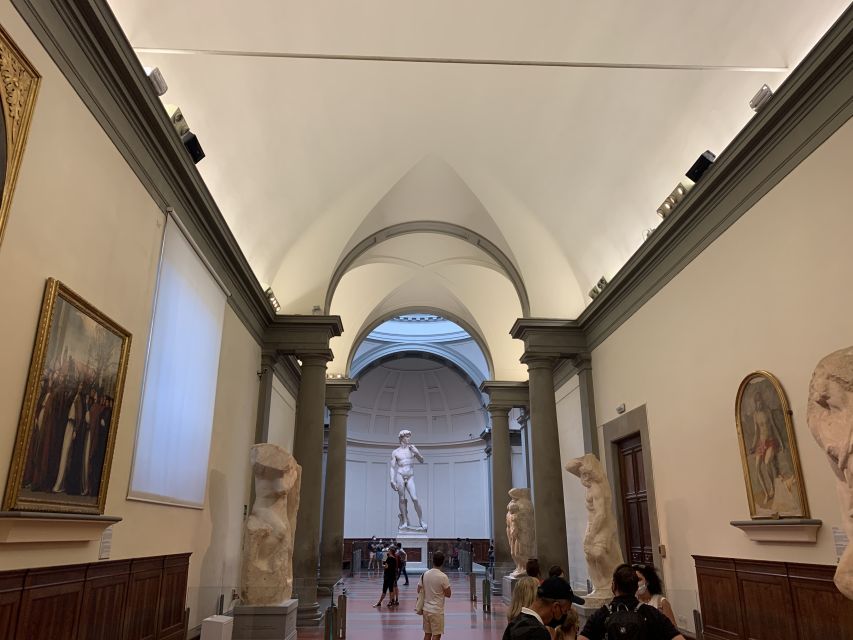
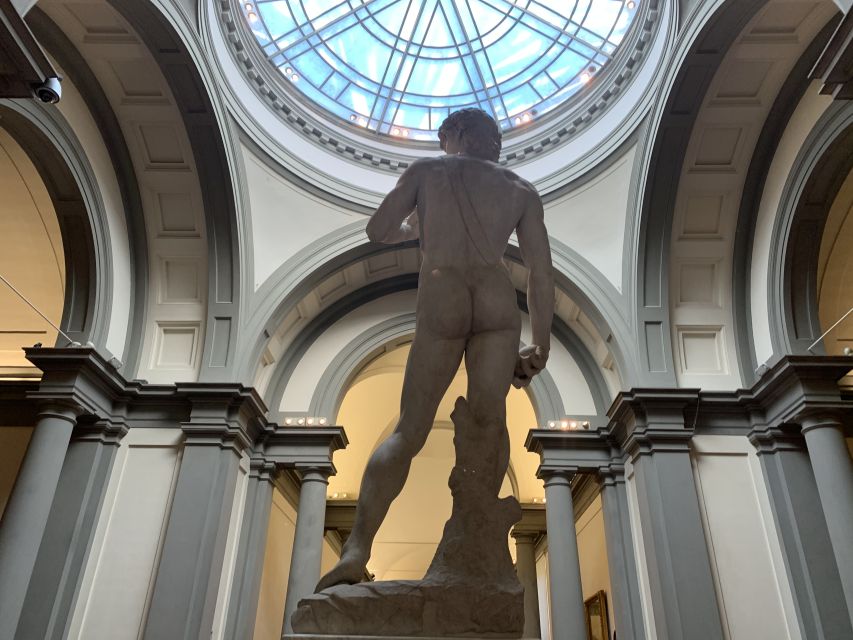
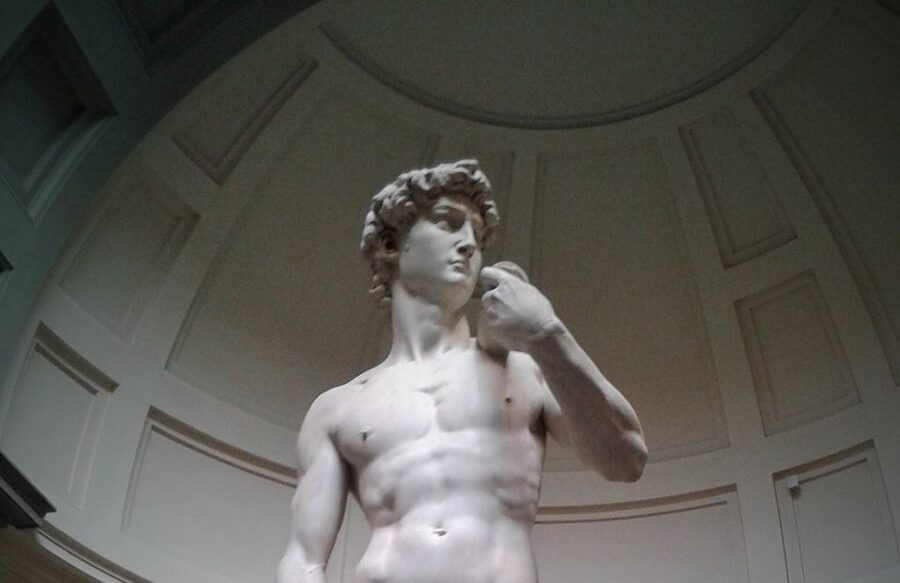
Then you enter the room that most people came to see. David is displayed beneath the high central space of the gallery, where you can walk around and view the figure from several angles.
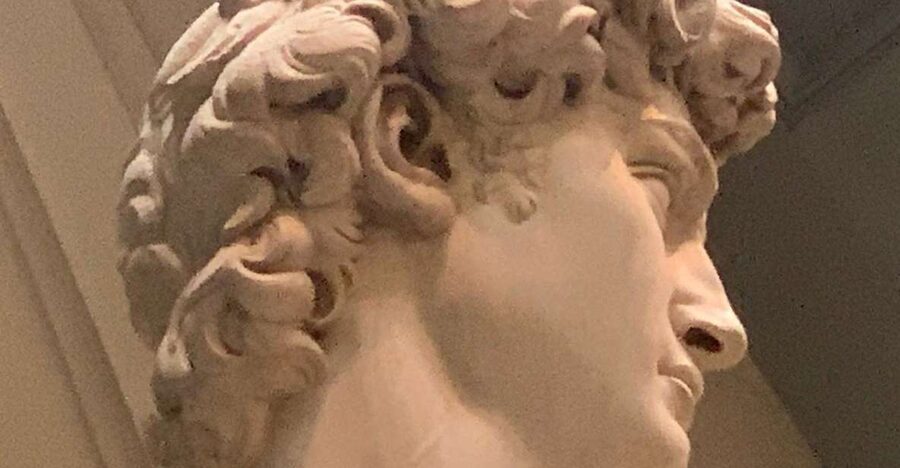
The sculpture is enormous, but the first impression is not simply size. It is the balance between physical power and concentrated thought. The face, hands, posture, and careful details invite you to look for the moment before action. Your guide explains the statue’s symbolism and why David became tied so closely to Florence’s civic identity.
A good explanation also helps you avoid the usual rushed visit. Many people walk in, take a photograph, and leave without noticing the choices that make the statue memorable. The guides praised most highly on this tour, including Elizabeth, Julia, Francesca, Rosa, Thomas, and Elia, are described as spending time on both Michelangelo’s life and the political setting around the work.
One guide connected Michelangelo’s return to Florence, his early artistic influences, and the politics of his period. That sort of background makes David more than a famous body carved in marble. It shows you how art, public power, religion, and local pride met in Renaissance Florence.
The space can be crowded, so your guide may need to adjust position and timing. Laura was specifically praised for handling the crowds while pointing out small details that are easy to miss. The audio system helps, but you should still stay close enough to see the guide’s gestures and follow the group.
The tour leaves you time to take photographs after the explanation. Photography rules and crowd movement can change, so follow the museum staff rather than assuming you can use your camera anywhere. You may also remain in the gallery after the guided hour and look at the rooms again on your own.
A few other Florence mornings to weigh against this
- Florence: Timed Entrance Ticket to Michelangelo’s David
★ 4.6 · 16,983 reviews - Florence: Cathedral & Brunelleschi’s Dome Ticket & Audio App
★ 4.4 · 6,973 reviews - Florence: Michelangelo’s David Priority Ticket & Audio App
★ 4.4 · 6,812 reviews - Florence: Uffizi Priority Ticket & Masterpieces Audio App
★ 4.2 · 6,402 reviews
Medici instruments and the museum’s less famous rooms
The Accademia is not only a Michelangelo museum. The route continues to the Musical Instruments Museum, which contains pieces from the Medici collection, including Stradivari violins and early pianos.
This section gives the visit welcome variety. After several marble figures, the instruments shift your attention to sound, court life, craftsmanship, and collecting. If you are traveling with children or with someone less focused on sculpture, this room can keep the hour from feeling too narrow.
The guide’s role here is to point out why these objects belong in a museum devoted to Florence’s artistic development. You are not simply seeing old instruments behind glass. You are seeing how powerful families used music and artistic objects as part of court culture.
The museum is fairly small, so expectations matter. You should not book this experience expecting a full-day art museum. The main attractions are David, the Michelangelo sculptures, and the instrument collection. Beyond those rooms, you will find religious paintings, medieval works, and altarpieces. They are worth seeing, but the themes can begin to feel repetitive if you are not interested in sacred art.
Byzantine-style paintings and altarpieces
The final part of the visit touches on paintings and altarpieces that show Florence’s movement from medieval artistic traditions toward the Renaissance. The Byzantine-inspired works tend to use formal poses, symbolic presentation, and a more restrained visual language than the later works.
A guide helps you read that change. Rather than treating every painting as an isolated object, you can follow the development of style across the rooms. One guide was praised for explaining how and why styles changed through different periods, turning what might seem like a row of similar religious paintings into a short lesson in art history.
This is also the section where the one-hour limit becomes noticeable. The museum offers more than can be covered in depth during a brief guided visit. You will receive an introduction to these paintings and altarpieces, not a full explanation of every major work.
I see that as a sensible trade-off. The tour is built around David and Michelangelo, with enough of the rest of the collection to give the museum shape. If medieval and Renaissance painting is your main interest, plan to stay afterward or return with a separate ticket and more time.
Why the one-hour format works, and where it falls short
One hour is a good length for a first visit to the Accademia. You get the essential rooms without spending half a day in a relatively compact museum. It also fits neatly into a busy Florence plan.
The short format keeps the guide focused. You are unlikely to spend too long on minor objects when David, the Prisoners, and the Medici instruments need attention. This works especially well if you are in Florence for only a day or two.
The drawback is that the tour can feel brisk. If you want to study paintings, compare altarpieces, or stand quietly with David, the guide’s schedule may not give you enough time. The answer is simple: follow the guided route, then stay inside afterward to revisit what interested you.
The tour operator allows participants to remain in the gallery after the guided portion. That detail improves the value because you are not forced to leave after the one-hour explanation. You can use the guide for orientation, then slow down on your own.
What $70 buys you in Florence
At $70 per person, this is not the cheapest way to see David. The museum ticket itself costs less when you can secure a regular reservation, so the price difference should be understood as payment for three things: access at a chosen time, a separate entrance, and a live English-speaking guide.
For a last-minute booking, the value is stronger. Several people turned to this type of tour after direct museum tickets were sold out. If seeing David is a high priority and your Florence dates are fixed, paying more can protect one of the city’s essential visits.
The guide is the other major part of the value. A self-guided visit gives you the statue, but a strong guide adds the story of Michelangelo, the Prisoners, the politics around David, and the museum’s other collections. Several people described the experience as closer to an art history lesson than a basic museum entry.
The value is less clear if you already know Renaissance sculpture well or if you can obtain a regular Accademia ticket easily. You may prefer to enter independently, take your time, and use a book or audio guide. Also note that the cost does not drop on days when museum entry is free, according to one booking, so check Florence’s free-admission dates before paying.
Who will get the most from this tour?
I would choose this experience if you want David explained rather than simply photographed. It suits first-time visitors, people with limited time, and anyone who finds museums easier to enjoy when a guide gives the objects a clear order.
Families can also do well here. One guide was praised for speaking at a moderate pace and keeping two young children interested with stories. The small group helps, since you can hear the explanation and ask a question without trying to catch a guide across a crowd.
Art students and serious museum fans may appreciate the background on Michelangelo, but they should treat the visit as an introduction. The one-hour route cannot cover every painting or detail. Stay afterward if you want a closer look.
The tour is wheelchair accessible, and the listed language is English. Food, drinks, and hotel pickup are not included, so arrange those separately. The meeting point is central, and the walk to the museum is only five minutes.
You can cancel up to 24 hours before the activity for a full refund, and the reserve-now, pay-later option keeps payment flexible. Starting times vary, so check the available slot against lunch, other timed tickets, and your travel plans.
Should you book the Accademia tour?
Book it if avoiding Florence’s long queue matters and you want a guide to explain why David and the Prisoners matter. The strongest part of the experience is the combination of fast-track entry and focused storytelling, especially when you get a guide like Julia, Elizabeth, Francesca, Rosa, or Elia.
Skip it if you prefer silent, unhurried museum visits, already have a regular Accademia ticket, or mainly want to study paintings beyond Michelangelo. At $70, the tour earns its price through convenience and interpretation, not through a large itinerary.
For most first-time visitors, I think the sensible plan is to take the one-hour tour, listen closely in the Michelangelo rooms, then remain inside afterward. That gives you the best of both approaches: a clear explanation first, and free time to look again on your own.
FAQ
Where does the Accademia tour meet?
Meet at Via Cavour 21 red, between 11 black and 13 black. The red number is the one to use for the meeting point.
How long is the tour?
The full activity lasts one hour. About five minutes are spent walking from the meeting point to the Accademia, and the guided museum visit lasts about 55 minutes.
What language is the tour conducted in?
The live tour guide speaks English. Audio equipment is provided so you can hear the guide during the museum visit.
Does the tour include Accademia Gallery admission?
Yes. The price includes an Accademia Gallery entry ticket with skip-the-line access through a separate entrance.
Can I stay in the museum after the guided tour?
Yes. You are allowed to remain in the gallery after the guided experience and continue looking around on your own.
Is the tour wheelchair accessible?
Yes. The activity is listed as wheelchair accessible, and the group size is limited to nine participants.
Fresh on the Florence list
- Semi Private Deep Wine Chianti and San Gimignano from Florence★ 5.0 · 191 reviews
- From Florence: Wine Tasting and Dinner in Chianti Vineyards★ 4.6 · 192 reviews
- Small Group Florence Cathedral Guided Tour with Priority Access★ 4.0 · 192 reviews
- Hard Rock Cafe Florence with Set Menu for Lunch or Dinner★ 4.5 · 193 reviews
- Florence Sunset Food Tour with Wine & Dine at a Tuscan farmhouse★ 5.0 · 194 reviews
- Wine Experience In Chianti Hills from Florence★ 4.5 · 195 reviews
- Brunelleschi’s Dome and Cathedral Complex Reserved Ticket★ 4.5 · 195 reviews
- Florence: Duomo Complex Guided Tour★ 4.2 · 195 reviews
Uffizi & Accademia Gallery Tours, compared.
Skip-The-Line Uffizi Gallery Timed Entry Ticket
Read our review →
Timed Entrance Ticket to Michelangelo’s David
Read our review →
Michelangelo’s David Skip-the-Line Entry Ticket
Read our review →
Cathedral & Brunelleschi’s Dome Ticket & Audio App
Read our review →
Michelangelo’s David Priority Ticket & Audio App
Read our review →
Uffizi Priority Ticket & Masterpieces Audio App
Read our review →
Florence Accademia Gallery Tour with Entrance Ticket Included
Read our review →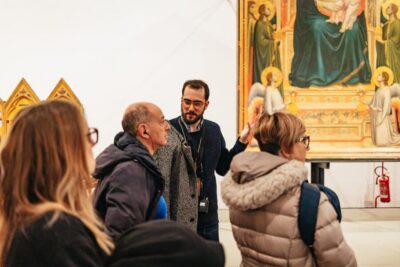
Browse the lists this tour appears in