
Reviewed · WALKING TOURS
Siena: Walking Tour and Skip-the-Line Duomo Tickets
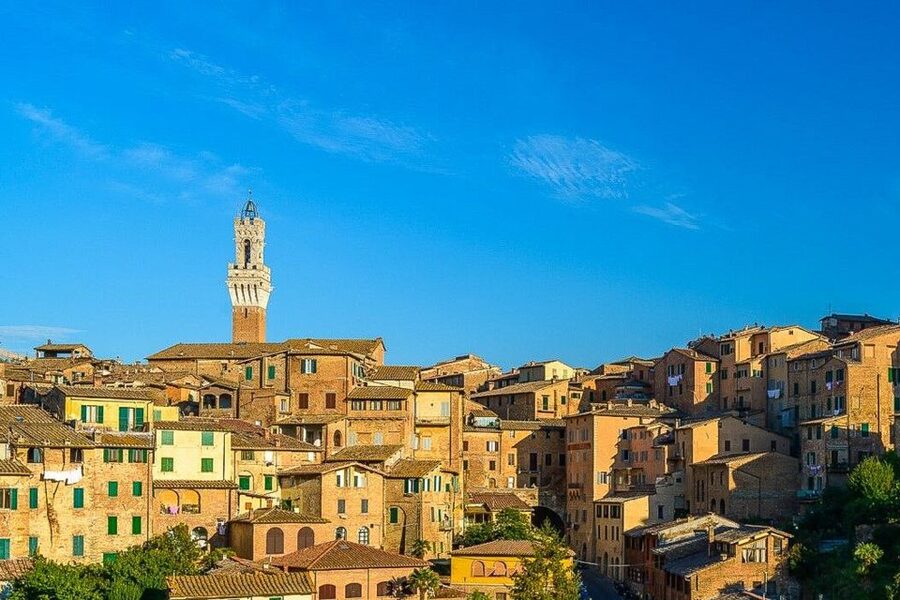
Siena’s greatest attraction is not one monument. It is the way the whole city still feels shaped by its medieval past. This tour takes you through narrow stone lanes, proud Gothic palaces, St Catherine’s church, the Palio neighborhoods, and finally into the dazzling Siena Duomo.
I like the local angle, especially the explanation of the Contrade, Siena’s fiercely loyal neighborhood districts. I also like that the cathedral comes at the end, when you can use the ticket to stay and look around on your own. The main drawback is time: two hours gives you a sharp introduction, not a leisurely visit to every stop.
Key points at a glance
- The Palio becomes easier to understand: Learn how Siena’s Contrade prepare all year for the bare-back horse race around Piazza del Campo.
- The Duomo ticket saves real time: Skip-the-line entry matters most during busy periods, when the cathedral queue can move slowly.
- Local guides make the difference: Elio, Claudia, Julia, Giorgia, Ambra, and Elena are among the guides praised for clear explanations, humor, and genuine affection for Siena.
- The route covers more than the main square: You see the Basilica di San Domenico, Palazzo Salimbeni, Palazzo Tolomei, Piazza del Campo, and the cathedral.
- The pace is active but manageable for walkers: Expect cobblestones, narrow streets, and church visits, with no hotel pickup included.
- Dress for church entry: Cover your shoulders and knees, and bring comfortable shoes for Siena’s uneven streets.
Why this short Siena tour works
At $47 per person, this experience sits in a sensible middle range for a guided city walk with cathedral admission included. You are paying for two useful things: a local guide who can connect Siena’s buildings to its customs, and a ticket that avoids the main cathedral line.
I see this as an orientation tour rather than a full-day cultural program. If you have only a morning in Siena, it helps you decide where to return later. If you have several days, it gives you the background to appreciate the city’s rival neighborhoods, art, and politics instead of simply photographing the prettiest façades.
The strongest part is the human touch. Guides such as Elio bring jokes and an easy pace, while Claudia and Giorgia are praised for turning local history into something personal and clear. Julia is noted for answering questions generously, and Ambra is particularly good at explaining the Palio tradition.
The tradeoff is group size. One past group had more than 30 people, which can feel crowded in small lanes and compact interiors. Headsets help, but audio quality is not always perfect. If English is not your first language, stay close to the guide and ask for a repeat when needed.
More skip-the-line tickets in Italy:
- Florence: Skip-The-Line Uffizi Gallery Timed Entry Ticket
★ 4.5 · 27,832 reviews - Vatican Museums & Sistine Chapel Skip-the-Line Entry Ticket
★ 4.4 · 13,838 reviews - Skip-the-Line Group Tour of the Vatican, Sistine Chapel & St. Peter’s Basilica
★ 4.5 · 12,779 reviews
Meeting under the tree at Piazza San Domenico
The tour begins at Piazza San Domenico, under the large tree in front of the church. That is a practical meeting point, but give yourself time to find it. Siena’s old center is built for pedestrians, with winding lanes and sudden changes in direction.
Starting here puts you near the Basilica di San Domenico, one of Siena’s important churches. The building is tied to St Catherine of Siena, patron of Italy, and the guide uses the church and its surroundings to explain her role in the city’s religious life.
This opening is more than a warm-up. Siena’s identity grew from a mix of religious devotion, civic rivalry, banking, trade, and neighborhood loyalty. You begin to see those threads before reaching the better-known Piazza del Campo.
Wear shoes with a firm sole. The route runs over cobblestones, and Siena’s streets can be tiring if you are used to smooth pavement. The activity is not suitable for people with mobility impairments, so consider that honestly before booking.
Basilica di San Domenico and the story of St Catherine
The Basilica di San Domenico gives the tour an early dose of Siena’s spiritual character. Here you learn about St Catherine and her importance to the city and to Italy.
I like this stop because it puts a face on Siena’s past. Instead of hearing only about rulers and buildings, you get a sense of the religious figures who shaped the town’s reputation. The guide also has a chance to explain how devotion and civic pride overlap in Siena.
The limitation is that time spent here is time not spent inside the cathedral. One person wanted less attention on St Catherine’s church and more time at the Duomo. That is a fair point if the cathedral is your main reason for booking.
Still, the church helps set up the rest of the walk. Siena is not just a museum of Gothic architecture. Its religious buildings remain central to the way the city explains itself.
Palazzi, banking, and Siena’s old wealth
From the church, the walk continues through the historic center, a UNESCO World Heritage Site. The streets lead to buildings that reveal how rich and influential Siena once was.
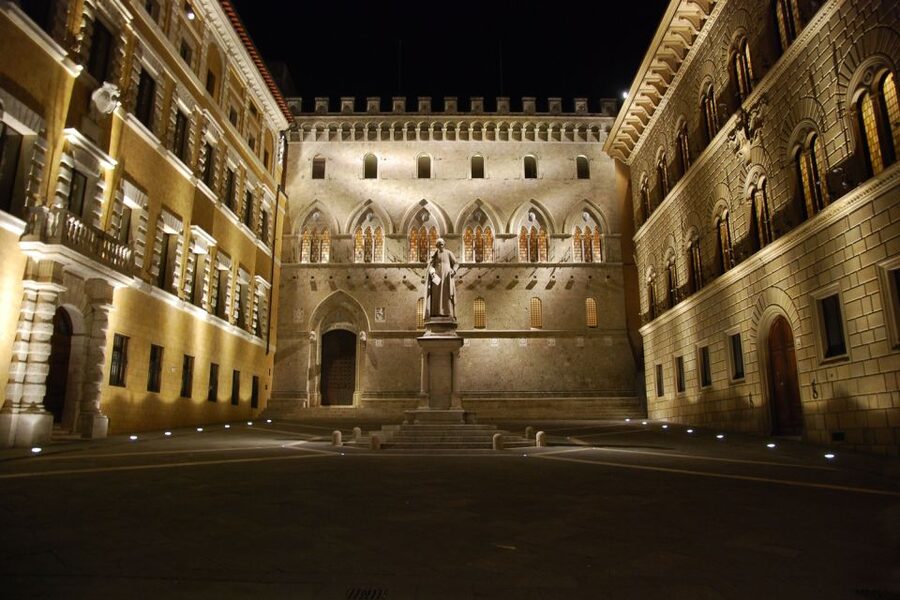
Palazzo Salimbeni is especially interesting. It is now associated with the world’s oldest bank, and its presence gives the guide a way to talk about banking, commerce, and the money that supported Siena’s art and grand construction.
You also see Palazzo Tolomei, an imposing private Gothic building. It is not the kind of place where you need a long interior visit to understand its value. The exterior tells the story through its scale, stonework, and position in the city.
This section works best when you listen for the connection between trade and beauty. The Duomo did not appear by magic. Siena’s wealth helped fund the churches, palaces, sculpture, and public spaces that make the center so memorable.
The bank stop may feel less exciting than the cathedral or Piazza del Campo. If you care mainly about art, you may wish the guide moved faster here. If you like seeing how a city functioned, it is a useful piece of the puzzle.
More walking tours in Italy:
- Milan: Guided Walking Tour & Last Supper Visit with Ticket
★ 4.7 · 5,409 reviews - Naples: Street Food Walking Tour with Local Guide
★ 4.8 · 4,256 reviews - Venice Walking Tour and Gondola Ride
★ 3.5 · 3,630 reviews - Venice: Rialto Bridge & Offbeat Unusual Venice Walking Tour
★ 4.2 · 3,538 reviews
Piazza del Campo and the living tradition of the Palio
Piazza del Campo is Siena’s great public room. The square is the setting for the Palio, the famous bare-back horse race held around its curved center.
The guide explains the Contrade, the city neighborhoods that compete in the race. These are not simply administrative districts on a map. They carry names, symbols, loyalties, and traditions that still matter to local residents.
This is one of the tour’s most valuable subjects because the Palio can look bewildering if you encounter it without context. The race lasts only a short time, but the preparation and neighborhood pride continue throughout the year. The guide helps you see why a city festival can feel like a central part of daily identity.
Do not expect to attend the race on this tour. You visit the square and learn how the tradition works. The value is the explanation, especially if you plan to return to Siena during Palio season.
Piazza del Campo is also the point where the route’s ideas come together. Politics, religion, banking, neighborhood loyalty, and public spectacle all meet here. The guide can turn a beautiful square into a readable one.
Siena Cathedral and its astonishing interior
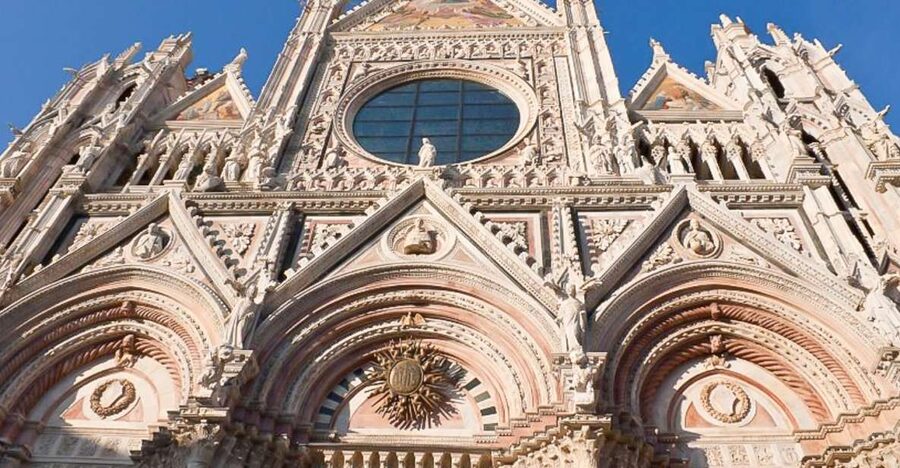
The final major stop is the Duomo of Siena, officially the cathedral. This is the payoff for many people, and the skip-the-line admission is a practical reason to choose this tour over a basic street walk.
Inside, expect centuries of art and devotion packed into a single building. The tour includes the chapels and masterpieces associated with artists such as Donatello, Michelangelo, and Bernini, along with other important works.
The cathedral is not a quiet, empty shell. There is a great deal to see, and a guide helps you know where to look. You may otherwise miss the importance of a sculpture, chapel, or decorative detail because the interior presents so much at once.
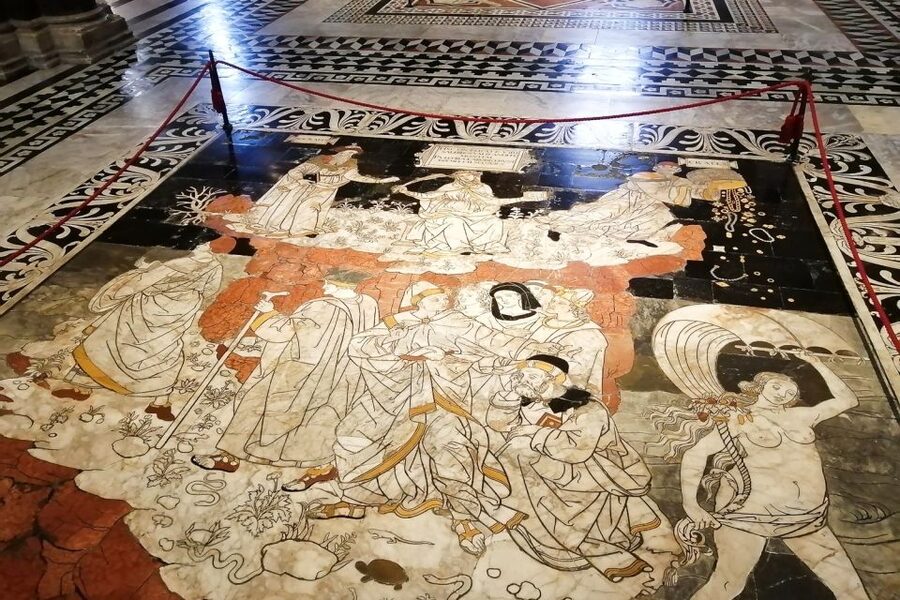
The cathedral floor is another major attraction. At times, large sections may be uncovered, allowing you to see its detailed marble design. The amount visible can vary, so do not book solely on the promise of seeing every section.
The cathedral is scheduled as the last part of the route. That is smart planning. You finish with the most visually powerful stop, and you can generally remain inside after the guided portion ends instead of being hurried back into the streets. One visitor used the opportunity to ask at the visitor center about adding other museum areas by paying the difference, but those extra admissions are not included in this activity.
What the guides add to the walk
This tour depends heavily on the person holding the microphone. The guide names most often praised include Elio, Claudia, Julia, Giorgia, Elena, Ambra, and Giulia.
Elio is described as funny, lively, and generous with practical advice. His restaurant and gelato suggestions can be useful after the tour, especially if you want to avoid obvious tourist traps. Claudia brings strong local pride and explains the neighborhoods, art, and architecture with warmth. Julia is noted for clear English, humor, and patience with questions.
Giorgia is praised for keeping a busy itinerary on track while still allowing time to look around. Ambra adds memorable stories about the Palio. The exact guide is not something you can assume in advance, but the repeated strength of the guiding team is a good sign.
You should expect storytelling, not an academic lecture. The best guides balance dates and names with local customs and personal insight. If you enjoy asking questions, this format should suit you.
Headsets are provided and are particularly useful in crowded streets or inside the churches. Bring your own compatible earphones only if you know they work with the tour equipment. Audio clarity has been mixed for some people, so standing near the guide remains wise.
Is two hours enough?
Two hours is enough to cover the main storyline of Siena, but not enough for an unhurried examination of every church and palace. The route is busy, though several people found the pace comfortable and not rushed.
Think of the tour in three parts:
- An introduction to Siena’s religious life and St Catherine
- A walk through its civic, banking, and Palio traditions
- A guided visit to the Duomo
That is a lot for 120 minutes. You will get a broad view, then you can choose what deserves more of your own time. I like this approach for a first morning in the city.
If you want extended time inside the cathedral, a slower look at every artwork, or a dedicated Palio history tour, you may find the schedule tight. One person specifically wished for a longer option. The tour is best for getting your bearings fast and deciding how to spend the rest of your day.
Clothing, weather, and practical comfort
Church rules are firm. Wear covered shoulders and knee-length trousers or skirts. Short skirts, sleeveless shirts, and bare feet are not allowed. A light shawl is a useful addition, especially in warm weather when your main outfit may be sleeveless.
The route operates in ordinary sightseeing weather, and rain does not necessarily ruin it. Several guides kept groups engaged during wet conditions, but Siena’s cobblestones become less comfortable when damp. Carry suitable footwear and a rain layer if the forecast looks poor.
There is no hotel pickup. You need to reach Piazza San Domenico yourself, then stay ready for a walking route through the old center. Because the streets are narrow and sometimes uneven, this is not the right choice if you need step-free access or have serious trouble walking.
Free cancellation is available up to 24 hours before the start, and you can reserve now and pay later. Those terms are helpful if your Tuscany schedule is still shifting, but check the current start times when you book.
Who should book this Siena experience?
I would choose this tour if you have limited time, want a clear introduction to Siena, or prefer to understand the city before exploring it alone. It is also a good fit if the Duomo queue worries you.
You will get the most from it if you:
- Have one morning or afternoon in Siena
- Want an English-speaking local guide
- Care about the Palio and Contrade
- Like history explained through stories and local customs
- Want cathedral entry included
- Can comfortably walk cobblestone streets for two hours
I would think twice if you dislike group tours, need a slow pace, or want to spend most of the time inside the cathedral. A large group can make narrow streets feel crowded, and the supplied audio equipment may not always be crystal clear.
At $47, I consider it good value for a first visit, especially in a busy season when skipping the cathedral queue saves time. The tour is less compelling for someone who already knows Siena well and only wants a long, quiet cathedral visit.
Should you book it?
Book this walking tour if you want Siena to make sense, not just look pretty. The guide connects St Catherine, medieval banking, Gothic palaces, the Palio, and the Duomo into one compact story.
The two-hour limit is real, and the group may be larger than ideal. But the route is well chosen, the local guides bring personality, and the cathedral ticket adds practical value. For a short stay in Tuscany, I would use it early in your visit, then return to the places that caught your attention.
FAQ
How long does the Siena walking tour last?
The guided experience lasts two hours.
What language is the tour conducted in?
The tour includes a live English-speaking guide.
Where does the tour meet?
The meeting point is Piazza San Domenico, under the large tree in front of the church.
Is hotel pickup included?
No. Hotel pickup is not included, so you need to reach the meeting point yourself.
Does the tour include Siena Cathedral admission?
Yes. Skip-the-line entrance to the Duomo, or Siena Cathedral, is included.
Which artists can I see inside the Duomo?
The cathedral contains masterpieces associated with Donatello, Bernini, Michelangelo, and other artists.
What should I wear to enter the churches?
You need clothing that covers your shoulders, along with knee-length trousers or skirts. Comfortable walking shoes are also necessary.
Is the tour suitable for people with mobility impairments?
No. The activity is not suitable for people with mobility impairments because it involves walking on Siena’s cobblestone streets.
Fresh on the Italy list
- Florence: Uffizi Guided Tour with Skip-the-Line Entry Ticket★ 4.8 · 499 reviews
- Milan: Last Supper and Sforza Castle Guided Tour★ 4.6 · 498 reviews
- Boat trip La Maddalena Archipelago – Departure from Palau★ 4.5 · 499 reviews
- Exclusive Golf Tour Private VIP with Local & Gelato o Wine★ 5.0 · 500 reviews
- Turin: Egyptian Museum Skip-the-Line Group Tour★ 4.7 · 500 reviews
- Itria Valley: Polignano, Ostuni, and Locorotondo, from Bari★ 4.6 · 502 reviews
- Colosseum, Palatine Hill and Roman Forum with Guided Tour★ 5.0 · 500 reviews
- Catania: Etna Nature Tour with Hiking, Cave Visit, & Tasting★ 4.7 · 502 reviews
Walking Tours, compared.
Guided Walking Tour & Last Supper Visit with Ticket
Read our review →
Rialto Bridge & Offbeat Unusual Venice Walking Tour
Read our review →
Private 3 hrs Venice Tour: St Mark’s, Walking tour & Boat tour
Read our review →
Skip the line: Uffizi and Accademia Small Group Walking Tour
Read our review →Browse the lists this tour appears in