
Reviewed · POMPEII & VESUVIUS TOURS
Sharing Tour of Pompeii
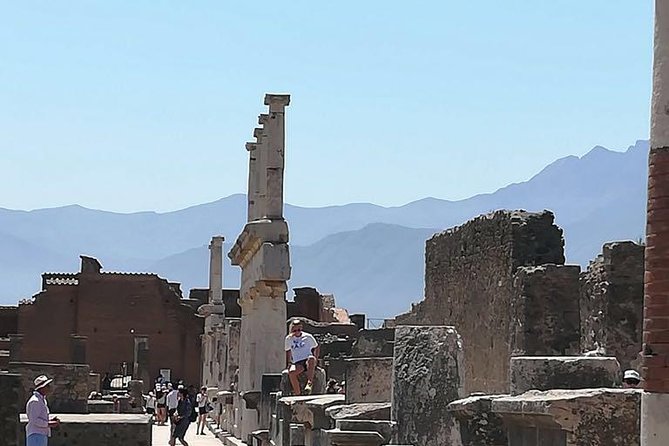
Pompeii gives you an unusually direct look at Roman daily life. This private 2.5-hour tour takes you beyond the famous streets to a Roman temple, the richly decorated Casa dei Vettii, and the lupanari, the small brothels preserved after Vesuvius buried the city in AD 79.
I like the small-group format, which keeps the price sensible for a party of up to eight, and I like the clear focus on three sites that show religion, domestic life, and the less polished side of Roman society. The English-language guide also helps you make sense of ruins that can otherwise feel like a maze of stone walls.
The main caution is the extra entrance charge. The tour costs $193.49 per group, but Pompeii admission is not included and is listed at €20 per person. Also, one serious complaint records a late cancellation, so I would avoid building an unchangeable schedule around this booking until your tour is firmly confirmed.
Key points to know before you book
- Three sharply different Pompeii stops: See a Roman temple, the elegant Casa dei Vettii, and the lupanari.
- Private group pricing: The $193.49 rate covers up to eight people, not each person individually.
- Pompeii admission costs extra: Budget €20 per person for the entrance ticket.
- English guide included: The private guide is included, though no guide name is supplied in the tour details.
- Simple meeting point: Meet at Pompei Scavi Villa dei Misteri, where your guide waits with a Sharing Tour of Pompei sign.
- Highly rated, with one booking warning: The experience is recommended by 98 percent of travelers and rated 4.9 from 487 reviews, but a cancellation complaint deserves attention.
What this Pompeii tour actually gives you
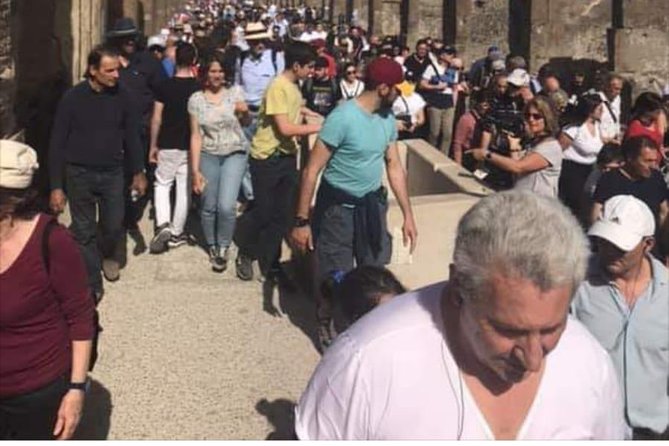
The name suggests a shared tour, but the practical setup is private. Only your group participates, and the advertised price covers as many as eight people. That makes this a useful option for a family, a group of friends, or several couples traveling together.
At $193.49, the value depends heavily on group size. For eight people, the guide portion works out to about $24 per person before admission. For two people, it is a much higher cost per head. You also need to add the €20 Pompeii entrance fee for each person, which is not part of the advertised price.
The tour lasts about two hours and 30 minutes. That is enough time for a focused introduction to several major themes, but not enough for every corner of the archaeological park. Pompeii is large, and you should book this with the right expectation: you are getting a guided selection, not an all-day examination of the entire city.
I see that as a strength if you have limited time. A guide can give your visit a clear shape instead of leaving you to wander from one partial wall to another. If you want to study every house, shop, bath, and public building, you will need more time in Pompeii after the tour.
A few other Pompeii mornings to weigh against this
- Pompeii: Entry Ticket and Guided Tour with an Archaeologist
★ 4.8 · 19,459 reviews - Pompeii: Entry Ticket with Optional Audio Guide
★ 4.2 · 12,360 reviews - Pompeii: Small Group Tour with an Archaeologist
★ 4.8 · 12,264 reviews
Meeting at Pompei Scavi Villa dei Misteri
The meeting point is Pompei Scavi Villa dei Misteri, at 80045 Pompei in the Metropolitan City of Naples. Your guide is supposed to wait with a Sharing Tour of Pompei sign, which gives you a straightforward way to identify the right person.
This detail matters because Pompeii has several nearby transport and entrance areas, and arriving at the wrong part of the site can waste precious minutes. The supplied information confirms that the meeting point is near public transportation, but it does not specify a hotel transfer route or a particular train or bus connection.
Pickup is offered, yet the clearest meeting instructions direct you to Villa dei Misteri. If you are counting on pickup, confirm the exact arrangement before the day of the visit. Do not assume that pickup means every hotel or every nearby town is covered.
The tour ends back at the meeting point. That is convenient if you want to continue exploring Pompeii on your own, return toward transport, or arrange lunch nearby. It also means you are not being dropped at a different part of the archaeological area.
A Roman temple and Pompeii’s religious world
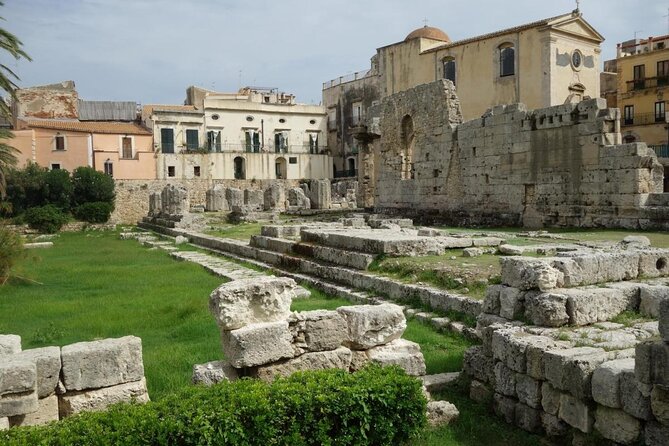
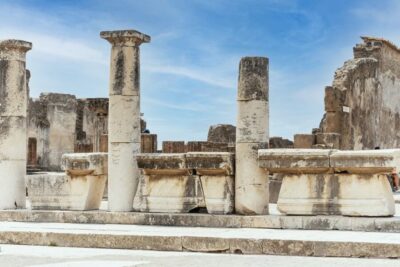
The first listed stop is a Roman temple buried in the eruption of Vesuvius in AD 79 and later recovered through excavation. The name of the temple is not supplied, so you should not book this expecting a particular sanctuary by name.
Still, the stop offers an important starting point. Pompeii was not simply a collection of private homes. Religion shaped the city’s public life, and a temple helps you see how worship, civic identity, and daily routines were connected.
A ruined temple can be harder to understand than a complete building. Columns may be broken, surfaces worn, and the original decoration incomplete. This is where a guide adds real value, explaining what you are looking at instead of leaving you with a few standing stones and a guess.
The stop also gives you a useful contrast with Casa dei Vettii. At the temple, the focus is public and religious. At the house, you move into the private world of wealthy Pompeii residents. That change from shared civic space to domestic display gives the short tour a sensible rhythm.
Casa dei Vettii, where Roman wealth went on display
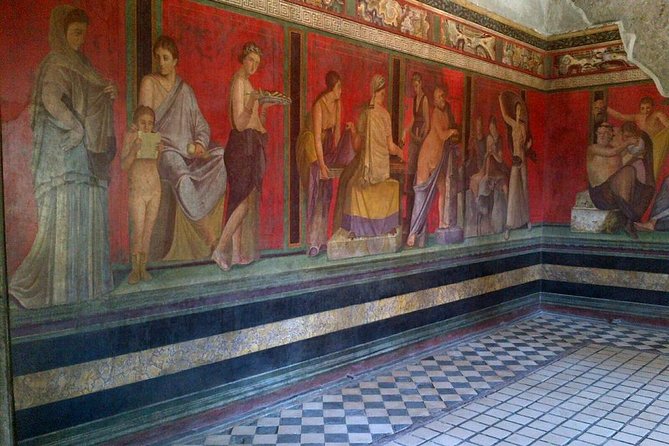
Casa dei Vettii is likely the artistic centerpiece of the experience. It was a Roman domus, or urban house, buried during the eruption and later uncovered by archaeological work. The house takes its name from its owners, the Vettii.
The home is described as one of the great examples of first-century Roman art. That makes it more than a stop for architecture fans. It gives you a chance to see how prosperous Romans used their homes to project status, taste, and social power.
The word house can be misleading. A Roman domus was not simply a private retreat in the modern sense. It could function as a place for family life, business, formal visits, and social display. The decoration mattered because visitors were meant to see it.
You should pay close attention to the artistic details your guide points out. The supplied information does not promise a specific fresco list or a particular route through the house, so I would not expect a fixed lecture on named rooms. What you can expect is a stop centered on Roman art and the identity of the homeowners.
Casa dei Vettii also makes the social divisions of Pompeii easier to discuss. The home represents wealth and presentation, while the lupanari later brings you to a more commercial and openly transactional part of Roman urban life. Put together, the two stops show that Pompeii was not frozen into one neat picture of Roman culture.
One practical point: archaeological sites can change access to individual buildings. The tour information identifies Casa dei Vettii as a stop, but it does not promise that every room will be open at every departure. Your guide can explain what is accessible on the day you visit.
Same city, an entirely different afternoon:
- Pompeii Small Group Tour with an Archaeologist
★ 5.0 · 6,593 reviews - Pompeii: Skip-the-Line Entrance Ticket with Audio Guide
★ 4.0 · 2,509 reviews - Naples: Pompeii and Mt. Vesuvius with Lunch and Wine Tasting
★ 4.5 · 2,454 reviews - Pompeii: Archaeological Park Tour with Ticket on request
★ 4.5 · 2,283 reviews
The lupanari and Pompeii’s frankest subject
The lupanari were brothels, named from the Latin lupa, meaning prostitute. These establishments offered paid sexual services during the Roman period, and some remain visible among Pompeii’s ruins.
This is not a polished or sentimental stop. That is precisely why it matters. The lupanari bring the tour into contact with a part of Roman life that is often softened in popular accounts. Pompeii preserved evidence of commerce, sex, and ordinary transactions alongside temples and decorated homes.
The stop may interest you most if you want Pompeii to feel like a real city rather than a museum of grand monuments. The lupanari show that ancient urban life included businesses serving practical demands, and that Roman society cannot be understood only through elite villas and public buildings.
Families should think about the group’s comfort before booking. The tour details describe the lupanari plainly, but they do not provide an age recommendation or a warning about the level of detail used by the guide. If you are visiting with children, decide in advance whether this subject fits your group.
The lupanari also give the guide a chance to explain how archaeologists identify a building’s function. You should listen for evidence rather than relying on modern assumptions. The value of this stop is not only the subject itself, but the way the ruins reveal the working life of an ancient town.
Why the three-stop plan works in two and a half hours
The route brings together three different parts of Pompeii:
- A Roman temple for religious and civic life
- Casa dei Vettii for private wealth and first-century art
- The lupanari for commercial and social history
That is a smart selection for a short visit. You get variety without spending the entire time on one type of building. The sequence also helps you compare public belief, domestic display, and paid services.
The limitation is coverage. Two hours and 30 minutes passes quickly in an archaeological park, especially when you include meeting, ticket arrangements, walking, and explanations. You are unlikely to see every famous area of Pompeii within this tour.
If this is your only visit, ask yourself what matters most. If you want a readable introduction with a few memorable stops, the plan makes sense. If you want the amphitheater, baths, bakeries, streets, gardens, and a long look at other villas, you may need a separate period of independent sightseeing.
Because the group is private, you can ask questions and set the pace within reason. The tour is still limited by its duration, but a private group is generally better suited to questions than a large public departure. The details do not promise a fully customized route, so treat the itinerary as the core plan rather than an open invitation to redesign the visit.
Price, tickets, and the real value
The listed cost is $193.49 per group of up to eight. That is the first figure to consider, but it does not tell the whole story. Pompeii admission is separate, at €20 per person, and the tour information makes clear that the entrance ticket is never included.
For a group of eight, the guide price is reasonable for a private experience. For a smaller party, the cost is less attractive, though you are paying for privacy rather than simply buying a seat on a large group tour.
The wording about tickets can be confusing. One part says tickets are bought daily for customers, while another clearly says the €20 admission price is not included. I would treat this as a ticket-purchasing service, not free admission. Confirm how payment and collection work before you arrive.
Soda or pop and a tip are also excluded. Those are small costs compared with the entrance fee, but it is useful to know what the advertised price does and does not cover.
The best value comes when you divide the guide cost among several people and care about interpretation. If you are comfortable reading signs and planning your own route, independent entry may cost less. If you want a private English-speaking guide to connect the ruins and answer questions, this package has a stronger case.
Booking timing and the cancellation concern
The experience is often booked about 50 days in advance. That suggests you should not leave it until the last minute if the date matters to you, especially during a busy Pompeii visit.
Free cancellation is available up to 24 hours before the start time for a full refund. Changes made inside that 24-hour window are not accepted, and a late cancellation by you is not refunded. The cut-off follows local time.
There is also a minimum number of travelers requirement. If the operator cancels because that minimum is not met, you are offered another date or experience, or a full refund.
One poor rating describes being informed in the middle of the night that the tour would not take place. The complaint also raises the issue of a booking marked confirmed but not guaranteed. This is not enough to erase the strong overall score, but it is enough for practical caution.
I would keep your confirmation details handy and contact Tours Pompei directly if the status is unclear. If Pompeii is tied to a cruise departure, train reservation, or same-day flight, leave backup time. A tour with a late change can disrupt a tightly packed Italian itinerary.
Who will get the most from this visit
I would choose this tour for a group of friends or family members who want a private introduction without paying a per-person guide fee for eight separate people. It also suits a first Pompeii visit focused on meaning rather than maximum coverage.
The experience is a good fit if you want:
- An English-language guide
- A private group rather than a shared group with strangers
- A short, focused visit
- A mix of religion, Roman art, and everyday commerce
- Help identifying and interpreting difficult ruins
You may want another plan if you need a full-day archaeological visit, a named specialist guide, or a guaranteed hotel transfer. The supplied details do not provide a guide’s name, a full site map, or a detailed list of every building included.
Most people can participate, and service animals are allowed. The tour is near public transportation, though no specific route is provided. If mobility or access is a concern, ask the operator for current site details before booking, since the information here does not describe the walking surface or distance.
Should you book the Sharing Tour of Pompeii?
I would book it if you are traveling with several people, want a private English tour, and prefer three carefully chosen subjects over a rushed attempt to see all of Pompeii. Casa dei Vettii gives the visit artistic weight, while the temple and lupanari add religious and social context.
I would pause if you are traveling alone or as a couple and mainly want the lowest possible cost. The $193.49 guide fee becomes much less attractive when split between only two people, and the €20 entrance ticket still applies to everyone.
Before paying, confirm the tour status, the exact pickup arrangement, and how the separate admission ticket will be handled. With those points clear, this is a focused and useful way to read Pompeii through its public religion, private wealth, and commercial life.
FAQ
Where does the Pompeii tour start?
The tour starts at Pompei Scavi Villa dei Misteri, 80045 Pompei, in the Metropolitan City of Naples, Italy.
Where does the tour end?
The activity ends back at the meeting point.
How do I find the guide?
You should look for a guide holding a Sharing Tour of Pompei sign.
How long does the experience last?
The tour lasts approximately two hours and 30 minutes.
Is the tour private?
Yes. Only your group participates, and the advertised group size is up to eight people.
Is Pompeii admission included?
No. The Pompeii entrance ticket is not included. The stated ticket price is €20 per person.
Is an English-speaking guide included?
Yes. A private tour guide is included, and the tour is offered in English. No specific guide name is provided.
Can I cancel for a refund?
Yes. You can cancel at least 24 hours before the local start time for a full refund. Cancellations or changes made less than 24 hours before the start time are not accepted for a refund.
Fresh on the Pompeii list
- Stories of Pompeii: Small Group tour with archeology expert guide★ 5.0 · 191 reviews
- Mount Vesuvius: Vineyard Tour with Wine Tasting and Lunch★ 4.8 · 193 reviews
- Pompeii: Skip-the-Line Guided Tour with Expert Archaeologist★ 4.8 · 196 reviews
- Pompeii: 2 Hour Private Tour with an Archeologist Guide★ 5.0 · 214 reviews
- Pompeii: Skip-the-Line Entry & Audioguide★ 3.8 · 225 reviews
- Herculaneum: Tickets & Tour with a Local Archaeologist★ 4.8 · 226 reviews
- Pompeii and Mount Vesuvius Small Group Tour★ 4.5 · 233 reviews
- From Naples/Salerno: Pompeii, Sorrento, and Positano Tour★ 4.5 · 250 reviews
Pompeii & Vesuvius Tours, compared.

Entry Ticket and Guided Tour with an Archaeologist
Read our review →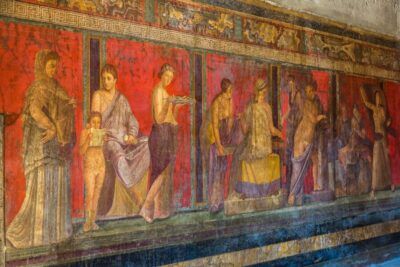



Pompeii Small Group Tour with an Archaeologist
Read our review →
Pompeii, Amalfi Coast and Positano Day Trip from Rome
Read our review →Browse the lists this tour appears in