
Reviewed · POMPEII & VESUVIUS TOURS
Private Day Tour to Vesuvius, Herculaneum & Pompeii with Pick Up
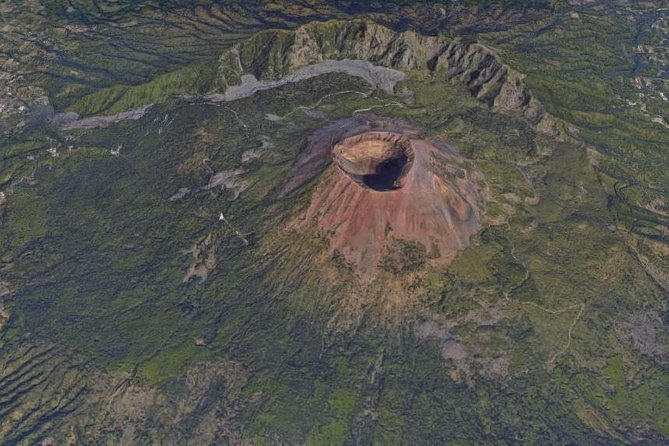
Mount Vesuvius is the finale here, but the real strength is the way the day links the volcano to the two cities it buried. You see Pompeii’s public life, Herculaneum’s preserved homes and waterfront remains, then climb from the upper parking area toward the crater. It is a big day with a clear story.
I like the private vehicle and flexible pickup, especially if you are staying in Sorrento, Naples, Salerno, Amalfi, or near a cruise dock. I also like having a guide at each archaeological park, with names such as Antonino, Antonio, Giacomo, and Ilaria praised for clear explanations and an ability to keep children involved. The drawback is simple: three major sights in one day means a brisk schedule, and the volcano walk is rougher than its short distance suggests.
Key points to know before booking
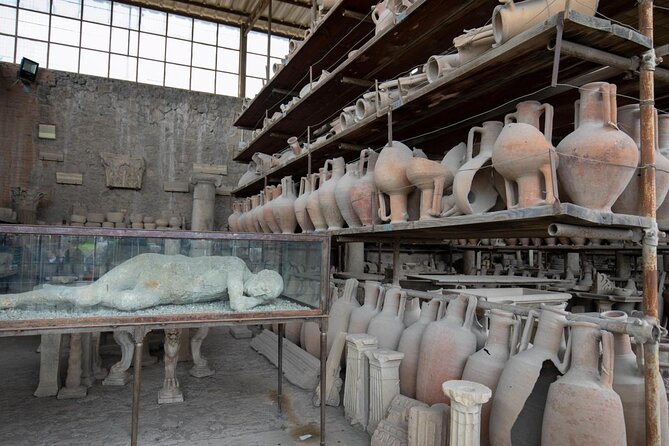
- Three major sights in one day: Pompeii, Herculaneum, and Mount Vesuvius fit into an 8 to 9 hour private outing.
- Pickup saves time: Collection can be arranged at accommodation, a cruise port, train platform, airport, or another suitable point in the service area.
- Pompeii gets the longest visit: Plan on about two hours for the main sights, not the whole archaeological park.
- Herculaneum is smaller but more detailed: Its houses, decoration, and waterfront remains reward careful looking.
- The summit requires a hike: Allow about 35 minutes up and 35 minutes back, with a rough, gravelly trail.
- Check the package carefully: Pompeii and Herculaneum admission may depend on the option selected, while Mount Vesuvius costs €12.60 per person.
One volcanic story, told in three places
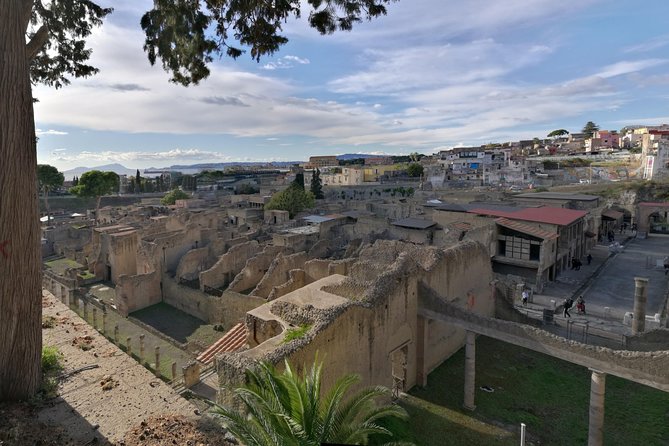
This tour works because the sites are not separate historical stops. Pompeii and Herculaneum were Roman towns destroyed by the eruption of Vesuvius in AD 79. At Pompeii, the scale and city plan make the disaster feel enormous. At Herculaneum, better-preserved houses and the marina area bring the event closer to everyday life.
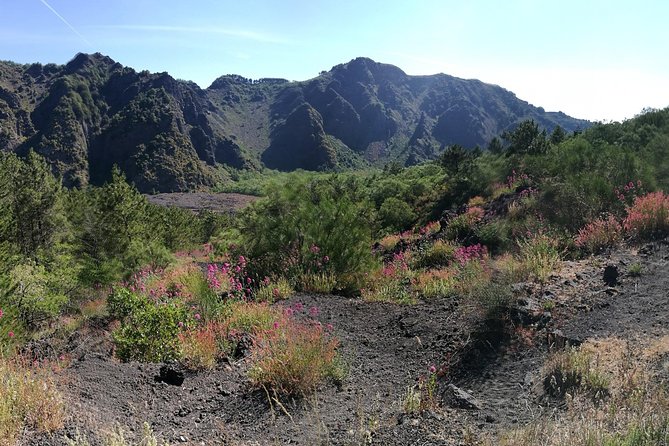
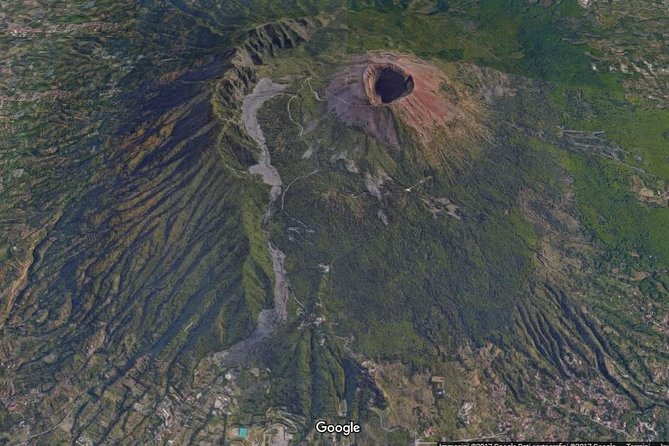
Then you go up the volcano itself. From the upper parking area, the trail reaches the crater rim, where you can look into the caldera when weather and visibility cooperate. You also get views across the Bay of Naples and toward Sorrento when the sky is clear.
A private tour matters here because the roads between the sites are awkward to combine by public transport in one day. Your driver can pick you up at your accommodation if the streets allow it, or at the nearest point a vehicle can reach. Cruise passengers can arrange pickup near Naples, Salerno, the Amalfi Coast, or Sorrento, but must provide ship and re-boarding details when booking.
A few other Pompeii mornings to weigh against this
- Pompeii: Entry Ticket and Guided Tour with an Archaeologist
★ 4.8 · 19,459 reviews - Pompeii: Entry Ticket with Optional Audio Guide
★ 4.2 · 12,360 reviews - Pompeii: Small Group Tour with an Archaeologist
★ 4.8 · 12,264 reviews
Pompeii in two hours: a strong introduction, not the whole city
Your Pompeii visit begins at the main gate, where a licensed guide meets you after ticket purchase. The planned visit lasts about two hours. That is enough for an intelligent first look at important streets and buildings, but Pompeii is far too large to see fully in this time.
You generally begin near Piazza Porta Marina, the most impressive of the city’s seven gates. This western entrance gives you a useful sense of Pompeii’s connection to the outside world before the route moves toward the center.
The Forum is the key stop. This broad civic space was the city’s center for administration, justice, business, markets, and worship. I find it especially useful early in a visit because it gives you the city’s public framework. Once you understand the Forum, the surrounding buildings make more sense.
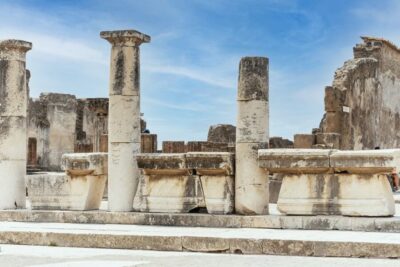
The Basilica follows. This was a place for business and legal work, reached from the Forum through five entrances divided by tuff pillars. The remains are stark, but the guide can help you picture the building as a working part of Roman civic life rather than simply a field of columns.
At the Thermopolium VI, you see a small cook-shop where hot food was sold. This is one of the most approachable stops for families because it connects the ruins to an ordinary need: buying a quick meal. Pompeii becomes easier to understand when you look for places used by people at work, not only grand homes.
The Casa del Fauno is one of Pompeii’s largest houses, occupying an entire block of roughly 3,000 square meters. Its original layout reaches back to the second century BC. It offers a sharp contrast with the cook-shop and helps show the gap between wealthy household life and the city’s commercial streets.
The Casa dei Vettii gives you another look at wealth. The house belonged to the brothers Aulus Vettius Restitutus and Aulus Vettius Conviva, formerly enslaved men who made their money through trade. A painting of Priapus, associated with prosperity, protects the entrance. This is a good place to ask your guide about status, business, and how social mobility worked in Roman Pompeii.
The Stabian Baths show a more communal side of Roman life. The route passes the pool and colonnade before reaching the men’s bathing areas: the apodyterium for changing, the frigidarium for cold water, the tepidarium for moderate heat, and the calidarium for hot baths. The sequence gives you a practical look at how a Roman bath complex functioned.
The final listed Pompeii stop is the Teatro Grande. Built into a natural slope, the theater used separated seating areas, corridors, and vaulted passages to move people through the auditorium. It is a fine place to picture Pompeii as a lively town with entertainment, politics, trade, and domestic life.
The key warning is timing. Two hours can feel rushed, particularly if you enjoy inscriptions, house decoration, or photography. A guide can keep you from wandering without a plan, but you will not cover every open street or building. If Pompeii is your main goal, book a dedicated Pompeii visit instead of trying to fit all three sites into one day.
Herculaneum offers closer detail
After Pompeii, your driver takes you to the Archaeological Park of Herculaneum. A licensed guide meets you at the main gate, and the planned visit lasts about one hour and forty minutes.
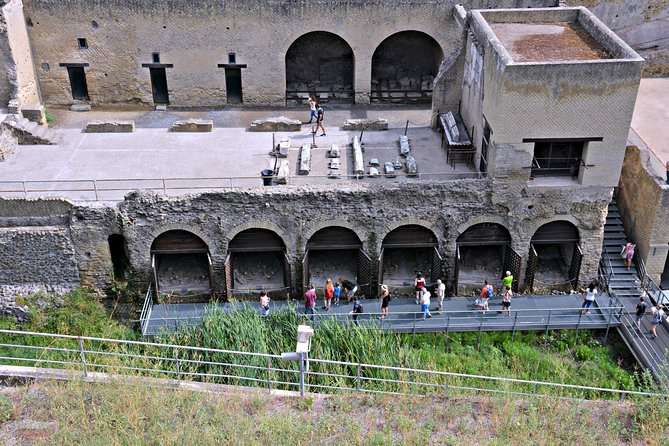
Herculaneum is smaller than Pompeii, but that does not make it a lesser stop. Its more concentrated remains make it easier to focus on individual homes, rooms, and surviving details. The Casa dei Cervi, one of the town’s wealthiest private residences, gives you a look at elite domestic life. Its owner was evidently extremely wealthy.
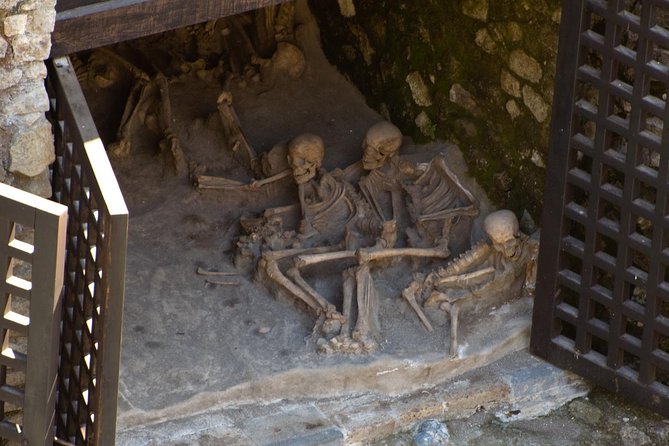
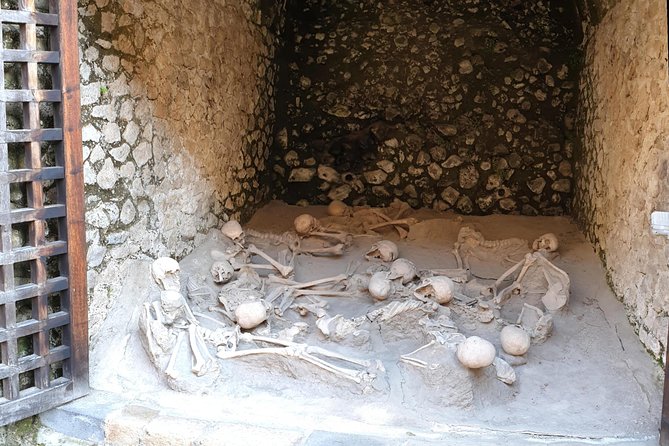
The Salone della Barca di Ercolano adds a darker and more personal note. In the marina area, archaeologists found about 300 skeletons and an exceptionally preserved boat. The restored boat is among the important discoveries shown here. It helps you grasp how quickly the eruption trapped people near the waterfront.
I like placing Herculaneum after Pompeii because the contrast becomes clear. Pompeii gives you streets, public buildings, and a much larger urban setting. Herculaneum lets you slow down over houses and surviving objects. You should not think of it as a shorter version of Pompeii. It offers a different kind of visit.
Still, one hour and forty minutes is not enough for every corner. The guide’s selection matters, and the private format lets you ask for more attention to homes, daily life, or the eruption itself. If you want to study the sites rather than gain a broad overview, consider visiting one park on its own.
Mount Vesuvius is a real walk, not a scenic drive
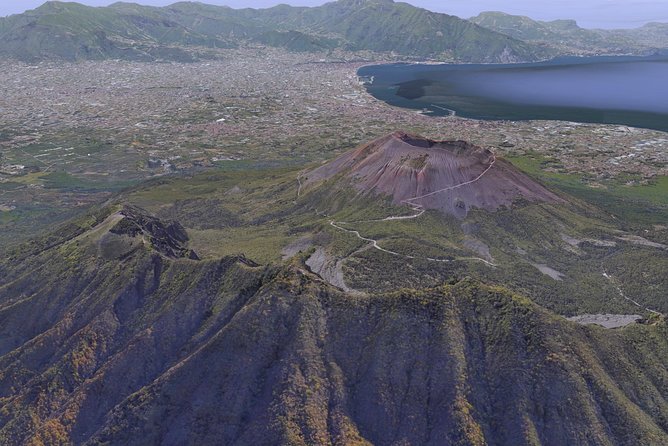
The volcano section begins at the Vesuvius National Park parking area, roughly 1,000 meters above sea level. The trail called Il Gran Cono starts here, and an information point can provide details about the protected area and sell a map.
Even before you walk, the views begin. You can look toward Mount Somma, Punta Nasone, and the old volcanic formations. The trail then rises toward the crater rim, known in this area as Sterminator Vesevo.
The stated volcano portion allows about two and a half hours, including the drive from the highway, the climb, and the return. The walking section is about 35 minutes to the top and about 35 minutes down, though some people take longer. One detailed account described the route as roughly two miles up and back, while another stressed the rough gravel and loose footing.
Wear sturdy walking shoes. Casual clothing is fine, but sandals and smooth-soled shoes are poor choices. You need enough fitness for an uphill walk and a descent on uneven ground. The tour requires a moderate physical fitness level, and the volcano is the part most likely to test it.
At the top, you can look into the caldera if clouds do not block the view. Weather makes a major difference. One reported experience reached Vesuvius on a cloudy day and could not see inside the crater, while another had a clear view from the summit. If the volcano is your top priority, ask about doing it earlier in the day, when morning conditions may be clearer, though weather can change quickly.
The Mount Vesuvius admission fee is €12.60 per person and is listed separately from the tour price. The base price is $120.98 per person, but your final cost depends on the booking option, since Pompeii and Herculaneum tickets and an on-site guide may be included or offered as upgrades. Check those details before paying.
Same city, an entirely different afternoon:
- Pompeii Small Group Tour with an Archaeologist
★ 5.0 · 6,593 reviews - Pompeii: Skip-the-Line Entrance Ticket with Audio Guide
★ 4.0 · 2,509 reviews - Naples: Pompeii and Mt. Vesuvius with Lunch and Wine Tasting
★ 4.5 · 2,454 reviews - Pompeii: Archaeological Park Tour with Ticket on request
★ 4.5 · 2,283 reviews
The private vehicle is the practical advantage
The driver handles the route between Pompeii, Herculaneum, and Vesuvius, which is the main reason this itinerary is realistic in one day. Pickup can be arranged from accommodation, a port, train station, airport, or cruise docking area within the service region. If a narrow street blocks direct access, you are collected at the closest point reachable by car.
The vehicle and drivers receive especially strong praise in the supplied feedback. Dominic or Domenica is described as prompt, professional, kind, and comfortable to ride with. Enzo is also noted as a good driver who pointed out sights during the journey. Antonino and Antonio sometimes act as both driver and guide, while other arrangements pair a driver with a separate site guide.
Travel time becomes useful when the person accompanying you explains the area, the eruption, and the history of Naples. That is not the same as having a full lecture in the van, so expectations should be clear. The most valuable guiding happens inside Pompeii and Herculaneum, where a licensed guide can connect the ruins to what you are seeing.
The private format also helps families and mixed-ability groups. One account describes a guide helping a wheelchair user, though the tour still includes uneven archaeological ground and a volcano climb. Service animals are allowed. If someone in your group cannot manage Vesuvius, tell the operator early so the day’s plan can be discussed.
What the guide can add
The quality of the day depends heavily on the individual guide. Antonino, Antonio, and Tony are repeatedly singled out for warmth, patience, strong English, and detailed explanations. Giacomo, Ilaria, and Alona are also identified as guides who made the sites engaging and easy to follow.
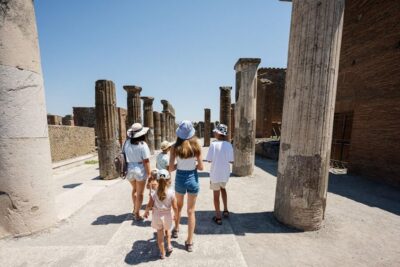
A private guide gives you room to ask questions without waiting for a large group. You can spend a little longer on the Forum, ask about Roman baths, or request help understanding the difference between a villa, shop, and cook-shop. Several accounts also describe guides keeping children and teenagers interested, which is no small feat in a hot archaeological park.
The guiding style may not suit everyone. The company uses an animated, story-led approach rather than a quiet academic lecture. If you prefer long stretches of independent looking, say so at the start. The two-hour site limits mean the guide must keep the group moving, and some people may find that pace brisk.
Is $120.98 good value?
At $120.98 per person, the tour is not the cheapest way to see Pompeii. But the price includes private transportation and pickup, which can be worth a great deal when you are connecting three separate sites in one day. Group discounts may also affect the per-person cost.
The value improves if you are arriving by cruise ship, staying outside Pompeii, traveling with children, or trying to avoid changing trains and arranging local transport. A private vehicle also gives you a return to the original pickup point or another requested drop-off in the excursion area.
The price needs careful checking. Admission to Vesuvius costs €12.60 per person. Pompeii and Herculaneum tickets are included only with the selected ticket option, and a site guide may also depend on the package. Lunch is not included, and neither are food or drinks beyond bottled water.
One important point: a lunch stop is not fixed in the details provided. Some arrangements include a local restaurant or an organic farm, but you should ask to see the menu and prices before ordering. You are free to choose what you eat, and the tour does not include lunch in its stated price.
Who should book this full day
I would choose this for a first visit when you want the main archaeological picture rather than a specialist study of one site. It suits families, couples, cruise passengers, and anyone who values a private car and direct pickup.
It is also a good fit if you want to ask plenty of questions. The private setting gives you more personal attention than a large group, and the guides can adjust the pace to your interests within the fixed schedule.
I would hesitate if you dislike long days, uphill walking, or fixed time limits. Pompeii and Herculaneum involve uneven surfaces, and Vesuvius adds a genuine hike. Someone hoping to photograph every room or read every inscription should book separate visits instead.
Free cancellation is available up to 24 hours before the start time. Poor weather can lead to a different date or a full refund, and the same applies if the minimum number required is not met.
Should you book it?
Book this tour if you want three major sights with transport solved, and you are comfortable seeing Pompeii and Herculaneum as a focused introduction. The private driver, hotel or port pickup, and strong guide choices make a difficult day much easier.
Skip it in favor of separate visits if Pompeii is a lifelong study goal, if you need a slow pace, or if you do not want to hike Vesuvius. Before booking, confirm the exact ticket package, guide inclusion, pickup point, lunch plan, and weather policy. For the right group, this is a demanding but memorable day that connects Roman daily life with the volcano above it.
FAQ
How long does the tour last?
The experience lasts approximately 8 to 9 hours. The schedule includes Pompeii, Herculaneum, travel between the sites, and the Mount Vesuvius climb.
Is hotel pickup included?
Pickup is offered from accommodation when the streets allow vehicle access. If not, you meet the driver at the closest accessible point. Pickup can also be arranged from a port, train station, airport, or cruise docking area in the stated service regions.
Are Pompeii and Herculaneum admission tickets included?
Tickets are included if you select the option that includes them. The standard details also state that admission tickets may not be included, so check the exact package before booking.
How much does Mount Vesuvius admission cost?
The Mount Vesuvius ticket costs €12.60 per person and is not included in the listed tour price.
How difficult is the Mount Vesuvius walk?
The route takes about 35 minutes to walk up and about 35 minutes back down from the upper parking area. The trail can be rough, gravelly, and uphill, so sturdy walking shoes and moderate physical fitness are needed.
Is lunch included?
No. Lunch, food, and drinks are not included. Bottled water is included, and any restaurant stop or meal arrangement should be confirmed before you order.
Fresh on the Pompeii list
- Stories of Pompeii: Small Group tour with archeology expert guide★ 5.0 · 191 reviews
- Mount Vesuvius: Vineyard Tour with Wine Tasting and Lunch★ 4.8 · 193 reviews
- Pompeii: Skip-the-Line Guided Tour with Expert Archaeologist★ 4.8 · 196 reviews
- Pompeii: 2 Hour Private Tour with an Archeologist Guide★ 5.0 · 214 reviews
- Pompeii: Skip-the-Line Entry & Audioguide★ 3.8 · 225 reviews
- Herculaneum: Tickets & Tour with a Local Archaeologist★ 4.8 · 226 reviews
- Pompeii and Mount Vesuvius Small Group Tour★ 4.5 · 233 reviews
- From Naples/Salerno: Pompeii, Sorrento, and Positano Tour★ 4.5 · 250 reviews
Pompeii & Vesuvius Tours, compared.
Entry Ticket and Guided Tour with an Archaeologist
Read our review →
Pompeii Small Group Tour with an Archaeologist
Read our review →
Pompeii, Amalfi Coast and Positano Day Trip from Rome
Read our review →Browse the lists this tour appears in