
Reviewed · POMPEII & VESUVIUS TOURS
Pompeii Guided Group Tour with Entry Ticket and Archaeologist
Pompeii is far too large for a quick look, and this two-hour guided walk gives you a useful first map of the ancient city. You move from the Forum to grand houses, public baths, and a snack bar preserved by Mount Vesuvius. I like the focus on daily life, and I like that entry is included, so you can spend your time looking rather than sorting out tickets. The main drawback is simple: two hours covers highlights, not all of Pompeii.
I also like the choice of tour times and the easy train-station location, just 100 meters from the Porta Marina Superiore entrance. Still, meeting instructions need careful reading. The group can reach 35 people, and past experiences with headsets, accents, and guide quality have not been perfectly consistent.
Key points at a glance
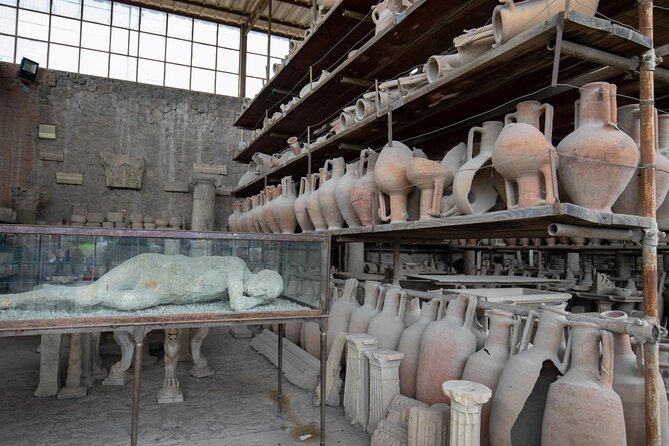
- See Pompeii’s central highlights: The route includes the Forum, Macellum, Forum Baths, House of the Faun, House of the Vettii, Via dell’Abbondanza, and Thermopolium.
- Meet at the Circumvesuviana station: Tempio Travel/Pompeii Tickets is on the first floor of the red station building at Via Villa dei Misteri 1.
- Allow time for walking: Ancient streets are uneven, and sturdy, comfortable shoes matter more here than smart clothes.
- Expect an English tour: The guide explains Roman public life, food, homes, bathing, commerce, and social customs.
- Entry is included: The standard Pompeii archaeological-site ticket is part of the booking, but Villa of the Mysteries requires a separate plus ticket.
- Plan to stay afterward if possible: The tour shows key areas, but Pompeii is much too large to finish in two hours.
Why a guided introduction helps at Pompeii

Pompeii can look like a field of broken walls if you do not know what you are seeing. A guide gives those stones a purpose. The Forum becomes the political, economic, and religious center of town. A painted counter becomes an ancient place for buying hot food. A bath complex reveals how Romans spent leisure time, not just how they built houses.
That context is the chief reason to book this tour instead of walking in alone. You can visit Pompeii independently, but you may pass a bakery, shrine, dining room, or water system without understanding its role. A good guide turns the remains into a picture of ordinary routines.
The strongest part of this experience is its subject matter. You are not just looking at famous ruins. You are following a practical path through public buildings, wealthy homes, a market, a road, and a food counter. Guides such as Laura, Alessandra, Rita, Eraldo, and others have been praised for clear explanations, patience, humor, and an ability to answer questions. Guide quality can vary, so I would treat the advertised archaeologist description with some care. Some visitors felt their guide was an archaeological expert, while others felt they received a prepared tour script rather than specialist insight.
A few other Pompeii mornings to weigh against this
- Pompeii: Entry Ticket and Guided Tour with an Archaeologist
★ 4.8 · 19,459 reviews - Pompeii: Entry Ticket with Optional Audio Guide
★ 4.2 · 12,360 reviews - Pompeii: Small Group Tour with an Archaeologist
★ 4.8 · 12,264 reviews
Finding Tempio Travel before the start
The meeting point is at the first floor of the Circumvesuviana station at the Pompeii Scavi Villa dei Misteri stop. Look for the red station building and the office named Tempio Travel/Pompeii Tickets. The address is Via Villa dei Misteri 1, and the office is about 100 meters from Porta Marina Superiore.
Arrive 15 minutes before the time printed on your voucher. This is not a detail to brush aside. Several poor experiences came from confusion over the meeting point, including people who reached the archaeological site but did not find the tour office. The voucher may show the booking platform prominently, while the local company name appears less clearly.
I would not rely only on a map pin. Read the voucher before you leave, identify the station, and allow extra time to walk between the transport stop and the office. The tour operator says the directions are clear and that staff tried to contact people who did not arrive, but the conflicting accounts show why you should get there early and keep your phone available.
The location works well if you arrive by Circumvesuviana train. Parking and transport are not included, and no food or drinks are supplied. Most people can take part, and service animals are allowed, but you should be ready for a fair amount of walking over old paving.
Starting at Porta Marina Superiore
The tour begins at Porta Marina Superiore, one of the main access points to the archaeological park. Entry is included, so once the group is organized, you can move into Pompeii without buying a separate standard admission ticket.
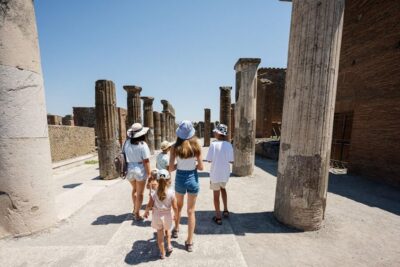
The first minutes are useful for orientation. Pompeii is not a small cluster of ruins. Its streets, homes, public buildings, and commercial spaces spread across a large area. A guided route helps you understand where you are before the ancient city begins to blur into one long succession of walls.
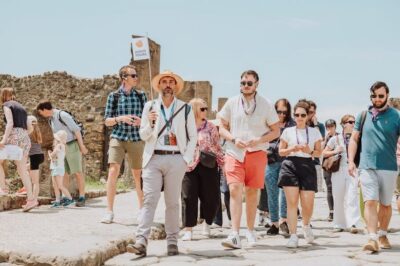
The pace is designed for a mixed group. Some tours have included around 20 people, while the maximum is 35. In open spaces, a larger group may be manageable, but narrow streets and crowded rooms can make it harder to stay close to the guide. Headsets are supplied when the group has more than 15 people. They can help in a crowd, though one person found the audio device echoed and made a strong accent harder to follow.
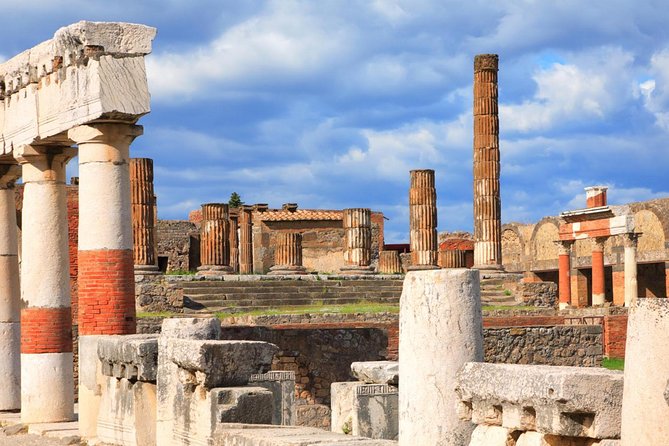
The Forum, Pompeii’s public center
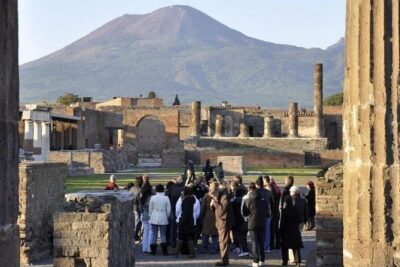
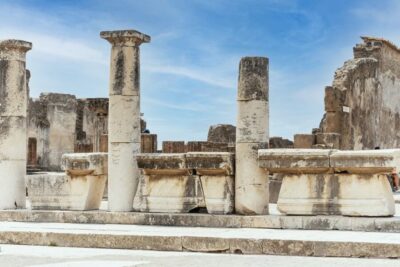
The Forum receives about 30 minutes, making it the longest stop on the route. That is sensible. This broad civic square was the city’s main political, economic, and religious center, and it gives you the clearest sense of Pompeii as an organized Roman town.
Your guide can explain how different buildings around the square served public and sacred functions. This is where a live explanation has real value. Without one, it is easy to see columns and foundations without grasping how power, trade, worship, and public life met in one place.
The Forum is also a good place to understand the scale of Pompeii. You may arrive expecting a few preserved streets and instead find a complete urban center with long sightlines and many layers of activity. Keep your camera ready, but pay attention to the layout. The shape of the square tells you as much as any individual statue or wall.
Same city, an entirely different afternoon:
- Pompeii Small Group Tour with an Archaeologist
★ 5.0 · 6,593 reviews - Pompeii: Skip-the-Line Entrance Ticket with Audio Guide
★ 4.0 · 2,509 reviews - Naples: Pompeii and Mt. Vesuvius with Lunch and Wine Tasting
★ 4.5 · 2,454 reviews - Pompeii: Archaeological Park Tour with Ticket on request
★ 4.5 · 2,283 reviews
The Macellum and Roman food
The Macellum sits on the Forum and served as a market for meat and fish. The stop lasts about 10 minutes, enough for the guide to explain what was sold and how food fit into Roman life.
The painted decorations are especially useful. They show foods eaten in the first century AD, giving you a more ordinary view of Pompeii than the grand villas do. You begin to picture shopping, cooking, and eating rather than only emperors, temples, and disaster.
This is one of the tour’s better choices because it connects the monumental center with everyday needs. A market is not as instantly famous as a villa, but it can tell you more about how a town functioned day by day.
The Forum Baths and Roman bathing
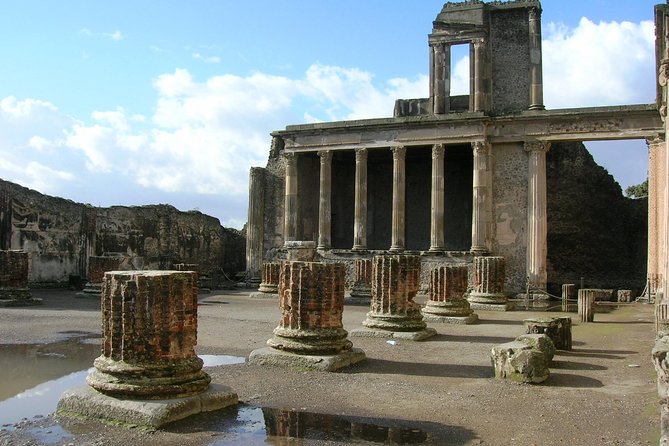
The Forum Baths take about 15 minutes. Behind the Temple of Jupiter, this complex covered roughly 410 square meters and had separate male and female sections, each with its own entrance.
The water supply came from the Serino aqueduct, with a well available if the aqueduct failed. Details like this show the practical engineering behind Roman comfort. The baths were not simply decorative buildings. They depended on water management, heating, room design, and regular maintenance.
Look for the original ceilings and surviving stucco decoration. The calidarium, or hot room, has a marble basin and mosaic flooring. A guide can help you understand the sequence of spaces and the role of heat, water, and steam. Fifteen minutes is enough for a focused explanation, but not enough for an unhurried study of every room.
The House of the Faun and Alexander’s mosaic
The House of the Faun was one of the largest and most luxurious aristocratic homes from the Roman Republic. It offers a sharp contrast with the market and baths. Here, scale and decoration point to wealth and social rank.
The famous Alexander Mosaic inside is a copy. The original is held at the National Archaeological Museum of Naples, known as MANN. That distinction matters. You are seeing the setting and a reproduction in Pompeii, not the original artwork.
The house earns about 10 minutes on the route. That is enough to appreciate its size and hear why it matters, but you should not expect a full study of the residence. If grand houses and mosaics are your main interest, you may want to remain in the park after the official walk ends.
The House of the Vettii and private life
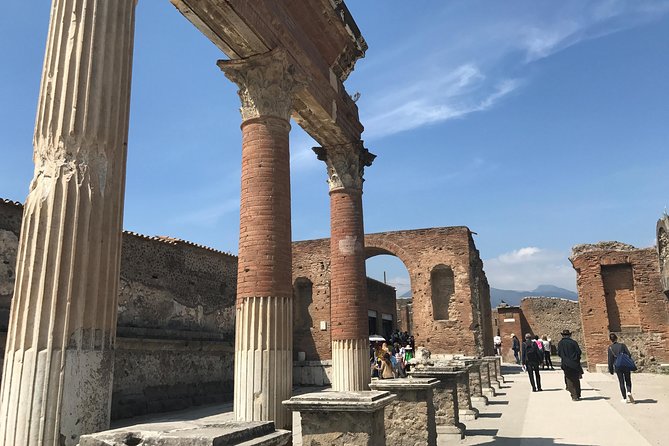
The House of the Vettii is another major home, buried in the AD 79 eruption and later uncovered through excavation. It takes its name from its owners, Aulus Vettius Restitutus and Aulus Vettius Conviva.
The house is valued for its Roman paintings and decoration. It also contains an erotic room, a reminder that Pompeian homes could include imagery and spaces that modern visitors may find frank. The guide can place those scenes within the social world of the house rather than treating them as a cheap surprise.
Ten minutes goes quickly here. You will get an introduction to the owners, the art, and the room’s unusual subject matter, but you may not have much time to inspect every painted detail. Families can still take this route, though parents may prefer to give children a brief warning that some Roman art is sexual in nature.
Walking Via dell’Abbondanza
The route continues along Via dell’Abbondanza, one of Pompeii’s important streets. It links major parts of the city, including the Forum, the Stabian Baths, theaters, the Temple of Isis, and the Amphitheater.
This street is where the tour’s separate stops begin to fit together. You are no longer looking at isolated buildings. You are walking through the connections between civic space, entertainment, religion, bathing, and residential districts.
The walk also adds time on uneven ground. Wear shoes with good support. Pompeii rewards slow looking, but the two-hour schedule means you will keep moving. If rain arrives, the experience becomes less comfortable, and poor weather can lead to a new date or a full refund under the stated policy.
Thermopolium, an ancient hot-food counter
The final named stop is the Thermopolium in Regio VI, Insula VIII, 8. The name refers to a place where something hot was sold. In plain terms, it functioned much like an ancient takeaway counter.
This is a small but memorable finish. After seeing wealthy homes and formal public buildings, you get a glimpse of quick food for ordinary customers. The counter helps you imagine Pompeii as a working town, not just a museum of elite Roman life.
The stop lasts about 10 minutes. It will not explain every commercial building in the city, but it gives the tour a human ending. Food, errands, bathing, business, and public meetings are easier to picture after you have followed the route.
What two hours can and cannot cover
The advertised duration is about two hours. That is enough for a well-organized introduction to the Forum district and selected highlights. It is not enough to see all of Pompeii, and even the operator points out that the city is too large to cover completely in that time.
I would treat the tour as a guided framework, not a complete visit. Some groups have finished with time to continue independently. Others have found the tour ran a little long and had to leave before the final portion. The exact experience can depend on crowd levels, guide pace, weather, and questions from the group.
If you have only a morning in Pompeii, this format makes sense. You get the major explanations first, then you can decide which areas deserve more of your own time. If you have several hours available, keep exploring after the tour. The Amphitheater, theaters, Temple of Isis, Stabian Baths, and other parts of the park are not covered in detail on this short route.
Price and practical value at $59.13
At $59.13 per person, this is not the cheapest way to enter Pompeii. The value rests on the guide and the time saved, not on the ticket alone.
I think the price is reasonable for someone visiting Pompeii for the first time, especially if you want a clear explanation of Roman daily life and do not want to spend your first hour finding the most important buildings. It is less convincing for an experienced Roman archaeology enthusiast who already has a detailed plan and mainly wants independent access.
The group size matters. A maximum of 35 is not intimate, though the headsets help groups larger than 15 hear the guide. In open areas, this may work well. Inside smaller houses, you may need patience, and taking photographs can be harder when everyone gathers in one room.
The tour is offered in English only. Guide quality has ranged from excellent and entertaining to adequate but repetitive. Some people found the guide’s accent and the audio equipment difficult. That does not make the tour a poor choice, but it does mean you are paying for a group service with some variation, not a guaranteed private specialist.
Who should book this Pompeii tour?
I would recommend it to first-time visitors who want structure, context, and included entry. It is a good fit for families if children enjoy stories about food, houses, baths, and ancient city life. Several guides have kept younger visitors interested by explaining what people actually did in each place.
It also suits anyone arriving by train, since the meeting office is close to the Villa dei Misteri stop and Porta Marina Superiore. People with limited time can use the two-hour route as a practical introduction.
I would think twice if you need a small, quiet group, a guaranteed archaeologist with a specialist background, or a complete day inside the park. You may prefer a private guide or a longer tour. Also reconsider if unclear meeting instructions would cause stress. Read the voucher closely and arrive early.
Free cancellation is available up to 24 hours before the start time. Changes or cancellations inside that window are not refunded, and a no-show is treated as nonrefundable. The experience depends on good weather, with a different date or full refund offered if the operator cancels for weather.
My booking verdict
I would book this tour as a well-priced orientation to Pompeii, not as the final word on the site. Its best features are the sensible route, included entry, strong focus on daily life, and the chance to continue exploring afterward.
Book early if your schedule is fixed, since it is commonly reserved several weeks ahead. Choose an early start during busy periods when possible, arrive at the red Circumvesuviana station 15 minutes ahead, and wear sturdy shoes. If you follow those steps, this guided introduction should help Pompeii feel like a city rather than a pile of ruins.
FAQ
Where is the meeting point for the Pompeii tour?
Meet 15 minutes before the time on your voucher at Tempio Travel/Pompeii Tickets on the first floor of the red Circumvesuviana station at Via Villa dei Misteri 1. The office is about 100 meters from Porta Marina Superiore.
Is Pompeii entry included?
Yes. The standard entrance ticket to the Pompeii Archaeological Park is included. The separate plus ticket for the Villa of the Mysteries is not included.
How long does the guided tour last?
The guided tour lasts approximately two hours. It covers selected highlights rather than the entire archaeological park.
Is the tour offered in English?
Yes. The experience is offered in English.
Are headsets provided?
Headsets are provided for groups of more than 15 people. They are intended to help you hear the guide in larger groups.
Can I cancel for a full refund?
Yes, if you cancel at least 24 hours before the local start time. Cancellations or changes made less than 24 hours in advance are not refunded. If poor weather causes the operator to cancel, you can receive a different date or a full refund.
Fresh on the Pompeii list
- Stories of Pompeii: Small Group tour with archeology expert guide★ 5.0 · 191 reviews
- Mount Vesuvius: Vineyard Tour with Wine Tasting and Lunch★ 4.8 · 193 reviews
- Pompeii: Skip-the-Line Guided Tour with Expert Archaeologist★ 4.8 · 196 reviews
- Pompeii: 2 Hour Private Tour with an Archeologist Guide★ 5.0 · 214 reviews
- Pompeii: Skip-the-Line Entry & Audioguide★ 3.8 · 225 reviews
- Herculaneum: Tickets & Tour with a Local Archaeologist★ 4.8 · 226 reviews
- Pompeii and Mount Vesuvius Small Group Tour★ 4.5 · 233 reviews
- Pompeii: Day Tour of Pompeii and Vesuvius with Bus Transfer★ 4.2 · 250 reviews
Pompeii & Vesuvius Tours, compared.
Entry Ticket and Guided Tour with an Archaeologist
Read our review →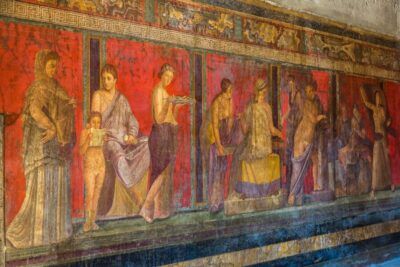

Pompeii Small Group Tour with an Archaeologist
Read our review →
Pompeii, Amalfi Coast and Positano Day Trip from Rome
Read our review →Browse the lists this tour appears in