
Reviewed · POMPEII & VESUVIUS TOURS
Pompeii and Herculaneum Small Group Tour with an Archaeologist
Pompeii and Herculaneum tell the same volcanic story in very different ways. Pompeii gives you broad streets, theaters, public baths, shops, and grand houses. Herculaneum is smaller but preserves more wood, color, and household detail. Seeing both with an archaeologist helps you understand the difference instead of simply wandering through two sets of ruins.
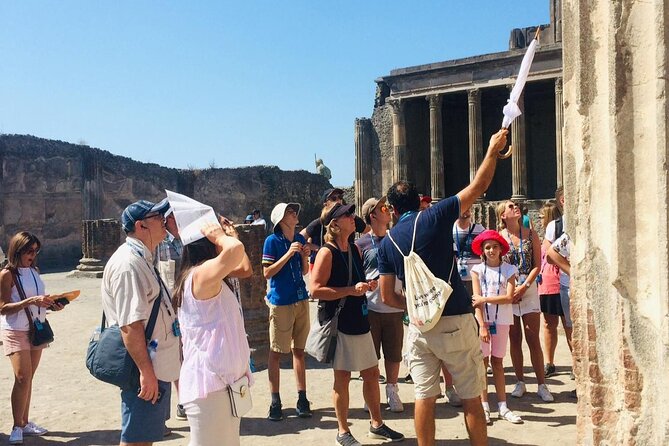
I like the two-site format and the practical transport. Tickets are included, the guide handles the train or minibus connection, and headsets help you follow explanations in a group of up to 20 people. I also like the guides’ strong reputation. Michele, Diego, Michael, Paulo, Antonio, Alfredo, and others are repeatedly praised for turning walls and paving stones into stories about daily Roman life.
The catch is time. Two hours at Pompeii is enough for highlights, not the whole city, and the pace can feel quick when you want to stop for photographs or study a fresco. Lunch is at your own expense and may be arranged at a mall, which is convenient but not especially atmospheric.
Key points to know before booking
- Two ancient towns in one day: Pompeii and Herculaneum offer different views of Roman life and work well as a pair.
- Archaeologist-led visits: Guides including Michele, Diego, Michael, Paulo, and Antonio bring specialist background and welcome questions.
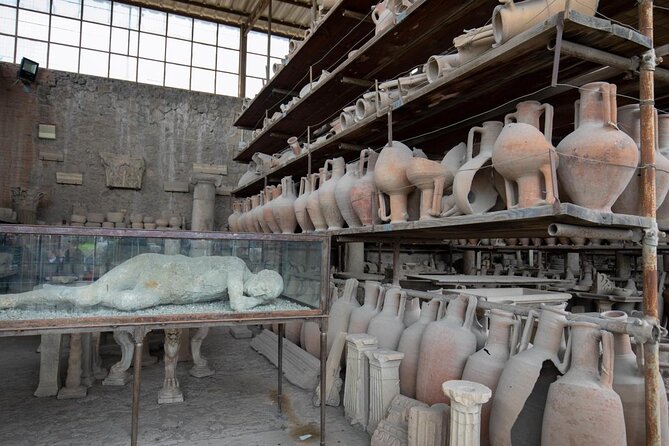
- Pompeii gets a brisk two-hour tour: You see major houses, baths, theaters, the Forum, brothel, and plaster casts, but not every corner.
- Herculaneum is smaller and more detailed: Preserved wooden features, frescoes, homes, and public buildings make this a strong second stop.
- Transport depends on your starting point: Naples, Sorrento, and Rome departures use minibus transport, while Pompeii departures use the Circumvesuviana train to Herculaneum.
- Good value for a tightly planned day: At $77.09, the price includes both entry fees, guiding, headsets, and transport on the selected route.
Why seeing Pompeii and Herculaneum together makes sense
Pompeii is the famous one, and rightly so. Its streets form a large Roman town you can walk through almost as a real city plan. You see the Forum, public baths, theaters, houses, shops, and lanes marked by centuries of ordinary movement.
Herculaneum is a different kind of archaeological experience. The site is smaller, but the volcanic material preserved more fragile objects and upper-level details. Wooden doors, partitions, carbonized beams, painted rooms, and household layouts help you picture domestic life with unusual clarity.
I like this pairing because the second site corrects the first impression. After Pompeii’s open streets and monumental public spaces, Herculaneum shows you tighter homes and finer details. You do not simply repeat the same ruins. You compare two towns affected by the same eruption in different ways.
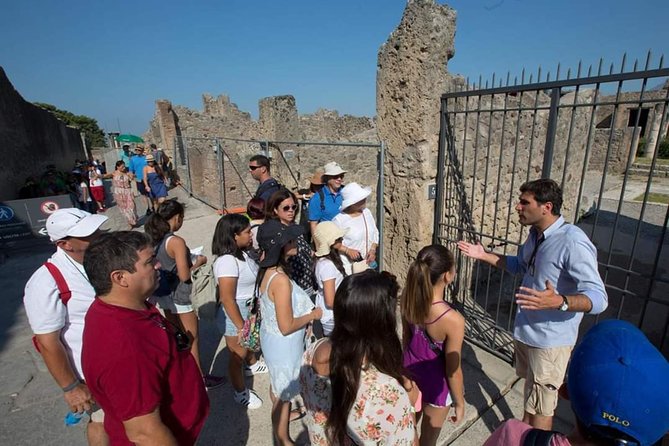
The guide matters here. An archaeologist can explain why one wall is important, how a bath complex worked, or what a house layout tells you about status and family life. Without that context, some of the best details are easy to walk past.
A few other Pompeii mornings to weigh against this
- Pompeii: Entry Ticket and Guided Tour with an Archaeologist
★ 4.8 · 19,459 reviews - Pompeii: Entry Ticket with Optional Audio Guide
★ 4.2 · 12,360 reviews - Pompeii: Small Group Tour with an Archaeologist
★ 4.8 · 12,264 reviews
Meeting points and the shape of the day
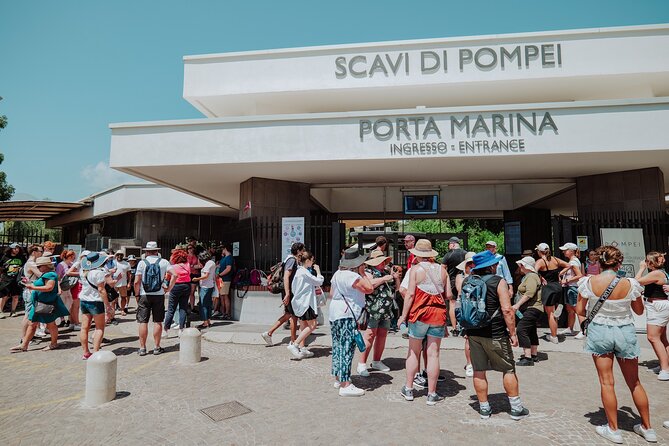
The meeting point depends on the option you book. Pompeii departures meet at Porta Marina Superiore. Naples departures meet outside Starhotels Terminus. Sorrento departures meet at Piazza Angelina Lauro. The Rome option includes train tickets to Naples, then full-day transport from Naples.
The experience lasts roughly six to 11 hours, depending on your departure city and transport arrangements. The Pompeii visit comes first, followed by a short lunch break and the transfer to Herculaneum.
From Naples, Sorrento, and Rome, you ride in a modern minibus with the guide. From Pompeii, you receive a one-way Circumvesuviana ticket and travel with the guide to Herculaneum. The train ride takes about 30 minutes, followed by a walk of roughly 10 minutes to the ruins.
That difference matters. The Naples, Sorrento, and Rome options are more door-to-door. The Pompeii option is useful if you are already based there, but the tour ends at Herculaneum. If your car or luggage is back near Pompeii, you need to arrange your own return. The guide does not accompany you back.
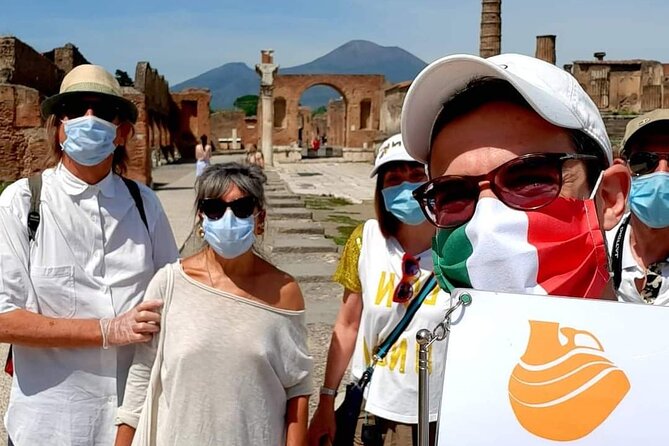
Headsets are supplied for everyone. They are useful in courtyards and along busy streets, though you need to stay close enough to keep the connection. One poor experience involved a guide moving too fast and the headset signal dropping. That is not a reason to avoid the tour, but it is a good reminder to speak up if you fall behind.
Pompeii’s Forum, Basilica, and main street
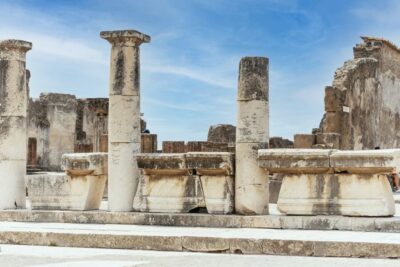
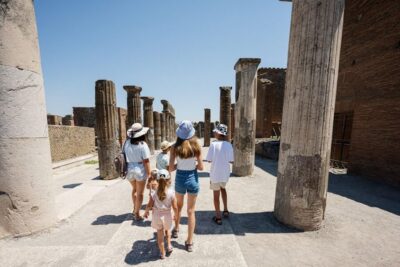
The Pompeii portion begins with the Basilica, an open portico used for business and public activity. It is not a church in the later Christian sense. Your guide can use the remains to explain how commerce and legal affairs fit into the city’s public center.
From there, you move toward the Forum, Pompeii’s main square. This is the place to get your bearings. Temples, civic buildings, and public spaces gathered here, and the surrounding streets show how the town connected everyday trade with political and religious life.
You also walk along a main street. The paving stones, building fronts, and wheel marks help you see Pompeii as a functioning town rather than a museum of isolated objects. The route gives you a useful overview before moving into individual homes and buildings.
The drawback is that the official Pompeii visit is about two hours. That is a sensible length for a guided introduction, especially when Herculaneum still lies ahead, but Pompeii is too large to cover fully in that time. You may see the major sights and still leave wishing for another half-day.
Houses, plaster casts, and public baths
The House of Menander is one of Pompeii’s grander residences, with fine decoration, an impressive plan, and important contents. It gives the guide a chance to explain how a wealthy Roman home was arranged and how architecture signaled social position.
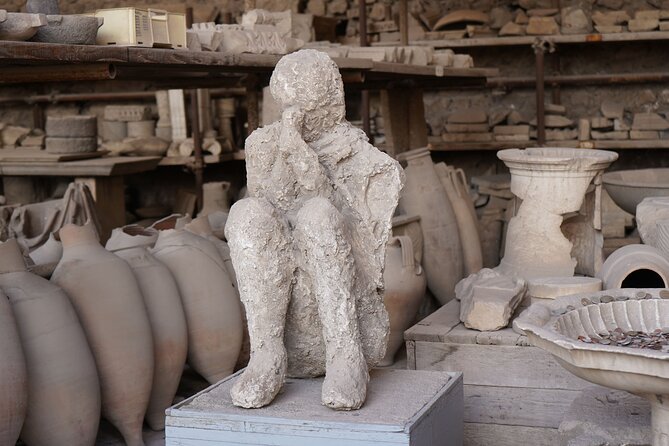
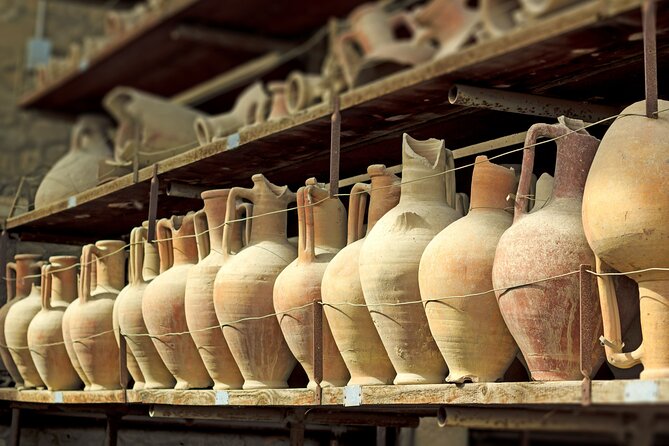
At the Granaries of the Forum, marble tables and fountain pieces are displayed alongside plaster casts. The casts are among Pompeii’s most somber sights. They offer a human connection to the eruption, though the experience can feel heavy after the grand houses and public monuments.
The Stabian Baths are among the city’s oldest bath complexes. The scale of the site shows that bathing was not just a private chore. It was part of public life, exercise, conversation, and routine. The guide can point out how the separate rooms and heating systems worked.
The Lupanar, Pompeii’s famous brothel, is a brief but memorable stop. Small rooms and erotic imagery offer a direct look at a commercial side of Roman life that polite public monuments often hide. It is popular, so the group may not linger long.
The House of the Faun is one of Pompeii’s largest and most impressive private residences. Its size and decoration show the reach of an elite household, while its name comes from the famous faun statue found there. This is one of the stops where a guide’s explanation helps you distinguish the original setting from the objects now displayed elsewhere.
Same city, an entirely different afternoon:
- Pompeii Small Group Tour with an Archaeologist
★ 5.0 · 6,593 reviews - Pompeii: Skip-the-Line Entrance Ticket with Audio Guide
★ 4.0 · 2,509 reviews - Naples: Pompeii and Mt. Vesuvius with Lunch and Wine Tasting
★ 4.5 · 2,454 reviews - Pompeii: Archaeological Park Tour with Ticket on request
★ 4.5 · 2,283 reviews
Pompeii’s theaters and the limits of a highlight tour
The Odeon, or Teatro Piccolo, is a smaller covered theater designed for performances to a more limited audience. The Teatro Grande is the city’s main theater and gives you a sense of Pompeii’s entertainment culture and public gatherings.
These stops round out the visit. You see not only where people lived and worshipped, but also where they watched performances and spent leisure time.
Still, do not book this as an unhurried Pompeii study day. You will not have time to examine every house, visit every gallery, or sit with each mosaic. One particularly useful tip is to bring realistic expectations: you can learn a great deal and see the main sights, but you cannot properly explore the full archaeological park in two hours.
If you already know you want extensive time at Pompeii, plan a separate return visit. This tour works best as a first, guided orientation.
The lunch break and transfer to Herculaneum
After Pompeii, you get a short lunch break at your own expense. The timing is practical rather than leisurely. One arrangement may use a mall, chosen to avoid the tourist traps around the Pompeii entrance and to offer several food choices, including pizzerias.
That stop will please you if you want speed, toilets, and predictable options. It may disappoint you if you hoped for a quiet meal beside the ruins or a small local restaurant. You can also bring your own lunch, which is sensible if you want to protect your time and budget.
The transfer then takes you to Herculaneum. Minibus passengers are dropped near the entrance. Pompeii-based passengers take the Circumvesuviana train with the guide and walk from Ercolano Scavi station.
This is one of the tour’s strongest practical features. Moving between the sites on your own is possible, but coordinating tickets, directions, and timing takes attention. Here, the guide keeps the day moving and takes you directly to the entry point.
Herculaneum’s waterfront, benefactor, and public life
Herculaneum begins with the archaeological park itself, followed by a compact route through the town’s major buildings. The House of the Deer gets its name from marble deer or stag statues found in its peristyle. It is a good introduction to the site’s domestic scale and refined decoration.
At the Terrace of M. Nonius Balbus, you learn about one of the town’s leading benefactors. His public works and honors show how wealthy individuals gained status by funding civic improvements. The long inscription connected with his funeral altar adds a personal and political layer to the ruins.
The College of the Augustales was linked to the cult of Emperor Augustus and may also have served as a local civic center. It helps you see how imperial loyalty, religion, and town administration could overlap.
The House of the Telephus Relief is unusual because it had private access to the nearby Suburban Baths. That detail makes the house feel less like a static floor plan and more like a functioning residence connected to the town’s public amenities.
The House of the Wooden Partition is important for its elegant carbonized wooden divider. Fragile wood rarely survives an ancient disaster, so this kind of feature is one reason Herculaneum feels different from Pompeii.
Herculaneum’s preserved homes and bath complexes
The House of the Skeleton probably formed from three smaller buildings. Its name comes from human remains found in an upper room in the 19th century. The story is grim, but it also shows how excavation has shaped the way we understand the site.
The Central Baths were built around the start of the first century AD and divided into men’s and women’s sections, each with its own entrance. Like Pompeii’s Stabian Baths, they reveal the importance of bathing, but the smaller setting lets you focus more closely on the design.
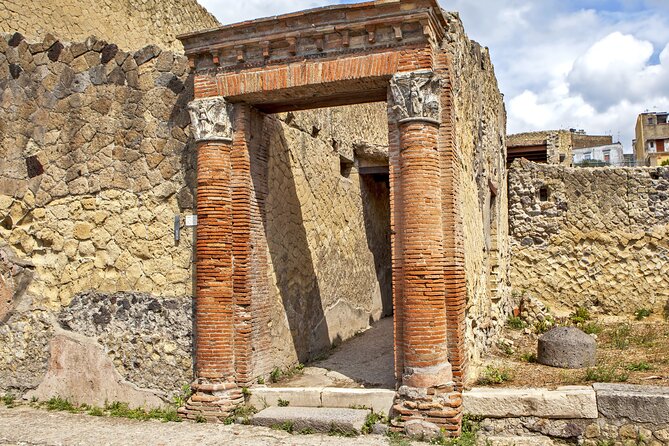
The House of the Black Salon is one of Herculaneum’s luxurious mansions. Its monumental entrance still retains carbonized wooden doorposts and a lintel, a rare survival that shows how much more domestic material remains here.
The Samnite House has an atrium surrounded by a gallery with Ionic columns and rooms decorated with frescoes. Its layout reflects an older Samnite style, giving the guide a chance to explain that the town’s culture did not begin as simply Roman.
The House of the Beautiful Courtyard is especially distinctive. Instead of the standard atrium, it has a courtyard with a stairway and stone balcony. That unusual design is easy to appreciate when the guide points out how it differs from the more familiar Roman house plan.
The House of the Grand Portal completes the route with columns, frescoes, and charred wooden remains. By this point, you have seen enough homes to compare wealth, layout, decoration, and function across the town.
The Herculaneum visit is also about two hours. That feels more appropriate for the site’s smaller size, but the route remains focused. You see important buildings rather than wandering freely through every accessible lane.
How much value do you get for $77.09?
At $77.09 per person, the price is strong if you need transport and want a guide at both sites. Adult admission alone is listed as 20 euros for Pompeii and 16 euros for Herculaneum. The package also includes guiding, headsets, and the required transport for your chosen departure option.
The value is highest for people starting in Naples, Sorrento, or Rome. You avoid arranging the full-day connection yourself, and the minibus simplifies the return journey. The Rome option is especially logistical, since it includes train tickets to Naples and full-day transport from there.
If you are already staying beside Pompeii and are comfortable with public transport, the value calculation is closer. You still receive both entry tickets and specialist guiding, but you must handle your own return from Herculaneum. The included one-way train ticket only takes you from Pompeii to the second site.
The group can reach 20 people. That is still small enough for a structured visit, but it is not a private tour. Headsets help, and the guide names repeatedly associated with strong visits include Michele, Diego, Michael, Paulo, Antonio, Alfredo, Amadeo, Tomas, Gianni, and Vince. The actual guide is assigned by the operator, so you should not assume a specific person will lead your date.
Who will enjoy this focused archaeological day?
I would choose this tour if you want an informed first visit and prefer not to spend your holiday studying regional train timetables. It suits history fans, first-time visitors, and anyone who wants the main story of both towns in one day.
It also works well for people who enjoy asking questions. The best accounts of the experience describe guides who explain architecture, engineering, city planning, and daily life in a conversational way. The archaeologist format is worth paying for if those details matter to you.
I would be cautious if your priority is photography, slow exploration, or a long lunch. Pompeii’s two-hour route is packed, and some people find both sites rushed. The tour is also not recommended for people with visual impairments unless they are accompanied by a dedicated personal assistant.
Confirmation arrives at booking, the sites are near public transport, and most people can participate. Free cancellation is available up to 24 hours before the start time. After that point, the paid amount is not refunded, and late changes are not accepted.
Should you book the Pompeii and Herculaneum tour?
Book it if you want efficient coverage, expert explanation, and transport handled for you. The guides are the main reason to choose this experience. A strong archaeologist can make the Forum, baths, frescoes, wooden doors, and plaster casts mean far more than they would on a quick self-guided walk.
Do not book it expecting to master Pompeii in a morning. Think of the day as a high-quality introduction to two major archaeological sites. Bring water, wear comfortable shoes, keep lunch simple, and stay close enough to hear the headset.
For most first-time visitors based in Naples or Sorrento, the combination is worth the $77.09. If you are already in Pompeii and want a slow, independent day, buy tickets separately and return another time. If you want the big picture without the usual transport fuss, this tour is a smart and well-organized choice.
FAQ
How long does the Pompeii and Herculaneum tour last?
The full experience lasts approximately six to 11 hours, depending on your selected departure point and transport arrangements. The guided visits at Pompeii and Herculaneum each take about two hours, with a short lunch break between them.
Where do I meet the guide?
Pompeii departures meet at Porta Marina Superiore. Naples departures meet outside Starhotels Terminus, and Sorrento departures meet at Piazza Angelina Lauro. The Rome option includes train travel to Naples before the full-day transport service.
Is transportation between Pompeii and Herculaneum included?
Yes. The Pompeii option includes a one-way Circumvesuviana train ticket, with about 30 minutes on the train and a 10-minute walk to the ruins. Naples, Sorrento, and Rome options use a modern minibus.
Are admission tickets included?
Yes. Entry to both archaeological sites is included. The listed standard admission prices are 20 euros for Pompeii and 16 euros for Herculaneum.
Is lunch included?
No. Meals and drinks are not included. A short lunch break is provided, and you pay for your own food. You may also bring a packed lunch.
Does the tour return me to Pompeii after Herculaneum?
No. The Pompeii departure option concludes at the Herculaneum ruins. The return journey to Pompeii is not included, so you must arrange it yourself if your car or accommodation is there.
Fresh on the Pompeii list
- Explore Pompeii with an Archaeologist★ 5.0 · 511 reviews
- Pompeii Skip-the-line Tour with Archaeologist Guide★ 5.0 · 559 reviews
- Pompeii Private Tour with an Archaeologist and Skip The Line – 3 hours★ 5.0 · 564 reviews
- Ercolano: Herculaneum Entry Ticket with Optional Audio Guide★ 4.1 · 581 reviews
- Pompeii private tour with an Official Guide★ 5.0 · 631 reviews
- Pompeii: Exclusive Tour with Archaeologist and Entry Tickets★ 4.9 · 634 reviews
- Pompeii Ticket + Tour with Optional Tasting Experience at Pompeii★ 5.0 · 663 reviews
- From Naples: All-Inclusive Mount Vesuvius Half-Day Tour★ 4.2 · 674 reviews
Pompeii & Vesuvius Tours, compared.

Entry Ticket and Guided Tour with an Archaeologist
Read our review →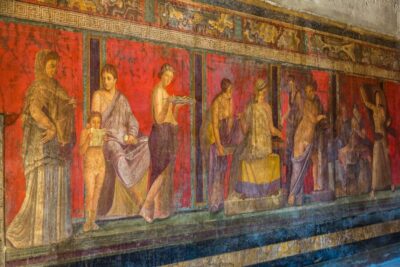

Pompeii Small Group Tour with an Archaeologist
Read our review →
Pompeii, Amalfi Coast and Positano Day Trip from Rome
Read our review →Browse the lists this tour appears in