
Reviewed · POMPEII & VESUVIUS TOURS
Pompeii 2h Small-Group Tour with Expert Archaeologist
Pompeii is far too large to understand by wandering without a plan. This two-hour guided walk takes you from the theaters and villas to the baths, brothel, forum, and basilica, giving you a useful first look at the city before you explore further on your own.
I like the low price of $32.67 and the way the route covers major sights that are easy to miss. I also like the short format: two hours is long enough to make sense of Pompeii, yet manageable for families, older adults, and anyone fitting the ruins into a busy southern Italy itinerary.
The main caution is that the quality depends on the guide assigned to your group. Guides such as Luca, Manuela, Roberta, and Patrizia have been praised for clear storytelling and warm family-friendly styles, but one less successful experience felt limited to basic facts. The group can also reach 30 people, so a small group is not guaranteed.
Key points at a glance
- A focused two-hour route: See nine major Pompeii areas without trying to cover the entire archaeological park.
- Strong guides can make the difference: Luca, Roberta, Manuela, Patrizia, and other guides are praised for humor, clear English, and vivid storytelling.
- Admission is included: The listed price includes the Pompeii entrance ticket, though special free-entry rules may affect the value.
- Family-friendly, with one important caveat: Many guides keep children engaged, but the tour remains a history-focused walking experience.
- Groups may range from 6 to 30 people: The advertised format is small-group, but the maximum is larger than some visitors expect.
- Easy meeting point: Meet at Ristorante Suisse on Piazza Esedra, close to public transportation and about a five-minute walk from the train station.
Why two hours can work at Pompeii
Pompeii is not a compact monument. It is an enormous ancient city, and its streets can feel confusing when you first arrive. You may spend precious time looking at a map, walking toward a closed section, or passing an important house without realizing what you are seeing.
That is where this tour earns its keep. The guide gives you a route and a story. Instead of treating the ruins as scattered walls, you get a basic picture of how public life, entertainment, bathing, religion, commerce, and private homes fit together.
Two hours will not cover all of Pompeii. It is best understood as an introduction to the major highlights. After the guided walk, you can decide if you want to continue exploring independently, return to a house you passed quickly, or simply leave before the heat and rough paving wear you down.
The pace appears moderate rather than punishing. Gianluca, for example, was praised for keeping the group moving without going too fast for an older parent. That matters here. Pompeii’s uneven stone streets are tiring, and a guide who stops at sensible points makes the visit more comfortable.
A few other Pompeii mornings to weigh against this
- Pompeii: Entry Ticket and Guided Tour with an Archaeologist
★ 4.8 · 19,459 reviews - Pompeii: Entry Ticket with Optional Audio Guide
★ 4.2 · 12,360 reviews - Pompeii: Small Group Tour with an Archaeologist
★ 4.8 · 12,264 reviews
Starting at Piazza Esedra
The meeting point is Ristorante Suisse at Piazza Esedra, 10/13, in Pompei. The activity ends back at the meeting point, so you are not left trying to find the guide or your companions at a different exit.
The location is near public transportation, and the train station is described as roughly a five-minute walk away. That makes this tour practical for a day trip by train, especially if you are coming from Naples or staying elsewhere along the Bay of Naples.
Arrive with enough time to find the restaurant and gather your group. One guide was especially helpful when a group was delayed by a train from Rome, but you should not count on late arrival being accepted. The official terms require changes or cancellations at least 24 hours before the start time, and a late cancellation is not refundable.
The archaeological park: a quick orientation
The first stop introduces the Archaeological Park of Pompeii and the eruption of Mount Vesuvius in AD 79. The scheduled ten minutes is short, so think of this as a quick orientation rather than a full lecture.
A good guide will help you understand what you are about to see: an ancient Roman city preserved by volcanic material, with streets, buildings, decoration, and public spaces still visible. That broad frame is useful before the more specific stops begin.
The wording of the route mentions famous frescoes, but the main benefit is context. Pompeii can overwhelm you with detail. A guide helps you notice the difference between a private residence, a public building, a theater, and a commercial or social space.
The Odeon and Teatro Grande
The Odeon, also called the Teatro Piccolo, receives about ten minutes. It was a smaller theater, and its inclusion gives you a useful contrast with the much larger Teatro Grande that follows.
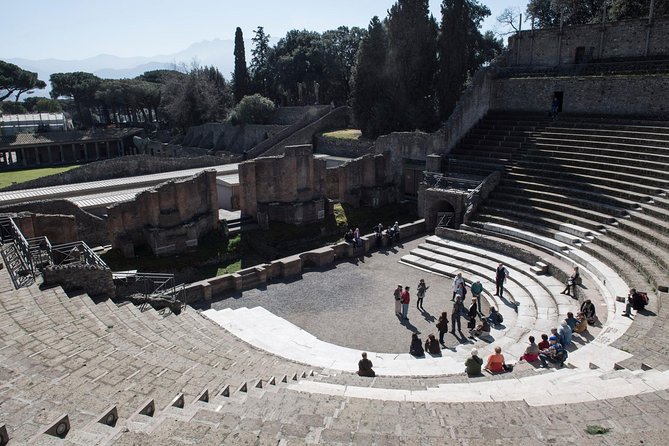
The Teatro Grande is scheduled for 15 minutes and is described as Pompeii’s most important theater. This is one of the places where the guide’s storytelling matters. Empty stone seating can look simple at first, but the shape of the building and its role in city life become easier to grasp when someone explains what you are looking at.
You will not have time for a long theatrical history during a two-hour route. Still, seeing both theaters gives the tour a nice rhythm. You move from a smaller performance space to a grander public venue and get a sense of how entertainment formed part of urban life.
Same city, an entirely different afternoon:
- Pompeii Small Group Tour with an Archaeologist
★ 5.0 · 6,593 reviews - Pompeii: Skip-the-Line Entrance Ticket with Audio Guide
★ 4.0 · 2,509 reviews - Naples: Pompeii and Mt. Vesuvius with Lunch and Wine Tasting
★ 4.5 · 2,454 reviews - Pompeii: Archaeological Park Tour with Ticket on request
★ 4.5 · 2,283 reviews
House of Menander and the Roman home
The House of Menander gets 15 minutes. It is presented as one of Pompeii’s wealthiest and most impressive homes, noted for its architecture, decoration, and contents.
This is an important stop because it shifts the focus from public buildings to domestic life. Pompeii becomes more personal here. You can consider how a powerful household used space, decoration, and design to display status.
The house is also a good test of the guide’s skill. A basic description of wealth and decoration will give you only the surface. A stronger guide can help you read the building as a home with social purpose, not merely as a collection of rooms.
Several families found the guides especially good at keeping children involved in this sort of stop. Manuela and Patrizia were praised for explaining the ruins in an entertaining way while handling children between about 7 and 13. That does not mean every child will love every minute, but the format can work well when the guide uses stories rather than dates alone.
Stabian Baths and the Lupanar
The Stabian Baths receive about 15 minutes. These baths occupy a large area near the Brothel Lane, the Holconius crossroads, and Via Stabiana. They are described as Pompeii’s oldest thermal complex.
The baths help you see how public facilities shaped everyday life. Even if you know little about Roman bathing, the scale of the complex makes clear that this was more than a simple place to wash. It was part of the city’s social fabric.
The Lupanar, Pompeii’s famous brothel, receives ten minutes. It is a memorable stop, but it can also attract crowds. The building is often one of the most talked-about parts of Pompeii, so the guide’s timing and crowd management can make a real difference.
Roberta was praised for knowing how to move around crowded areas, which is exactly the sort of practical help you want at a popular site. The tour will not remove the crowds, but a guide may help you avoid standing in the worst congestion for every explanation.
Via dell’Abbondanza and the House of the Faun
The route continues along Via dell’Abbondanza, one of Pompeii’s key streets. The itinerary does not assign a separate time to the street, but its position between the Lupanar and House of the Faun gives you a chance to see how the city connected its major buildings.
This is where Pompeii’s street plan begins to make more sense. You are not only visiting isolated houses. You are walking along a route that linked homes, shops, public buildings, and social spaces.
The House of the Faun receives ten minutes. It was one of Pompeii’s largest and most impressive private residences. Like the House of Menander, it shows the scale and ambition of wealthy domestic architecture.
The two homes serve different purposes in the tour. Menander helps explain decoration and household status, while the House of the Faun gives you a stronger sense of size and grandeur. Ten minutes is not much, so expect a highlights stop rather than a full architectural study.
The Forum and Basilica
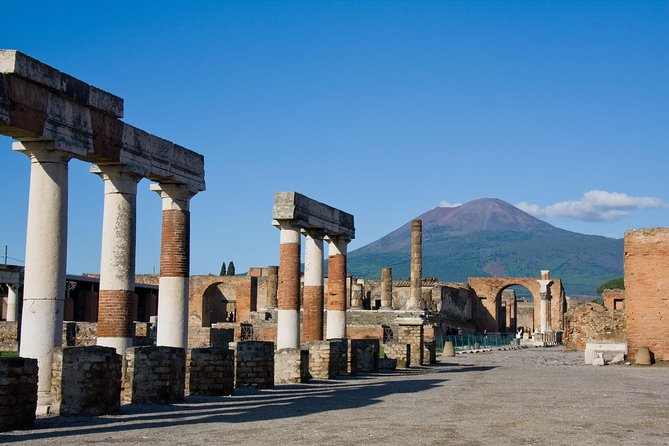
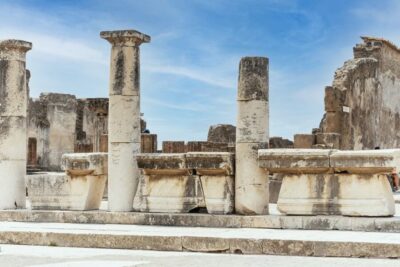
The Foro de Pompeya, or ancient main square, receives 15 minutes. This is one of the most useful places to pause because the forum gives you a sense of Pompeii as a functioning city rather than a group of preserved buildings.
The forum was the center of public life. From here, the guide can tie together the religious, civic, and commercial parts of the city that you have seen along the way.
The Basilica receives another 15 minutes. It was an open portico that provided shelter for merchants and other activity. Its inclusion adds an important civic and commercial layer to the tour.
The forum and basilica are particularly valuable near the end because they help organize everything that came before. The theaters show public entertainment, the baths show communal life, the villas show private wealth, and the forum and basilica show civic business.
Guide quality: the real variable
The strongest praise goes to guides who combine facts with personality. Luca was singled out for passion and storytelling, with explanations that made the ancient city feel inhabited rather than frozen in ruins. Manuela was praised for being both entertaining and educational, and for adapting well to families.
Roberta was described as informative, funny, and skilled at handling crowds. Patrizia received similar praise for kindness, local knowledge, and patience with energetic children. Barbara was appreciated for answering questions, offering choices about which areas to see, and finding shade and rest points in hot weather.
That last point is worth noting. Pompeii is exposed, and weather can change the feel of the visit dramatically. One group dealt with intense heat, while another encountered hail, heavy rain, and wind. Guides who look for covered or shaded places can make the difference between a memorable visit and an exhausting one.
There is also a less favorable possibility. One experience felt underwhelming because the guide offered only widely known facts and did not provide the expected archaeology focus. Another group paid for a small-group format but ended up in a group of about 20 after two people could not join, using headsets that one person found difficult to hear.
So, if the guide assigned to you is not a specialist in the way you hoped, the tour may feel more like a standard highlights walk. The high overall rating suggests that this is not the usual outcome, but it is a fair reason to keep expectations realistic.
Group size, headsets, and the private upgrade
The tour requires at least six people and accepts up to 30. That range matters. A group of six to ten can feel personal, with room for questions and easier movement through tight streets. A group approaching 30 will feel more like a formal walking tour.
The experience can also be upgraded to a private tour. That is worth considering if you have young children, an older family member, a short list of specific buildings, or a strong preference for asking questions.
Headsets may be used in larger groups. They help you hear in a crowded archaeological park, but they are not perfect for everyone. If clear, close conversation is your priority, a genuinely small group or private option may be the better choice.
Is $32.67 good value?
At $32.67 per person, this is a fairly modest way to add structure and interpretation to a Pompeii visit. The price includes admission according to the tour details, which improves the value because you are paying for both entry and a guided route.
There are two exceptions to keep in mind. Pompeii admission is free on the first Sunday of each month, and it is free for people under 18 who show valid identification or a passport. On those dates, the ticket portion has less value, though you are still paying for the guide.
The tour makes the most financial sense if you have only a few hours, want help finding the major sights, or prefer not to manage Pompeii’s huge layout alone. It is less compelling if you already plan to spend most of the day exploring independently and enjoy reading signs or using a self-guided audio tour.
The best value comes from the guide’s ability to connect the places. You are not paying simply to enter Pompeii. You are paying to use two hours efficiently and to hear explanations while standing at the actual buildings.
Who should book this Pompeii tour?
I would recommend it for first-time visitors with limited time, families wanting a manageable introduction, and older adults who prefer a moderate pace. It also suits anyone arriving by train and looking for a clear meeting point near the station.
Children can enjoy it when the guide makes the subject lively. Many guides have done this well, especially with children between 7 and 13. Still, the one sharply negative family experience is a reminder that kid-friendly does not guarantee a playful tour. Children aged 6 and 8 may need extra patience and breaks.
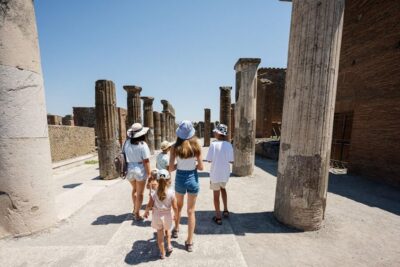
People with a moderate level of physical fitness should be prepared for walking over uneven ancient streets. Shade is limited, and weather can affect comfort. Bring what you need for the conditions, and let the guide know if your group needs a slower pace or a short rest.
Booking and cancellation details
You receive confirmation when you book. The tour is offered in English and accepts mobile tickets.
You can cancel for a full refund up to 24 hours before the local start time. Cancellations made less than 24 hours ahead are not refunded, and changes inside that window are not accepted.
Because the tour requires a minimum of six people, it can be canceled after confirmation if that number is not reached. In that case, you are offered another option or a full refund.
FAQ
How long does the Pompeii tour last?
The tour lasts approximately two hours.
What price is listed for the tour?
The listed price is $32.67 per person.
Is Pompeii admission included?
Yes. The tour details state that admission tickets are included.
Is the tour offered in English?
Yes. The tour is offered in English.
Where does the tour begin?
It begins at Ristorante Suisse, Piazza Esedra, 10/13, 80045 Pompei, Italy.
Where does the tour end?
The activity ends back at the meeting point.
How many people can join the tour?
The tour requires a minimum of six people and has a maximum of 30 participants.
Can children join the tour?
Yes. The activity is described as family-friendly, and children under 18 can enter Pompeii free with valid identification or a passport. The tour details do not state a separate minimum age.
Is Pompeii free on any regular date?
Pompeii admission is free on the first Sunday of each month. People under 18 also receive free admission when they show a valid document on the day of the tour.
Should you book it?
Book this tour if you want a well-organized Pompeii introduction and do not want to lose time finding the major buildings yourself. The two-hour route is efficient, the price is reasonable when admission is included, and the strongest guides add real value through stories, pacing, family care, and crowd management.
Choose the private upgrade if personal attention matters, or if your group includes very young children, an older relative, or someone who may struggle with headsets. If you want a full-day study of Pompeii, this tour is only a starting point, not the whole visit.
My practical call: book it for a first visit with limited time, but understand that the assigned guide shapes the experience. At its best, this is a lively, well-paced walk through Pompeii’s essential sights. At its weakest, it is a basic tour you could partly replace with signage and an audio guide. The odds favor a good experience, especially if you value clear direction and human storytelling over exploring every street at your own pace.
More 2-Hour Experiences in Pompeii
- 2 hours Pompeii Tour with Local Historian – Ticket Included
★ 5.0 · 335 reviews - Pompeii: 2 Hour Private Tour with an Archeologist Guide
★ 5.0 · 214 reviews - Lucca: 2-Hour City Center Walking Tour
★ 4.7 · 1,314 reviews - Milan Duomo and Rooftop 2-Hour Guided Tour
★ 4.6 · 1,076 reviews
Fresh on the Pompeii list
- Stories of Pompeii: Small Group tour with archeology expert guide★ 5.0 · 191 reviews
- Mount Vesuvius: Vineyard Tour with Wine Tasting and Lunch★ 4.8 · 193 reviews
- Pompeii: Skip-the-Line Guided Tour with Expert Archaeologist★ 4.8 · 196 reviews
- Pompeii: 2 Hour Private Tour with an Archeologist Guide★ 5.0 · 214 reviews
- Pompeii: Skip-the-Line Entry & Audioguide★ 3.8 · 225 reviews
- Herculaneum: Tickets & Tour with a Local Archaeologist★ 4.8 · 226 reviews
- Pompeii and Mount Vesuvius Small Group Tour★ 4.5 · 233 reviews
- From Naples/Salerno: Pompeii, Sorrento, and Positano Tour★ 4.5 · 250 reviews
Pompeii & Vesuvius Tours, compared.
Entry Ticket and Guided Tour with an Archaeologist
Read our review →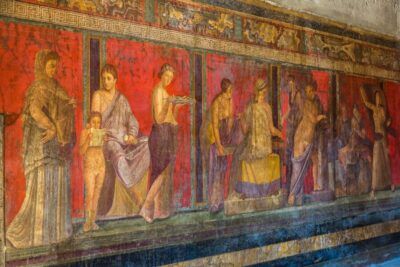

Pompeii Small Group Tour with an Archaeologist
Read our review →
Pompeii, Amalfi Coast and Positano Day Trip from Rome
Read our review →Browse the lists this tour appears in