
Reviewed · POMPEII & VESUVIUS TOURS
Explore Pompeii with an Archaeologist
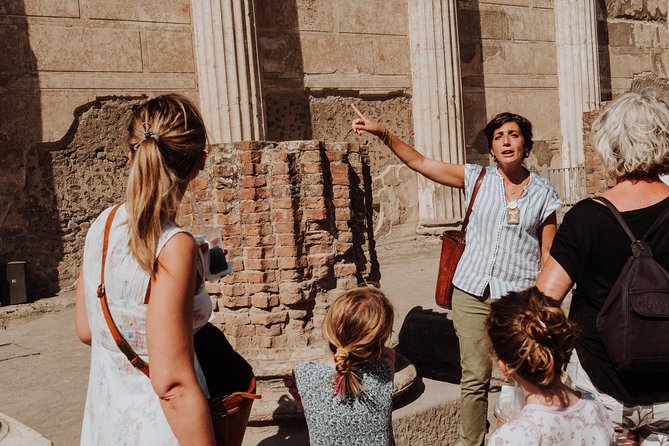
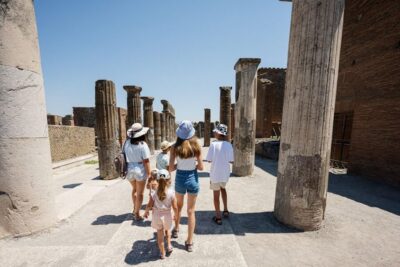
Pompeii makes far more sense when someone helps you read it. In two focused hours, this tour takes you from the city’s main square to grand houses, public baths, a brothel, an ancient snack bar, and the theater, with an archaeologist explaining what you are seeing. I like the skip-the-line admission and the chance to ask questions in a group capped at 20 people.
I also like the route’s variety. You are not left staring at one famous ruin, but move through homes, streets, civic buildings, and public spaces. The trade-off is pace: Pompeii is enormous, and two hours gives you a strong introduction rather than the whole city. Crowds, heat, uneven stone, and occasional difficulty hearing through the headset can also affect the visit.
Key points to know before you book
- A fast introduction to Pompeii: See 12 major locations in about two hours, including the forum, brothel, baths, theater, and several famous houses.
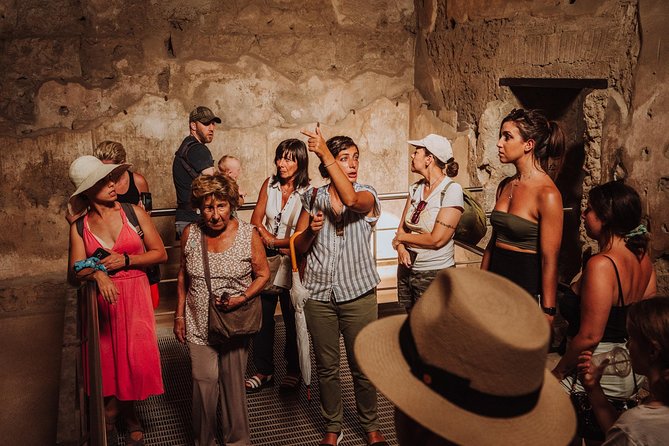
- An archaeologist leads the walk: Guides such as Mario Celentano, Teresa, Alexandra, Rosanna, Ilaria, and Antonio have been praised for clear explanations and lively storytelling.
- Admission is included: The tour begins at Porta Marina Superiore, with the guide holding an Askos Tours sign.
- Small, but not private: The maximum is 20 people per guide, so you can ask questions, though a full group may still feel busy at popular rooms.
- Expect a workout: Pompeii involves substantial walking over uneven ancient surfaces, with limited shade and hot conditions in summer.
- Plan extra time if you can: The guided route ends at Piazza Esedra, and you can continue exploring independently afterward.
Starting at Porta Marina Superiore
Your meeting point is Via Villa dei Misteri 2, at Pompeii’s Porta Marina Superiore entrance. Look for an Askos Tours guide holding a sign with the company name at the top. The tour includes the Pompeii admission fee, so you do not need to arrange a separate entry ticket for this experience.
The skip-the-line feature is useful, but keep your expectations sensible. It is designed to help you avoid the standard admission wait, not to give you a private route through every crowded room inside the park. Pompeii is a major archaeological site, and busy periods can still mean queues at individual houses or restricted interiors.
Askos Tours limits each guide’s group to 20 people. That is a reasonable size for a public site. You should have a better chance of seeing the guide and asking a question than you would in a large coach group, but this is still a shared tour, not a private visit.
For groups of 16 or more, headsets are provided. They can be a real help when the guide is speaking beside a busy road or when the group spreads out. Still, sound can become harder to catch in crowded spaces, so stay reasonably close and do not wander too far ahead.
A few other Pompeii mornings to weigh against this
- Pompeii: Entry Ticket and Guided Tour with an Archaeologist
★ 4.8 · 19,459 reviews - Pompeii: Entry Ticket with Optional Audio Guide
★ 4.2 · 12,360 reviews - Pompeii: Small Group Tour with an Archaeologist
★ 4.8 · 12,264 reviews
The Forum, Basilica, and ancient city center
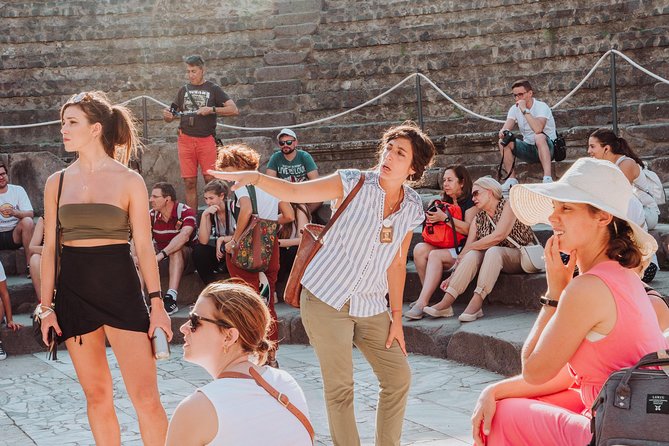
The first major stop is the Forum, Pompeii’s main square. This is the right place to begin because it gives you a sense of how the city was organized. Your guide can point out the civic and religious heart of Pompeii before moving you into the smaller, more personal spaces.
Next comes the Basilica, the city’s courthouse. Its large scale helps explain the public side of Roman life. This is one of the places where a guide adds real value, since bare walls and columns do not always tell you how a building functioned.
The Forum and Basilica are also among the most exposed parts of the route. There is little shelter from the sun, and a summer visit can feel hard going. Bring a hat or umbrella, use the fountains to refill your bottle, and do not underestimate the heat simply because the tour lasts only two hours.
The Lupanar and Forum granaries
The Lupanar, or brothel, is one of Pompeii’s most talked-about sights. Its small rooms and surviving details offer a glimpse into a less formal side of Roman urban life. It can be a crowded stop, and access to individual rooms may move slowly if many groups arrive at once.
The ancient granaries beside the Forum provide a different kind of lesson. Rather than focusing on daily entertainment or private homes, this stop helps you think about storage, trade, and the practical systems that kept a city running. The displays and remains can be easier to understand when your guide explains what the building was used for.
The tour does not linger at every location for a long time. The listed route gives roughly ten minutes to each stop, so your guide will select the details that best fit the group and the conditions on the day. If one place catches your interest, make a note of it and return after the guided walk.
Pompeii’s grand homes: Menander and the Faun
The House of Menander is one of the route’s important domestic stops. It shows how a wealthy Roman home could combine private rooms, decoration, and formal spaces for receiving visitors. The name comes from a celebrated Greek playwright, a useful reminder that Roman culture drew heavily on the Greek world.
The House of the Faun is larger and more elaborate. It is famous for its scale and for the connection to the Alexander Mosaic, although what you see on display can vary with site arrangements. The house gives you a sense of the money and space available to Pompeii’s elite.
These homes are where the guide’s storytelling matters most. A list of room names is not enough. You want help understanding how people moved through the house, what was public or private, and why decoration carried social meaning. Guides including Mario and Alexandra have been praised for making those details clear and for answering questions rather than simply reciting a script.
Do keep the pace in mind. Two hours is enough to appreciate the main features, but not enough to study every painting, courtyard, or architectural detail. If domestic architecture is your main interest, plan to stay in the park after the tour ends.
Same city, an entirely different afternoon:
- Pompeii Small Group Tour with an Archaeologist
★ 5.0 · 6,593 reviews - Pompeii: Skip-the-Line Entrance Ticket with Audio Guide
★ 4.0 · 2,509 reviews - Naples: Pompeii and Mt. Vesuvius with Lunch and Wine Tasting
★ 4.5 · 2,454 reviews - Pompeii: Archaeological Park Tour with Ticket on request
★ 4.5 · 2,283 reviews
The Stabian Baths and Via dell’Abbondanza
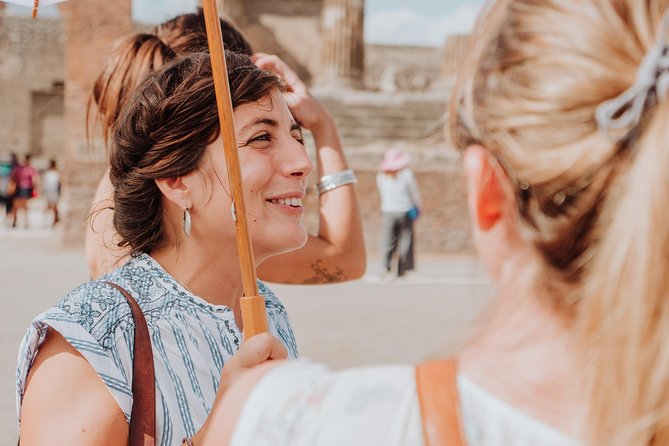
The Stabian Baths, or Terme Stabiane, show Pompeii’s public life in a more relaxed setting. Roman baths were not only places to wash. They were social spaces, and the surviving layout helps you picture the sequence of rooms and the systems that supported them.
The route then reaches Via dell’Abbondanza, one of Pompeii’s key streets. Walking along it connects the buildings you have seen with the ordinary movement of the city. You can look at doorways, walls, paving, and storefronts while your guide explains how the street fitted into everyday life.
This is also one of the clearest reminders that Pompeii is a city, not a single monument. The distances between stops require steady walking, and the ancient paving can be rough. Wear firm, comfortable shoes and expect a proper walk rather than a gentle museum visit.
The itinerary lists admission as included at most stops, with the street itself marked as free. That simply reflects the fact that you are already inside the archaeological park. You are not paying separate admission at each building.
The Thermopolium and Pompeii’s everyday food culture
Thermopolium VI is an ancient food shop, and it is one of the most enjoyable stops for visitors who want something more personal than grand public buildings. The name refers to a place selling prepared food and drink. Its counters and surviving decoration help you picture a quick meal in the Roman city.
This stop adds balance to the tour. The Forum shows power, and the grand houses show wealth. The Thermopolium brings the focus back to ordinary commerce and eating habits. It is the kind of place that can make Pompeii feel less like a collection of ruins and more like a functioning neighborhood.
The shop may be busy, especially if several groups arrive at once. Listen closely, and ask your guide to repeat a point if the crowd makes it hard to hear. You are paying for explanation as much as access, so use the chance to ask about the building’s purpose and what can be established from the remains.
The Teatro Grande and House of the Vettii
The Teatro Grande is the final public venue on the route. The theater gives you another view of community life, this time through performance and gathering. Its scale and form help explain how entertainment fitted into the city’s daily rhythm.
The last listed stop is the Casa dei Vettii, or House of the Vettii. This is another of Pompeii’s celebrated wealthy homes, with decoration and room layouts that reveal status, taste, and domestic life. The house works well near the end of the tour because you have already seen the Forum, streets, baths, and food shop. You can now compare elite private life with the city’s public spaces.
Access to particular rooms can change, and lines may form within the park. That is one of the few limits of a fixed group route. Your guide can keep the visit moving, but cannot control how many other people are admitted to a house at the same time.
The official end point is Piazza Esedra, at 80045 Pompei. From there, you can leave the site or continue exploring on your own if you still have energy. One useful plan is to treat the guided walk as your orientation, then return to the areas you most enjoyed.
What the guide adds to the ruins
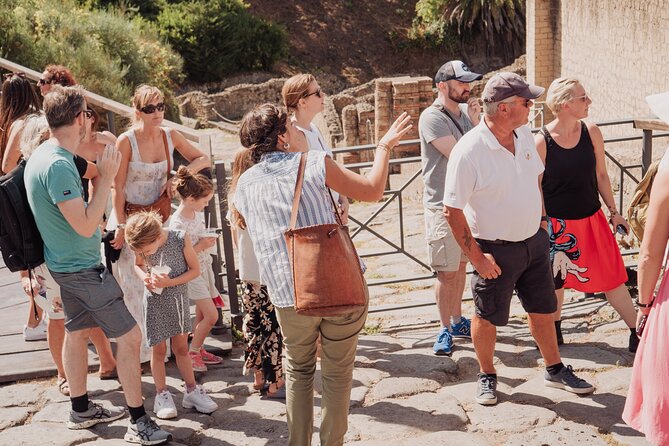
The strongest part of this experience is the human explanation. Several guides have received praise for clear pacing, patience, humor, and the ability to answer questions. Mario Celentano, Teresa, Alexandra, Rosanna, Ilaria, Antonio, Julia, Diego, Jolanta, Sergio, and Rafaela are among the guides named in the feedback, though you should not assume a particular person will lead your departure.
Rosanna has been praised for combining detailed explanations with humor. Teresa is described as passionate and willing to answer questions. Mario is noted for checking the group’s pace and telling stories rather than simply listing facts. These are useful qualities at Pompeii, where a good guide must keep one eye on the ruins and another on the group.
The experience is not perfect for every learning style. One unhappy customer found the guide too slow, less interactive than expected, and difficult to understand. That criticism is worth taking seriously. A shared tour depends on the individual guide, the group’s questions, and the noise around each site.
If you prefer a quick, lively walk with frequent questions, say so early and stay engaged. If you want long discussions at each house or time in areas currently being excavated, a private tour or a longer visit may suit you better. This tour is built around the main sights, not every corner of Pompeii.
Price, timing, and practical value
At $35.67 per person, this is priced as an accessible introduction rather than a luxury archaeological study. The fee covers admission, a guide with archaeological training, and headsets for larger groups. That makes the cost easier to justify if you want context but do not need a private guide.
Two hours is the key value question. You get a brisk route through 12 locations, but Pompeii is too large to understand fully in that time. I see this as a strong first pass, especially if you have a tight schedule, are visiting from Naples or nearby, or want help deciding which sections deserve a second look.
Several people have found it easy to reach by train, but transportation is not included. You must make your own way to the Porta Marina Superiore meeting point and arrange your return from Piazza Esedra. Check the exact meeting address carefully, since Pompeii has more than one entrance and the wrong gate can cost you time.
The activity is usually booked about 30 days ahead. That suggests you should reserve early for a fixed vacation schedule, particularly if you need a specific morning or afternoon. Confirmation arrives at booking, and free cancellation is available up to 24 hours before the local start time. Cancellations or changes inside that window are not refunded or accepted.
Heat, walking, families, and access
Pompeii is physically demanding in a quiet way. You are not climbing a mountain, but you will walk across uneven ancient surfaces for much of the tour. A refillable water bottle is a smart choice, and fountains are available inside the site. In warm weather, add a hat, umbrella, and light clothing.
Most people can take part, but the surface conditions matter if you have mobility concerns. The supplied information does not promise a step-free route, so ask the provider before booking if you need a specific access arrangement.
Families can do well on this tour. A guide who explains the site clearly and uses stories can hold the attention of children of different ages better than a long audio recording. The Lupanar may require a parent to decide how much detail is suitable for younger children.
Service animals are allowed. Other dogs must weigh no more than 10 kilograms and be no taller than 40 centimeters, remain on a leash, and be carried inside buildings. You must collect their waste. Anyone under 18 should bring a passport or ID to qualify for free admission.
Is this Pompeii tour worth booking?
Book it if you want a reasonably priced, guided introduction to Pompeii and care about seeing a broad mix of sights in a short time. The archaeologist-led format, included admission, small group limit, and strong record of clear guides make it a sensible choice for first-time visitors.
Think twice if you want a slow, highly interactive tour, a private pace, or access to excavation areas not included in the route. You should also leave extra time afterward if Pompeii is a major reason for your trip. For most people, the best plan is simple: use the two-hour walk to understand the city, then explore your favorite houses, streets, or public buildings independently.
FAQ
Where does the Pompeii tour begin?
Meet at Via Villa dei Misteri 2, at the Porta Marina Superiore entrance of the Pompeii archaeological site. The guide will hold an Askos Tours sign.
Where does the tour end?
The route ends at Piazza Esedra in Pompeii, at 80045 Pompei.
How long does the experience last?
The tour lasts approximately two hours.
Is Pompeii admission included?
Yes. The Pompeii admission fee is included in the tour price.
How large is the group?
The maximum is 20 people per guide. Headsets are supplied for groups of 16 or more.
Is transportation included?
No. You must arrange your own transportation to the starting point and from the end point.
What is the cancellation policy?
You can cancel for a full refund up to 24 hours before the experience start time. Cancellations or changes made less than 24 hours in advance are not accepted for a refund.
Can children and dogs enter?
Most people can participate, and anyone under 18 should bring a passport or ID to qualify for free admission. Service animals are allowed. Other dogs must be no more than 10 kilograms and 40 centimeters tall, remain leashed, and be carried inside buildings.
Fresh on the Pompeii list
- Pompeii Skip-the-line Tour with Archaeologist Guide★ 5.0 · 559 reviews
- Pompeii Private Tour with an Archaeologist and Skip The Line – 3 hours★ 5.0 · 564 reviews
- Ercolano: Herculaneum Entry Ticket with Optional Audio Guide★ 4.1 · 581 reviews
- Pompeii private tour with an Official Guide★ 5.0 · 631 reviews
- Pompeii: Exclusive Tour with Archaeologist and Entry Tickets★ 4.9 · 634 reviews
- Pompeii Ticket + Tour with Optional Tasting Experience at Pompeii★ 5.0 · 663 reviews
- From Naples: All-Inclusive Mount Vesuvius Half-Day Tour★ 4.2 · 674 reviews
- From Pompeii: Bus Transfer to Vesuvius with Park Entry Fee★ 4.2 · 700 reviews
Pompeii & Vesuvius Tours, compared.
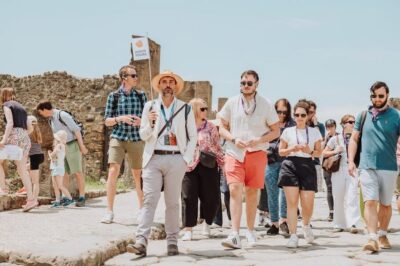
Entry Ticket and Guided Tour with an Archaeologist
Read our review →

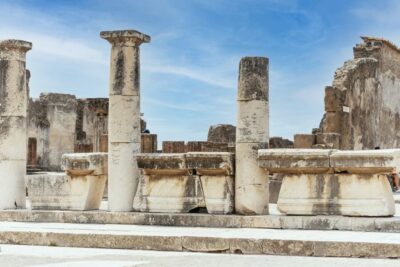

Pompeii Small Group Tour with an Archaeologist
Read our review →
Pompeii, Amalfi Coast and Positano Day Trip from Rome
Read our review →Browse the lists this tour appears in