
Reviewed · POMPEII & VESUVIUS TOURS
Pompeii Small Group Tour with an Archaeologist
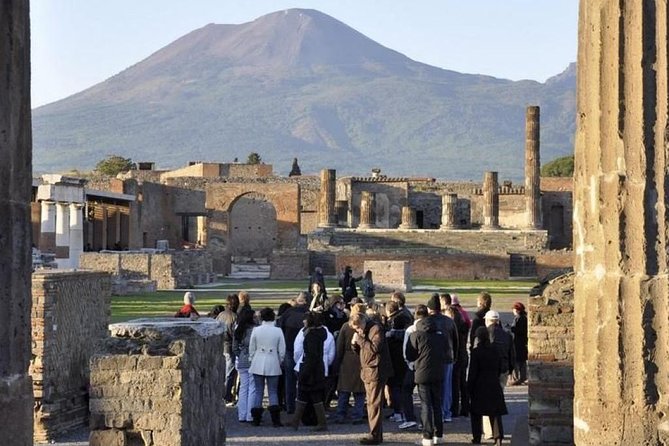
Pompeii becomes far easier to understand when an archaeologist points out what you are seeing. This two-hour walk takes you from the Basilica and Forum to painted houses, public baths, theaters, and the casts of victims in the Forum granaries. I like the clear route through the site and the way guides such as Alessandra, Paolo, Teresa, and Vincenzo connect buildings to ordinary Roman life.
I also like that you can remain inside the ruins after the guided visit and continue on your own. The main consideration is time: Pompeii is enormous, and two hours gives you a useful introduction rather than a full look at the city. Some visitors also found a group of 20 a little large, and a late start or headset problem can eat into the tour.
Key points to know before booking
- Archaeologist-led visit: You get historical context from a licensed guide with an archaeological background, not just directions from one ruin to the next.
- A strong first route: The tour covers the Forum, victim casts, House of Menander, Stabian Baths, Lupanar, House of the Faun, and both major theaters.
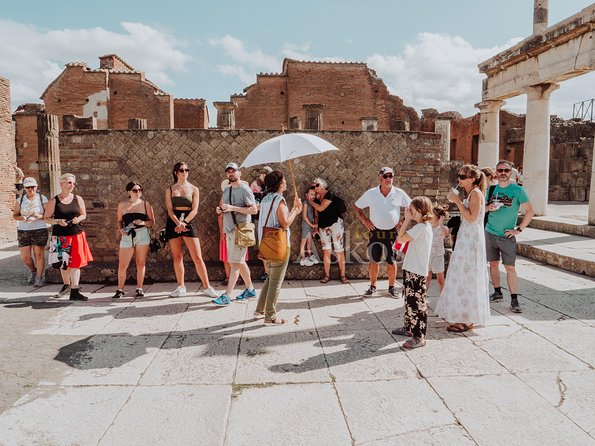
- Maximum group of 20: This is small enough to feel organized, but not as intimate as a private or very small tour.
- Two hours inside the ruins: Expect the essential sights and a guided orientation, then plan extra time if you want to see more.
- Uneven Roman streets: Wear sturdy shoes, carry water, and expect ramps, steps, and a few steeper sections.
- Good value at $35.67: The price includes the Pompeii Express entrance ticket and guiding, making it a practical choice for a first visit.
Why an archaeologist helps at Pompeii
Pompeii is not a tidy museum with one obvious route. It is a large, open archaeological park crossed by ancient roads, with houses, shops, temples, public buildings, theaters, and baths spread across a wide area. Without help, you can see plenty and still miss what makes each place important.
A good guide gives you a sequence and a story. The Basilica becomes more than a roofless collection of columns. The Forum becomes the civic center of a working Roman town. A private house reveals social status, art, ritual, and domestic life. The casts in the Forum granaries bring the eruption back to the people caught in it.
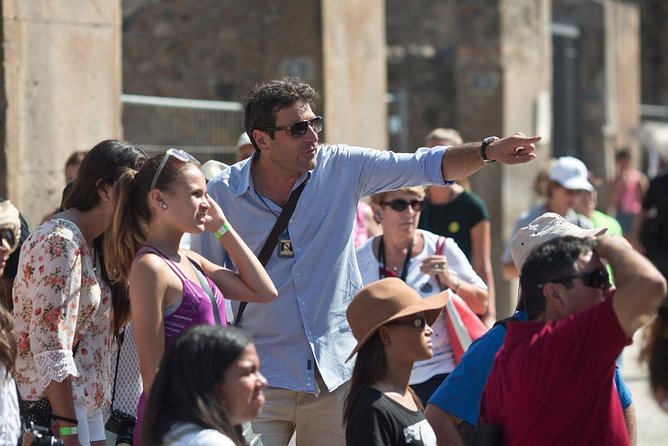
The guides are the main reason this tour earns such strong marks, with a 4.8 rating from 6,593 reviews and recommendation from 96 percent of participants. Alessandra is praised for making time for questions while explaining both past discoveries and current archaeological work. Paolo is noted for his care with preservation and education, while Teresa is described as a clear storyteller who adjusted her pace to the group.
Other guides, including Alfredo, Amadeo, Antonio, Jolanta, Julia, Rafaela, and Vincenzo, are singled out for humor, patience, and the ability to keep younger visitors involved. Your guide will vary, so treat those names as examples of the style you might encounter, not a guarantee of who will lead your walk.
A few other Pompeii mornings to weigh against this
- Pompeii: Entry Ticket and Guided Tour with an Archaeologist
★ 4.8 · 19,459 reviews - Pompeii: Entry Ticket with Optional Audio Guide
★ 4.2 · 12,360 reviews - Pompeii: Small Group Tour with an Archaeologist
★ 4.8 · 12,264 reviews
Meeting at Porta Marina Superiore
The tour begins at the Pompeii Archaeological Park entrance called Porta Marina Superiore, at Via Villa dei Misteri 2. Look for the guide holding an Askos Tours sign. Confirmation arrives when you book, and the meeting point is near public transportation, but you still need to arrive with time to spare.
The entrance process is designed to be simple. Your Pompeii Express ticket is included, and the group goes directly into the ruins with skip-the-line access. That matters most during busy periods, when standing outside in the sun before a two-hour walking tour can drain your energy before the first column comes into view.
The tour finishes inside the archaeological park rather than returning you to the starting gate. This is useful because you can continue exploring on your own, but pay attention near the end. One person wished the guide had explained more clearly how to find the exits, so ask before the formal tour ends if you are unsure where to leave.
Basilica and Forum: Pompeii’s public center
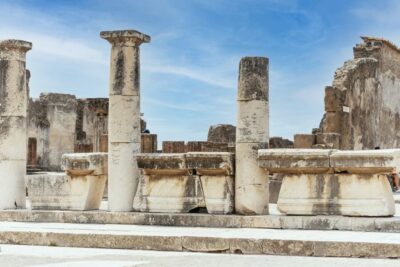
The Basilica is the first major stop. It was an open portico used for business and public activity, and its surviving scale helps you picture the importance of the city’s civic core. This is a short stop, but the guide’s explanation gives you a framework for the buildings that follow.
From there, you reach the Forum, Pompeii’s main square. This is one of the places where a guide adds real value. The open space can look simple at first, but it was the center of public, religious, and commercial life. Your guide can help you read the surrounding structures and understand how the square worked as part of the city.
The planned route is efficient. You do not spend the whole morning wandering between disconnected buildings, and you get an introduction to Pompeii’s public life before moving into homes, baths, and entertainment spaces.
The Forum granaries and the human cost of the eruption
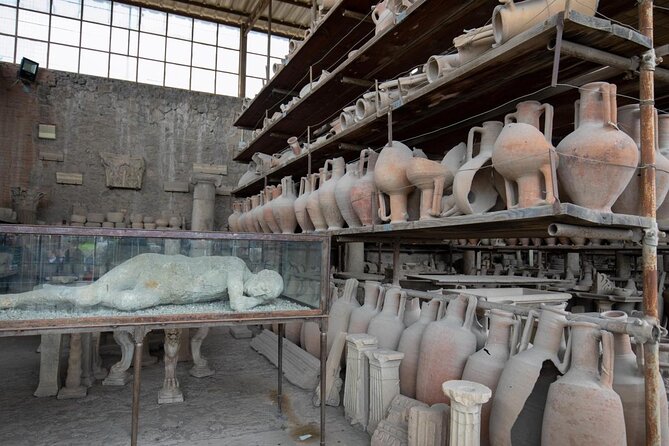
The Forum granaries hold marble tables, fountain basins, and plaster casts of some victims of the eruption. You may also see casts of a dog and a tree. This is often the most emotional point of the tour, and it deserves more than a quick photograph.
The casts are not complete bodies preserved in the ash. They were made from spaces left in the hardened volcanic material after organic matter decomposed. That detail changes how you look at them. You are not simply viewing an ancient object. You are confronting the shape of a person or animal at the moment disaster overtook Pompeii.
A thoughtful guide keeps this section grounded and respectful. The tour’s focus on individual lives is one of its strongest features. Instead of treating the eruption as a dramatic event alone, the explanation brings attention to the people who lived in these streets and the sudden fate that ended their lives.
Same city, an entirely different afternoon:
- Pompeii: Skip-the-Line Entrance Ticket with Audio Guide
★ 4.0 · 2,509 reviews - Naples: Pompeii and Mt. Vesuvius with Lunch and Wine Tasting
★ 4.5 · 2,454 reviews - Pompeii: Archaeological Park Tour with Ticket on request
★ 4.5 · 2,283 reviews - Discover the Ancient Ruins of Pompeii: Day Trip from Rome
★ 3.5 · 2,247 reviews
Walking Pompeii’s original streets

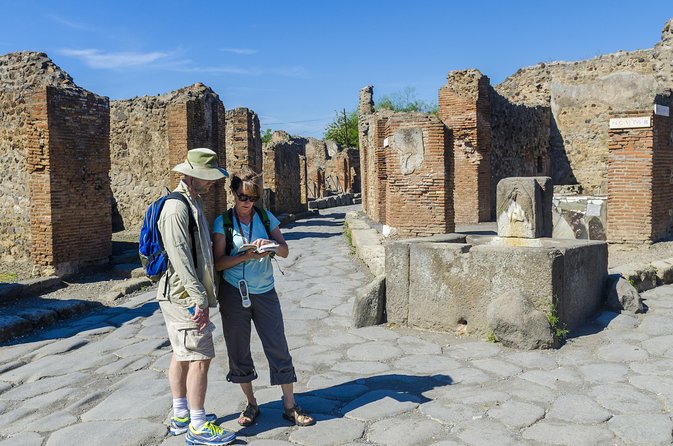
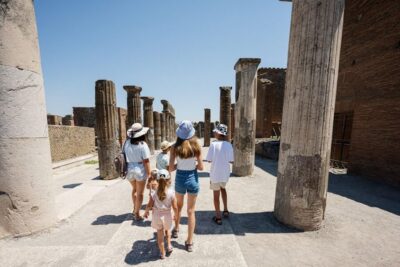
Between the major stops, you walk along the original paved roads. The streets are one of Pompeii’s most revealing features because they show the city at ground level. You see how hard surfaces, raised sidewalks, corners, and crossings shaped movement through the Roman town.
This is also where the physical demands become clear. The stone paving is uneven, and there are ramps, steps, and modest climbs. Several streets can feel steep, especially in hot weather. Sturdy shoes are more important here than fashionable footwear, and a hat, sunglasses, sunscreen, and a small bottle of water are sensible choices.
There is limited shade across much of the park. Summer visitors should plan for direct sun, while winter can be a pleasant time for walking, with cooler conditions and fewer queues. The tour operates year-round, in rain or shine, so check the weather and dress for a long period outdoors.
House of Menander and the details of private life
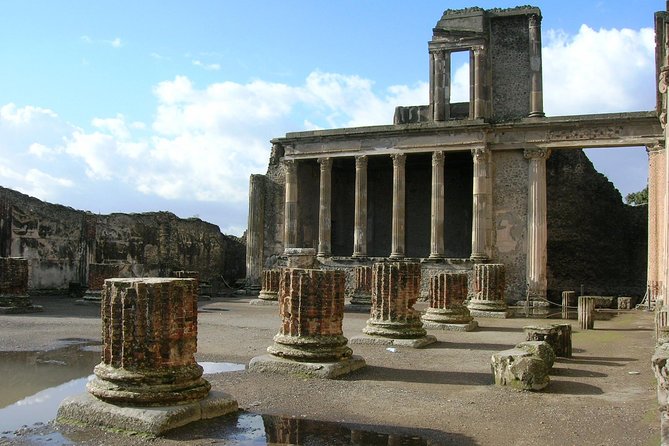
The House of Menander is one of Pompeii’s grand private residences, known for its architecture, decoration, and contents. This stop shifts the mood from public spaces to the home, where wall paintings, mosaics, courtyards, and room layouts help show how wealthy Roman families presented themselves.
The value of this stop is in the details. A guide can explain how to look at a house instead of simply walking through it. You learn to notice the arrangement of rooms, the use of decoration, and the contrast between formal spaces and more private areas.
Fifteen minutes is enough for an informed introduction, but not enough to study every fresco or mosaic. If domestic architecture is your main interest, keep notes and return after the group tour. You will already have learned what deserves a closer look.
Stabian Baths: Roman engineering and daily routines
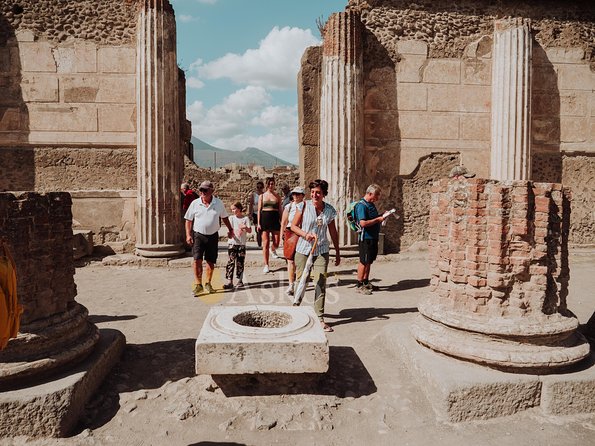
The Stabian Baths occupy a broad area between the Brothel Lane, the Holconius crossroads, and Via Stabiana. They are described as the oldest thermal complex in Pompeii, giving the stop both architectural and social importance.
Public baths were not simply places to wash. They were part of daily city life, with rooms designed for different temperatures and activities. The remains let you think about how Roman engineering supported a routine shared by many people.
Your guide’s explanation is especially useful here because bare walls and ruined chambers can be hard to interpret on your own. The stop is fairly short, but it helps you see Pompeii as a functioning city rather than a collection of abandoned buildings.
The Lupanar and Pompeii’s less polished side
The Lupanar is Pompeii’s most famous brothel. It is a compact, memorable stop, known for its small rooms and erotic imagery. The site offers a blunt look at one part of Roman commercial and social life that can be easy to romanticize or oversimplify.
Expect a crowd near this popular building, particularly at busy times. The rooms are tight, so your view may be limited while the group moves through. This is one of the places where a guide can provide useful context and keep the stop from becoming little more than a quick glance at the walls.
The subject matter may not suit every child, though children must be accompanied by an adult in any case. Families should decide in advance if they are comfortable with the content.
House of the Faun and the small theater
The House of the Faun is one of Pompeii’s largest and most impressive private residences. Its size gives you a strong sense of the gap between the homes of wealthy families and the smaller spaces elsewhere in the city.
The route also includes a brief look at the Teatro Piccolo, or small theater. Because this is a short stop, you should think of it as a quick orientation rather than a full visit. It adds another piece to the city’s cultural life before the final theater.
These stops also show why a guided route helps. Pompeii offers so many houses and public buildings that it is easy to lose track of which ones matter and why. The guide selects highlights and gives you a reason to pause.
Teatro Grande and the end of the guided route
The tour ends at the Teatro Grande, Pompeii’s most important theater. It is a fitting final stop because it brings together architecture, entertainment, and public life. The space is larger and more dramatic than the Teatro Piccolo, and the guide can help you picture how performances and audiences fit into the structure.
At the end, you remain inside the ruins. This is a real advantage over tours that lead you directly back to the gate. You can use the remaining time to revisit a house, seek out another street, or continue toward areas not included in the guided route.
The tradeoff is that two hours pass quickly. The route gives you a strong backbone for independent exploration, but you should not expect to cover the whole archaeological park. If you have only a short time in Pompeii, the tour helps you spend it well. If you want a full day of archaeology, use this as the opening portion rather than the entire visit.
What the $35.67 price gets you
At $35.67 per person, this is a sensible middle-ground option. The fee includes the Pompeii Express entrance ticket, guidance for the full tour, and a licensed guide with an archaeological background. You are paying for both access and interpretation, not merely a walk to the gate.
The value is strongest if this is your first visit. Pompeii’s size and uneven layout can make independent sightseeing slow, and a guide helps you find major highlights without spending half your time checking a map. You also receive enough context to make later self-guided wandering more rewarding.
The group can include up to 20 people per guide. That is smaller than a large coach excursion, but it is not a quiet private experience. With a full group, you may need to wait while everyone gathers around a fresco or moves through a narrow room. Headsets are provided for groups of 16 or more, which should make it easier to hear, though one poor experience involved a headset problem and a delayed start.
That complaint appears to be an exception among the many very positive accounts, but it points to a fair concern. A late beginning or a long stationary explanation can reduce a two-hour tour to much less time walking through the ruins. Arrive early, stay close to the guide, and speak up if you cannot hear.
Who should book this Pompeii tour
I would choose this tour for a first-time visitor who wants the major sights explained without paying private-tour prices. It also suits families, since guides such as Alfredo, Amadeo, and Antonio have been praised for keeping children and teenagers involved.
It is a good match for you if you:
- Want an archaeologist-led introduction rather than a self-guided visit
- Prefer a focused two-hour route through famous buildings
- Plan to stay inside afterward and explore independently
- Want entrance access included in the price
- Enjoy stories about real people, homes, public life, and the eruption
- Can walk on uneven stone streets for about two hours
I would hesitate if you have significant mobility limitations. The route includes uneven ground, steps, ramps, and some slightly steep sections. Mobility scooters are not allowed, and the experience is not recommended for people with mobility impairments. The operator advises contacting them about a suitable private tour if you need a more accessible arrangement.
Small dogs are permitted only if they weigh no more than 10 kilograms and are no taller than 40 centimeters. They must be leashed, carried in buildings, and cleaned up after. Service animals are allowed.
Smart ways to make the visit better
Book ahead if your date is fixed. The tour is often reserved about a month in advance, with an average booking lead time of 31 days. That does not prove every departure sells out, but it is a useful warning for peak dates.
Arrive at Porta Marina Superiore early enough to identify the Askos Tours sign and settle in before the start time. Late arrival is a serious problem at Pompeii. One late group arrived about 45 minutes after the scheduled beginning and could not be reunited with the guide, since the site is large and phone coverage may be poor.
Wear shoes with firm soles. Bring water, especially in summer, and add a hat, sunscreen, and sunglasses. Do not count on regular shade. Under 18 visitors should carry an identity card or passport, and children must stay with an adult.
After the tour, ask the guide which nearby areas are worth seeing next and how to find the exit. One useful possibility is the House of Mysteries, which is not part of this route but may be available as an extension or as a separate area to visit. Do not assume it is included. Ask before leaving the group.
Free cancellation is available if you cancel at least 24 hours before the local start time. Cancellations or changes made within 24 hours are not refunded.
Should you book it?
Book this Pompeii Small Group Tour with an Archaeologist if you want a well-chosen introduction, clear explanations, and the freedom to keep exploring after the guide finishes. At $35.67, the included entry ticket and archaeological guidance make it good value, especially for a first visit.
Do not book it expecting a complete tour of Pompeii or a private pace. The maximum group is 20, the route involves demanding footing, and two hours only covers selected highlights. For most people, though, that is the right balance: let an archaeologist give you the framework, then use the rest of your day to wander with better eyes.
FAQ
How long does the Pompeii tour last?
The tour lasts approximately two hours.
Where does the tour begin?
It begins at Porta Marina Superiore, the main archaeological site entrance at Via Villa dei Misteri 2, 80045 Pompei.
Where does the tour finish?
The guided tour finishes inside the Pompeii ruins. You can remain in the archaeological park afterward to explore independently.
Is the Pompeii entrance ticket included?
Yes. The Pompeii Express entrance ticket is included in the tour price.
What is the maximum group size?
The maximum is 20 people per guide.
Are headsets provided?
Headsets are provided for groups of 16 or more.
Is the tour offered in English?
Yes. The experience is offered in English.
Is the tour suitable for people with mobility issues?
It is not recommended for travelers with mobility issues or impairments because the route includes steps, ramps, uneven ground, and slightly steep climbs. Mobility scooters are not allowed.
Can I cancel for a full refund?
Yes, if you cancel at least 24 hours before the experience begins. Cancellations made less than 24 hours before the start time are not refunded.
Fresh on the Pompeii list
- Explore Pompeii with an Archaeologist★ 5.0 · 511 reviews
- Pompeii Skip-the-line Tour with Archaeologist Guide★ 5.0 · 559 reviews
- Pompeii Private Tour with an Archaeologist and Skip The Line – 3 hours★ 5.0 · 564 reviews
- Ercolano: Herculaneum Entry Ticket with Optional Audio Guide★ 4.1 · 581 reviews
- Pompeii private tour with an Official Guide★ 5.0 · 631 reviews
- Pompeii: Exclusive Tour with Archaeologist and Entry Tickets★ 4.9 · 634 reviews
- Pompeii Ticket + Tour with Optional Tasting Experience at Pompeii★ 5.0 · 663 reviews
- From Naples: All-Inclusive Mount Vesuvius Half-Day Tour★ 4.2 · 674 reviews
Pompeii & Vesuvius Tours, compared.
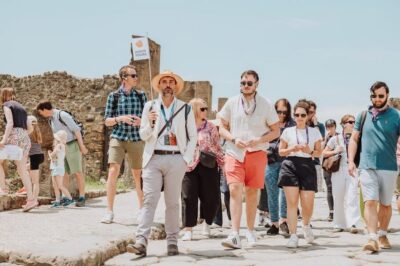
Entry Ticket and Guided Tour with an Archaeologist
Read our review →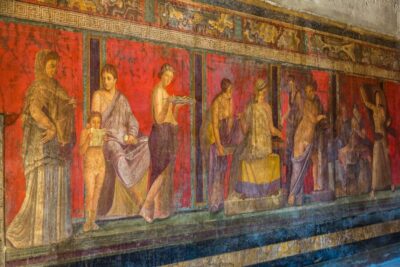


Pompeii, Amalfi Coast and Positano Day Trip from Rome
Read our review →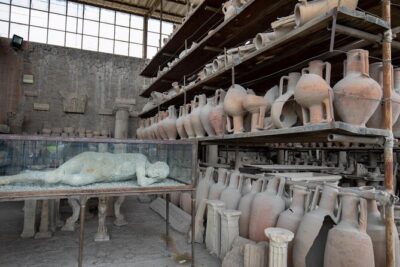
Pompeii and Mount Vesuvius Day Trip from Rome with Pizza Lunch
Read our review →Browse the lists this tour appears in