
Reviewed · POMPEII & VESUVIUS TOURS
PompeiI Exclusive Tour with your Archaeologist in a Small Group
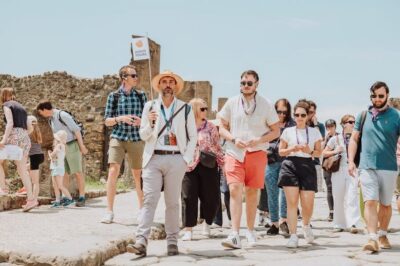
Pompeii makes far more sense with someone to explain what you are seeing. This two-hour walk takes you from the western gate through the Forum, temples, baths, shops, private homes, and theater, turning broken walls into a picture of ordinary Roman life.
I like the archaeologist-led storytelling and the small group, capped at 15 people. I also like the focused route: you see many of Pompeii’s key places without spending half the day wondering which street to follow. Guides including Ricardo, Raffaele, Antonio, PierLuigi, and Ornella are praised for clear explanations, humor, and genuine enthusiasm.
The main catch is simple but important: the €19 adult entrance ticket is not included in the $30.25 tour price. The two-hour route also cannot cover all of Pompeii, and some major areas, including the amphitheater and brothels, may be left for another visit.
Key points to know before you book
- Meet at Porta Marina Superiore: Look for the guide outside the park holding a sign marked Pompeii Vip.
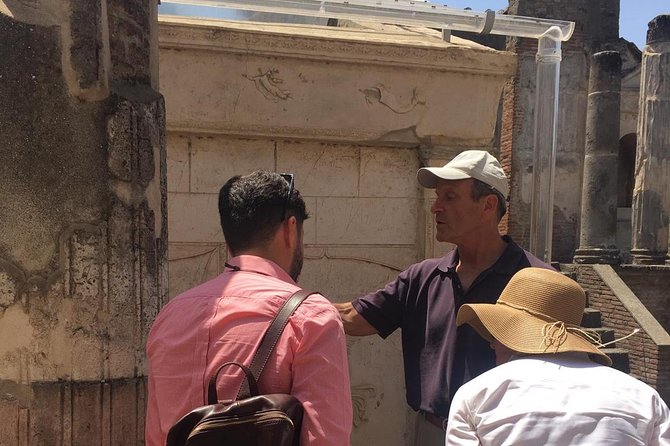
- An archaeologist leads the walk: The best part is learning how experts interpret houses, streets, casts, and public buildings.
- Small group, maximum 15 people: This gives you a better chance to hear the guide and ask questions.
- The route covers Pompeii’s central sights: Expect the Forum, temples, baths, food shops, homes, Via dell’Abbondanza, and Teatro Grande.
- Budget for the park ticket: The tour costs $30.25, then add €19 per adult for admission. Children under 18 enter free.
- Wear serious walking shoes: Pompeii’s old streets are uneven, and the site is too large for casual footwear.
Why an archaeologist changes the Pompeii experience
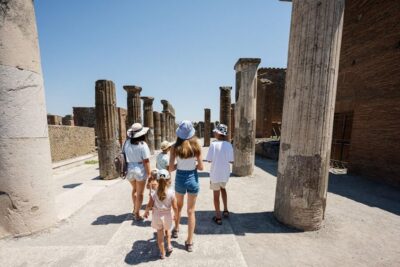
Pompeii is not a tidy museum arranged for easy viewing. It is a large Roman city spread across ancient streets, with walls missing, buildings partly closed, and details that can be hard to read without help.
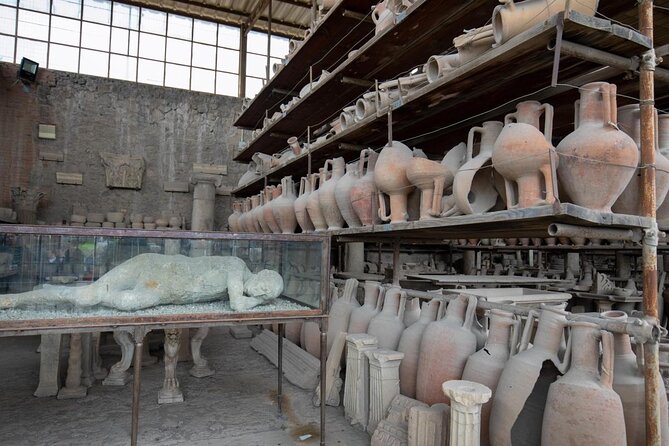
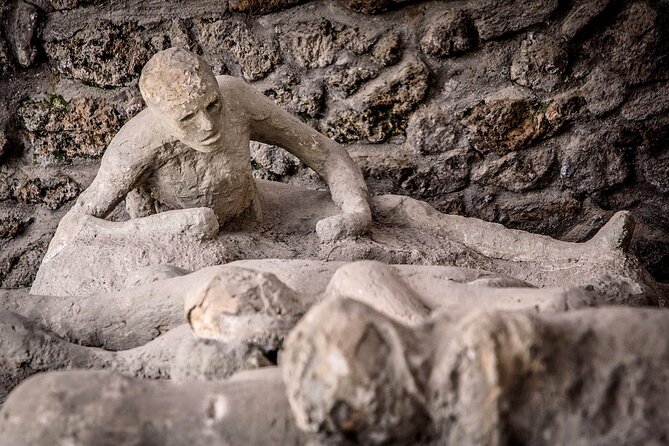
A guide gives those fragments meaning. Instead of seeing a stone counter, you learn that it belonged to a thermopolium, an old Roman diner. Instead of passing a row of columns, you understand how the Forum worked as the center of public life. Instead of treating plaster casts as simple exhibits, you hear how archaeologists made them by filling voids left in the hardened ash.
That last point is one of the more powerful parts of the visit. Plaster casts connected with the eruption can be seen near the Macellum. The subject is difficult, but the guide can explain the archaeological method and place the remains in context without turning the moment into spectacle.
The strongest guides appear to treat Pompeii as both a research site and a human story. Antonio is praised for explaining the ongoing excavation work and for sharing photographs of an area where photography was not allowed. Ricardo is noted for explaining how archaeologists know what they know, not simply naming each building. Those details matter. They help you read evidence rather than just collect names.
A few other Pompeii mornings to weigh against this
- Pompeii: Entry Ticket and Guided Tour with an Archaeologist
★ 4.8 · 19,459 reviews - Pompeii: Entry Ticket with Optional Audio Guide
★ 4.2 · 12,360 reviews - Pompeii: Small Group Tour with an Archaeologist
★ 4.8 · 12,264 reviews
Starting at Porta Marina Superiore
The meeting point is outside the archaeological park at Via Villa dei Misteri, 1, in Pompei. More specifically, the guide waits at Porta Marina Superiore with the Pompeii Vip sign.
This western entrance once led toward the sea, which explains the name Marina. It is a useful place to begin because the route immediately places you at one of the ancient city’s main gateways.
The first stop is listed as about 10 minutes, though the actual time at each location can vary. Expect walking between sites as well as short explanations at each point. The two-hour schedule is brisk, but it gives you a good first look at the city before you explore more on your own.
The separate priority arrangement is designed to reduce waiting at the gate. Still, do not assume the $30.25 booking is your admission ticket. The provider sends a link for buying a skip-the-line entry ticket online, and staff can also help you purchase one on site. I would sort this out before arrival so you are not dealing with ticket questions when the group is ready to leave.
Temples and the Forum: Pompeii’s public center
From Porta Marina, the route moves toward the Temple of Venus. Venus was Pompeii’s patron goddess, and the temple occupied a significant position near the city’s western approach.
The remains are not as intact as some of the smaller buildings, but the stop helps you understand the city’s religious identity and its connection to Rome. A guide can also point out the dramatic setting, with Mount Vesuvius visible behind parts of the city on a clear day.
Next comes the Basilica. This was not a church in the modern sense. It was one of the Forum’s grandest buildings and served business and legal purposes, including the administration of justice.
This is a good place to listen closely to the guide’s explanation of Roman civic life. Pompeii was not just a collection of houses and shops. It had courts, commercial spaces, temples, baths, entertainment venues, and a public square where the city’s affairs unfolded.
The Temple of Apollo is among Pompeii’s oldest places of worship. Its position along the road from Porta Marina to the Forum shows how carefully the city’s important religious spaces were placed along major routes.
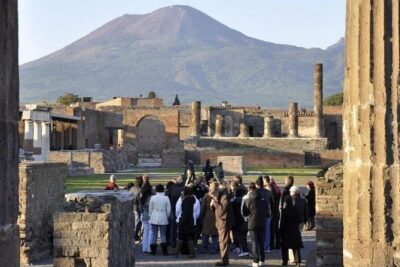
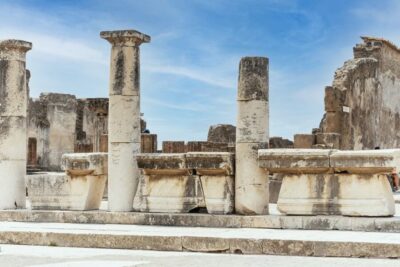
The Forum comes next, and it is the essential public space on this walk. It was the center of daily activity, surrounded by temples and civic buildings. The open area can look stark at first, especially under bright sun, but the guide helps you picture it filled with movement, business, ceremony, and political life.
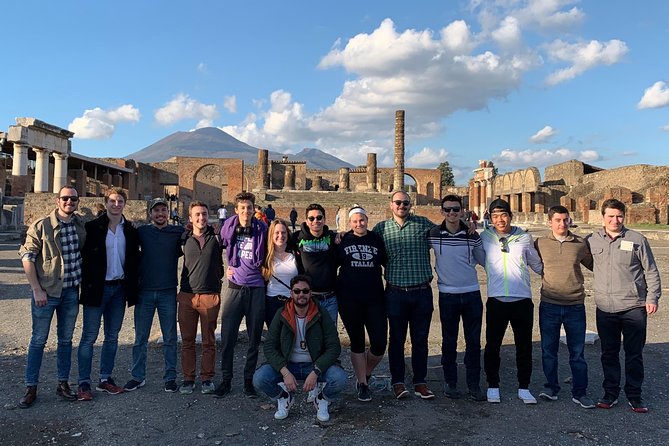
The Temple of Jupiter closes this central group of stops. It dominates the north side of the Forum, with Vesuvius rising behind it. That view is one of the tour’s most memorable visual moments, since the volcano is tied so closely to Pompeii’s destruction.
Food, shopping, and the plaster casts
At the Macellum, you see a monumental market building used for food and everyday goods. This stop is especially useful for understanding Pompeii as a working city rather than a frozen monument.
The nearby plaster casts require a thoughtful explanation. Archaeologists created them by pouring plaster into cavities left in the compacted volcanic material after organic remains decomposed. The result preserves the shape and posture of people caught in the eruption.
The Forum Baths offer a different view of daily routine. They are among the best-preserved parts of Pompeii, and the separate male and female sections had different entrances.
Baths were places for washing, exercise, social contact, and routine. The preserved rooms allow you to see more than decorative remains. You can get a sense of how Roman engineering provided heated spaces and organized public use.
The Thermopolium of Vetuzio Placido was a food and drink counter, effectively an old neighborhood diner. The painted surfaces and built-in serving counter make it one of the easiest places to imagine in use.
This is where a lively guide can add the most value. A good explanation connects the counter, street, and surrounding rooms to the practical question of how residents ate when they were not cooking at home. The stop is short, but it is one of the most relatable parts of the route.
Same city, an entirely different afternoon:
- Pompeii Small Group Tour with an Archaeologist
★ 5.0 · 6,593 reviews - Pompeii: Skip-the-Line Entrance Ticket with Audio Guide
★ 4.0 · 2,509 reviews - Naples: Pompeii and Mt. Vesuvius with Lunch and Wine Tasting
★ 4.5 · 2,454 reviews - Pompeii: Archaeological Park Tour with Ticket on request
★ 4.5 · 2,283 reviews
The House of the Faun and Pompeii’s private world
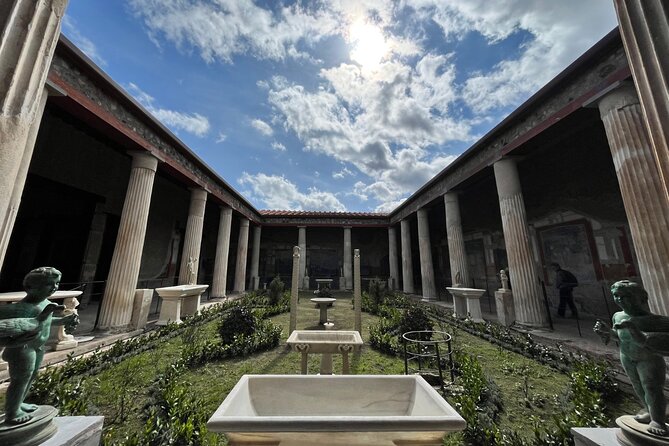
The House of the Faun is one of Pompeii’s largest private residences. Its entrance carries the Latin greeting HAVE, a small detail that gives the building an unexpectedly personal touch.
The route also identifies the House of the Vettii, one of the city’s most famous and wealthy homes. It is associated with Priapus, a god linked with prosperity. Both houses can be affected by seasonal openings and closures, so you should treat their inclusion as subject to site conditions rather than a guarantee that every room will be open.
These homes help balance the public buildings earlier in the walk. The Forum shows how Pompeii operated as a city. The houses show how wealth, status, decoration, and domestic life worked behind private walls.
Do not expect a long, leisurely study of every room. In two hours, the guide has to keep moving. You may get an overview of a house, a key detail, and a short explanation before heading back into the street.
Via dell’Abbondanza and the Teatro Grande
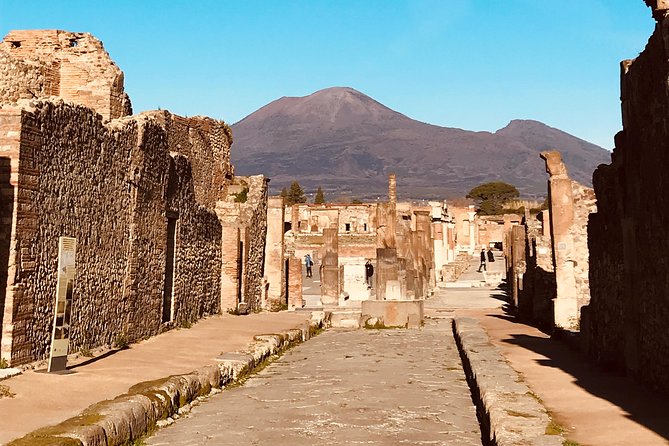
Via dell’Abbondanza was Pompeii’s main street, the ancient decumanus maximus. Walking along it gives you a better sense of the city’s size and shape than visiting isolated buildings does.
Look at the street as infrastructure. The paving, storefronts, sidewalks, and entrances reveal how people moved through town and how commercial life met residential life. The route does not simply jump from famous building to famous building. It uses the street to connect the city’s parts.
The final listed stop is Teatro Grande, where comedies and tragedies were performed in the Greco-Roman tradition. The theater gives the tour a strong finish because it shifts attention from work, religion, and private homes to entertainment.
After two hours, you will have seen a good selection of Pompeii’s central sites. You will not have seen everything. Pompeii is too large for that, and the route does not promise the amphitheater, brothels, or every outlying district.
That limitation can actually work in your favor. You get an organized introduction, then you can decide what deserves a longer look. Ask the guide where to continue if you have extra time. One guide specifically helped with nearby planning and offered dinner suggestions, which can be useful if Pompeii is part of a larger day around Naples.
What the two-hour format feels like
Two hours is a sensible length for a first visit. It is long enough to build a clear picture of the city but short enough to keep the walking and concentration manageable.
The pace is not a slow photographic stroll. You move through several areas, stop for explanations, and continue. Some guides make time for questions and photos, while others may keep a tighter rhythm to fit the route.
The small-group format is a real advantage. With a maximum of 15 people, you should have a better chance of hearing the guide than in a large crowd. One account described a group of about 12 as a comfortable size, though one group was reportedly larger than the advertised maximum. If exact group size is crucial to you, confirm it before booking.
Most guides speak clear English. One guide was praised for speaking without the distorted earphones sometimes used on larger tours. Another account raised the opposite concern, reporting a faulty earpiece that was not replaced. If your tour uses audio equipment, check it at the start and speak up right away.
Weather also matters. Pompeii has exposed streets, and rain can make the old paving slippery. In wet conditions, guide Raphael Romano was praised for knowing when to use covered shelters while continuing the explanation. The activity requires good weather, so a poor-weather cancellation may result in another date or a full refund.
Price, tickets, and overall value
The advertised cost is $30.25 per person. Add the €19 adult park ticket, and the basic adult cost becomes roughly $30.25 plus €19, before any currency conversion or optional arrangements.
That makes the tour a good value if you want interpretation rather than simple entry. The guide fee is modest for an English-speaking archaeologist-led walk, and the route covers many of the places most first-time visitors hope to see.
The price is less attractive if you expect a private tour, a full-day visit, or admission to the park bundled into one payment. It is also important to understand the ticket wording before you arrive. The Viator booking confirms your place on the tour, but it is not the ticket that lets you enter Pompeii.
Children under 18 can enter the park free, according to the provided information. Even so, check how the booking handles younger participants before you finalize the purchase, since the tour price and site admission are separate matters.
Free cancellation is available up to 24 hours before the start time for a full refund. Changes or cancellations inside that 24-hour window are not accepted for a refund. The company may also cancel if the minimum number of participants is not reached, offering another date or a refund.
Who will get the most from this Pompeii tour
I would choose this experience if you are visiting Pompeii for the first time and want the site to make sense quickly. It is particularly useful if you do not already know Roman architecture, religious buildings, or the technical side of archaeological work.
Families can also do well with this format. A two-hour route is easier for children than an unstructured day across the entire park, and guides such as Raffaele have been praised for keeping younger participants interested.
This tour suits you if you enjoy asking questions. Ricardo, Antonio, Raffaele, Ornella, and PierLuigi are all identified in the feedback as guides who bring energy and answer questions. The quality can still vary from guide to guide, as with any shared tour, and one account noted repeated explanations and a faulty earpiece.
You may want a different option if your main goal is the amphitheater, brothels, or a very specific house. The itinerary is built around major temples, public buildings, homes, shops, baths, the main street, and the theater. It is a strong introduction, not an exhaustive survey.
Wear comfortable walking shoes. That advice is not decorative. Pompeii’s streets are old, uneven, and spread across a large archaeological park. Bring water and allow time after the tour if you want to explore beyond the guided route, but those extras are not listed as part of the activity.
Should you book it?
Book this tour if you want an archaeologist to explain Pompeii’s public buildings, homes, shops, baths, and plaster casts in clear English, and if a focused two-hour visit suits your schedule.
The best reasons to choose it are the modest guide price, small group, priority entry arrangement, and the strong record of guides who make the site understandable. The main cautions are the extra €19 admission fee, the possibility of seasonal closures, and the fact that the route leaves large parts of Pompeii for later.
For a first visit, I think the guided format is worth the cost. You can always continue alone afterward, but finding your way through Pompeii without context can leave you looking at walls and wondering what mattered. This tour gives you the basic map, the key stories, and enough direction to make the rest of the city easier to read.
FAQ
Where does the Pompeii tour meet?
The meeting point is at Via Villa dei Misteri, 1, 80045 Pompei NA, Italy. The guide waits outside the archaeological park at Porta Marina Superiore with a sign marked Pompeii Vip.
Is the Pompeii entrance ticket included?
No. The tour price does not include admission to Pompeii Archaeological Park. Adult admission is €19, while entry is free for children under 18. The provider sends a link for buying skip-the-line tickets online.
How long does the tour last?
The tour lasts approximately two hours. It ends back at the meeting point.
What language is the tour offered in?
The experience is offered in English.
How large is the group?
The activity lists a maximum of 15 participants. The small-group format is intended to provide a more relaxed pace and more personal attention.
Can I cancel for a full refund?
Yes. You can cancel at least 24 hours before the experience start time for a full refund. Cancellations or changes made less than 24 hours before the start time are not accepted for a refund.
Fresh on the Pompeii list
- Stories of Pompeii: Small Group tour with archeology expert guide★ 5.0 · 191 reviews
- Mount Vesuvius: Vineyard Tour with Wine Tasting and Lunch★ 4.8 · 193 reviews
- Pompeii: Skip-the-Line Guided Tour with Expert Archaeologist★ 4.8 · 196 reviews
- Pompeii: 2 Hour Private Tour with an Archeologist Guide★ 5.0 · 214 reviews
- Pompeii: Skip-the-Line Entry & Audioguide★ 3.8 · 225 reviews
- Herculaneum: Tickets & Tour with a Local Archaeologist★ 4.8 · 226 reviews
- Pompeii and Mount Vesuvius Small Group Tour★ 4.5 · 233 reviews
- From Naples/Salerno: Pompeii, Sorrento, and Positano Tour★ 4.5 · 250 reviews
Pompeii & Vesuvius Tours, compared.
Entry Ticket and Guided Tour with an Archaeologist
Read our review →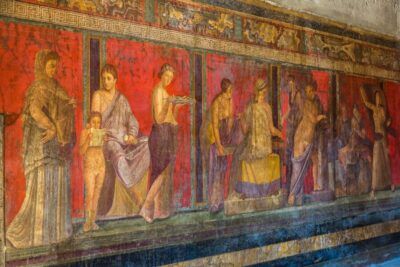
Pompeii Small Group Tour with an Archaeologist
Read our review →
Pompeii, Amalfi Coast and Positano Day Trip from Rome
Read our review →Browse the lists this tour appears in