
Reviewed · MUSEUMS
Leonardo Da Vinci Museum Entrance Ticket
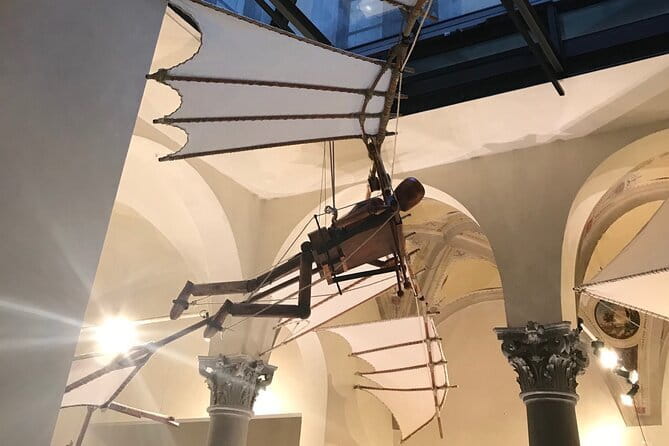
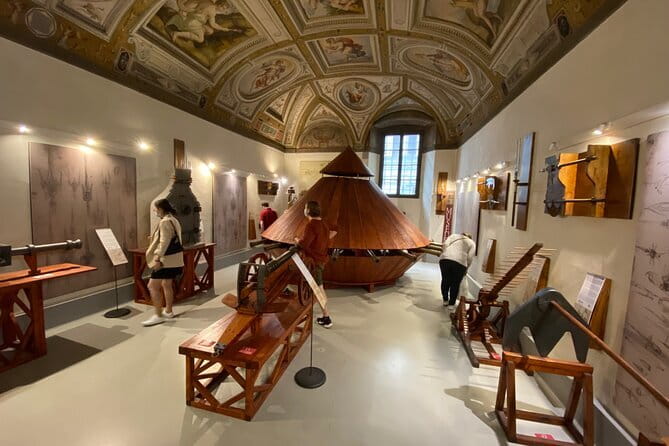
Leonardo da Vinci’s ideas become much easier to grasp when you see them as wooden models you can inspect from every side. At Florence’s Museo Leonardo Da Vinci, more than 50 machines fill four rooms, from bridges and pulleys to flying devices, military designs, and anatomical studies.
I like the museum’s working models, which turn sketches into something you can understand with your hands and eyes. I also like the low price and central location, making this an easy one-hour addition to a day around Florence’s main sights.
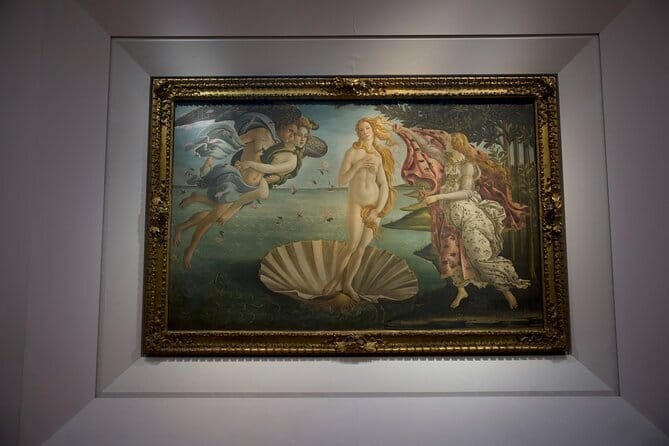
The catch is important: this is a museum of reconstructions, not a gallery of Leonardo’s original paintings or personal objects. If you came hoping for the Mona Lisa or original Renaissance manuscripts, you may leave disappointed.
Key points to know before you go
- Four rooms cover different fields: Civil engineering, flight, warfare, and anatomy each get their own space.
- Most models really work: You can see how Leonardo’s drawings might have functioned, rather than simply viewing them behind glass.
- This is a self-guided visit: You set the pace, with a documentary on large screens and written displays to help explain the designs.
- Families get the most hands-on fun: Interactive exhibits and a children’s building area add a playful side to the visit.
- Plan on one to one and a half hours: You can move quickly, but reading the displays and trying the machines takes longer.
- Check the city carefully: This ticket is for Florence, not Leonardo museums in Rome, Milan, or Venice.
What kind of Leonardo museum is this?
Florence’s Museo Leonardo Da Vinci focuses on the inventor, engineer, scientist, and restless problem-solver. It is not primarily an art museum. You will not come here to see Leonardo paintings, and the attraction does not present a major collection of original artifacts.
Instead, the museum brings his notebooks and drawings to life through physical models. The displays show how Leonardo studied motion, water, flight, warfare, architecture, anatomy, and machines. For many people, that broader picture is the real reward. Leonardo was not only the painter of the Mona Lisa. He was also a man who studied how the world worked.
The museum occupies the Galleria Michelangelo, a building on one of Florence’s best-known central streets. The space has its own character, including painted ceilings that help you picture the kind of historic setting in which Leonardo’s work is being discussed.
You should think of this as an educational exhibition with interactive elements, not a major art institution. That distinction will help you set the right expectations before paying for admission.
More Museums in Florence
- Florence: Skip-The-Line Uffizi Gallery Timed Entry Ticket
★ 4.5 · 27,832 reviews - Florence: Leonardo Interactive Museum Entry Ticket
★ 4.5 · 11,763 reviews - Florence Accademia Gallery Tour with Entrance Ticket Included
★ 4.5 · 6,148 reviews
The four rooms and what you will see
The first room is devoted to civil machines. Here, the emphasis is on practical engineering: construction, water movement, transport, and mechanical systems. Leonardo often watched how simple forces could solve large problems, and the models let you follow that thinking in a direct way.
This section is useful if you enjoy bridges, gears, pulleys, and building methods. Rather than asking you to decipher a notebook page, it gives you a physical object to study. You can look at the parts, see how they connect, and understand why a design might have worked.
The second room covers flying machines. Leonardo’s fascination with flight led him to study birds, wings, air, and the movement of bodies. The models do not turn his plans into modern aircraft, but they show how seriously he tried to reason through the problem.
This room tends to appeal to children and adults who enjoy mechanical ideas. It also reveals a key part of Leonardo’s method: close observation followed by imaginative design. His flying machines may not have been practical in his time, but the thought process behind them remains fascinating.
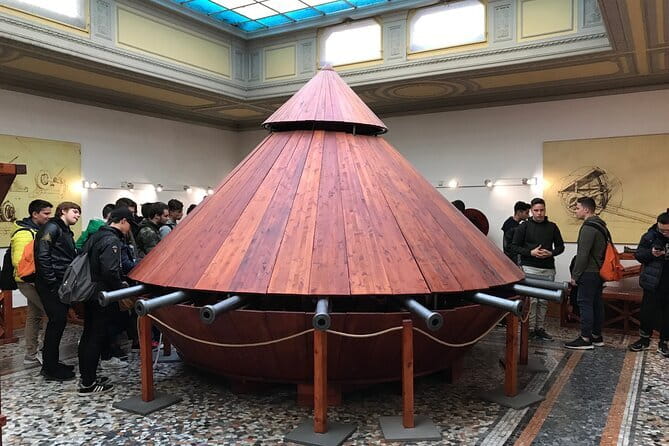
The third room presents war machines. Expect designs linked to defense, attack, movement, and military engineering. This section gives a more complicated view of Leonardo. The same mind that studied anatomy and painted religious scenes also worked on weapons and battlefield technology.
You may find tanks, weapon systems, or other military concepts represented through replicas and models. The displays are best understood as interpretations of Leonardo’s drawings. They are not surviving machines from the Renaissance.
The fourth room contains the newer collection of anatomical models. Leonardo’s studies of the human body show his habit of combining art and science. He wanted to understand structure, proportion, and movement, not simply produce attractive images.
These models add balance to the mechanical displays. They remind you that Leonardo’s curiosity moved freely between engineering, painting, music, architecture, anatomy, and military design. The museum also presents his contributions in those wider fields, giving you a fuller sense of his range.
Why the working models matter
A sketch can be beautiful and still be hard to understand. A machine model gives you a second way in.
Most of the museum’s models are real working machines. That does not mean they are original Renaissance objects. They are replicas built from Leonardo’s designs, with the aim of showing how the plans may have operated.
That difference matters. If you expect original objects, the museum may feel thin. If you want to see the ideas made physical, it offers good value for the price.
The hands-on displays are a major part of the appeal. Some allow you to experiment with mechanical principles, while others are designed mainly for looking. A few interactive pieces may not always work perfectly, so keep your expectations practical. The experience is more about trying, turning, and examining than about polished high-tech presentation.
I find this approach especially useful for families. Children can begin with the moving parts and simple challenges, then absorb the larger story almost by accident. Adults who enjoy science, design, or engineering will also have plenty to examine, though art lovers looking for original paintings may find the focus too narrow.
A self-guided visit at your own pace

This is not a guided walking tour, and no guide name is provided for the experience. You enter the museum and move through the rooms independently. English is offered, and the displays and documentary help provide context as you go.
That format gives you control. You can spend five minutes with a machine that catches your eye or move quickly through a section that feels less relevant. A careful visit takes about one hour to one hour and 30 minutes.
If you read every panel, test the interactive devices, and pause for the documentary, plan closer to the longer estimate. If you have a packed Florence schedule, you can make this a compact stop of roughly an hour.
Large-screen monitors show a documentary about Leonardo’s life and work. It is useful for placing the models in context, particularly if you arrive knowing only the famous names and paintings. Do not expect a full lecture or a personal guide. The museum works best when you take your time and connect the displays for yourself.
Some information describes the attraction as allowing flexible entry during the day, and the visit is self-guided. Still, follow the entry instructions on your confirmation, since ticket arrangements can vary.
Same city, an entirely different afternoon:
- Tuscany Day Trip from Florence: Siena, San Gimignano, Pisa and Lunch at a Winery
★ 5.0 · 21,634 reviews - Florence: Timed Entrance Ticket to Michelangelo’s David
★ 4.6 · 16,983 reviews - Florence: Michelangelo’s David Skip-the-Line Entry Ticket
★ 4.5 · 12,764 reviews - The Best tour in Florence: Renaissance & Medici Tales – guided by a STORYTELLER
★ 5.0 · 12,316 reviews
The best choice for families and curious minds
The museum has a clear family advantage. Children can handle some exhibits, test mechanical ideas, and use a building area in a separate room at the end of the displays. That gives younger visitors something active to do after the more traditional sections.
Parents should still know that this is not a nonstop amusement attraction. Some displays are hands-off, and much of the visit involves looking closely and reading. One room may feel more playful, while another may suit older children better.
For adults, the museum works best if you arrive with a question. How did Leonardo think about flight? How could a pulley multiply force? What did he learn from studying the body? The machines become more interesting when you look for the problem each one tries to solve.
I would recommend basic reading about Leonardo before your visit, even if it is only a short overview. You will recognize the difference between his artistic work and his mechanical studies, and the models will have more meaning.
Location, opening hours, and timing
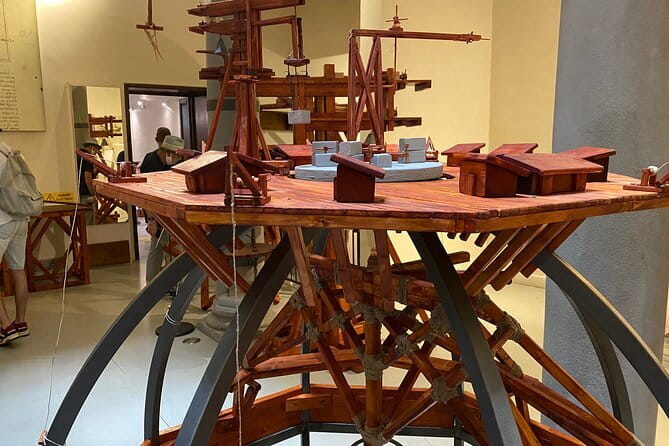
The museum is in central Florence at the Galleria Michelangelo. It is near public transportation and close to major tourist sights, so you can add it to a walking day without arranging a separate excursion.
Opening hours are listed as 10:00 a.m. to 6:00 p.m., Monday through Sunday, for the stated operating period from June 29, 2023, through February 16, 2027. Check the current details when booking, especially if your visit falls near a holiday or after that published period.
The central location is one of the ticket’s practical strengths. You do not need hotel pickup or drop-off, and food and drinks are not included. A café agreement is in place with Caffé Michelangiolo in the exhibition area, but you should treat refreshments as an extra rather than part of the admission.
The on-site bookshop sells books, publications, and souvenirs. It is a sensible place to find more background on Leonardo after seeing the machines, though some gifts are standard tourist merchandise.
Is the $12.55 ticket good value?
At $12.55 per person, this is a reasonably priced museum stop for Florence, where admission costs can quickly add up. The value depends on what you want from it.
For a family, the ticket can work well because several people can share the same activity, and children have hands-on options. For a visitor with an interest in science or invention, the working replicas provide more than a room of static pictures.
For an art-focused visitor, the value is weaker. The museum does not include Leonardo’s paintings, and its collection is made mainly from reconstructed models. You are paying for interpretation and access to an educational display, not rare original works.
The short duration helps. You can fit the museum into a busy day before lunch, after a major church visit, or during a hot afternoon when a cool indoor hour sounds appealing. If you are looking for a full half-day museum, this will feel too small.
The ticket is also useful when you want a simple, flexible activity. There is no guide to keep pace with, and a small maximum group size of 20 is listed for the activity. Since the visit itself is self-guided, the main benefit of prebooking is having admission arranged in advance and potentially saving time at the entrance.
The most important booking warning
Florence has more than one Leonardo da Vinci museum, and other cities have attractions with similar names. Pay close attention to the city shown on your confirmation before you pay.
A booking for Florence will not get you into a Leonardo museum in Rome, Milan, or Venice. This is an easy mistake to make when planning an Italy trip with several stops, and changing the ticket after the fact may not be possible.
The attraction provider is Museo Le Macchine di Leonardo da Vinci. Keep the museum’s full name and Florence location visible on your booking confirmation so you do not follow directions for a different city.
Free cancellation is available if you cancel at least 24 hours before the experience start time. Cancellations made inside that window are not refunded, and changes made inside 24 hours are not accepted. The cut-off uses local Florence time.
Who should book this Florence museum?
I would choose this museum for:
- Families wanting an indoor activity with some hands-on exhibits
- Adults who enjoy machines, engineering, anatomy, and scientific ideas
- Visitors with only one free hour
- Anyone curious about Leonardo beyond his paintings
- People looking for a lower-cost central Florence attraction
I would think twice if you mainly want authentic Renaissance objects, original Leonardo art, or a detailed scholarly presentation. The museum’s models are engaging, but they are replicas, and the storytelling may feel basic if you already know Leonardo’s work well.
Wheelchair users may find the museum suitable, as the attraction is described as wheelchair friendly. The information also says most people can participate. Specific details about every room, lift, or restroom are not provided, so contact the provider if you need precise access information.
Should you book the Leonardo da Vinci Museum?
Book it if you want to see Leonardo’s inventions turned into physical, often working models. The four-room layout, central location, documentary, and family activities make it easy to fit into a Florence itinerary.
Do not book it expecting a Leonardo art collection or original artifacts. For the best experience, treat it as a compact science and invention museum. Give yourself an hour at minimum, stay longer if the machines catch your interest, and verify that your ticket says Florence.
At $12.55, I see it as a good-value short stop for curious adults and families. It is not a must for every art lover, but it can change the way you understand Leonardo by showing the engineer behind the famous painter.
FAQ
Where is the Leonardo da Vinci Museum located?
The museum is at the Galleria Michelangelo on a well-known street in central Florence, Italy. It is near public transportation and close to major tourist attractions.
What are the museum’s opening hours?
The listed hours are 10:00 a.m. to 6:00 p.m., Monday through Sunday, for the operating period from June 29, 2023, through February 16, 2027.
How long does the visit take?
Plan for about one hour to one hour and 30 minutes. You can finish faster if you move quickly, or take longer if you read the displays and try the interactive exhibits.
Is the visit guided?
No guide is specified for this experience. The museum is self-guided, with displays and a documentary about Leonardo’s life and work.
What does the admission ticket include?
The ticket includes admission to the Leonardo da Vinci Museum. Food, drinks, and hotel pickup and drop-off are not included.
Does the museum show original Leonardo paintings?
The museum focuses on models of Leonardo’s inventions and studies rather than his original artwork. It is best suited to learning about his machines, engineering, anatomy, and scientific interests.
How many models are on display?
More than 50 models are displayed across four rooms. The rooms cover civil machines, flying machines, war machines, and anatomical models.
Is the museum suitable for children?
Yes. The museum includes hands-on exhibits and a children’s building area. Some displays are hands-off, so the experience combines interactive activities with traditional viewing and reading.
Can I cancel the ticket for a refund?
You can cancel for a full refund if you cancel at least 24 hours before the experience start time. Cancellations or changes made less than 24 hours before the start time are not accepted for a refund.
Fresh on the Florence list
- Florence: Uffizi Guided Tour with Skip-the-Line Entry Ticket★ 4.8 · 499 reviews
- The Best of Florence Walking Tour in a Small Group★ 5.0 · 503 reviews
- Florence: Uffizi Gallery Tickets with Optional Audio Guide★ 4.1 · 503 reviews
- Premium Pasta and Gelato Cooking Class in Florence★ 5.0 · 508 reviews
- From Florence: Tuscany & San Gimignano Tour with 2 Tastings★ 4.8 · 511 reviews
- Florence: Guided Tour of Medici Family Secrets and Chapels★ 4.7 · 512 reviews
- Tuscany Vespa Tours Through the Hills of Chianti★ 5.0 · 515 reviews
- Pasta and Tiramisu Cooking Class with optional Local Market Tour★ 5.0 · 515 reviews
Museums, compared.
Vatican: Museums & Sistine Chapel Entrance Ticket
Read our review →
Vatican Museums & Sistine Chapel Tour with Optional Basilica
Read our review →
Vatican Museums, Sistine Chapel & St Peter’s Basilica Guided Tour
Read our review →
Skip-The-Line Uffizi Gallery Timed Entry Ticket
Read our review →
Vatican Museums, Sistine Chapel & Basilica Tour
Read our review →
Vatican Museums & Sistine Chapel Skip-the-Line Entry Ticket
Read our review →Vatican Museums, Sistine Chapel & Basilica Tour
Read our review →
Vatican Museums & Sistine Chapel Guided Tour
Read our review →Browse the lists this tour appears in