
Reviewed · MUSEUMS
Leonardo Interactive Museum® Entrance Ticket
Leonardo’s ideas become much easier to grasp when you can turn a model, test a mechanism, or build a small design instead of only looking at a page in a book. This compact Florence museum sorts his work into earth, water, air, and fire, with machines based on his drawings.
I like the independent format, since you can move at your own speed rather than follow a guide with a fixed speech. I also like the mix of engineering, anatomy, and painting, plus the useful labels in six languages. The main catch is size: you may see everything in an hour, and busy periods can make the hands-on stations crowded.
Key points to know before you go
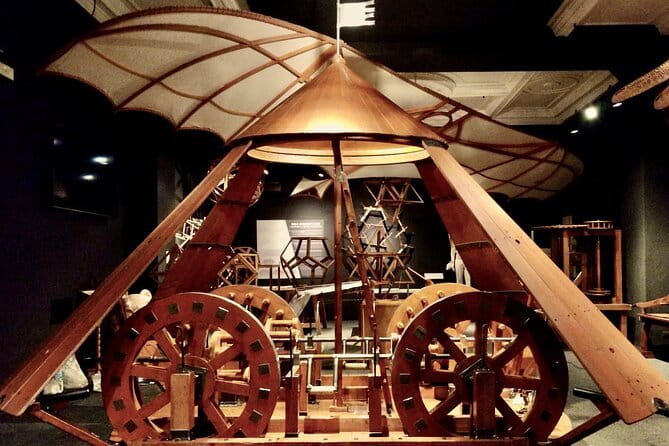
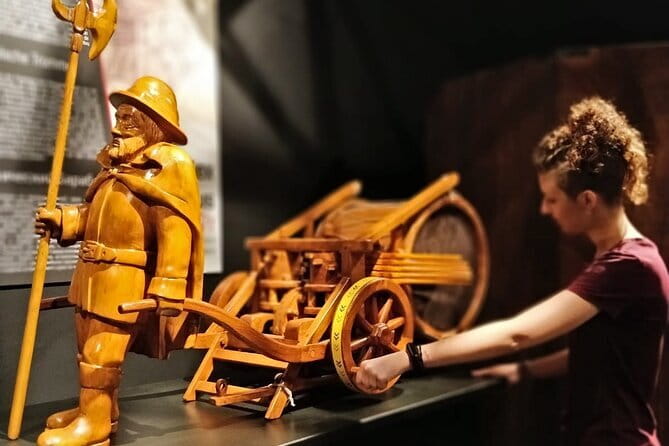
- Working models based on Leonardo’s drawings: Try mechanisms connected with bridges, ball bearings, flying machines, and other inventions.
- Four clear subject areas: The displays are grouped under earth, water, air, and fire, making Leonardo’s broad interests easier to follow.
- Good for families and curious adults: Children can touch and test many models, while adults interested in engineering, art, or anatomy have plenty to examine.
- A compact visit: Plan on about 60 to 90 minutes, though some families may want up to two hours.
- Six-language information: Labels and multimedia material are available in Italian, English, French, German, Spanish, and Russian.
- Self-guided and air-conditioned: You get no guided tour, but you can pause at the exhibits that interest you most and escape Florence’s heat for a while.
What the Leonardo Interactive Museum actually offers
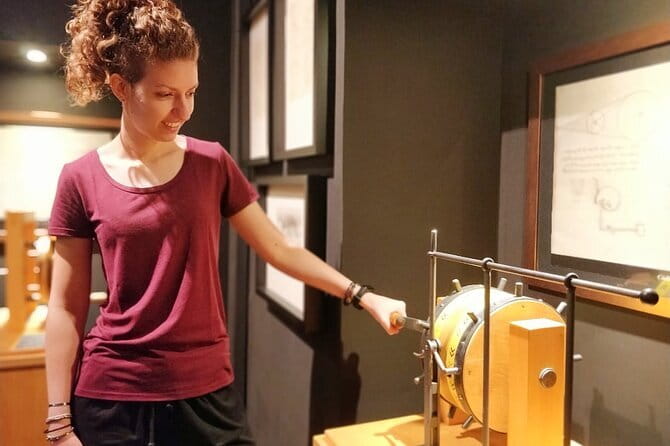
This is not a grand art museum devoted mainly to paintings. It is a hands-on exhibition built around Leonardo da Vinci as an inventor, engineer, artist, and student of the human body.
The central idea is simple: Leonardo drew machines centuries ago, and the museum turns many of those drawings into physical models. Some are built to scale when possible. You are not just reading that he imagined a flying machine or a mechanical device. You can look closely at how the parts fit together and, at many stations, try the mechanism yourself.
That practical approach explains the museum’s strongest appeal. Leonardo’s sketches can seem abstract on a gallery wall. A model gives you something concrete to work with. You can see why a particular shape might create lift, how a bridge might hold together, or how a machine transfers motion.
The museum is recommended for children and adults, but I would set expectations correctly. It is small rather than sprawling, and it is not designed as a full biography of Leonardo. Think of it as a focused introduction to his mechanical imagination, with added sections on anatomy and art.
More Museums in Florence
- Florence: Skip-The-Line Uffizi Gallery Timed Entry Ticket
★ 4.5 · 27,832 reviews - Florence: Leonardo Interactive Museum Entry Ticket
★ 4.5 · 11,763 reviews - Florence Accademia Gallery Tour with Entrance Ticket Included
★ 4.5 · 6,148 reviews
Earth, water, air, and fire
The main exhibition is arranged in four sections: earth, water, air, and fire. This organization helps you make sense of a man whose interests jumped from civil engineering to flight, hydraulics, military devices, and natural science.
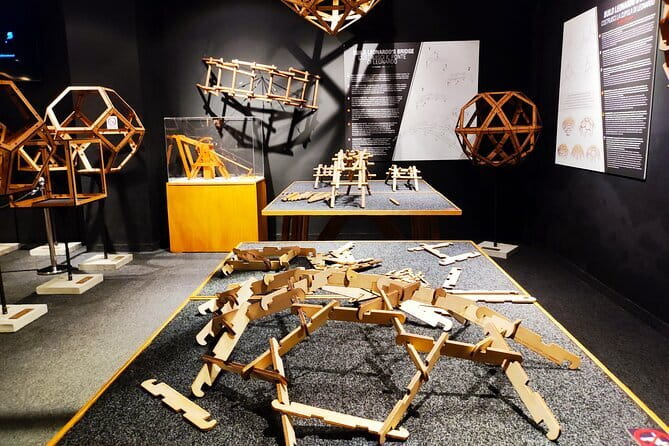
In the earth section, you might find models linked to construction, movement, and mechanical force. One hands-on favorite is the bridge-building activity. It gives families a reason to work together, and it shows how a simple structure can gain strength through the way its pieces are arranged.
The water section focuses on Leonardo’s interest in water movement and machines associated with it. The value here is not simply seeing an old design reproduced. It is watching a principle work in front of you, which makes the display more useful for children who learn by doing.
Air is likely to attract anyone curious about flight. Leonardo studied birds and sketched ideas for flying devices long before powered aviation existed. A model cannot make his design practical, but it can help you see how he approached lift, wings, and human flight.
Fire brings in another side of Leonardo’s mechanical work. The exhibits show how broad his thinking was, moving beyond art and peaceful engineering into machines shaped by the needs of his time.
Some machines have been well used over the years, and not every moving part may feel perfect. That matters because the museum’s interactive label can sound more ambitious than the actual condition of every exhibit. Still, the chance to handle working replicas is the main reason to choose this museum, and many stations remain engaging.
The hands-on side works best for families
If you are visiting Florence with children, this museum gives you a welcome change from rooms where everyone must keep their hands behind their back. Children can test mechanisms, work on puzzles, and build three-dimensional models.
The exhibits are especially well suited to school-age children and teenagers. Younger children may need help understanding the instructions or waiting for a turn, and the museum requires adults to supervise children at all times.
I would not reserve this only for families. Adults who enjoy engineering, design, physics, or the history of inventions can have a good time here too. The models make Leonardo’s thought process visible, and you may find yourself testing a mechanism longer than expected.
One of the nicest family activities is building the bridge together. It turns the visit into a shared task rather than a quick walk past display cases. Other models let you assemble or examine three-dimensional forms, giving grandparents, parents, and children something to do side by side.
The tradeoff is noise and crowding. The museum limits the number of people entering at a time, but timed entry does not guarantee a quiet visit. If several groups are using the same machines, you may need patience. On the busiest days, it can be hard to reach every station or read every placard.
Anatomy and Leonardo’s paintings
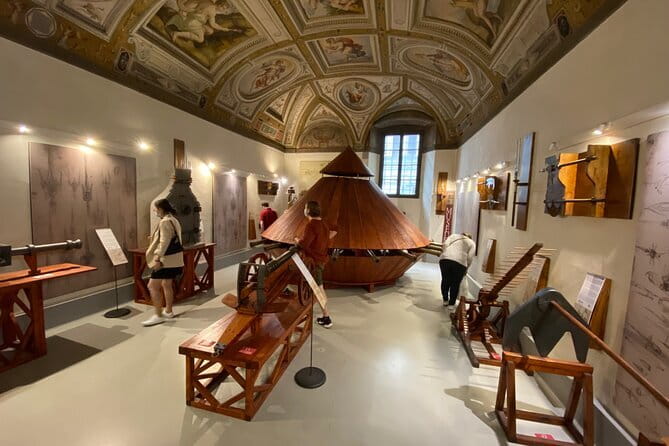
The museum is not limited to machines. A section on Leonardo’s anatomical studies shows his interest in the human body and the careful observation behind his drawings.
This adds welcome balance to the mechanical displays. Leonardo was not only imagining devices. He was studying structure, proportion, movement, and the natural world. The anatomy section helps connect his scientific curiosity with his work as an artist.
You will also find a gallery of his most important paintings, reproduced with high-resolution backlight technology. These are reproductions, not original masterpieces, so you should not treat this as a substitute for Florence’s major art museums.
The gallery does give you a chance to connect the artist and engineer in one visit. You can look at the paintings alongside the studies and machines, then consider how observation shaped all parts of Leonardo’s work. For a visitor who wants an introduction rather than a specialist art lesson, that combination is useful.
If your main goal is to see original Renaissance paintings, spend your museum time elsewhere. If you want to understand Leonardo’s range, the reproductions make the visit feel broader than a machine-only exhibition.
Same city, an entirely different afternoon:
- Tuscany Day Trip from Florence: Siena, San Gimignano, Pisa and Lunch at a Winery
★ 5.0 · 21,634 reviews - Florence: Timed Entrance Ticket to Michelangelo’s David
★ 4.6 · 16,983 reviews - Florence: Michelangelo’s David Skip-the-Line Entry Ticket
★ 4.5 · 12,764 reviews - The Best tour in Florence: Renaissance & Medici Tales – guided by a STORYTELLER
★ 5.0 · 12,316 reviews
How long to allow for the visit
The stated visit time is about one hour to one hour and 30 minutes. That is a fair plan for most people.
You can walk through quickly in around an hour if you read only the main labels and do not wait long at the interactive stations. I would allow 90 minutes if you want to test the machines, study the diagrams, and browse the anatomy and painting sections.
Families may need longer, especially if children want to repeat the activities or build several models. Some people have found that two hours gives them a more relaxed visit, though the museum’s compact size means you will not need a whole morning.
This makes the museum easy to fit between larger Florence sights. It can also be a practical midday stop because the rooms are fully air-conditioned. The cool interior is a real benefit during a hot day, especially when children need a break from walking.
Food, chewing gum, and drinks are not allowed in the exhibition areas. Plan snacks before entering or after leaving, and keep children supervised so the hands-on displays remain safe for everyone.
Language, signs, and the lack of a guide
This is a self-led experience. No guide is included, so you will not receive a live explanation or a set route through Leonardo’s life.
That arrangement suits you if you like to linger over one subject and skip another. You can spend extra time with a flying machine, move quickly through a less interesting display, or return to a model that caught your attention.
Every exhibit has written information in Italian, English, French, German, Spanish, and Russian. Multimedia displays provide more information about Leonardo’s life and work. This makes the museum accessible to a wide range of international visitors without requiring a private guide.
There is one practical weakness in the self-guided format: the museum does not always create a clear chronological path through Leonardo’s life. The four subject areas organize the machines, but they do not necessarily explain his development year by year.
Audio or multimedia material may also be harder to follow when the room is noisy. You can use the information outside the exhibit areas if you need a quieter place to listen. For the clearest experience, read the labels near the machines and treat the multimedia material as an optional extra.
Price and what the ticket is worth
At $11.95 per person, this is a moderate-cost Florence attraction. The ticket includes admission without commissions or extra booking costs, along with access to the interactive displays, multilingual information, anatomy section, and reproduced paintings.
The value depends on what you want from a museum. For a family, the price can make sense because several people can take part rather than simply look at objects. The hands-on format also gives children a better chance of staying interested than a traditional gallery filled with fragile works.
For an adult who already knows Leonardo’s mechanical designs well, the visit may offer fewer surprises. The museum works best as an introduction or as a visual way to understand ideas you have read about, not as a specialist archive.
The ticket is also useful when you have a tight Florence schedule. Booking in advance is recommended, and the admission is offered as a skip-the-line ticket. Since the museum is popular and capacity can feel tight at busy times, prebooking helps protect your planned visit.
Pay close attention to the attraction name and location when booking. The interactive museum is different from a historical museum, and the two can cause confusion. The museum’s location is near public transportation, but the meeting or ticket information should be checked carefully so you do not head to the wrong place.
Crowds, comfort, and practical concerns
The museum has bathrooms and air-conditioned rooms, both useful details for families and anyone spending a full day on foot in Florence.
Crowding is the main comfort concern. Even with timed entry, several groups may gather around the most popular machines. If you arrive during a busy period, you may need to circle back to an exhibit instead of using it right away.
A crowded room can also make it difficult to hear multimedia material or read every description. I would not rush. Pick a few machines that interest you most, then return to the rest if space opens up.
Children must be supervised at all times. Anyone who damages or risks damaging the museum, or disturbs other people, can be asked to leave. That rule is reasonable here because many displays invite physical interaction.
The museum shop is well stocked with books and souvenirs. It is a useful stop if you want to continue the subject at home, particularly with children who enjoyed building and testing the models.
Who should book this Florence museum
I would recommend this experience most strongly to:
- Families with children who need a break from traditional art museums
- Adults interested in engineering, invention, design, or science
- Leonardo fans who want to see physical versions of his ideas
- Art lovers who want a short introduction to the connection between his paintings, anatomy, and observation
- Independent visitors who prefer to explore without a guide
- Anyone looking for an air-conditioned activity lasting about 60 to 90 minutes
I would be more cautious if you expect original Leonardo paintings, a large museum, a quiet scholarly setting, or a detailed chronological biography. The painting gallery contains reproductions, and the museum’s greatest strength is its working models.
Should you book the Leonardo Interactive Museum?
Book it if you want to understand Leonardo by handling his ideas instead of only viewing them. The bridge-building activity, mechanical models, flying machines, multilingual labels, and family-friendly layout give the visit a clear purpose.
I especially like it as a Florence add-on. It does not take a full day, it is near public transportation, and the air conditioning can be a relief. At $11.95, it is a fair choice for families and curious adults, provided you accept that the museum is compact and may feel crowded.
Choose a quieter time if possible, prebook your entry, and confirm that you are selecting the interactive museum rather than a different Leonardo attraction. If you do that, you will get a lively, practical look at one of history’s most inventive minds.
FAQ
How much does admission cost?
The ticket price is $11.95 per person.
How long does the visit take?
Plan on about one hour to one hour and 30 minutes. Some families may prefer up to two hours to use the models at a relaxed pace.
Is the experience guided?
No. This is a self-led visit, and no guided tour is included.
Are the exhibits available in English?
Yes. Exhibit descriptions and multimedia information are available in English, Italian, French, German, Spanish, and Russian.
Is the museum suitable for children?
Yes. The exhibition is recommended for children and adults, and many machines and model-building activities are hands-on. Children must be supervised at all times.
Are children under five admitted free?
Yes. Children under five years of age receive free admission.
Is the museum air-conditioned?
Yes. The exhibition rooms are fully air-conditioned.
Can I bring food or drinks inside?
No. Food, chewing gum, and beverages are prohibited in the exhibit areas.
Is this the same as a historical Leonardo museum?
No. The interactive museum is a different attraction from the historical museum. Check the attraction name and location carefully when booking.
Can I cancel for a full refund?
Yes, if you cancel at least 24 hours before the experience start time. Cancellations made less than 24 hours in advance are not refunded, and changes within 24 hours are not accepted.
Fresh on the Florence list
- Florence: Uffizi Guided Tour with Skip-the-Line Entry Ticket★ 4.8 · 499 reviews
- The Best of Florence Walking Tour in a Small Group★ 5.0 · 503 reviews
- Florence: Uffizi Gallery Tickets with Optional Audio Guide★ 4.1 · 503 reviews
- Premium Pasta and Gelato Cooking Class in Florence★ 5.0 · 508 reviews
- From Florence: Tuscany & San Gimignano Tour with 2 Tastings★ 4.8 · 511 reviews
- Florence: Guided Tour of Medici Family Secrets and Chapels★ 4.7 · 512 reviews
- Tuscany Vespa Tours Through the Hills of Chianti★ 5.0 · 515 reviews
- Pasta and Tiramisu Cooking Class with optional Local Market Tour★ 5.0 · 515 reviews
Museums, compared.
Vatican: Museums & Sistine Chapel Entrance Ticket
Read our review →
Vatican Museums & Sistine Chapel Tour with Optional Basilica
Read our review →
Vatican Museums, Sistine Chapel & St Peter’s Basilica Guided Tour
Read our review →
Skip-The-Line Uffizi Gallery Timed Entry Ticket
Read our review →
Vatican Museums, Sistine Chapel & Basilica Tour
Read our review →
Vatican Museums & Sistine Chapel Skip-the-Line Entry Ticket
Read our review →Vatican Museums, Sistine Chapel & Basilica Tour
Read our review →
Vatican Museums & Sistine Chapel Guided Tour
Read our review →Browse the lists this tour appears in