
Reviewed · WALKING TOURS
Rome: Jewish Ghetto Walking Tour
Rome’s Jewish Ghetto is where ancient Rome, Jewish history, and modern city life meet in a surprisingly compact walk. You’ll see the Theater of Marcellus, older than the Colosseum, then follow the streets toward the Portico d’Ottavia, Great Synagogue, and Tiber Island. I like the way the tour connects major ruins with personal stories, and I like the included kosher gelato or coffee, a welcome pause on a warm day.
The main consideration is that this is a walking tour of the neighborhood, not an inside visit to every landmark. The Great Synagogue is part of the route, but entry is not listed, and past participants specifically wished they could go inside. You’ll also need to arrive on time, since late departures are not held.
Key points to know before you book
- Start at Trajan’s Column: Meet by the orange Roman Vacations sign at Foro Traiano, 84, then walk toward the Jewish Ghetto.
- See Rome in layers: The route links the Theater of Marcellus, Portico d’Ottavia, medieval streets, Jewish history, and Tiber Island.
- Expect a story-led tour: Guides including Angela, James, Tom, Daniel, Maria, and others are praised for making long stretches of history easy to follow.
- Enjoy a small local treat: Kosher gelato or coffee is included, while any additional food and drinks cost extra.
- Plan for outdoor conditions: The tour runs in all weather, so bring sunscreen, a hat, water, and an umbrella as needed.
- Allow 2.5 hours: The pace is manageable for many people, but comfortable shoes matter on Rome’s hard streets.
Why this short walk explains so much of Rome
I like tours that give you a clear sense of place rather than simply marching between famous photo stops. This one does that well. The Jewish Ghetto is not isolated from Rome’s wider story. Its streets sit beside ancient theaters, Roman temples, churches, fountains, bridges, and the river.
That setting gives the tour its real value. You are not only learning about the Jewish community in Rome. You are also seeing how one neighborhood changed as imperial Rome declined, Christian Rome took shape, and modern Rome grew around older buildings.
The history reaches back more than 2,000 years, but the guide’s job is to make that span manageable. The strongest guides appear to do this through stories and clear explanations rather than a flood of dates. James is repeatedly praised for presenting history as an engaging narrative, while Angela is noted for her energy, humor, and command of Jewish history. Tom is especially well regarded for placing ancient Rome and the Jewish Ghetto in context.
You do not need to be Jewish to appreciate the walk. The tour deals with the long presence of Jews in Rome, the restrictions imposed on the community, the suffering caused by persecution, and the resilience of people who continued to live, worship, and build a community here. It is a serious subject, but it is presented alongside architecture, art, food, and everyday streets.
More Walking Tours in Rome
- Rome: Trastevere & Campo de Fiori Street Food Walking Tour
★ 4.9 · 2,768 reviews - Rome: Paranormal Night Walking Tour & Secret Backstreets
★ 4.9 · 1,921 reviews - Rome by Night Walking Tour – Legends & Criminal Stories
★ 4.5 · 1,003 reviews
Starting at Trajan’s Column
The meeting point is at Foro Traiano, 84, near Trajan’s Column in central Rome. Look for the orange Roman Vacations sign. This is an important detail because the first meeting area can feel crowded and confusing, especially if you are coming from another sightseeing stop.
The tour does not begin inside the Jewish Ghetto. You first get a Roman history lesson near Trajan’s Column, then walk toward the neighborhood. That approach makes sense. It gives the guide room to explain how the city developed before you enter the area shaped by the Jewish community.
Arrive early. The company does not delay the tour for late arrivals, and missed tours are not refunded. Wear shoes that can handle several hours on Rome’s uneven pavement. Bring a reusable water bottle, since the itinerary is outdoors and Rome can be hot, particularly in summer.
Theater of Marcellus, an older rival to the Colosseum
The first major stop is the Theater of Marcellus, with about 20 minutes for a guided explanation. Many people know the Colosseum, but fewer realize that this theater is older. That alone makes it a useful correction to the usual Rome sightseeing list.
The building shows how ancient Roman structures were reused over time. You are looking at a monument from antiquity that remains part of the modern city rather than a ruin cut off from daily life. The guide can use it to explain Roman entertainment, construction, and the long transformation of the city.
This stop also sets the tone for the rest of the walk. You are not being shown one neatly preserved historical period. You are seeing layers placed one on top of another. The Theater of Marcellus leads naturally into a neighborhood where ancient remains, later buildings, religious sites, and modern businesses share the same streets.
The stop lasts about 20 minutes, so expect an explanation rather than a full architectural study. If ancient Roman history is your main interest, pay close attention here and ask questions. Guides such as Tom and James have been praised for answering questions in detail and for connecting individual monuments to the larger story of Italy.
The Turtle Fountain and its tale of unrequited love
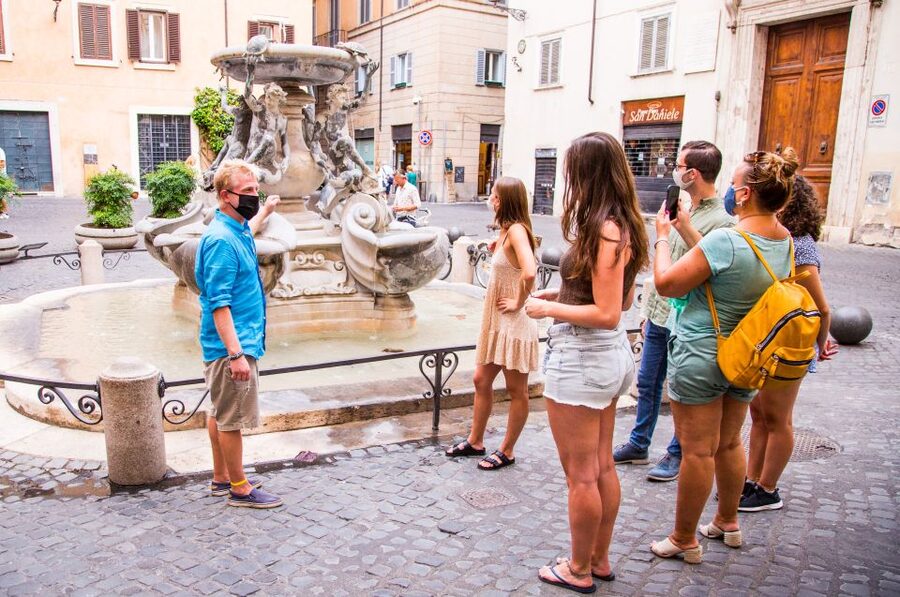
Piazza Mattei is home to the Fontana delle Tartarughe, or Turtle Fountain. The guided stop lasts around 20 minutes. It is a small, elegant fountain, and the story attached to it gives the square more character than a quick photograph would.
Your guide tells the tale of unrequited love connected with the fountain. That kind of story is useful on a walking tour because it gives you something memorable to carry with you. Rome has no shortage of grand monuments, but smaller places often become the stops you remember when a guide supplies the human detail.
Piazza Mattei also marks a change in mood. The Theater of Marcellus feels monumental and ancient. The fountain brings you into the texture of Rome’s public squares, where art, rumor, romance, and daily life overlap.
The square is not a long stop, and the tour does not present it as a major standalone sight. I see it as a bridge between the ancient ruins and the more focused Jewish history ahead. It is also a good place to listen closely, since the story helps make the route feel like a connected walk rather than a list of unrelated locations.
Same city, an entirely different afternoon:
- Vatican Museums & Sistine Chapel Tour with Optional Basilica
★ 4.3 · 67,413 reviews - Colosseum, Roman Forum & Palatine Guided Tour
★ 4.7 · 63,148 reviews - Vatican Museums, Sistine Chapel & St Peter’s Basilica Guided Tour
★ 4.5 · 39,149 reviews - Rome: Colosseum, Palatine Hill and Roman Forum Guided Tour
★ 4.8 · 32,814 reviews
Entering the Jewish Ghetto

The Jewish Ghetto section receives about 20 minutes of guided attention, though the subject continues through the later stops. Here you learn about the restrictions that confined Rome’s Jewish community to this area for centuries and about the difficult conditions people endured.
The last remaining piece of the wall that kept the Jewish community in the area is an especially meaningful stop. It turns a broad historical idea into something visible. Instead of hearing only about laws and boundaries, you can see a physical reminder of how those rules shaped daily life.
This is where the guide matters most. The subject calls for care, context, and respect. Angela is praised for explaining Jewish history in Rome with passion and clarity. Daniel is noted for bringing the neighborhood to life through stories, while other guides are praised for keeping explanations understandable even when covering many centuries.
The best approach is to listen for the connection between public history and private experience. What did it mean to live in a restricted district? How did families maintain religious and cultural life? How did the community respond to outside pressure and periods of violence? The tour is designed to address that wider story rather than focus only on buildings.
The Jewish Ghetto is still a living neighborhood, not an open-air museum. That matters. You should expect restaurants, streets, religious buildings, memorial markers, and ordinary city life beside sites connected with painful events. A guide helps you read those surroundings with more care.
Portico d’Ottavia and Rome’s layered streets
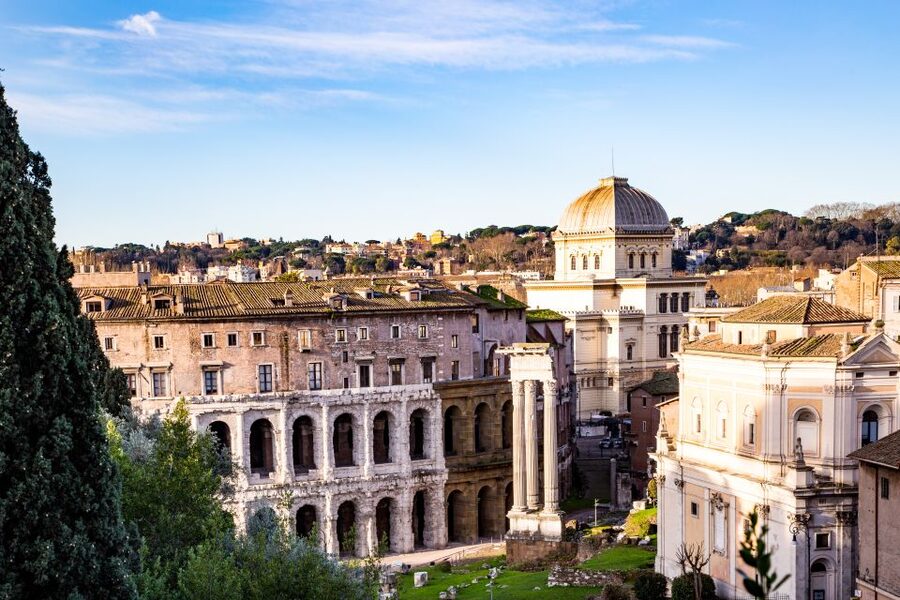
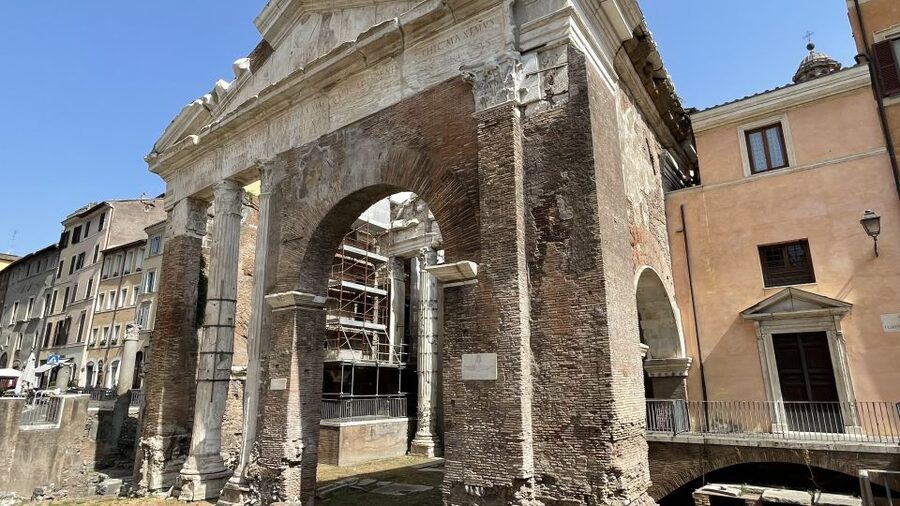
The Portico d’Ottavia receives about 15 minutes. This ancient structure is one of the clearest examples on the route of Roman remains still being used as part of the city.
Its connection with the Jewish Ghetto is important because the community grew around and among older Roman structures. The portico is not simply an ancient monument placed near the neighborhood. It helps explain the physical setting in which Jewish life developed in Rome.
Expect a guided look at the remains rather than a museum-style visit. The value comes from the explanation of what you are seeing and how it relates to the surrounding area. Without context, ancient stone can blur together after several days of sightseeing. A good guide gives the monument a role in the story.
This is also a good place to notice how compact the route is. The main stops are close enough to connect on foot, but the subject matter changes constantly. You move from imperial construction to Jewish community life, then toward the river and the Christian institution on Tiber Island.
Kosher gelato or coffee during the walk
The tour includes kosher gelato or coffee. The exact choice may depend on the day and the stop, but the break gives you a chance to pause after the historical explanations.
I consider this a small but worthwhile inclusion. It introduces you to a food tradition connected with the neighborhood and adds a practical rest to a 2.5-hour walk. The word kosher is not just a label here. It fits the tour’s effort to connect the neighborhood’s history with its Jewish identity in the present.
Additional food and drinks are not included. Some feedback refers to food and wine stops, but the stated inclusion is kosher gelato or coffee, so you should not book this expecting a full tasting tour. Think of it as one included refreshment, not a meal.
If you have dietary concerns, the supplied information does not specify every ingredient or alternative. Ask the guide on the day if you need details. The stop is best treated as a pleasant extra rather than the main reason to choose the experience.
The Great Synagogue and the limits of the visit
The Great Synagogue of Rome is one of the tour’s major landmarks. The route takes you past the synagogue and explains the Jewish community’s continuing presence in Rome.
The supplied details do not include admission inside the synagogue. That is worth knowing before you book. If seeing the interior is central to your plans, you will need to check separately for an entry option or another visit. Several people who enjoyed the walk still wished an inside visit had been part of it.
Even from the outside, the synagogue has an important place in the route. It provides a focus for the story of Roman Jews across the centuries and helps bring the tour into the modern era. The guide can explain the building and the community around it, rather than leaving you to admire the exterior without context.
This stop can also be emotionally heavy. The tour addresses persecution and the suffering of Rome’s Jews, including the destruction and loss that marked the community’s past. The strongest feedback points to guides who handle this material with feeling but also with a clear sense of history.
Crossing to Tiber Island
The final part of the route takes you across the oldest functioning bridge in Rome to Tiber Island. The bridge itself is part of the lesson. It links the Jewish Ghetto with the island and gives you a different view of how the neighborhood fits into the city.
On Tiber Island, you hear about the hospital that saved people during World War II. This is one of the tour’s most powerful modern stories because it shifts the focus from ancient walls and old restrictions to acts of courage during a period of extreme danger.
You also hear the story of Asclepius at the temple, now a church. This detail shows the way religious sites in Rome changed meaning over time. An ancient place associated with healing became connected with Christian worship, while the island continued its role as a place of care.
The tour concludes on the island, which is a useful ending point. You finish with the river nearby and a final set of stories linking medicine, religion, war, and survival. Since the walk ends here, you can plan your next Rome activity from the island or continue on foot, depending on your schedule.
Guides who make the long timeline work
The guide is the heart of this experience. The tour is offered in English, and the guides named in the supplied information include Angela, James, Tom, Daniel, Maria, Elena, Gabi, and others.
Several guides are praised for similar strengths:
- Angela brings energy, warmth, humor, and strong knowledge of the Jewish history of Rome.
- James is praised for telling history as a story and for answering questions with care.
- Tom is particularly strong at placing three millennia of Roman history in context.
- Daniel is noted for his clear explanations and for adjusting the walking pace when someone needed to move slowly.
- Maria is praised for making connections between the history of the Ghetto and Italy as a whole.
The guide assigned to your departure may differ. Still, the repeated pattern is useful: this tour works best when you enjoy listening, asking questions, and following a long story through several locations.
Small groups can improve the experience. Some departures have been intimate, and on certain dates a booked small group became a private tour because no one else joined. You cannot count on that happening, but a smaller group makes it easier to hear the guide, stop in shaded places, and ask questions.
Is $65 a fair price?
At $65 per person, this is not the cheapest way to walk through the Jewish Ghetto. You can visit the neighborhood on your own for free. The question is what the guide adds.
For me, the price makes more sense if you want context. The route covers ancient Rome, Jewish history, World War II, religion, architecture, and food in 2.5 hours. Without a guide, you would see many of the same streets and monuments, but you would miss the links between them.
The value is strongest for first-time visitors who want one organized introduction to the area. It can also work well for repeat visitors who have seen the central Roman sights but want a more focused subject.
The price is less compelling if you mainly want to enter the Great Synagogue, eat your way through the neighborhood, or spend a long time at each ancient site. Those are not clearly included. You are paying for a guided historical walk with one included gelato or coffee, not for admission tickets or a full food tour.
Free cancellation up to 24 hours before the start and the option to reserve now and pay later make the booking less rigid. Still, the strict late-arrival rule means you should build in extra time to reach Trajan’s Column.
Who should book this walk?
I would recommend it to anyone interested in Rome beyond the Colosseum and Vatican. It suits people who enjoy history presented through places and stories, rather than through a formal lecture.
It is also a good choice for families with older children and teenagers. One guide’s storytelling style kept teenagers interested, which is no small achievement in a city filled with ancient stone. The walk gives young people memorable hooks, including the Turtle Fountain story, the old theater, the wall, and the hospital on Tiber Island.
Jewish visitors may find the subject especially meaningful, but you do not need a Jewish background to take part. The tour explains the community’s past and present for a general audience.
People with walking difficulties should contact the provider before booking if they need specific arrangements. The route is on foot for 2.5 hours, though Daniel and other guides have adjusted the pace for people who needed to walk slowly.
Bring comfortable shoes, a sun hat, sunscreen, weather-appropriate clothing, and water. The tour runs in all weather, so an umbrella is sensible. If you enter a church, bare shoulders need to be covered.
FAQ
How long is the Rome Jewish Ghetto walking tour?
The tour lasts 2.5 hours.
Where does the tour begin?
It begins at Foro Traiano, 84, near Trajan’s Column in central Rome. Look for an orange Roman Vacations sign.
Where does the tour finish?
The tour concludes on Tiber Island after crossing the oldest functioning bridge in Rome.
What language is the tour offered in?
The live guided tour is offered in English.
What landmarks are included?
The route includes the Theater of Marcellus, Turtle Fountain in Piazza Mattei, the Jewish Ghetto, the Portico d’Ottavia, the Great Synagogue of Rome, and Tiber Island.
Is entry inside the Great Synagogue included?
The provided tour details do not list entry inside the Great Synagogue. The route includes the synagogue as a sightseeing and history stop.
Is food included?
Kosher gelato or coffee is included. Extra food and drinks are not included.
What should I bring?
Bring comfortable shoes, a sun hat, sunscreen, a reusable water bottle, weather-appropriate clothing, and an umbrella if needed. Bring a cover for bare shoulders inside churches.
What happens if I arrive late or the weather is bad?
The tour cannot be delayed for late arrivals, and missed tours do not receive a refund. The tour proceeds in all weather conditions.
Should you book the Rome Jewish Ghetto walk?
Book this tour if you want the Jewish Ghetto explained as part of Rome’s larger story. The ancient Theater of Marcellus, Turtle Fountain, Portico d’Ottavia, Great Synagogue, and Tiber Island make a strong sequence, but the guide is what turns those stops into a meaningful experience.
At $65, it is best value for a first visit, a history-minded family, or anyone who wants thoughtful Jewish and Roman context without arranging several separate visits. Skip it if you need synagogue admission, a full food experience, or lots of free time at each landmark. For most visitors seeking a focused, human account of one of Rome’s oldest neighborhoods, the 2.5-hour route is a worthwhile use of an afternoon.
Fresh on the Rome list
- Rome: Guided Catacombs Tour & Capuchin Crypt (Audio Guide)★ 4.3 · 191 reviews
- Guided tour of the Colosseum, Roman Forum and Palatine in Spanish★ 4.5 · 191 reviews
- Rome: Borghese Gallery Guided Tour with Skip-the-Line Ticket★ 4.5 · 192 reviews
- Rome: Arena Colosseum Tour with Arena Access★ 4.6 · 193 reviews
- Rome: Colosseum & Roman Forum Guided Tour★ 5.0 · 194 reviews
- Colosseum, Forum, Palatine Hill with audio guide and Arena or Bus option★ 4.0 · 193 reviews
- Rome: Domus Aurea Guided Tour and Virtual Reality Experience★ 4.7 · 194 reviews
- Rome Vintage Fiat 500 car Tour With Photographer★ 5.0 · 194 reviews
Walking Tours, compared.
Guided Walking Tour & Last Supper Visit with Ticket
Read our review →
Rialto Bridge & Offbeat Unusual Venice Walking Tour
Read our review →
Private 3 hrs Venice Tour: St Mark’s, Walking tour & Boat tour
Read our review →
Skip the line: Uffizi and Accademia Small Group Walking Tour
Read our review →Browse the lists this tour appears in