
Reviewed · WALKING TOURS
Rome: Guided City Center Evening Sightseeing Walking Tour
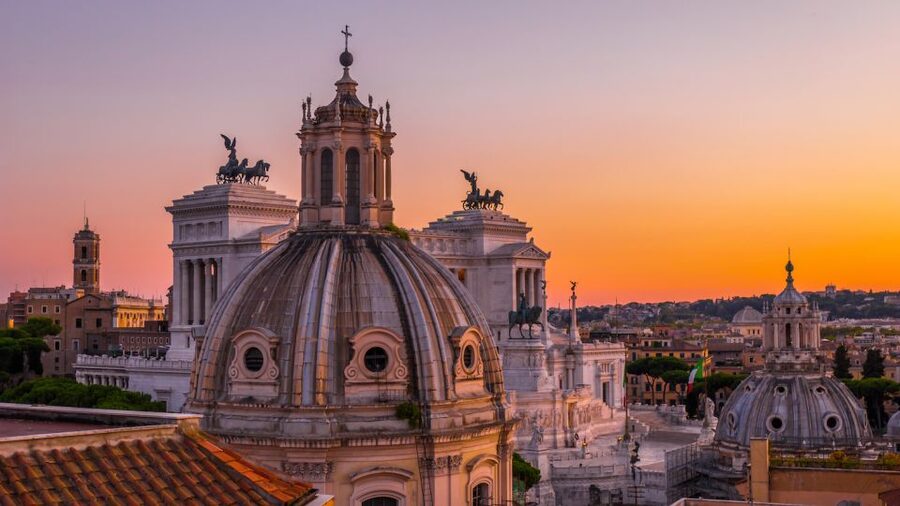
Rome is at its most theatrical when the heat fades and the fountains glow. This three-hour walk takes you from Piazza del Popolo to Campo de’ Fiori, with a sunset stop at Pincio Terrace, the Spanish Steps, Trevi Fountain, the Pantheon, and Piazza Navona along the way.
I like two things right away: the route gives you a fast, useful introduction to central Rome, and the evening timing makes the city easier to enjoy. You get cooler air, softer light, and a better chance to see the monuments without spending the whole afternoon dodging the sun.
The trade-off is simple: this is a full three hours on foot, with steps and a steep climb near the start. It is not suitable for wheelchair users, and it may feel too quick or tiring if you want long stops at each monument.
Key points to know before booking
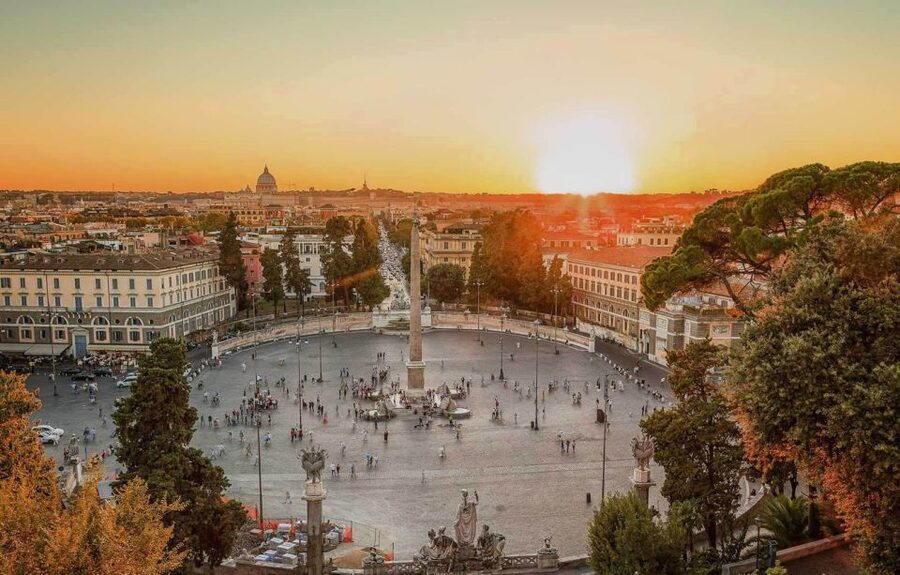
- Sunset at Pincio Terrace: Begin with a fine view over Rome’s rooftops from above Piazza del Popolo.
- Classic city-center route: See the Spanish Steps, Trevi Fountain, Pantheon exterior, Piazza Navona, and Campo de’ Fiori in one evening.
- Strong guide element: Guides including Andrada, Carolina, Marzia, and Ava have been praised for clear explanations, humor, and useful restaurant advice.
- Fast walking format: Expect to walk almost continuously, so comfortable shoes are essential.
- Good first-night choice: The route helps you get your bearings and decide which places deserve a return visit.
- Simple value: At $46 per person, you are paying for three hours of live explanation and route planning, not admission to indoor sights.
Why an evening walk works so well in Rome
Rome can be hard to read on your own. A fountain may look like decoration, a church may seem like just another grand building, and an obelisk can pass without much thought. A good guide turns those objects into clues about the city’s politics, religion, art, and long Roman memory.
That is the main value here. You can walk past the same landmarks alone, but the stories give them shape. One person described visiting the sights independently and then feeling as if they were seeing them for the first time once a guide explained them.
The timing helps, too. Rome’s summer heat can make sightseeing feel like an endurance test. In the evening, you can focus more easily on the buildings instead of searching for shade. Sunset also gives the opening section a clear visual reward before the tour moves into the illuminated squares and fountains of the historic center.
I would book this early in your stay. Several guests used it as their first evening activity, and that makes sense. The walk shows you where the main sights are, points out areas to revisit, and leaves you near Campo de’ Fiori, where you can continue with dinner or a drink.
More City Tours in Rome
- Rome: City Sightseeing Hop-on Hop-off Bus with Audioguide
★ 4.0 · 16,045 reviews - City Sightseeing Rome Hop-On Hop-Off Bus Tour
★ 3.5 · 5,446 reviews - Rome: Fettuccine Pasta Cooking Class in Rome’s City Center
★ 4.8 · 2,414 reviews
Starting at Piazza del Popolo
Meet your English-speaking guide in Piazza del Popolo, in front of Santa Maria del Popolo Church. Look for the Rome Your Way sign. The meeting point is next to the Leonardo da Vinci Museum, but allow a little extra time to find the right side of the large square. One person found the meeting instructions confusing, so do not arrive at the last minute.
Piazza del Popolo is an appropriate starting point. It is broad, formal, and packed with the ingredients that make Rome so enjoyable: churches, fountains, monuments, and layers of urban design. Your guide will introduce the square before leading you uphill toward Pincio Terrace.
That first climb is the main physical challenge at the beginning. It is steep enough to notice, and one person specifically called it the difficult part of the tour. If you are fit enough for a long city walk but dislike hills, take it slowly and save your energy for the rest of the route.
Sunset from Pincio Terrace
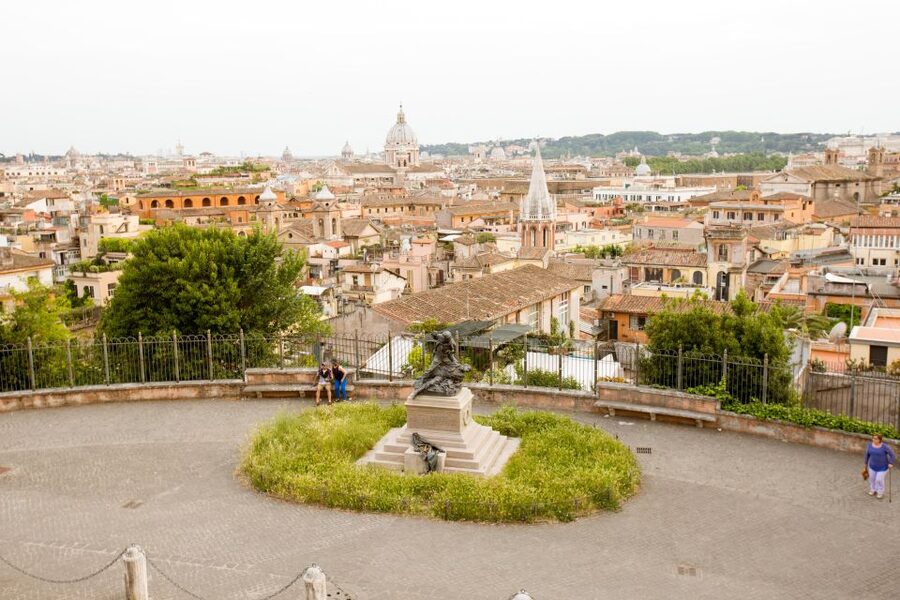
The Pincio Terrace gives you a wide view across Rome’s rooftops. This is not a visit to a museum or an ancient ruin. It is a pause above the city, and it gives you a useful sense of Rome’s scale before you begin threading through the streets below.
At sunset, the view is the emotional high point of the first section. You can look out across the city while the guide explains what you are seeing and places the monuments in context. The timing of sunset changes through the year, so check the available starting time when booking rather than assuming every departure will have the same light.
This stop also helps break up the route. After the uphill walk, you get a chance to pause, take photographs, and settle into the group. Do not expect a long formal rest break, though. The overall pace remains active, and the tour is designed to cover a large part of central Rome in a short time.
Spanish Steps and the Barcaccia Fountain
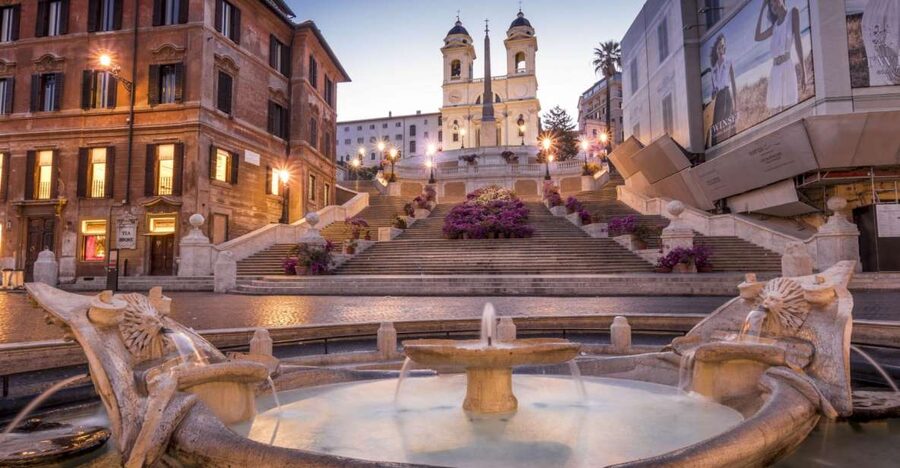
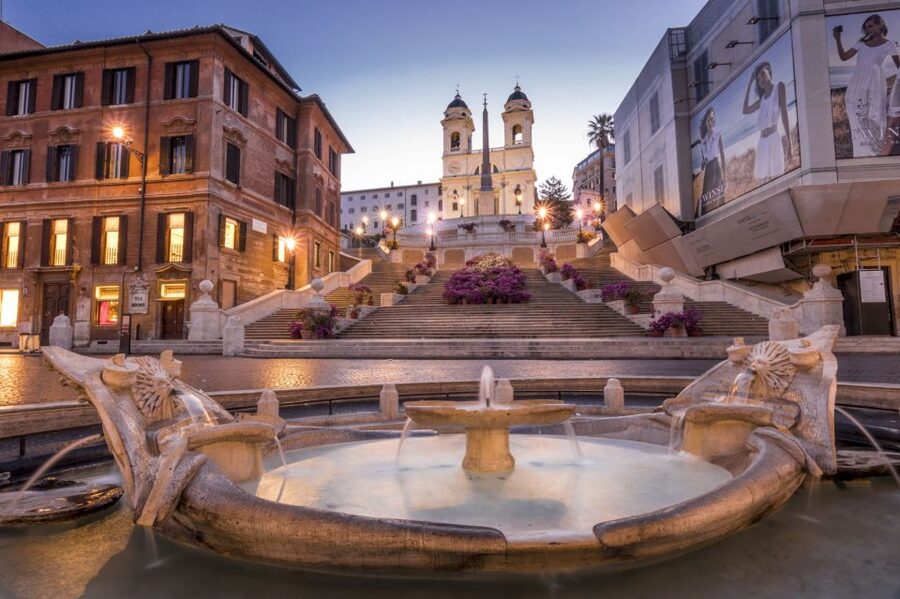
From the Pincio area, the walk continues to Piazza di Spagna and the Spanish Steps. The steps are one of Rome’s best-known meeting places, but their appeal is not only photographic. They connect different levels of the city and create a dramatic stage around Pietro and Gian Lorenzo Bernini’s Barcaccia Fountain.
The fountain sits at the foot of the steps in the shape of a half-sunken boat. A guide can help you notice details that are easy to miss when the square is full of people. The setting also shows how Rome’s art is often built into everyday public space. You are not looking at a sculpture behind glass. You are standing beside one as people pass on their way through the city.
The tour does not promise time to climb and linger at every point. If the Spanish Steps are high on your list, make a note to return later. The value here is seeing them as part of a connected route rather than treating them as an isolated stop.
More Walking Tours in Rome
- Rome: Trastevere & Campo de Fiori Street Food Walking Tour
★ 4.9 · 2,768 reviews - Rome: Paranormal Night Walking Tour & Secret Backstreets
★ 4.9 · 1,921 reviews - Rome by Night Walking Tour – Legends & Criminal Stories
★ 4.5 · 1,003 reviews - Best of Rome Walking Tour including Trevi Fountain
★ 4.5 · 923 reviews
Trevi Fountain and the coin tradition
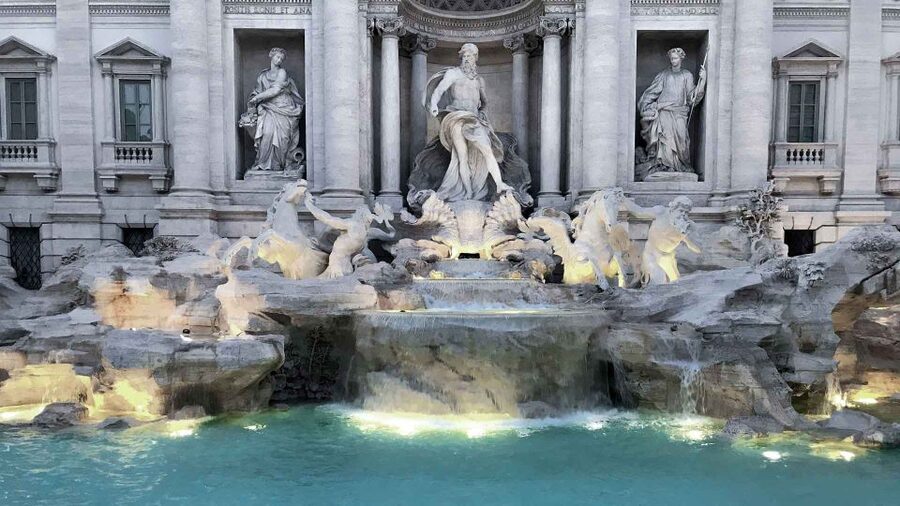
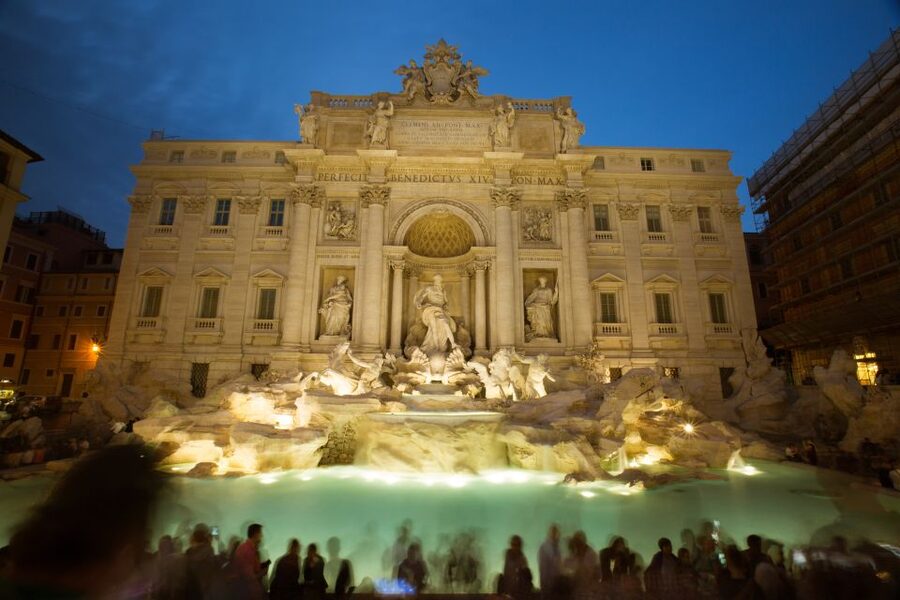
The Trevi Fountain is the grandest fountain on this walk and one of Rome’s most memorable sights. It is the city’s largest Baroque fountain, with water, stone, movement, and theatrical scale crowded into a single urban setting.
Your guide explains the familiar coin custom: toss a coin over your left shoulder into the fountain and, according to the legend, you will return to Rome. It is a small ritual, but it gives the stop a playful human touch after the heavier art and history.
The fountain can be crowded, even in the evening. Your guide can help you understand the design and story, but do not expect a quiet, private viewing. Keep your belongings secure and be patient when moving toward a good sightline. The group may need to keep moving so the three-hour route stays on schedule.
The Trevi stop shows the strength and limitation of this tour. You get the context and the essential view, but not the slow, unhurried experience you might want if fountains are your main interest. Put it on your return list if you would like to come back for photographs or a longer look.
The Pantheon from Piazza della Rotonda
Next comes Piazza della Rotonda and the exterior of the Pantheon. Built in 27 B.C. and later converted into a church dedicated to Mary and the martyrs, the building connects ancient Roman engineering with centuries of Christian use.
The walk focuses on the outside, so this tour does not replace an interior visit. That matters because the Pantheon’s interior is a major part of its appeal. Still, seeing the huge portico and ancient structure in the square gives you a valuable first look, especially if you plan to return during opening hours.
The guide can also explain the building’s later role as a church and its connection with Renaissance artists. Raffaello is buried there, adding another layer to a monument already carrying an extraordinary span of time.
Piazza della Rotonda is also a pleasant place to understand how Rome works as a city. A major ancient building is not separated from daily life by a large park or museum boundary. It faces a public square where people eat, walk, meet, and pass through.
Piazza Navona and Bernini’s Four Rivers Fountain
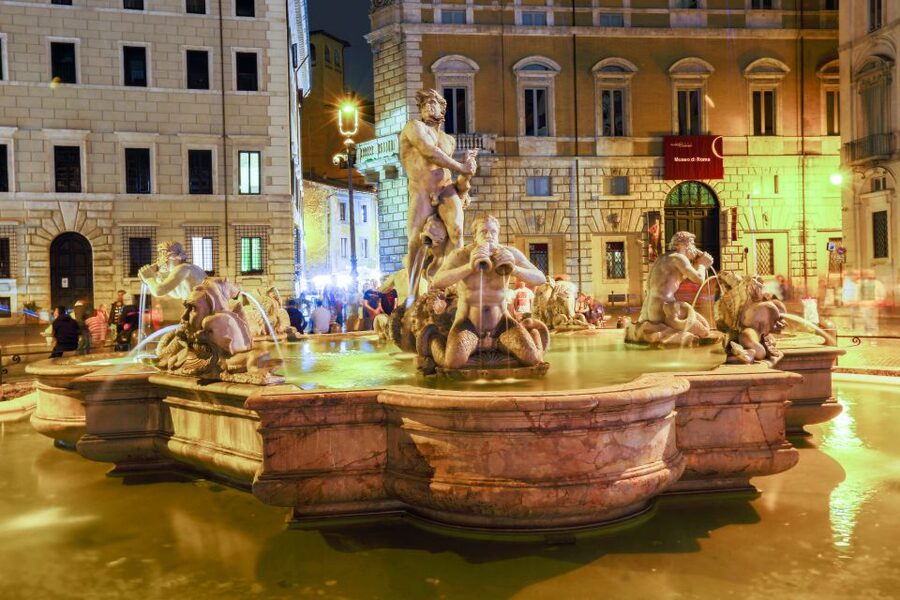
Piazza Navona is one of the richest stops for art and architecture on the route. The square follows the shape of an ancient stadium, and its long form makes it feel different from the more formal Piazza del Popolo or the compact space around Trevi Fountain.
At its center is Bernini’s Four Rivers Fountain. The sculpture represents four great rivers, and your guide can help you read the figures, animals, rocks, and obelisk as a single Baroque composition. This is where a live explanation earns its keep. Without context, the fountain can seem like a mass of stone. With the story, you begin to see the competition, drama, and visual tricks built into it.
The square also includes Sant’Agnese in Agone, associated with Borromini, Palazzo Pamphili, the Neptune Fountain at the northern end, and the Moor Fountain at the southern end. You will see several major works in a short stretch, which makes Piazza Navona one of the most rewarding parts of the walk.
Again, pace matters. You are covering a lot of ground, and the guide must balance explanation with movement. If you love Baroque art, note the details you want to study later. The tour gives you a strong introduction, but it cannot give every fountain and church the attention of a dedicated art walk.
Finishing at Campo de’ Fiori
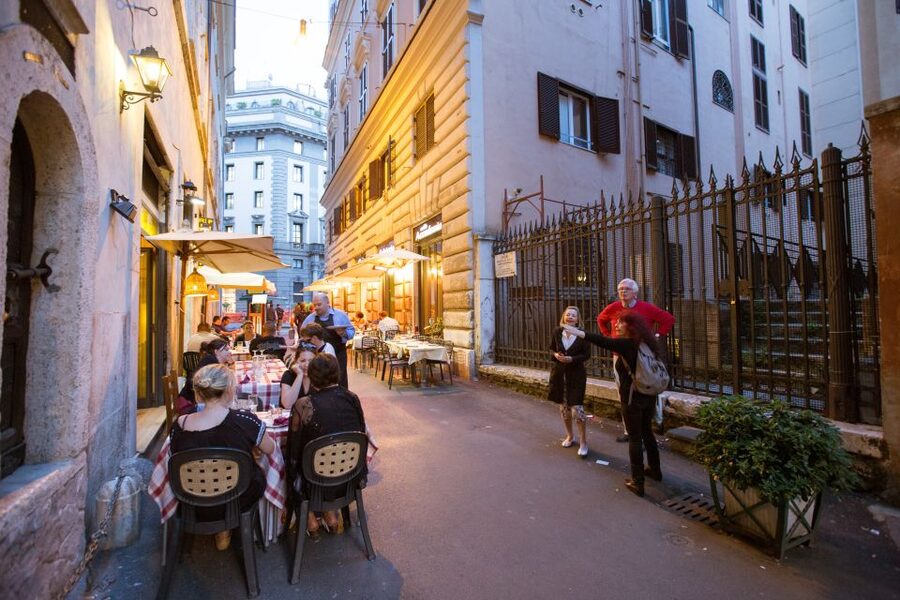
The route ends at Campo de’ Fiori, a useful place to finish because the square changes character after dark. In the morning, it is known for its market. At night, it becomes a center for eating, drinking, and nightlife.
The square also has a more somber past. It was once used for races and executions, and the statue of Giordano Bruno in the center recalls that history. This contrast is very Roman: a social square filled with evening activity that also carries memories of public punishment and religious conflict.
You are not returned to your hotel, and there is no hotel pickup or drop-off. That is worth planning for, but the final location is practical. You can ask your guide for restaurant ideas, and several guides have offered food suggestions during the walk. One particularly useful local recommendation was suppli, the fried Roman rice snack.
The end point also lets you decide how to use the rest of the night. You can eat nearby, continue walking, or return to one of the earlier sights. Since the tour covers several famous areas, you should finish with a short list of places you want to see again at your own pace.
The guides make the difference
The route is strong, but the guide is what turns it from a checklist into a real introduction to Rome. The best feedback centers on guides who explain history, religion, architecture, and art in a way that stays lively rather than sounding like a lecture.
Andrada receives repeated praise for clear communication, enthusiasm, and an ability to make a complicated Roman story easy to follow. Carolina is also described as engaging and well informed, while Marzia brought an archaeological background and offered practical suggestions for later visits. Ava, Ghil, Juliano, and Elida are also singled out for humor, warmth, strong storytelling, or detailed answers.
You should not assume you will receive a particular guide. But the pattern is encouraging: the experience depends heavily on live interpretation, and the guide team has a record of making the material accessible. Guides have answered questions outside the immediate stop, helped groups keep together, and adjusted their pace when needed.
Headsets are provided when necessary. That can help in noisy squares, though you should still stay close to the guide and keep track of the group. Rome’s central streets are busy, and it is easy to pause for a photograph while everyone else moves ahead.
Walking pace, comfort, and who should book
Plan on walking for nearly the full three hours. One detailed account describes a fast-paced route with no real break, while other experiences describe the pace as comfortable or gentle. The difference may depend on the guide, the group, and the evening conditions, so prepare for steady movement rather than a relaxed stroll.
Wear comfortable shoes and light clothing, especially in warm months. The opening climb to Pincio Terrace is the only specific hill mentioned, but Rome’s historic center has uneven surfaces and frequent steps. The tour is not suitable for wheelchair users.
This format suits first-time visitors, couples, solo visitors who want company, and families with older children who can manage the distance. Children aged five and younger join free, but the adult who brings them should think carefully about the late timing and sustained walking.
It is also useful if you arrive in Rome in the afternoon. Instead of spending your first evening trying to choose among dozens of sights, you get a guided orientation and a clear sense of what to revisit. If you have limited time, the route covers a great deal efficiently.
I would choose something else if you want interior visits, a slow photography walk, or detailed time at one monument. This is a city overview with expert commentary, not a series of extended site visits.
Is $46 a fair price?
At $46 per person, the tour sits in a reasonable range for a three-hour guided walk in a major European capital. You are not paying for attraction admission, transportation, food, or hotel service. You are paying for an English-speaking professional, a planned route, and the explanations that connect the sights.
The value is strongest if you are new to Rome. The guide saves you from piecing together the route yourself and gives you background that a quick look at each monument cannot provide. You also see several major sights in one evening, which can help you plan the rest of your stay.
The price is less attractive if you already know central Rome well or prefer exploring independently. You can visit these public squares without a ticket, and the walk does not include entry to the Pantheon or any other interior. In that case, the guide’s stories and the convenience of the route need to matter to you.
Free cancellation up to 24 hours before the tour and the option to reserve now and pay later reduce the risk of booking. Check the available start times, since the exact sunset experience depends on the date and departure.
Should you book this Rome evening walk?
Book it if you want a lively first look at Rome, enjoy learning as you walk, and can handle three hours on your feet. The sunset from Pincio Terrace, the fountains, and the final stop at Campo de’ Fiori give the route a good rhythm, while the guides add the history and practical tips that make the city easier to understand.
I would especially recommend it for your first or second night. You will see enough to get oriented, learn which squares deserve another visit, and avoid wasting your best sightseeing hours in the hottest part of the day.
Skip it if you need wheelchair access, dislike group walking, or want to enter and study each monument. For most first-time visitors who want Rome’s grand public spaces, good stories, and a cooler evening setting, $46 is a sensible way to begin.
FAQ
How long is the Rome evening walking tour?
The tour lasts three hours.
What sights are included?
The route includes Piazza del Popolo, Pincio Terrace, the Spanish Steps, Bernini’s Barcaccia Fountain, Trevi Fountain, Piazza della Rotonda, the exterior of the Pantheon, Piazza Navona, Bernini’s Four Rivers Fountain, and Campo de’ Fiori.
Where does the tour meet?
Meet in Piazza del Popolo, in front of Santa Maria del Popolo Church. Look for a guide holding a Rome Your Way sign. The church is next to the Leonardo da Vinci Museum.
Where does the tour end?
The walk ends at Campo de’ Fiori.
Is the tour conducted in English?
Yes. The live guide language is English.
Is hotel pickup or drop-off included?
No. You must make your own way to Piazza del Popolo and arrange your own return from Campo de’ Fiori.
Is the tour suitable for wheelchair users?
No. The activity is not suitable for wheelchair users.
Do young children need a ticket?
Children aged five and younger go free.
More Evening Experiences in Rome
- Rome: City Highlights Open-Top Bus Night Tour
★ 4.1 · 2,038 reviews - Vespa Sidecar Tour By Night with Pickup
★ 5.0 · 1,803 reviews - Rome by Night – Ebike Small Group Tour – Food and Wine (Option)
★ 5.0 · 1,275 reviews - Colosseum Sunset Tour with Entry
★ 4.5 · 1,230 reviews
Fresh on the Rome list
- Exclusive Golf Tour Private VIP with Local & Gelato o Wine★ 5.0 · 500 reviews
- Colosseum, Palatine Hill and Roman Forum with Guided Tour★ 5.0 · 500 reviews
- Rome Trastevere Pasta Making Class with Eating Europe★ 5.0 · 505 reviews
- Rome by Night Walking Tour★ 4.5 · 506 reviews
- Rome: Colosseum Express Tour with Forum & Palatine Access★ 4.5 · 511 reviews
- Rome Food Experience Max 6 People Group Tour | w/Private Option★ 5.0 · 516 reviews
- Rome: Navona Square Underground Ticket with Audio Guide★ 4.0 · 518 reviews
- Rome: Escorted Papal Audience Experience with Entry Ticket★ 4.4 · 518 reviews
Walking Tours, compared.
Guided Walking Tour & Last Supper Visit with Ticket
Read our review →
Rialto Bridge & Offbeat Unusual Venice Walking Tour
Read our review →
Private 3 hrs Venice Tour: St Mark’s, Walking tour & Boat tour
Read our review →
Skip the line: Uffizi and Accademia Small Group Walking Tour
Read our review →Browse the lists this tour appears in