
Reviewed · POMPEII & VESUVIUS TOURS
Pompeii: Exclusive Tour with Archaeologist and Entry Tickets
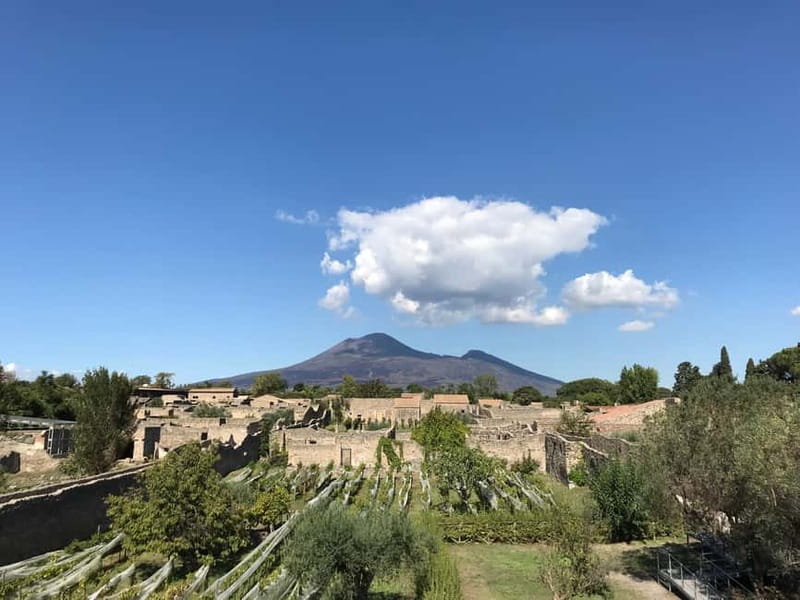
Pompeii is not a museum you simply look at. It is a whole Roman city under your feet, with streets, bakeries, election notices, fountains, houses, temples, and theatres laid out much as they were before Vesuvius erupted in 79 AD. I like that this tour puts an archaeologist-led explanation at the center, so the ruins become a lived-in town rather than a pile of old stones.
I also like the small-group format and included entry ticket, which save time at the gate and make it easier to hear your guide through the supplied headset. The two-hour route gives you a useful first look at the main districts, though Pompeii is enormous, so you will need extra time afterward if you want to explore at a slower pace.
Key points at a glance
- Meet beside the train station: The guide meets you outside the Porta Marina entrance, directly in front of Pompei Scavi, Villa dei Misteri station.
- See the civic heart first: The Forum, Basilica, temples, market, and baths explain how Pompeii worked as a Roman town.
- Look inside famous houses: The House of the Tragic Poet, House of the Vettii, and House of the Faun reveal Pompeii’s art, wealth, and social life.
- Finish with daily life and theatre: The Lupanare, taverns, bakeries, and Large Theatre add the human details often missed on a quick visit.
- Choose your group style: You can book a shared small group or select a private option.
- Plan for walking: Comfortable shoes, water, and an official photo ID are important, and the route is not suitable for wheelchair users or people with mobility impairments.
Why an archaeologist changes the Pompeii experience
Pompeii is famous enough that many people arrive with a few loose images in mind: a volcano, plaster casts, bright wall paintings, and a Roman street disappearing into the distance. The challenge is scale. The site is so broad that you can spend hours walking past important buildings without understanding what you are seeing.
That is where this tour earns its keep. A licensed archaeologist gives you a clear route and explains how the parts fit together. You learn not only what a building was called, but how it functioned in Pompeian life, who used it, and what the excavations can and cannot tell us.
Guides named Ricardo, Antonio, Livio, Raffaele, Rafael, Monica, Loredana, Pierluigi, and Ivan have led this experience at different times. The strongest pattern in the feedback is their ability to explain serious material in a warm, lively way. Several guides were praised for answering questions, adjusting the pace, allowing photo stops, and keeping children and teenagers involved.
I would especially value the archaeologist background if you have never visited Pompeii. It gives you a framework for the rest of the day. After the group tour ends, your guide points out what deserves a closer look, so you can continue on your own instead of wandering without a plan.
A few other Pompeii mornings to weigh against this
- Pompeii: Entry Ticket and Guided Tour with an Archaeologist
★ 4.8 · 19,459 reviews - Pompeii: Entry Ticket with Optional Audio Guide
★ 4.2 · 12,360 reviews - Pompeii: Small Group Tour with an Archaeologist
★ 4.8 · 12,264 reviews
Meeting at Porta Marina, beside Pompeii Scavi station
The meeting point is practical, but you need to get it right. Meet outside Pompeii’s Porta Marina entrance, directly in front of the Pompei Scavi, Villa dei Misteri station on the Circumvesuviana railway. Your guide holds a sign marked Pompei VIP.
Pompeii has more than one train station, so check the station name before setting out. One booking party nearly arrived late after confusing the stations, although the local team responded quickly and helped them find the meeting point.
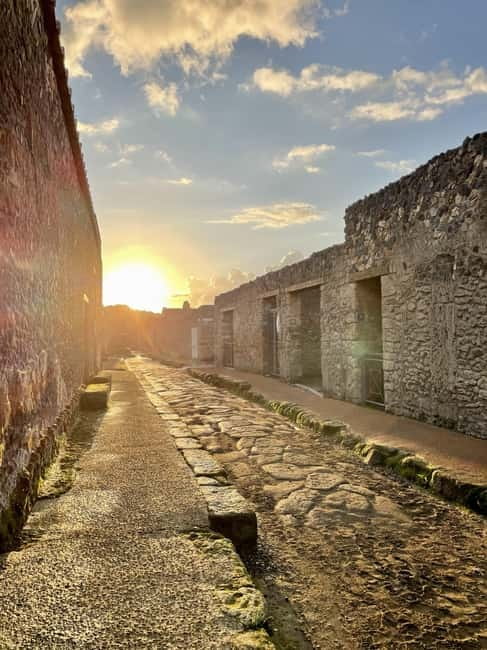
Porta Marina is one of the original entrances to the ancient city. It is a fitting start because you enter through the same general gateway used by people arriving for trade, business, worship, and public life. Once inside, you are walking on ancient paving stones, not viewing a reconstructed park.
The tour ends back at the ruins or at Piazza Esedra, depending on the arrangement. Transportation is not included, so plan your own route to and from Pompeii.
The Forum and Basilica: Pompeii’s public center
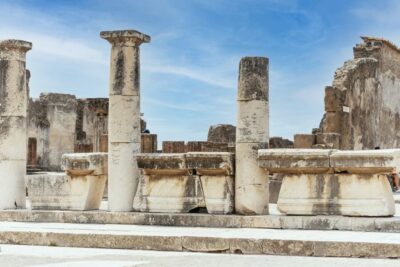
The first major stretch takes you toward the Basilica and the Foro Civile di Pompei, better known as the Roman Forum. This broad public space was the town’s civic and commercial center. It is also one of the best places to understand Pompeii’s scale, since the surrounding temples and government buildings frame the open square.
The Basilica was used for public business and legal matters. Your guide can help you read the remains as a working building rather than a set of columns. The Forum itself brings together religion, politics, commerce, and ceremony in one place.
This is a strong opening because it establishes the city’s structure. I like seeing the public center before the private homes. It helps you understand that Pompeii was not frozen as a quaint village. It was an active Roman town with local power, trade, religious duties, and social rank.
The drawback is that the Forum is exposed. On a hot day, there is little shade, and on a wet day, the broad paving can feel harsh. Bring water and wear shoes with a firm sole.
Temples of Jupiter and Apollo
The Temple of Jupiter and Temple of Apollo show the religious side of Pompeii. These were not isolated monuments placed for modern visitors. They were part of the city’s daily rhythm, tied to public ritual, identity, and the wider Roman world.
The Temple of Apollo is particularly useful for seeing how different cultural influences met in Pompeii. The city had roots that reached back before Roman rule, and its religious spaces reflect changes over time. A guide with archaeological training can point out layers of use and help separate solid evidence from easy assumptions.
The Temple of Jupiter also helps explain the Forum’s layout. From here, the relationship between sacred buildings and public space becomes easier to grasp.
You will not spend a long time at each temple, and that is sensible in a two-hour tour. Still, if you have a strong interest in ancient religion, architecture, or Roman urban planning, note the locations so you can return later.
Same city, an entirely different afternoon:
- Pompeii Small Group Tour with an Archaeologist
★ 5.0 · 6,593 reviews - Pompeii: Skip-the-Line Entrance Ticket with Audio Guide
★ 4.0 · 2,509 reviews - Naples: Pompeii and Mt. Vesuvius with Lunch and Wine Tasting
★ 4.5 · 2,454 reviews - Pompeii: Archaeological Park Tour with Ticket on request
★ 4.5 · 2,283 reviews
Forum Baths and the Macellum market
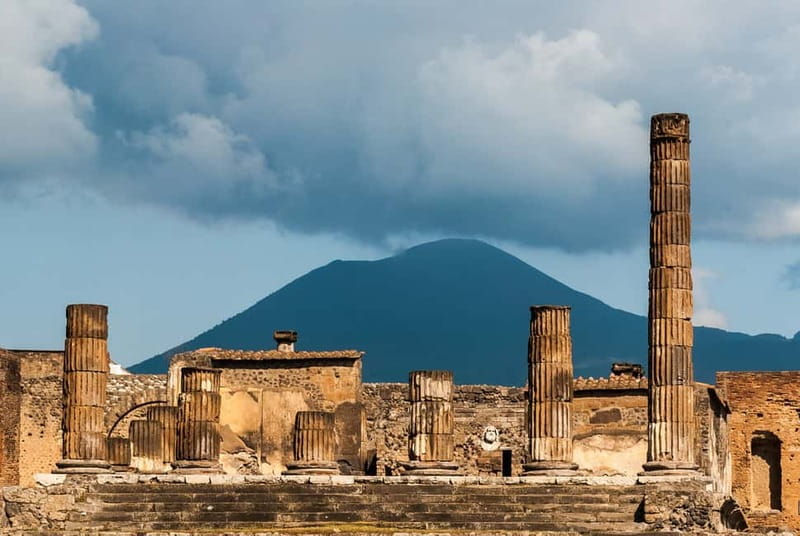
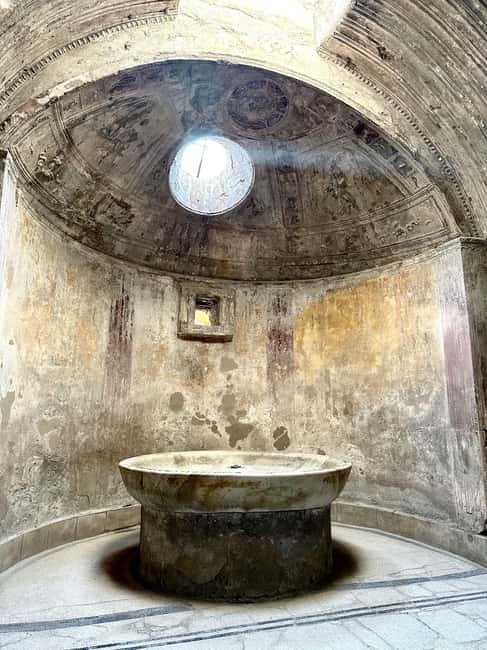
The Forum Baths offer a close look at Roman comfort and engineering. Bathing was a social habit as much as a practical one, and these remains show how public amenities were built into town life.
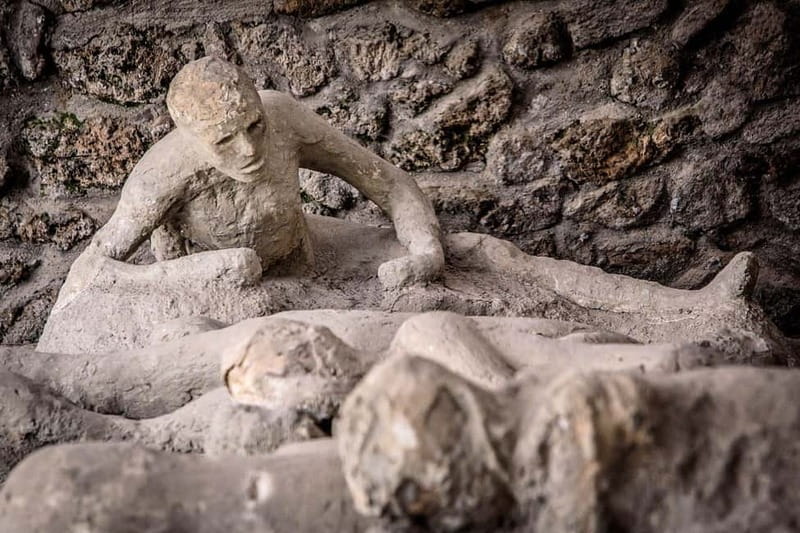
The Macellum was the city market. This is also where the tour includes the plaster casts associated with eruption victims. They are among Pompeii’s most haunting sights because they make the disaster personal. The casts do not show a theatrical scene. They show the final positions of people caught by the eruption, preserving a physical record of fear, surprise, and helplessness.
Your guide’s handling of this section matters. The best approach is factual and respectful, without turning human suffering into a spectacle. You will also hear about the eruption and the continuing work of excavation, including how archaeologists examine the site and interpret what remains.
The market area adds an important balance. Pompeii is not only about death. It was also a place where food was sold, business was done, and people met one another.
The House of the Tragic Poet and Roman private life
The House of the Tragic Poet introduces the private side of Pompeii. Its name comes from a famous mosaic associated with the house, and the building helps show how Roman homes were arranged around decorative and social spaces.
At Pompeii, painted walls and floor mosaics are not minor decoration. They signal taste, money, education, and status. A good guide explains how a home’s rooms worked and why certain images mattered to its owner.
You might find some houses closed or subject to changing access, since archaeological preservation and site management can affect what is open. The route includes the House of the Tragic Poet, House of the Vettii, and House of the Faun, but exact access can change on the day.
The House of the Vettii and House of the Faun
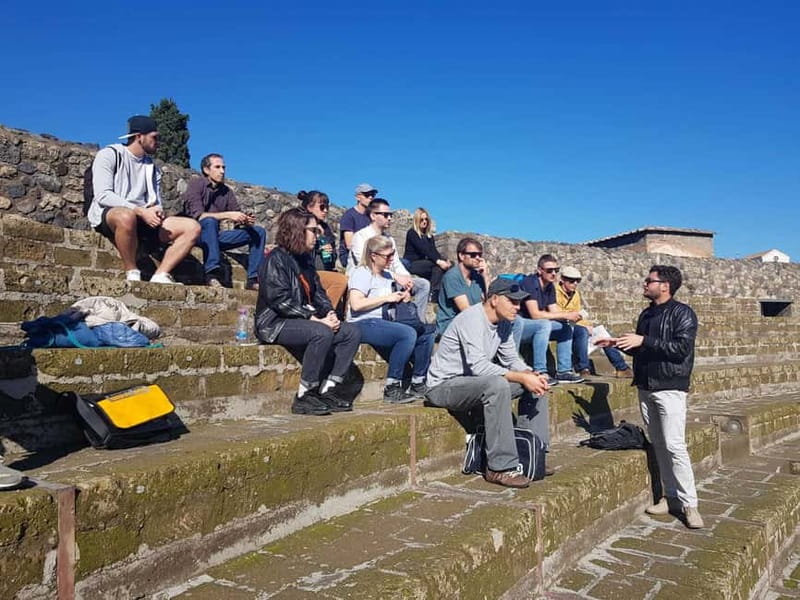
The House of the Vettii is one of the most rewarding stops for anyone interested in Roman domestic life. Its wall paintings and rooms offer a glimpse into the wealth of Pompeii’s elite, while the layout raises questions about family, servants, clients, and social display.
The House of the Faun is larger and more imposing. Its name comes from the faun statue in the entrance area, and it is associated with some of Pompeii’s finest mosaics. The scale alone tells you that this was a home built to impress.
These houses are where an archaeologist guide can add real value. I want someone to point out what I would miss on my own: the angle of a room, the purpose of a courtyard, the meaning of a mosaic, or the way a house opened toward the street.
The pace can feel brisk here. Two hours is enough for an introduction, not a full study of each room. If art is your main reason for visiting, ask your guide which houses or painted rooms to revisit after the tour.
The Lupanare, taverns, and ancient bakeries
The Lupanare is one of Pompeii’s best-known buildings, and it offers a frank look at commercial sex in the Roman city. Its small rooms and surviving imagery are direct, sometimes startling, and useful for understanding how Pompeii’s private and public lives overlapped.
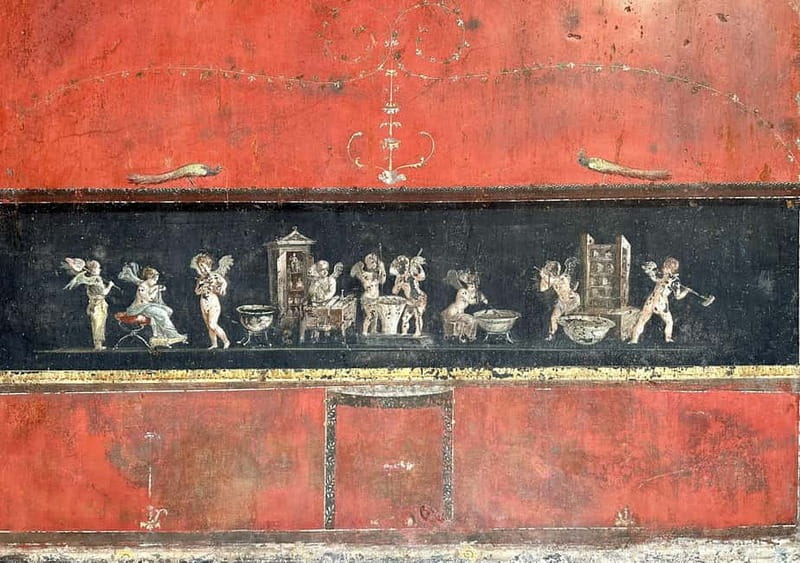
The tour also includes Thermopolium taverns and ancient bakeries. These places make the city feel especially close. A thermopolium was a food counter where people could buy prepared meals or drinks, while bakeries reveal the practical work behind everyday food.
I like this part because it moves away from grand temples and wealthy homes. You get a sense of ordinary errands, quick meals, shop work, and street activity. Pompeii becomes less like a collection of monuments and more like a town where people had to eat, sell, negotiate, relax, and earn a living.
Some stops may be crowded, and the Lupanare is not suited to every family or every child. If you are visiting with young children, decide in advance how you want to handle this section.
The Theatre District and the end of the route
The Large Theatre closes the main route with a look at entertainment and public gathering. Theatre was part of Roman social life, and the building’s shape helps you picture how audiences assembled for performances and civic events.
This final stop also gives the tour a change of mood after the plaster casts and domestic interiors. You have seen government, worship, markets, homes, sex work, food, and bathing. The theatre adds leisure and spectacle to the picture.
The group usually finishes at the ruins or Piazza Esedra. From there, you can leave or continue exploring independently. I recommend keeping the rest of the day open if possible. One visitor stayed through the entire day, and that is a sensible plan in cooler weather. Even after a well-planned tour, Pompeii still has more streets and buildings than you can cover in two hours.
How much value do you get for $50?
At $50 per person, this tour is not the cheapest way into Pompeii. It is a good value if you want an expert to handle the route, explain the major buildings, provide the admission ticket, and help you make sense of a huge archaeological park.
The ticket and skip-the-line access matter most when Pompeii is busy. You are not paying only for entry. You are paying for a focused introduction that helps you use the rest of your time well.
The private option changes the value calculation. It costs more than joining a shared group, but it may suit families, couples, or groups with very specific interests. The shared small group is the better budget choice, especially if you want guidance but do not need a fully personal route.
Two hours is both a strength and a limit. It keeps the visit manageable in heat or with children, and several guides have been praised for a clear pace that leaves room for photos. But Pompeii cannot be covered fully in that time. Think of this as a guided foundation, not the complete visit.
Who should book this Pompeii tour?
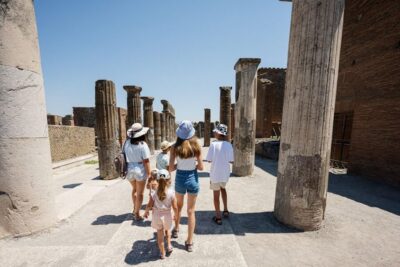
I would choose this tour if you are visiting Pompeii for the first time, arriving by train, or working with a tight schedule. It is also a smart choice for families and teenagers because the guide turns a long list of ruins into stories about people and daily routines.
History lovers will appreciate the archaeological perspective, especially the explanations of excavation methods, local life, language, trade, and the eruption. Guides have been praised for bringing in Latin and Greek word origins, discussing ongoing archaeological work, and answering detailed questions without losing the group.
You should think twice if you want to wander alone for a full day or photograph every fresco at your own speed. The group route has a set pace, and the site is not suitable for wheelchair users or people with mobility impairments.
Wear comfortable shoes and carry water. Swimwear, alcohol, drugs, pets, and electric wheelchairs are not allowed. You must send the full names and ages of all participants in advance through the booking message system, and each person, including children, should carry a passport or official ID. A photo of the document is accepted according to the tour information.
The tour is offered in English, Italian, French, and Spanish. You can cancel up to 24 hours before the start for a full refund, and the reserve-now, pay-later option helps if your Campania plans are still shifting.
Should you book it?
Book this Pompeii tour if you want the site to make sense quickly. The strongest reason is not simply skip-the-line entry. It is the combination of a licensed archaeologist, a sensible route, a listening headset, and enough context to notice details you could easily miss.
I would be especially happy with guides such as Ricardo, Antonio, Livio, Raffaele, or Ivan, all of whom have been praised for warmth, clear explanations, humor, and strong command of Pompeii’s past. Guide assignments can vary, so book for the structure and expertise rather than a guaranteed individual.
At $50, it is a fair choice for a first visit and an excellent starting point for a longer day at the ruins. If you have only two hours, book it without hesitation. If you have all day and prefer complete independence, enter on your own, but consider taking the guided route first so you know what deserves your time.
FAQ
Where does the Pompeii tour meet?
The meeting point is outside the Porta Marina entrance, directly in front of the Pompei Scavi, Villa dei Misteri Circumvesuviana train station. The guide holds a sign marked Pompei VIP.
How long does the guided visit last?
The guided tour lasts two hours. Starting times vary, so you need to check availability for the date you want.
Is the Pompeii entry ticket included?
Yes. Skip-the-line entry tickets and Pompeii admission Express tickets are included.
Is this a shared or private tour?
You can choose a shared small-group experience or select a private booking.
Which languages are available?
The tour is offered in English, Italian, French, and Spanish.
What identification do I need?
You must provide the full name and age of every participant before the tour. Each adult and child should bring a passport or official ID, and a photo of the document is accepted.
Is the tour suitable for wheelchair users?
No. The experience is not suitable for wheelchair users or people with mobility impairments.
Fresh on the Pompeii list
- Explore Pompeii with an Archaeologist★ 5.0 · 511 reviews
- Pompeii Skip-the-line Tour with Archaeologist Guide★ 5.0 · 559 reviews
- Pompeii Private Tour with an Archaeologist and Skip The Line – 3 hours★ 5.0 · 564 reviews
- Ercolano: Herculaneum Entry Ticket with Optional Audio Guide★ 4.1 · 581 reviews
- Pompeii private tour with an Official Guide★ 5.0 · 631 reviews
- Pompeii Ticket + Tour with Optional Tasting Experience at Pompeii★ 5.0 · 663 reviews
- From Naples: All-Inclusive Mount Vesuvius Half-Day Tour★ 4.2 · 674 reviews
- From Pompeii: Bus Transfer to Vesuvius with Park Entry Fee★ 4.2 · 700 reviews
Pompeii & Vesuvius Tours, compared.
Entry Ticket and Guided Tour with an Archaeologist
Read our review →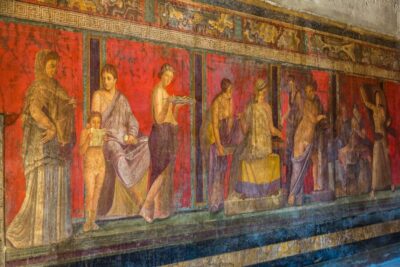

Pompeii Small Group Tour with an Archaeologist
Read our review →
Pompeii, Amalfi Coast and Positano Day Trip from Rome
Read our review →Browse the lists this tour appears in