
Reviewed · POMPEII & VESUVIUS TOURS
Pompeii: Guided Walking Tour with Entrance Ticket
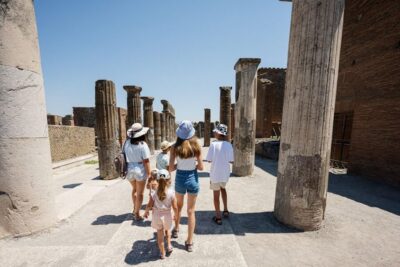
Pompeii is not just a collection of broken columns. It is a buried Roman town with streets, shops, baths, public squares, homes, painted walls, and reminders of ordinary life. This two-hour guided walk gives you a useful route through that vast site without asking you to decode every ruin on your own.
I like the included €20 entrance ticket, which makes the $50 price easier to judge, and I like the headsets that let you hear the guide while standing several steps away. The main drawback is the meeting-point confusion and occasional late start. A few groups waited 30 to 45 minutes, so do not plan a tight train connection afterward.
Key points to know before you book
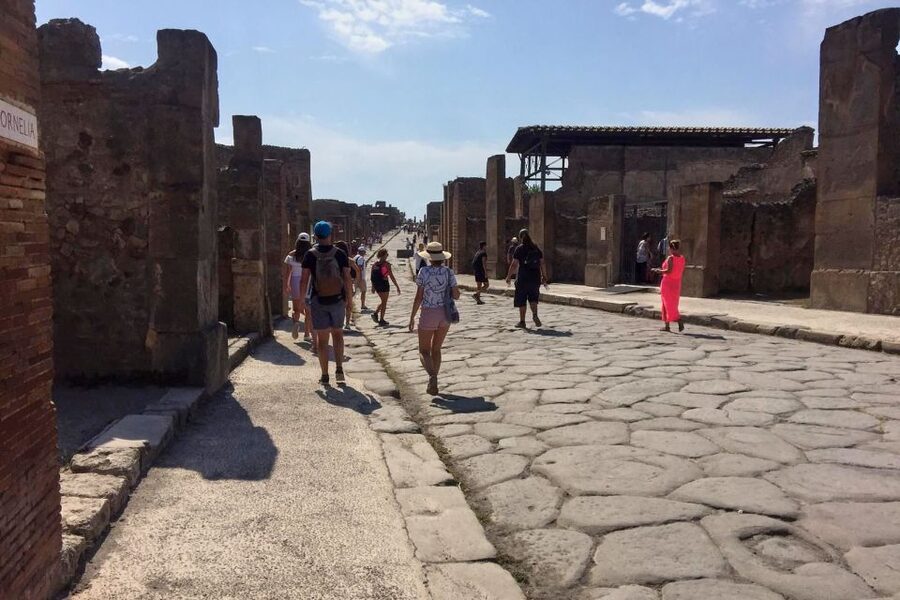
- See Pompeii’s essential public buildings: The route includes the Forum, Thermal Baths, and Lupanare, along with streets, houses, and old shops.
- Learn how the town worked: Guides explain Roman daily life, social customs, commerce, and what happened when Vesuvius erupted in 79 A.D.
- The ticket is included: The €20 Pompeii Archaeological Site entry fee is part of the $50 tour price.
- Headsets help in a crowded ruin: You can hear the guide clearly while walking or taking photographs.
- Expect a fast introduction, not a full-day visit: Pompeii is enormous, and two hours covers only a portion of it.
- Allow extra time at the meeting point: Meet at 10:50 a.m. in the garden of Hotel Vittoria, outside the Cellini coral shop on Via Mare.
Why a guide changes the Pompeii visit
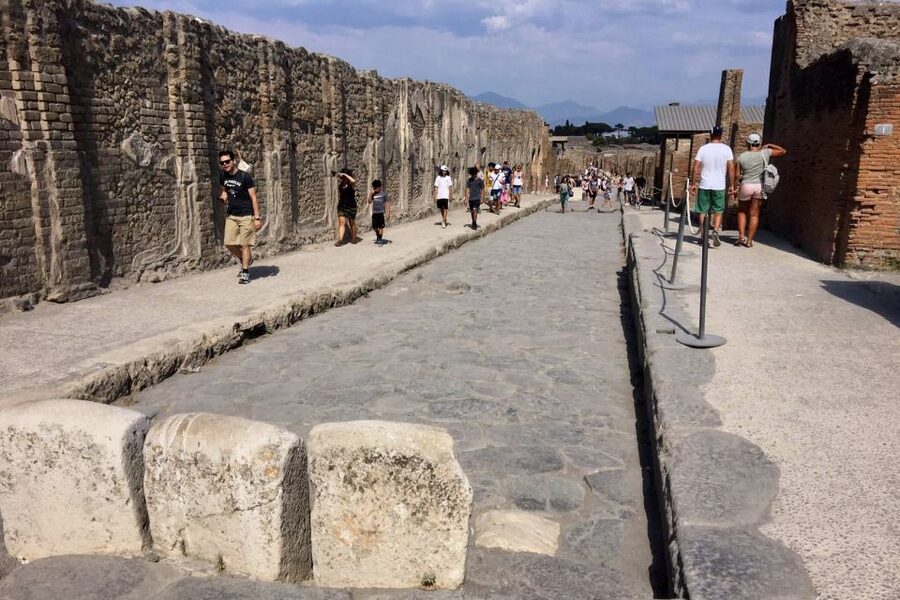
Pompeii can look easy at first. You see a paved street, a wall, perhaps a row of columns, and then another paved street. Without context, it is easy to walk past the most important details.
A good guide turns those fragments into a town. You begin to notice raised sidewalks, shop openings, public buildings, baths, painted decoration, and the way homes faced the street. The guide also helps explain the difference between private domestic life and the grand civic spaces built for the wider community.
That matters at Pompeii because the site is large and only part of the ancient town is open or excavated at any given time. The tour does not attempt to show you everything. Instead, it gives you a structured introduction, moving between public buildings and more personal places so the ruins feel connected.
The best guides use stories and humor to keep the two hours moving. Elisa, Salvatore, Francesca, Maria, Miguel, Imma, Mattia, and others have been praised for making the subject lively and easy to follow. Some guides focus more on jokes and storytelling, while others take a more academic approach. If you want a detailed archaeological lecture, this may feel light. If you want a clear, human introduction, it fits well.
A few other Pompeii mornings to weigh against this
- Pompeii: Entry Ticket and Guided Tour with an Archaeologist
★ 4.8 · 19,459 reviews - Pompeii: Entry Ticket with Optional Audio Guide
★ 4.2 · 12,360 reviews - Pompeii: Small Group Tour with an Archaeologist
★ 4.8 · 12,264 reviews
Meeting at Hotel Vittoria in Pompeii
The stated meeting point is at 10:50 a.m. in the garden of Hotel Vittoria, just outside the Cellini coral shop at Via Mare, 80045 Pompei. The guide should have a sign with the customer name.
The location is close to the Pompeii Scavi area, and some people find it easy to reach from the station. Still, the entrance zone can be confusing, especially when several tour operators and groups gather nearby. One practical problem is that the guide or representative may not always be easy to spot.
I would arrive early and keep your phone available. The company has contacted late arrivals, sent directions through WhatsApp, and even had a representative search the area by calling out a guest’s surname. That help can save the morning, but it is better not to depend on a last-minute rescue.
The meeting arrangements have not always run perfectly. Some tours began late because the group was still assembling or because the guide arrived after the scheduled time. Once the walk began, the actual guiding was usually the strong part, but the delay could be uncomfortable in hot weather and awkward if you have a train to catch.
Entering the archaeological area
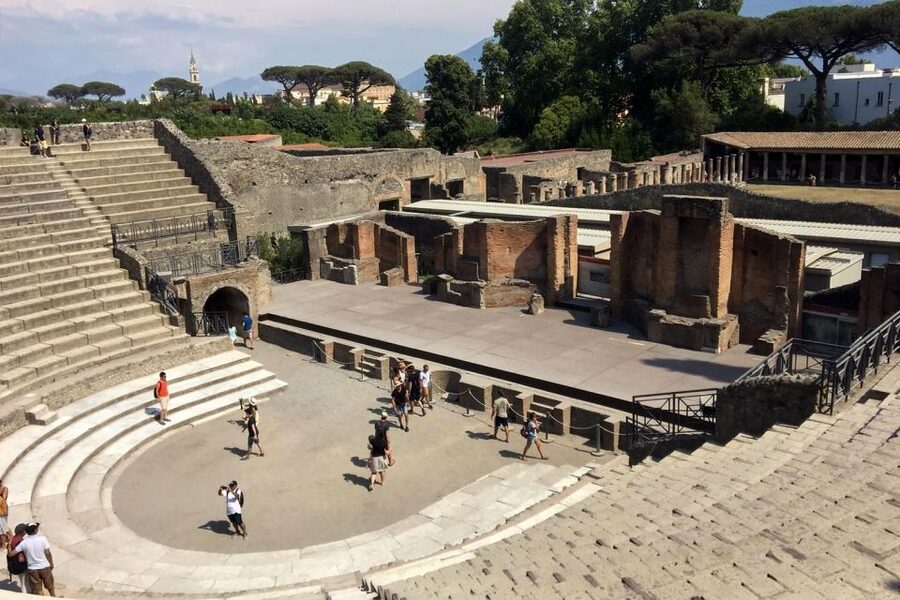
The tour includes entrance to the Pompeii Archaeological Site, with a stated ticket value of €20. You do not need to buy that standard admission separately.
The skip-the-ticket-line benefit is useful during busy periods, when the entrance area can be crowded. It does not mean you can ignore the meeting instructions. You still need to find the group and follow the guide through the entry process.
Child-fare bookings require a valid identification card or passport at the ticket office. Without proof of age, you could be asked to pay the full adult fare. Bring identification for children rather than hoping the rule will be overlooked.
The walking surface is uneven, and the site is exposed to the weather. Comfortable shoes are essential. Dress for sun, heat, rain, or cooler conditions, since the tour operates in all weather.
The Forum: Pompeii’s public heart
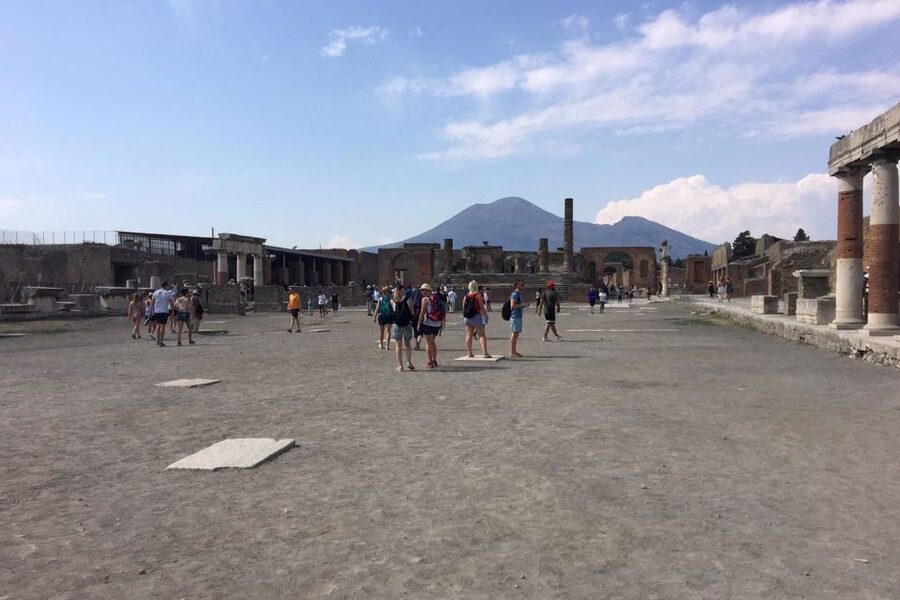
The Forum is one of the most important stops because it shows how Pompeii functioned as a civic town. This was not simply an open plaza for pretty photographs. It was the center of public, political, religious, and commercial activity.
From here, your guide can explain the town’s layout and point out how major public buildings related to one another. The Forum also gives you a useful sense of scale. Pompeii was a functioning city, not an isolated group of villas.
This is the point where a guide is especially helpful. Ruined walls and columns rarely explain their own purpose. A spoken explanation gives you a reason to look up, compare building forms, and imagine how residents used the space before the eruption.
The Forum can also be crowded, so headsets are valuable. You can step aside for a photograph and still follow the commentary. That small piece of equipment has a real effect on the quality of the walk.
More walking tours in Pompeii:
- Milan: Guided Walking Tour & Last Supper Visit with Ticket
★ 4.7 · 5,409 reviews - Naples: Street Food Walking Tour with Local Guide
★ 4.8 · 4,256 reviews - Venice Walking Tour and Gondola Ride
★ 3.5 · 3,630 reviews - Venice: Rialto Bridge & Offbeat Unusual Venice Walking Tour
★ 4.2 · 3,538 reviews
Thermal Baths and the practical side of Roman life

The Thermal Baths show a more everyday side of Pompeii. Roman bathing was not only about washing. It was part of social life, routine, and public culture.
The guide explains how the bathing complex worked and places it within the broader town. You get a better sense of how Romans spent time, used public facilities, and organized buildings around shared needs.
This stop helps balance the grander Forum. Pompeii is moving not only because of its final disaster, but because so much of the town still suggests normal activity. The baths, shops, and streets make the past feel close without requiring you to imagine an entire civilization from a single temple.
The Lupanare and Pompeii’s less polished side
The Lupanare is one of Pompeii’s most discussed buildings. The name is commonly used for a brothel, and the site offers a blunt look at a part of Roman urban life that is often treated too delicately in general museum displays.
Your guide can explain the building and its painted imagery without avoiding the subject. One Spanish-language review specifically praised a guide who explained such matters without taboos. That direct approach suits Pompeii, where public and private life sit side by side.
The Lupanare can draw crowds, and access may feel tight. It is also a stop that some families may want to prepare children for, depending on their age. The tour is not described as unsuitable for children, and one guide was praised for keeping children involved, but the subject matter is adult in nature.
Streets, shops, wine signs, and ordinary homes
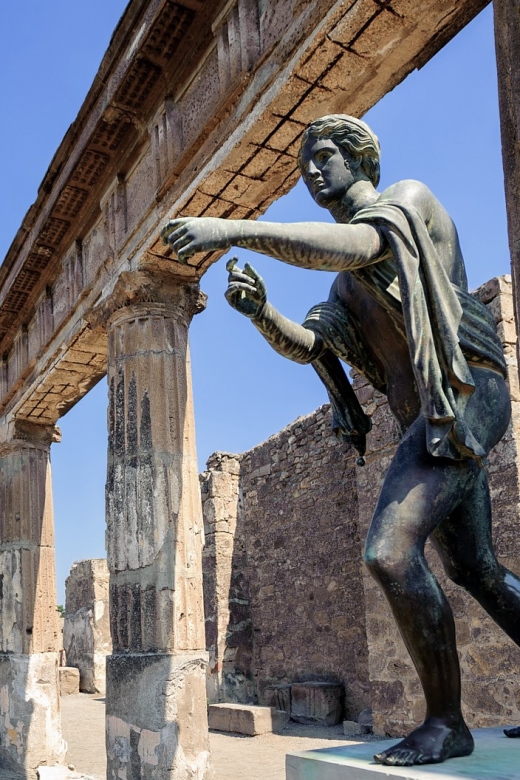
The streets may be the most revealing part of the tour. You can see the basic structure of a Roman town through paving, storefronts, entrances, and the remains of homes.
The route includes shops with signs connected to goods such as wine and produce. These details are small, but they make the town easier to picture. Instead of seeing only official buildings, you see places tied to buying, selling, eating, and moving around.
Domestic spaces also matter. Guides may take you to areas that reveal private life, household design, and the difference between community buildings and family spaces. Pompeii’s appeal comes from this mixture of grand and humble remains.
Do not expect every wall to be covered with objects. Many important artifacts have been moved to museums, including collections in Naples, to help protect them. Even so, the buildings, street plan, mosaics, and surviving artwork give the ruins their force.
What the eruption adds to the experience
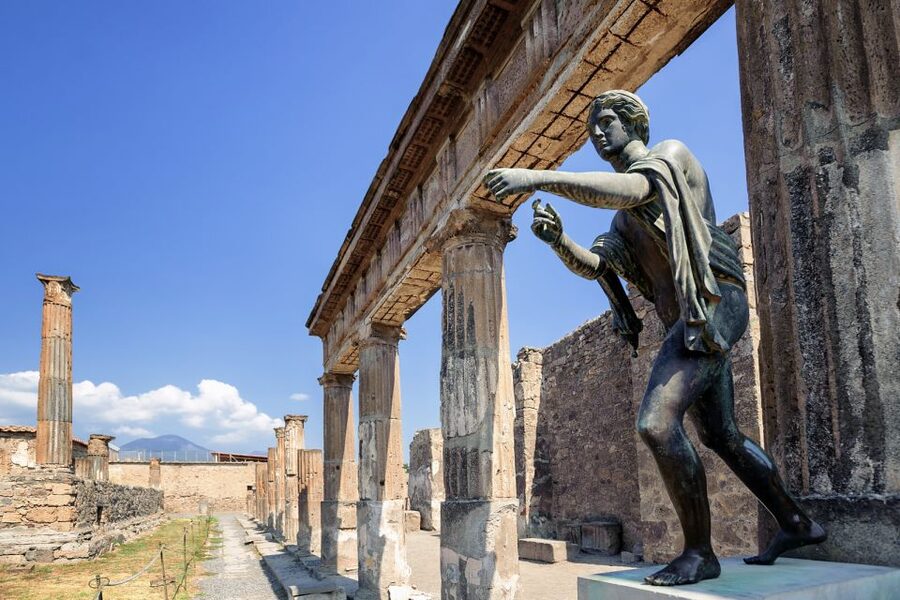
A guide explains what happened in 79 A.D., when Mount Vesuvius erupted and buried Pompeii beneath volcanic ash and rock. The date is familiar, but standing among the streets gives the event a different weight.
The ruins are not frozen in perfect condition. They are damaged, preserved, excavated, and still under care. You may see protected artwork and fragile remains behind glass, while other areas show the effects of centuries underground and years of exposure.
That tension is part of the visit. Pompeii is both a preserved ancient town and an active archaeological site. The excavation is still not finished, and the open area represents only part of the original settlement.
The two-hour route gives you enough background to understand the disaster without turning the entire visit into a lesson about destruction. The stronger guides connect the eruption to the people who lived there, which keeps the experience from becoming a simple list of dates.
Two hours, group pace, and what you will miss

Two hours is a sensible introduction, but it is not enough for all of Pompeii. The site is large, and even a well-planned route covers only a small section.
You will see major highlights and gain a framework for exploring more on your own. You may not have time for every house, street, or outlying building. The guide needs to keep the group together, explain the stops, answer questions, and reach the end on schedule.
The pace is usually manageable, with time for photographs. Still, this is a walking tour over uneven ancient streets, and there is little point in booking it if you want a slow, private inspection of every painting.
Group size is not clearly fixed in the supplied details. Some accounts describe a large group, and one delayed tour appears to have become oversized when a guide was missing. A bigger group can make it harder to ask questions or move through narrow areas, though the headsets help.
If you have a return train, leave a generous buffer. The advertised duration is two hours, but late starts have occurred.
Guide style and language
Tours are offered in English, French, Spanish, and Italian. A multilingual guide may lead the walk, and the exact language arrangement is not guaranteed if only one person books in a particular language.
The strongest guides combine clear explanations with personality. Elisa has been praised for humor and energy. Francesca has been described as friendly, lively, and able to make the route work for different ages. Salvatore, Miguel, Maria, Imma, Mattia, Alex, and others have also received praise for clear explanations, humor, and patience.
Guide quality can vary in tone. Some people prefer a more emotional connection to the ruins, while others want facts delivered in a clean, organized way. English is generally handled well, but one account noted that a guide’s accent made parts of another tour hard to understand. The included headset reduces that risk, though it cannot fix every language issue.
A minimum of two participants is required for the tour to operate. If that number is not reached, the company may cancel after confirmation and offer an alternative or full refund. The selected language may also change in a one-person booking.
Is $50 a fair price?
At $50 per person, this is not the cheapest way into Pompeii, but it is a reasonable package for a first visit. The entry ticket alone is listed at €20, leaving the rest of the price to cover the guide, organization, and headsets.
The value is strongest if you want someone to explain what you are seeing and help you use two hours well. Pompeii is easy to underread, and a guide can save you from wandering past significant buildings with no idea why they matter.
The value is weaker if you prefer to explore independently or intend to spend most of the day on site. You will still need extra time if you want to see beyond the guided route, and the tour does not include transportation, food, or drinks.
There is no hotel pickup. You must reach Pompeii on your own and find the meeting point. That keeps the price lower than a full transportation package, but it adds responsibility for your morning schedule.
Who should book this walk?
I would choose this tour for a first visit, especially if you have only a few hours in Pompeii. It suits couples, families with older children, and anyone who wants the main story without reading every sign.
It is also a good choice for visitors who want help with the site’s scale. The Forum, baths, Lupanare, streets, and shops create a useful starting route, and you can continue independently afterward if opening conditions and time allow.
I would think twice if you have mobility limits. The tour is not suitable for wheelchair users or people with mobility impairments. You should also reconsider it if you need a precisely timed finish, since late departures have occurred.
Free cancellation is available up to 24 hours before the tour for a full refund, and you can reserve now and pay later. Those policies are useful if your Campania plans are still shifting.
Should you book the Pompeii guided walk?
Book it if you want a lively introduction to Pompeii, a ticket included in the price, and a guide who can connect public buildings with ordinary Roman life. The headsets, multilingual options, and frequent praise for guides such as Elisa and Francesca add real value.
Do not book it as a complete Pompeii experience. Two hours is a highlights tour, and the meeting arrangements can be untidy. Arrive early, confirm the garden and Cellini shop location, wear good shoes, and keep your afternoon flexible.
For most first-time visitors, I think the guidance is worth the added cost. Pompeii becomes far more meaningful when the streets, shops, baths, and Forum are explained as parts of one living town.
FAQ
How long is the Pompeii guided walking tour?
The tour lasts two hours. You should allow additional time for finding the group, possible delays, and continuing your own visit afterward.
What is included in the price?
The $50 price includes entry to the Pompeii Archaeological Site, listed as a €20 ticket, a professional guide, headsets, and skip-the-ticket-line access.
Where is the meeting point?
Meet at 10:50 a.m. in the garden of Hotel Vittoria in Pompeii, outside the Cellini coral shop on Via Mare, 80045 Pompei. The guide should carry a sign with the customer name.
Which languages are available?
The tour is offered in English, French, Spanish, and Italian. A multilingual guide may lead the group, and a requested language is not guaranteed if only one participant speaks it.
Is the tour suitable for wheelchair users?
No. The activity is not suitable for wheelchair users or people with mobility impairments.
What should I bring?
Bring comfortable shoes, weather-appropriate clothing, and a passport or identification card for children booking the child fare.
Can I cancel the booking?
Yes. You can cancel up to 24 hours in advance for a full refund. Reserve now and pay later is also available.
Fresh on the Pompeii list
- Explore Pompeii with an Archaeologist★ 5.0 · 511 reviews
- Pompeii Skip-the-line Tour with Archaeologist Guide★ 5.0 · 559 reviews
- Pompeii Private Tour with an Archaeologist and Skip The Line – 3 hours★ 5.0 · 564 reviews
- Ercolano: Herculaneum Entry Ticket with Optional Audio Guide★ 4.1 · 581 reviews
- Pompeii private tour with an Official Guide★ 5.0 · 631 reviews
- Pompeii: Exclusive Tour with Archaeologist and Entry Tickets★ 4.9 · 634 reviews
- Pompeii Ticket + Tour with Optional Tasting Experience at Pompeii★ 5.0 · 663 reviews
- From Naples: All-Inclusive Mount Vesuvius Half-Day Tour★ 4.2 · 674 reviews
Pompeii & Vesuvius Tours, compared.

Entry Ticket and Guided Tour with an Archaeologist
Read our review →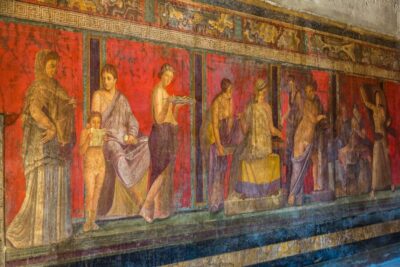

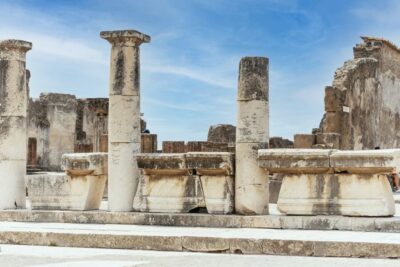

Pompeii Small Group Tour with an Archaeologist
Read our review →
Pompeii, Amalfi Coast and Positano Day Trip from Rome
Read our review →Browse the lists this tour appears in