
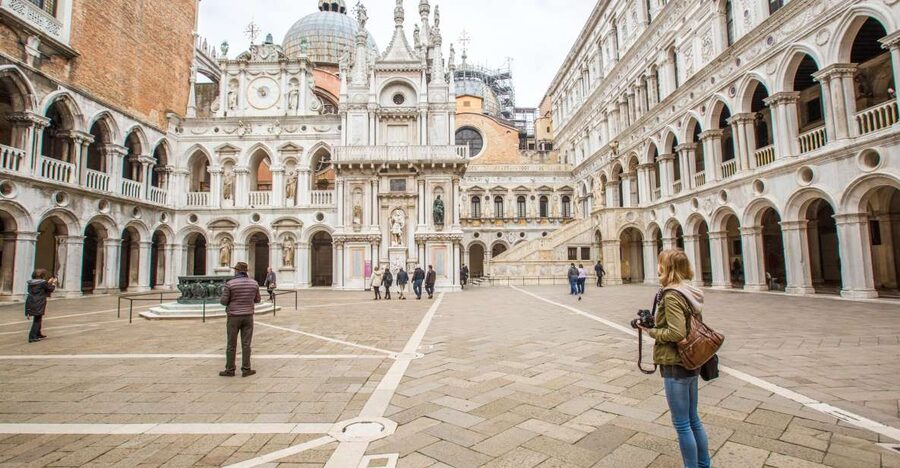
Reviewed · SKIP-THE-LINE TICKETS
Venice: Doge’s Palace Skip-the-Line Tour with Prisons
The most memorable part of this Doge’s Palace tour is the sharp change from glittering rooms of power to the grim prison corridors across the Bridge of Sighs. You move through the halls where Venice’s rulers shaped a maritime republic, then follow the route taken by prisoners, including Casanova.
I like the separate entrance for reserved visitors, especially when St. Mark’s Square is crowded. I also like the mix of art and politics: Tintoretto, Titian, Veronese, and Bellini matter more when you understand who paid for them and why. The main drawback is that 75 minutes can feel brisk, and security checks still create a line.
Key points to know before booking

- The Bridge of Sighs is part of the guided route, along with the historic prisons.
- Casanova’s connection gives the prison visit extra drama, but the tour also explains Venice’s wider justice system.
- The palace’s government rooms are as important as its art, showing how the republic was run.
- Your ticket includes the Correr Museum, Archaeological Museum, and Biblioteca Marciana, with access valid for three months from issue.
- Guides such as Denise, Donatella, Marco, and Marina have earned especially warm praise for clear storytelling and local insight.
- Skip-the-line does not mean no waiting at all. Every visitor must pass through security.
Entering the Doge’s Palace in St. Mark’s Square
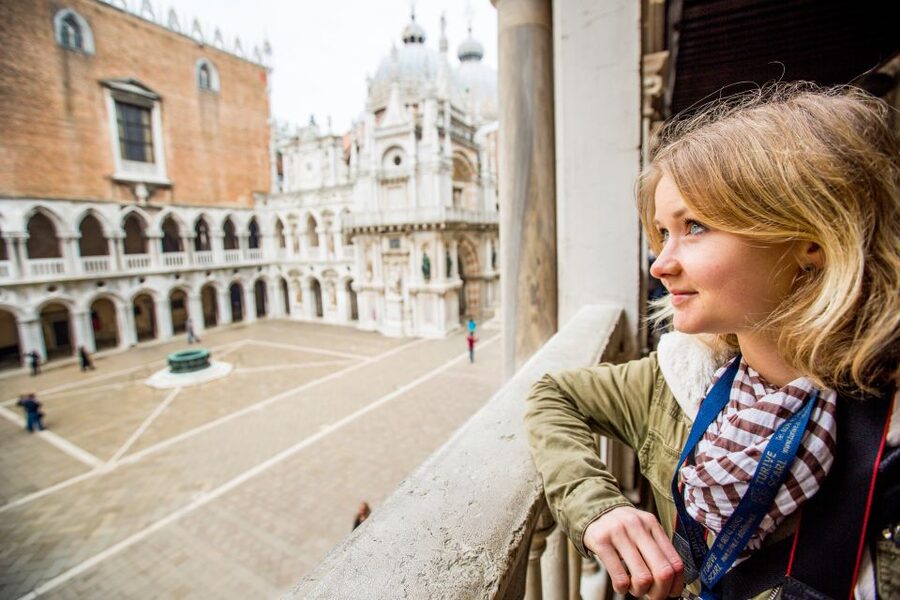
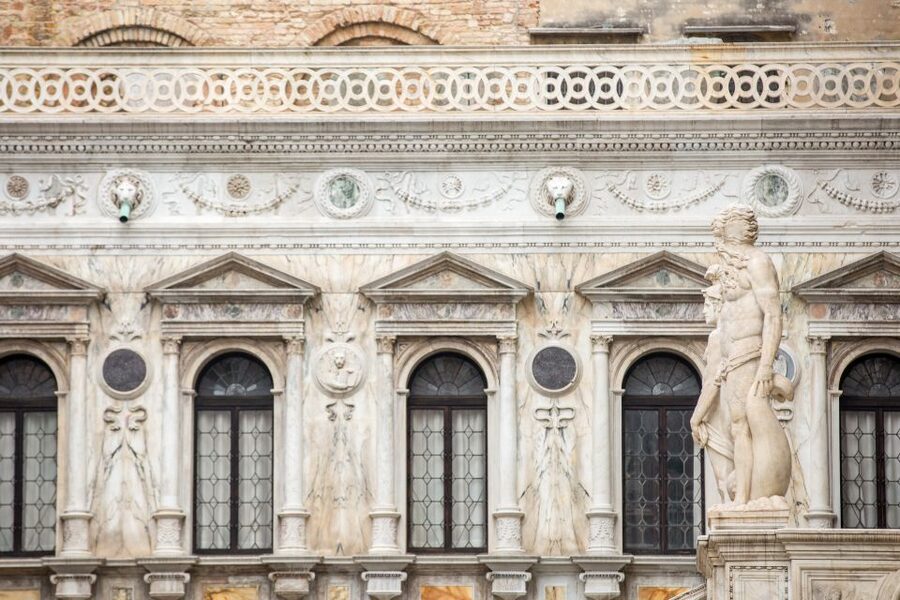
The Palazzo Ducale is one of Venice’s essential sights because it tells two stories at once. From the outside, it is a graceful meeting of Byzantine, Gothic, and Renaissance design. Inside, it becomes a working picture of Venetian power, law, trade, ceremony, and punishment.
The meeting point can change according to the option you book, so check your confirmation carefully. Some departures use a tour shop before the group walks to the palace. Give yourself time to find that location, particularly if you are arriving through the maze of lanes around St. Mark’s Square.
The skip-the-line benefit is useful, but keep your expectations sensible. You bypass the queue for visitors without reserved tickets, yet the palace still requires a security check. At busy times, that check can produce a wait of its own.
Once inside, the guide helps you make sense of the route. The palace is not a simple sequence of decorated rooms. It is a huge political machine, built to impress ambassadors, control officials, and reinforce the authority of the Doge and his council.
More Skip-the-Line Tickets in Venice
- Skip the Line: St. Mark’s Basilica Guided Tour
★ 4.0 · 2,380 reviews - Venice: St. Mark’s Basilica Skip-the-Line Entry & Audioguide
★ 3.9 · 2,107 reviews - Skip-the-Line: Doge’s Palace & St. Mark’s Basilica Fully Guided Tour
★ 4.5 · 1,892 reviews
The halls where Venice governed itself
The palace served as the center of Venetian political power for centuries. Your guide explains how the Doge, councils, judges, and administrators worked within the building, giving the grand rooms a practical purpose beyond their decoration.
This context is one of the tour’s biggest strengths. Without it, the palace can seem like an endless procession of paintings and gilded ceilings. With a good guide, you begin to see how the artwork supported the republic’s public image.
Look closely at the scale of the halls. Large rooms, formal stairways, and carefully arranged entrances were designed to make government feel permanent and powerful. The palace was not simply the Doge’s private home. It was a public center where decisions affecting Venice and its overseas interests were made.
The guide also places Venice within the European Middle Ages. That wider setting helps explain why the city became such an important trading power and why its leaders invested so heavily in ceremony, art, and architecture.
Guides are central to the experience. Denise is particularly well regarded for bringing local Venetian stories into the tour, with a humorous style and family connections to the city. Marco has been praised for combining historical detail with jokes and a comfortable pace. Donatella, Marina, Louisa, and others have also received strong praise for answering questions and keeping the palace easy to follow.
Guide quality can vary, as it does on any scheduled group tour. Some visitors have found the commentary difficult to hear because of microphone static, crowd noise, or an accent. You may want to stay close enough to the guide to see and hear clearly, rather than drifting toward the back of the group.
Gold staircases and masterpieces overhead
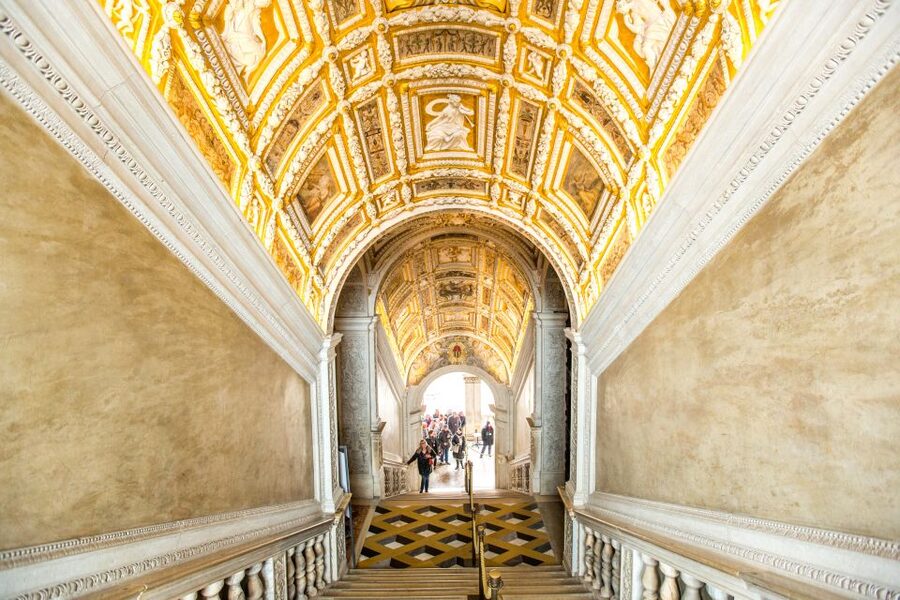
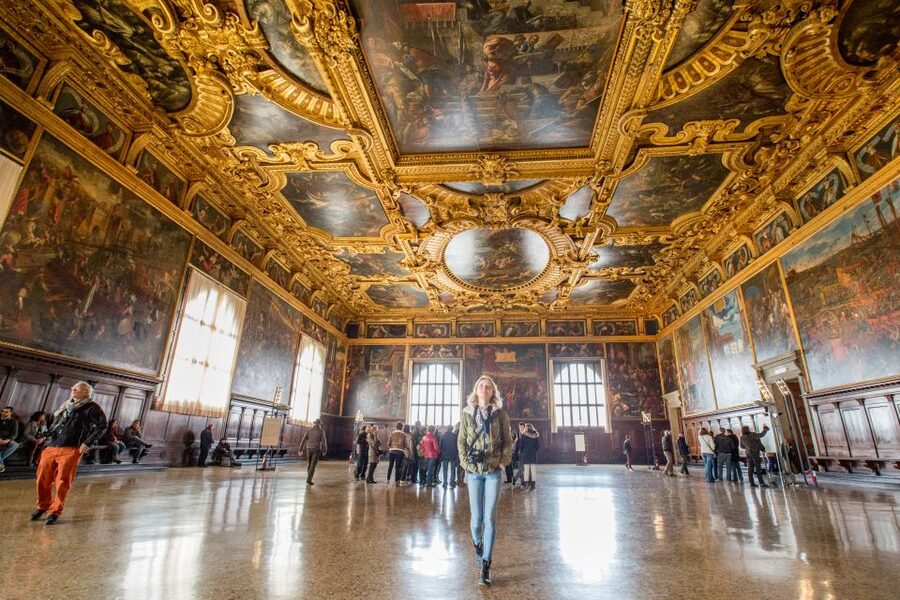
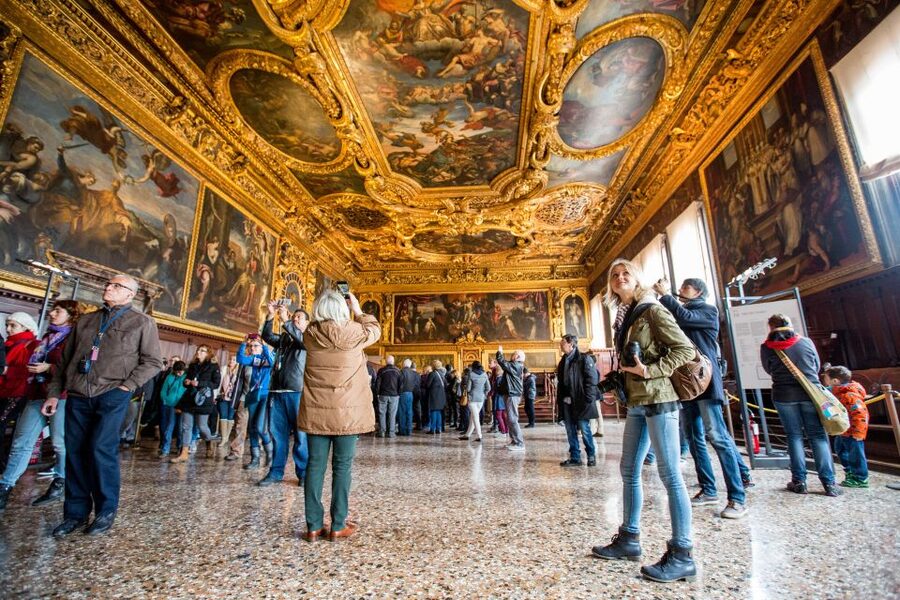
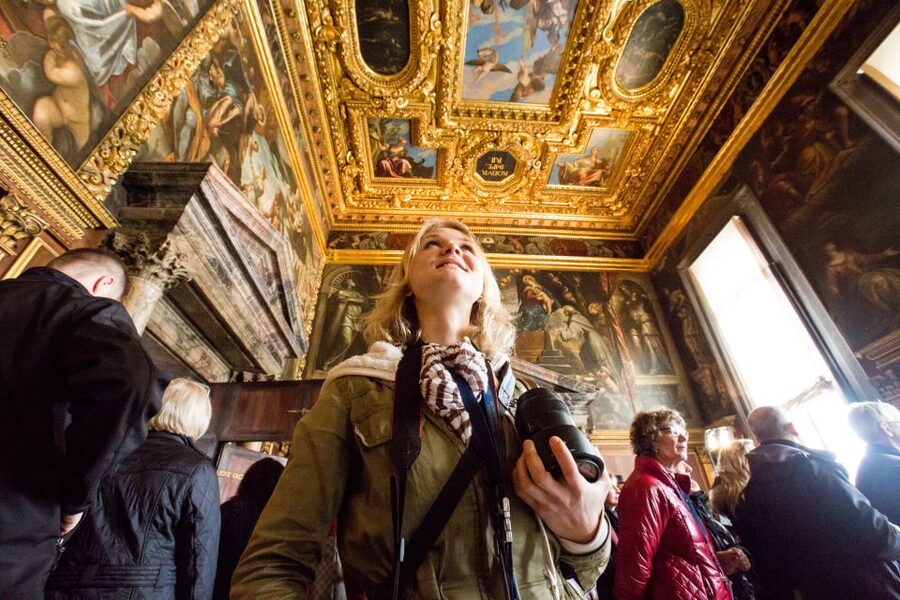
The palace’s decoration is not subtle. You will see lavish ceilings, gilded details, formal portraits, and huge painted scenes intended to overwhelm the senses. The gold staircase is a particular highlight, with decoration that reflects the building’s role as a ceremonial entrance to power.
The art is not presented as a detached museum collection. Tintoretto, Titian, Veronese, and Bellini are part of the palace’s larger message. Their work helped turn political spaces into places of spectacle, where Venice could display wealth, confidence, religion, and civic pride.
Tintoretto is especially important to the palace experience, with scenes that use scale and drama to fill the grand rooms. Your guide points out selected works rather than trying to explain every painting. That is sensible. A short tour needs to give you a few anchors, or the decoration becomes visual noise.
I appreciate this guided approach for a first visit. You learn where to focus your eyes, why certain rooms mattered, and how the palace changed over time. You will not receive a full art-history course in 75 minutes, but you should leave with a clearer sense of what you are seeing.
The pace is generally designed to keep the group moving through the major rooms. That helps in high season, when stopping too long can cause crowding. The tradeoff is that you may wish for more time with a particular painting or ceiling.
After the guided portion, you can usually remain inside and look around again. This is valuable. The first pass gives you the story; a second look lets you study the details that caught your eye. The included palace admission also gives you a chance to visit areas the guide may not cover in depth, such as the armoury, where available along the open visitor route.
Crossing the Bridge of Sighs
The Bridge of Sighs connects the palace to the prison buildings. Its name comes from the sighs prisoners were said to make as they caught their last view of Venice through the small stone windows while being led away from the courts.
The bridge is often photographed from outside, but walking through it gives the landmark a different weight. You are no longer looking at a pretty white arch over a canal. You are following the route from judgment to confinement.
The passage is fairly short, yet it is one of the tour’s most effective moments because the guide connects the architecture to the justice system. The bridge was part of a controlled movement through the city’s institutions, not merely a scenic crossing.
You should expect crowds and a steady pace here. It is not a quiet, private viewing. Still, the combination of the bridge, the palace, and the prisons makes this tour more complete than a palace visit focused only on state rooms.
Same city, an entirely different afternoon:
- Venice: Doge’s Palace Reserved Entry Ticket
★ 4.6 · 42,716 reviews - Venice: Grand Canal Gondola Ride with App Commentary
★ 4.1 · 18,908 reviews - Boat Trip: Glimpse of Murano, Torcello & Burano Islands
★ 4.3 · 15,699 reviews - Venice: Grand Canal by Gondola with Live Commentary
★ 4.1 · 13,681 reviews
Inside the prisons and Casanova’s escape
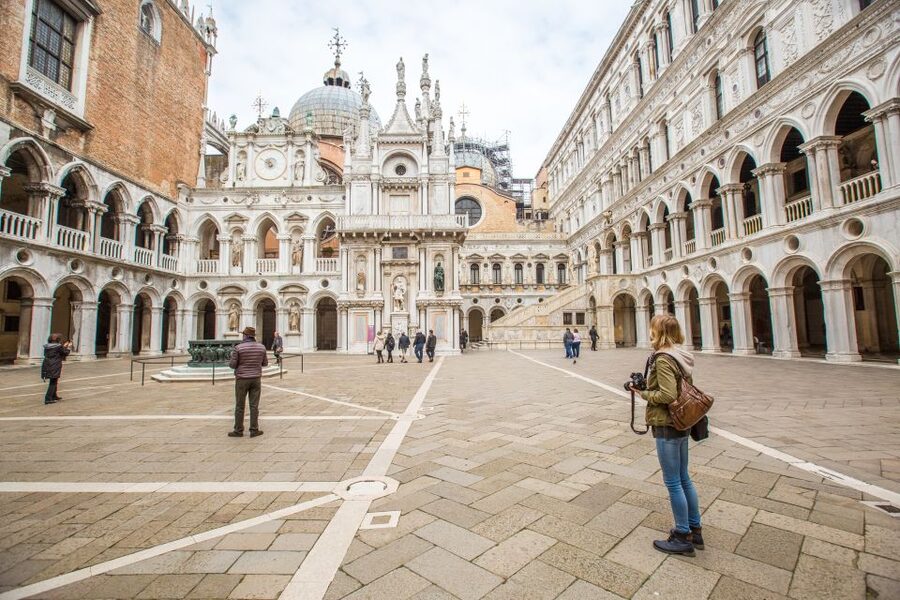
The prison section changes the tone completely. The rooms and passageways are far less polished than the palace interiors, and that contrast is the point. Venice’s public glory existed alongside strict courts and harsh confinement.
Casanova is the prison’s most famous name. Giacomo Casanova was incarcerated here and later escaped, giving the visit a memorable human story. His escape adds adventure, but the prison route also reminds you that many less famous prisoners passed through the same system.
The prison visit is not a separate add-on. It is included in the guided route, along with the Bridge of Sighs. I consider this a major reason to choose this experience rather than buying a basic palace entry and wandering through the grand rooms alone.
Expect a more confined route than in the main palace. That can be uncomfortable for anyone who dislikes narrow historic interiors, and visitors with limited mobility may not be able to take part in every section. One practical concern is seating: there may be lengthy waits or periods without a place to rest, which matters if you are over 65 or need regular support.
What the $54 price really buys you
At $54 per person, this is not the cheapest way to enter the Doge’s Palace. You are paying for three things: reserved admission, a live guide, and access to the prisons and Bridge of Sighs.
The skip-the-line element has real value during busy periods. One family found that the regular queue could have taken several hours, making the reserved entry worthwhile. The exact wait depends on the day, but avoiding the main non-reserved line can protect a large part of your limited time in Venice.
The guide also changes the value calculation. If you enjoy reading room panels and forming your own route, a self-guided visit may suit you better. If you want the palace’s art, government, architecture, and prison story tied together, the extra cost is easier to justify.
Your ticket includes the Correr Museum, Archaeological Museum, and Biblioteca Marciana in St. Mark’s Square. These admissions are not guided, and the ticket is valid for three months from its date of issue. That gives you flexibility to return on another day rather than trying to squeeze every museum into the same morning.
For a short stay, the package is practical. You can take the guided tour first, then return to the museums when you have more energy. If you already hold admission to these sites, or plan only a quick look at the palace, the price may feel less attractive.
Timing, languages, and the pace of the visit
The advertised duration is 75 minutes. That is long enough to cover the palace highlights, bridge, and prisons, but short enough to fit into a busy Venice schedule.
Some past departures have run closer to 90 minutes, but you should plan around the stated 75-minute duration rather than count on extra time. Arrive prepared to keep moving, especially in crowded periods.
Tours are offered in English, Spanish, French, German, and Italian. From November through March, a tour may be bilingual. That can mean commentary takes longer or feels less focused, so check the language arrangement when choosing your departure.
The experience is best for adults who want historical context, couples interested in architecture and art, and families with older children. A tour can also work well for children aged seven and above if the guide uses stories and humor. Admission is free for children up to age six, according to the stated terms.
The tour is less suitable if you need a slow, seated visit or want to examine each painting at length. The palace is physically demanding in places, and the route may not work for every visitor with a disability. If accessibility is important for your group, treat that as a deciding issue rather than an afterthought.
Small details that make the visit better
Wear shoes suitable for walking through a large historic building. You will be moving between public rooms, stairways, the bridge, and prison areas, and there may be waits during the route.
Keep your attention on the guide during transitions. The best information often comes between the obvious sights, when the guide explains how the palace worked or links the prison route to Venetian law.
If the microphone sounds unclear, move closer and ask the guide to repeat an important point. Several visitors have praised the commentary but found the audio equipment less reliable than they hoped.
Do not use flash photography. The palace is filled with art and decoration, but flash photography is not allowed.
Set aside time after the guided tour if your schedule permits. The ability to stay and revisit rooms is one of the tour’s useful features. You can look again at the paintings, inspect the architecture, and visit included museum sites at a calmer pace.
Who should book this Doge’s Palace tour?
I would choose this tour for a first visit to Venice, especially if you are visiting during a crowded season. The palace is too important to rush through without context, and the reserved entry can save valuable time.
I would also recommend it to anyone fascinated by political history, courtroom drama, famous prisoners, or grand European art. The route has a good balance: government offices, masterpieces, ceremonial rooms, a famous bridge, and real prison spaces.
I would think twice if you dislike group tours, need extensive rest stops, or prefer to set your own pace. The 75-minute format is efficient, but efficiency means you may not linger where you want. The included museums help offset that limitation, since you can explore them independently over the following three months.
FAQ
How long does the Doge’s Palace tour last?
The tour lasts 75 minutes. Some past tours have lasted longer, but you should plan on the stated duration.
Does the tour include the prisons and Bridge of Sighs?
Yes. The guided visit includes the Doge’s Palace, the prisons, and the Bridge of Sighs.
Is the tour really skip-the-line?
You use a separate entrance and skip the line for visitors without reserved tickets. You must still pass through the palace security check, so a short wait is possible.
Which languages are available?
Tours are offered in English, Spanish, French, German, and Italian. From November through March, tours may be bilingual.
Does the ticket include other museums in St. Mark’s Square?
Yes. The ticket includes the Correr Museum, Archaeological Museum, and Biblioteca Marciana. These museum admissions do not include a guide, and the ticket is valid for three months from its date of issue.
Is the tour free for young children?
Children aged up to six enter free.
Can I take photographs inside?
Photography with flash is not allowed.
Should you book it?
Book this tour if you want the Doge’s Palace to make sense, not just look beautiful. The combination of reserved entry, a live guide, the Bridge of Sighs, Casanova’s prison, and three months of museum access gives the $54 price a fair case, particularly when the regular queue is long.
Choose another option if you need a fully accessible route, lots of seating, or unlimited time with individual artworks. For most first-time visitors, though, this is a well-shaped introduction to Venice’s center of power, with enough drama in the prison passage to keep the palace from feeling like one long succession of painted ceilings.
Fresh on the Venice list
- Murano: Glass Blowing Demonstration and Artistic Glass Gift★ 4.6 · 507 reviews
- From Venice: Dolomites, Lake Misurina, and Cortina Day Trip★ 4.6 · 508 reviews
- Venice Islands: Murano Glass & Burano Colors Guided Visit★ 4.5 · 510 reviews
- The Majestic Teatro La Fenice: Guided Tour in Venice★ 4.3 · 513 reviews
- Real Venetian Kayak – Tour of Venice Canals with a Local Guide★ 4.5 · 518 reviews
- Venetian Carnival Mask Making Class in Venice, Italy★ 4.5 · 525 reviews
- Half Day Murano and Burano Island Tour by Private Boat★ 4.5 · 529 reviews
- Venice Trilogy: Murano, Burano & Torcello by Lagoon Boat★ 4.5 · 532 reviews
Skip-the-Line Tickets, compared.
Skip-The-Line Uffizi Gallery Timed Entry Ticket
Read our review →
Vatican Museums & Sistine Chapel Skip-the-Line Entry Ticket
Read our review →
Skip-the-Line Group Tour of the Vatican, Sistine Chapel & St. Peter’s Basilica
Read our review →
Michelangelo’s David Skip-the-Line Entry Ticket
Read our review →
Vatican Museums & Sistine Chapel Skip-The-Line Ticket
Read our review →
Vatican, Sistine Chapel & St. Peter’s Skip-the-Line Tour
Read our review →
Skip-the-Line Vatican, Sistine Chapel & St. Peter’s | Small Group
Read our review →
Vatican: Vatican Museums Sistine Chapel Skip-the-Line Ticket
Read our review →Browse the lists this tour appears in