
Reviewed · WALKING TOURS
Syracuse: Ortigia and Neapolis Guided Walking Tour
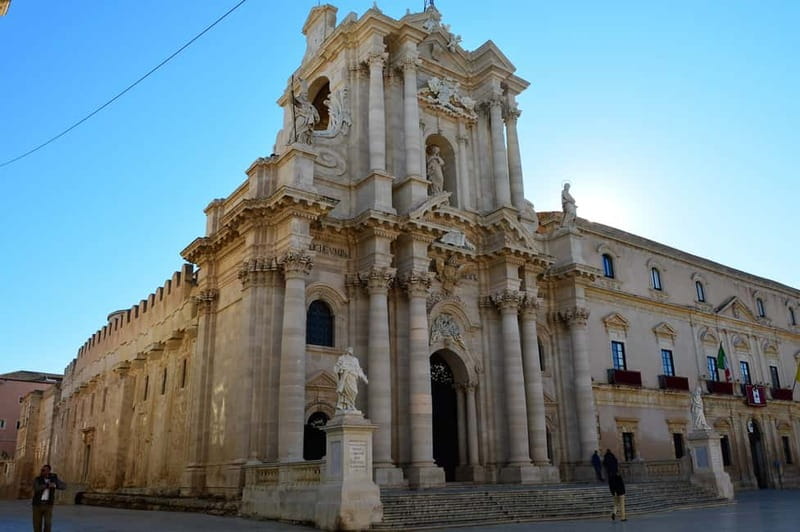
Syracuse makes its long past unusually easy to read. In one tour, you move from the Greek Theater and Roman Amphitheater to the lime-white lanes of Ortigia, then into the Cathedral of Syracuse, where ancient columns from the Temple of Athena still form part of the church. The city’s layers are the main event.
I like the private-group format, which lets you stop for questions and adjust the pace, and I like that the tour joins Neapolis with Ortigia instead of treating them as separate sights. Guides including Giuseppe, Anna, Marcelo, and Laura are praised for clear storytelling and local history. The main drawback is cost: $317.20 covers up to five people, but monument tickets, transport, food, and drinks are extra.
Key points to know
- Two sides of Syracuse in three hours: See the archaeological park and the old island city in one guided outing.
- A church built around a temple: The Cathedral incorporates the ancient Temple of Athena, with several architectural periods to explain.
- Ancient theater views: The Greek Theater gives you a striking look toward the Ionian Sea.
- Private questions welcome: A small group makes it easier to ask about Greek religion, wars, legends, architecture, and daily life.
- Bring practical gear: Comfortable shoes, a hat, and water matter, especially in the open archaeological park.
- Tickets cost extra: The tour does not include admission to the monuments, so add that to your budget.
Why this Syracuse tour works so well
Syracuse is not a place you should see only through a quick photo stop. The city was once a major Greek power and a capital of the Mediterranean, and its remains are spread across two very different settings. Neapolis is open, monumental, and archaeological. Ortigia is a lived-in old town of narrow lanes, churches, piazzas, and sea views.
This tour gives you a guide to connect those pieces. You are not simply looking at stones and moving on. You can ask why a Greek temple became part of a Christian cathedral, how Roman rule changed the city, or what legends surround the Ear of Dionysius.
The private arrangement is especially useful here. A guide can spend more time on the subjects you care about, whether that is ancient religion, military history, architecture, or local stories. Several guides have a reputation for turning facts into lively explanations. Giuseppe is praised for interactive storytelling and energy, while Anna is noted for her clear pacing, patience, and strong grasp of Sicilian art and history.
The advertised duration is three hours. Some private tours have run three and a half or even more than four hours, but you should treat those longer outings as guide-dependent rather than guaranteed. If you have a train, dinner reservation, or onward drive, keep a little extra time in hand.
More walking tours in Italy:
- Milan: Guided Walking Tour & Last Supper Visit with Ticket
★ 4.7 · 5,409 reviews - Naples: Street Food Walking Tour with Local Guide
★ 4.8 · 4,256 reviews - Venice Walking Tour and Gondola Ride
★ 3.5 · 3,630 reviews
Starting at Neapolis Archaeological Park
The stated meeting point is the Biglietteria Parco Archeologico Neapolis on Via Luigi Bernabò Brea. Your guide meets you at the ticket office holding a sign with the local partner’s name. This is a practical start because you begin beside the archaeological site rather than spending the first part of the tour finding it.
The park is the more physically demanding half of the experience. You will be outside, walking between large ancient structures, so wear shoes that can handle uneven ground. A hat and water are sensible, especially on a sunny day. The activity is described as wheelchair accessible, but the park includes broad archaeological spaces and historic terrain, so if you need a particular route or assistance, confirm the details before booking.
The tour includes a headset, an underrated benefit in an open site. Ancient ruins are spread out, and without one, you may miss half the guide’s explanation whenever the group stretches across a path. The headset should make it easier to look around while still following the story.
Admission is not included. One detailed account put the archaeological park ticket at 13 euros per person, but prices can change, so check the current charge when planning your budget. The activity offers skip-the-ticket-line access, yet you still need to pay the entrance fee separately.
The Greek Theater and Syracuse’s grand scale
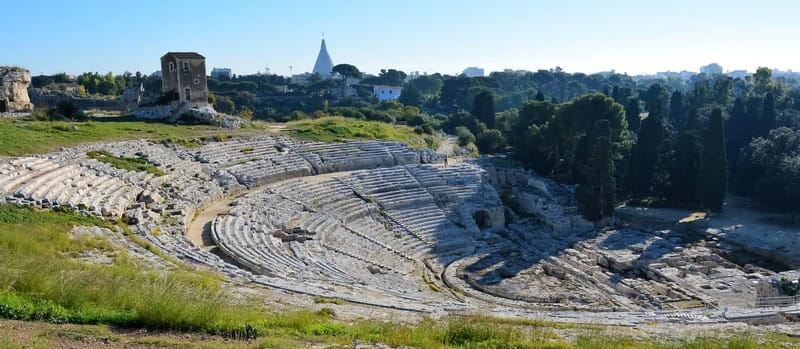
The Greek Theater is likely to be one of the strongest parts of the park. Its size gives you a quick sense of Syracuse as a serious Greek city, not a minor outpost. This is where the past becomes physical: you can see how the seating rises and how the performance space sits below it.
The setting adds to the experience. From the theater, you get beautiful views toward the Ionian Sea. That combination of monumental stone and open water helps explain why Syracuse became such an important Mediterranean center.
Your guide can also place the theater within the city’s wider religious and civic life. The experience is designed to explain early Greek history through architecture and religious practice, so expect more than a basic list of dates. A good guide will show you how public buildings, sacred places, and political power were connected.
The open setting can also expose you to sun, heat, or sudden rain. One tour continued through a rainstorm in Ortigia, so bring a light layer if the forecast looks uncertain. There is no promise of indoor shelter during the archaeological portion.
The Roman Amphitheater and the change of power
The Roman Amphitheater gives the park a different feel from the Greek Theater. Here, you see evidence of a later ruling power and a city that continued to matter after Greek dominance. The contrast helps you understand Syracuse as a place repeatedly reshaped by conquest and occupation.
The tour’s historical scope reaches beyond Greece and Rome. Guides discuss the city’s Arab and Spanish periods as well, making the outing useful if you want to understand Syracuse as a long-lived Sicilian city rather than a single ancient ruin.
This is where a private guide earns the fee. On your own, the amphitheater and theater can blur into a series of impressive shapes. With a well-prepared guide, each site gets a role in the city’s story. Marcelo, for example, is praised for covering Syracuse from its Greek origins through Roman, Arab, and Spanish control, with a clear interest in archaeology.
A few other Italy mornings to weigh against this
- Colosseum, Roman Forum & Palatine Guided Tour
★ 4.7 · 63,148 reviews - Vatican Museums, Sistine Chapel & St Peter’s Basilica Guided Tour
★ 4.5 · 39,149 reviews - Rome: Colosseum, Palatine Hill and Roman Forum Guided Tour
★ 4.8 · 32,814 reviews - Rome: Guided Tour of Colosseum, Roman Forum & Palatine Hill
★ 4.7 · 27,897 reviews
Paradise Latomia and the Ear of Dionysius
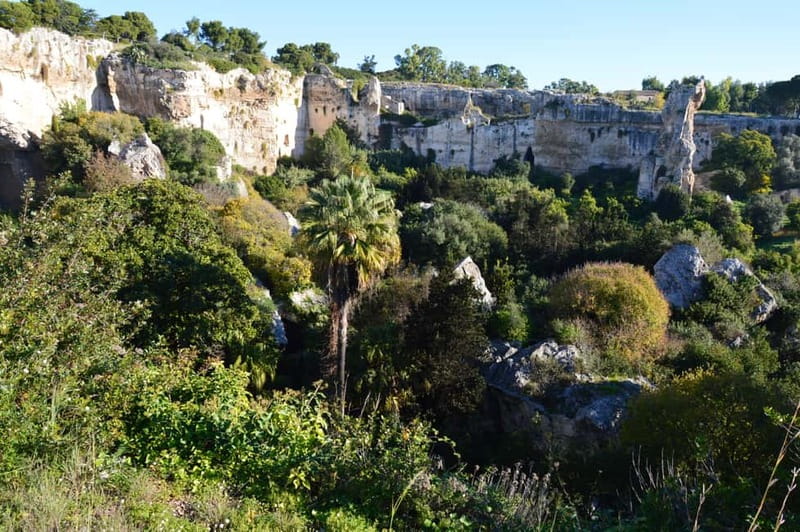
The Paradise Latomia is another memorable part of Neapolis. A latomia is a stone quarry, and this area shows how Syracuse’s builders cut into the rock itself. The space is tied to the city’s ancient labor, construction, and prison traditions.
The nearby Ear of Dionysius brings in one of Syracuse’s best-known legends. Its unusual shape has long inspired stories about sound carrying through the stone. A guide can separate legend from history while still explaining why the place captured people’s imagination.
You will get more from this section if you ask questions. The site has an obvious visual hook, but the guide’s explanation gives it meaning. Families may find the story especially engaging, and the tour is designed to involve both parents and children.
Do not expect every stop to feel equally grand. Some parts of the park are about scale and views, while others are about rock, engineering, or a small detail that needs explanation. That variety is a strength, though children with short attention spans may need the guide to keep the pace moving.
The Cathedral of Syracuse and Temple of Athena

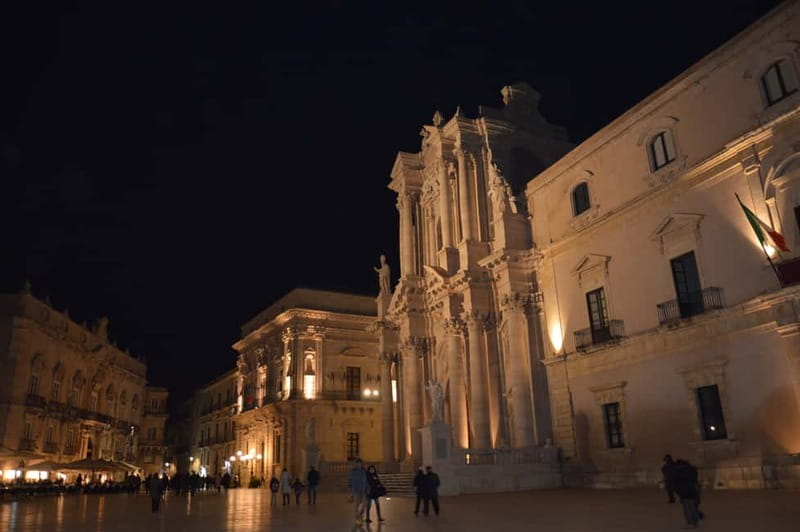
The Cathedral is the key bridge between ancient Syracuse and the city you see today. It incorporates the pagan Temple of Athena, so ancient Greek columns remain part of a working Christian church. This is not a reconstructed ruin placed behind glass. The old structure has been reused, altered, and absorbed into later religious life.
I find this kind of site more revealing than a perfectly preserved monument. It shows how cities actually change. New communities build over older ones, keep useful walls, borrow sacred spaces, and give familiar structures new meaning.
Your guide explains the cathedral’s different architectural styles and the way its history reflects Syracuse’s changing rulers and faiths. The building is not simply Greek or Christian. It carries several periods at once, which makes it one of the most valuable stops for anyone interested in architecture.
The Cathedral also gives you a pause from the open park. After walking among theaters and quarries, an interior visit can provide shade and a change of rhythm. Still, the precise access arrangements and any entry charges should be confirmed when you book, since monument fees are not part of the tour price.
Walking through Ortigia’s old streets
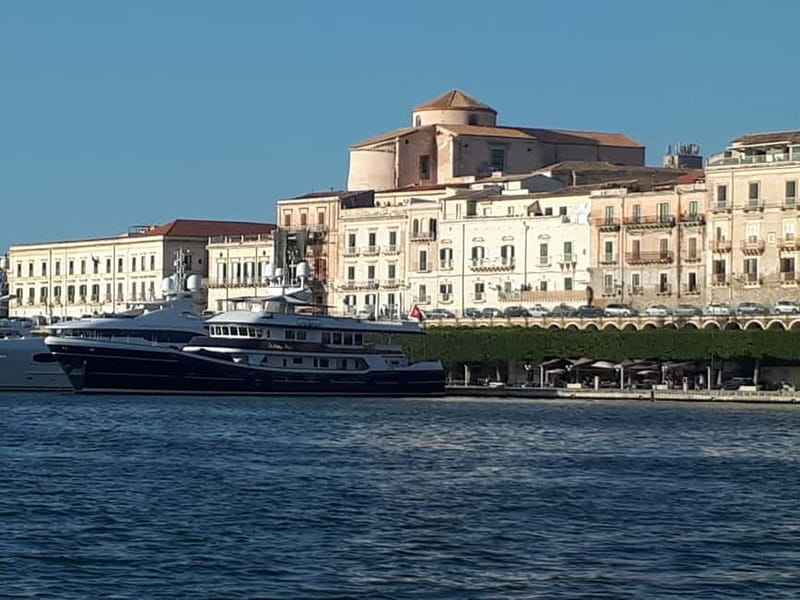
Ortigia is a compact island, but its streets can feel like a maze. The guided walk is designed to help you read the old city rather than merely follow its prettiest lanes. You will see the Cathedral and Temple of Athena, then continue through the historic fabric that grew around them.
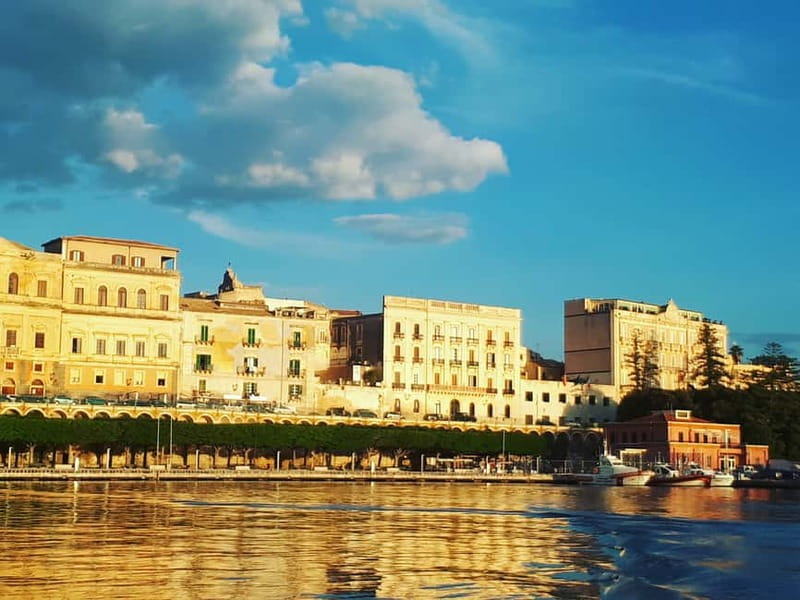
The island is lime-white and visually striking, with layers of Greek, Roman, Arab, Spanish, and later Sicilian influence. The tour emphasizes the city’s continuing Greek identity while also showing how many cultures have shaped it.
This is the more atmospheric half of the day. Neapolis tells you about public monuments and ancient engineering. Ortigia puts those centuries into streets, facades, churches, and everyday urban life. I like having both in one outing because each makes the other easier to understand.
The old lanes may be easier for some people than the archaeological park, but the tour is still a walking experience. Tell the guide if your group needs a slower pace. One outing accommodated four older adults who walked more slowly, and another guide remained patient with a family traveling with children. That does not guarantee a custom route, but the private format gives you a better chance to discuss your needs.
The guides make the difference
The strongest praise for this experience centers on the guides, not on the headset or booking flexibility. Giuseppe is repeatedly described as enthusiastic, energetic, and skilled at making history come alive. His interactive storytelling worked particularly well for teenagers, and he is known for answering a steady stream of questions without losing momentum.
Anna is another frequently recommended guide. She is praised for her clear explanations, polished organization, and ability to make local history, architecture, and art feel relevant. She also confirmed meeting details in advance for some groups and handled difficult weather with care.
Marcelo brings a strong archaeology focus and has been willing to extend a private tour well beyond the advertised time. Laura is described as friendly and well prepared. Rosanna is noted for explaining Syracuse’s complex past and its continuing Greek character.
You cannot always choose your guide by name, so consider these names examples of the level of service to seek rather than a guarantee. The available languages are English, French, Italian, Russian, Spanish, and German. If language matters to your group, select carefully at booking.
Is $317.20 good value?
The price is $317.20 for a private group of up to five. At the full group size, that works out to about $63.44 per person before admission fees. For four people, it is about $79.30 each. For two, the per-person cost rises to $158.60, so the value depends heavily on group size.
You are paying for a licensed guide, a private format, and a tour that covers both major areas of Syracuse. You are not paying for monument entrance, hotel pickup, drop-off, food, drinks, or any transport between sites. That last point matters because the archaeological park and Ortigia are separate areas. Some outings have used a short taxi ride between them, but transport is not included in the stated price.
For a family or group of four or five, the price can make good sense. You share one guide fee, ask questions freely, and avoid trying to coordinate two separate visits. For a solo visitor or couple watching costs, a group tour or self-guided visit may be cheaper.
The best reason to pay for this tour is not speed. It is interpretation. If you are happy reading signs and exploring at your own pace, you may not need it. If you want the ancient sites connected to Syracuse’s religious, political, and architectural story, a private guide adds real value.
Who should book this experience?
I would recommend it most strongly to first-time visitors who have limited time in Syracuse and want the essential sites explained in one session. It also suits families because the guide can answer questions at the level of both adults and children.
History and architecture fans should enjoy the range. You get Greek theater design, Roman public building, quarry engineering, Christian reuse of a pagan temple, and the layered streets of Ortigia. The tour also works well for people who dislike large groups and want the freedom to interrupt with questions.
It is less suitable if you want a slow, unstructured day with long cafe breaks or independent museum time. Three hours is enough to cover a lot, but not enough to linger deeply at every site. Since the outing is walking-heavy and tickets are extra, budget both energy and money.
Book only after checking the starting time and language. Free cancellation is available up to 24 hours before the activity, and you can reserve now and pay later, which helps if your Sicily schedule is still changing.
Should you book the Syracuse Ortigia and Neapolis tour?
Book it if you want Syracuse’s major ancient and historic sights to make sense as one story. The combination of Neapolis and Ortigia is excellent, and the private format gives you a better chance of a relaxed pace and useful answers.
I would especially choose it for a group of four or five, where the price becomes more reasonable. Add the separate monument fees, bring water and a hat, and allow extra time in case your guide extends the visit. If your priority is the lowest possible cost, explore independently. If you want the Greek Theater, Ear of Dionysius, Cathedral, and Temple of Athena brought together by a strong storyteller, this is a solid choice.
FAQ
How long does the Syracuse Ortigia and Neapolis tour last?
The advertised duration is three hours. Some private outings have lasted longer, but you should plan around the stated three-hour schedule and allow extra time if you have a later appointment.
Where does the tour start?
The meeting point is the Biglietteria Parco Archeologico Neapolis on Via Luigi Bernabò Brea, 96100 Siracusa. Your guide meets you at the ticket office with a sign showing the local partner’s name.
What sights are included?
The tour covers the Neapolis Archaeological Park and Ortigia. Main sights include the Temple of Athena, Cathedral of Syracuse, Greek Theater, Roman Amphitheater, Paradise Latomia, and Ear of Dionysius.
Are entrance fees included?
No. Entrance fees to monuments are separate from the tour price. One detailed account cited an archaeological park admission charge of 13 euros per person, but you should check the current price.
Is transportation included?
No. Hotel pickup and drop-off are not included, and food and drinks are also excluded. Some groups have used a short taxi ride between the archaeological park and Ortigia, but transport is not part of the stated tour price.
Is the tour suitable for children and wheelchair users?
Children of all ages can join, and the guide will involve both parents and children. The activity is described as wheelchair accessible. Bring comfortable shoes, a hat, and water for the walking portions.
Fresh on the Italy list
- Rome: Guided Catacombs Tour & Capuchin Crypt (Audio Guide)★ 4.3 · 191 reviews
- Guided tour of the Colosseum, Roman Forum and Palatine in Spanish★ 4.5 · 191 reviews
- Bolgheri: Winery Tour with Wine Tasting★ 4.7 · 191 reviews
- Stories of Pompeii: Small Group tour with archeology expert guide★ 5.0 · 191 reviews
- Palinuro: Costa del Mito Boat Tour★ 4.9 · 191 reviews
- From Palau/La Maddalena: All inclusive Yacht Tour★ 4.8 · 191 reviews
- Small-Group Cooking Class in Positano: Gnocchi, Tiramisù & Drinks★ 5.0 · 191 reviews
- Semi Private Deep Wine Chianti and San Gimignano from Florence★ 5.0 · 191 reviews
Walking Tours, compared.
Guided Walking Tour & Last Supper Visit with Ticket
Read our review →
Rialto Bridge & Offbeat Unusual Venice Walking Tour
Read our review →
Private 3 hrs Venice Tour: St Mark’s, Walking tour & Boat tour
Read our review →
Skip the line: Uffizi and Accademia Small Group Walking Tour
Read our review →Browse the lists this tour appears in