
Reviewed · VATICAN & SISTINE CHAPEL TOURS
Sistine Chapel, Vatican Museums & St Peter’s Small Group Tour
The real prize here is not simply seeing Michelangelo’s Sistine Chapel. It is getting through one of Rome’s most confusing museum complexes with a guide who can point out what matters before the crowds carry you onward. Guides such as Thomas, Leticia, Gracelyn, Erica, and Brandon have been praised for lively storytelling, strong art knowledge, and smart crowd management.
I like the skip-the-line Vatican entry, which can save precious time, and the planned route from the museums to St. Peter’s Basilica. I also like the small-group promise, with a maximum of 12 people, because a quieter group makes it easier to hear the guide and stay together.
The main caution is pace. Three hours is short for the Vatican, and the crowds can be intense. The Raphael Rooms may be skipped because of crowd controls, and St. Peter’s Basilica can close without warning for religious events.
Key points before you book
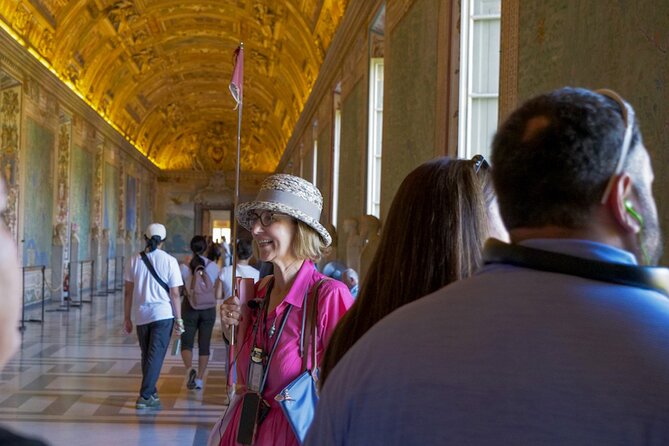
- A three-hour route covers the Vatican’s major sights: You see the Vatican Museums, Cortile della Pigna, Raphael Rooms when conditions allow, Sistine Chapel, St. Peter’s Square, and usually St. Peter’s Basilica.
- Skip-the-line access saves time, not crowds: You bypass some ticket queues, but the museums can still feel packed, especially during Jubilee events and major ceremonies.
- The group is capped at 12 people: That is a useful size for a guided visit, though occasional operational problems have caused larger groups.
- The guides make a major difference: Thomas, Leticia, Gracelyn, Erica, Brandon, Siriki, Lora, and others have been praised for clear explanations and crowd handling.
- St. Peter’s Basilica is often the emotional high point: The escorted route can use the Scala Regia shortcut, avoiding a long public line when access is operating normally.
- Book with realistic expectations: This is a highlights tour, not a slow art seminar. You will walk, climb steps, and keep moving.
Starting near the Vatican Museums
The tour begins at Viale Giulio Cesare 237, a practical location near public transportation and the Vatican Museums. You are not collected from your hotel, so allow time to reach the meeting point and arrive ready to walk.
The experience is offered in English and includes a mobile ticket, an English-speaking guide, museum and Sistine Chapel admission, escorted entry to St. Peter’s Basilica, and all taxes and fees. Headsets are supplied for groups of six or more. Keep hold of the headset until the end, since failing to return it can result in a €100 lost-property charge.
The group size is listed as a maximum of 12. That is small enough for the guide to manage corners, doorways, and sudden crowd stops without losing everyone. One reported problem involved a group that grew to 18 after another guide failed to appear, so I would treat the 12-person limit as the normal plan rather than an absolute guarantee in every unusual situation.
Your guide will first get you through the entrance process and orient you to the enormous museum complex. This part matters. The Vatican Museums contain more than five miles of corridors, galleries, courtyards, stairways, and passageways. Without a plan, it is easy to spend your energy simply figuring out where to go.
More Museums in Rome
- Vatican Museums & Sistine Chapel Tour with Optional Basilica
★ 4.3 · 67,413 reviews - Vatican Museums, Sistine Chapel & St Peter’s Basilica Guided Tour
★ 4.5 · 39,149 reviews - Rome: Vatican Museums, Sistine Chapel & Basilica Tour
★ 4.3 · 13,872 reviews
Seeing the Vatican Museums in 2 hours and 10 minutes
The museum portion takes about 2 hours and 10 minutes, making it the longest section of the tour. That sounds generous until you consider the size of the collection and the number of people moving through it.
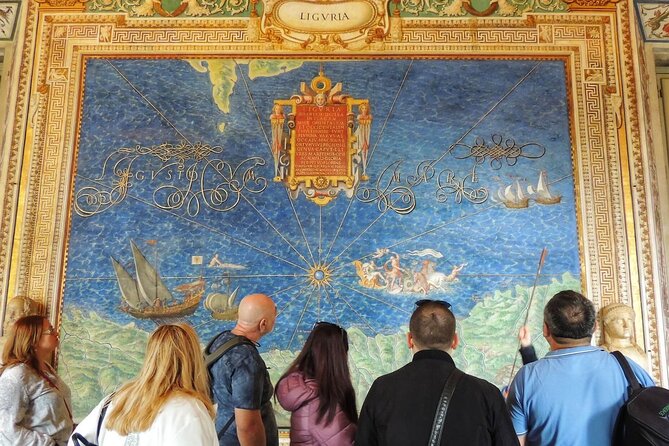
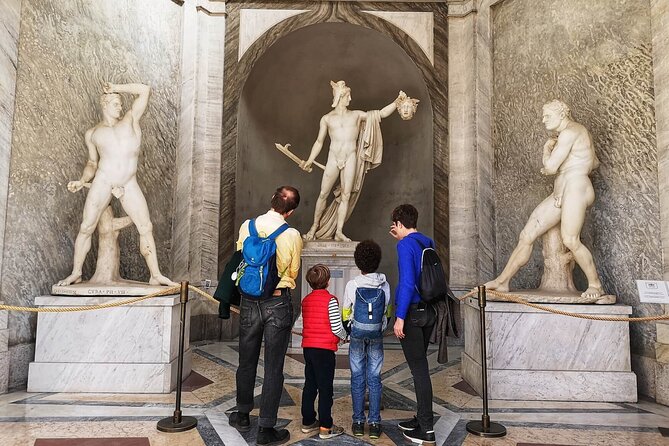
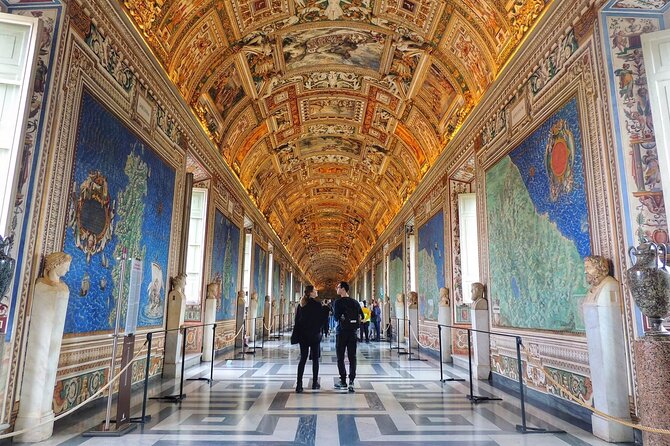
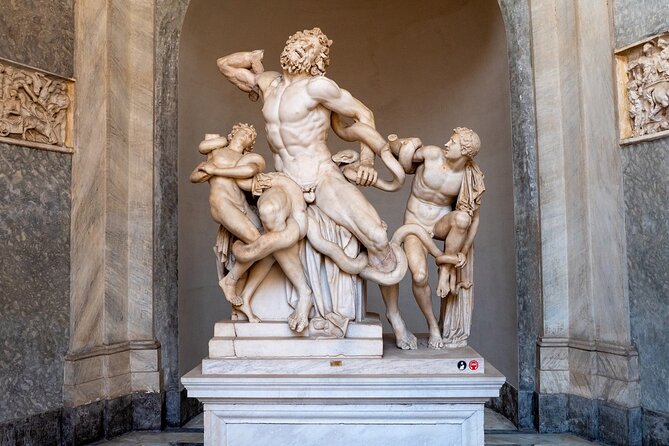
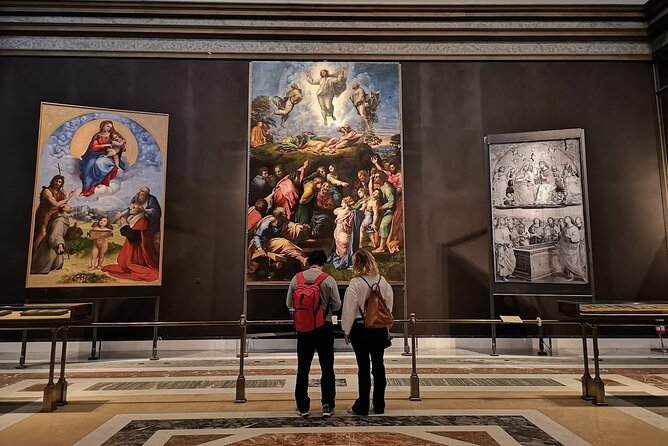
The Vatican Museums present art and objects covering roughly 2,000 years of human achievement. You might pass ancient sculpture, Renaissance painting, decorated ceilings, maps, tapestries, and rooms connected to the papal apartments. The guide’s job is to select the pieces that reward your attention rather than bury you under a list of names and dates.
That selection is one of the tour’s strongest points. Guides have been praised for explaining both the stories behind the artworks and the techniques used to make them. Erica, for example, was singled out for helping visitors understand what to focus on, while Thomas was praised for mixing historical detail with humor.
You should still expect a selective visit. A three-hour tour cannot cover every gallery or pause at every masterpiece. Some rooms may be crossed quickly, and a few people have felt rushed when the guide needed to keep the group moving. The Vatican’s staff can also direct crowds along changing routes, leaving little room for a guide to stop wherever they wish.
The famous works are not always the only worthwhile sights. A good guide can help you notice a ceiling detail, a sculptural gesture, or a bit of symbolism that would otherwise disappear in the sheer volume of decoration. That is the real value of joining a tour here: not just finding the rooms, but knowing where to look once you arrive.
The pinecone courtyard and the modern sphere
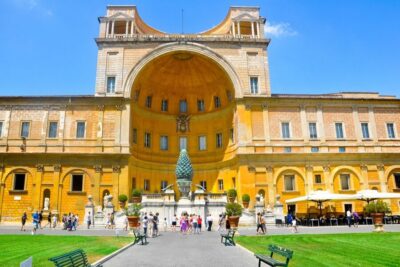
The Cortile della Pigna, or Pinecone Courtyard, provides an open-air pause in the museum route. Its name comes from the huge ancient bronze pinecone displayed there. The sculpture was found near the Baths of Agrippa and was moved to the Vatican centuries ago.
It is an odd and memorable sight, especially after moving through indoor galleries. Your guide can give the object context and explain why such a large ancient bronze sculpture occupies this Vatican courtyard.
The courtyard is also associated with Arnaldo Pomodoro’s Sfera con Sfera, a large metal sphere with a cracked outer surface and a second damaged sphere inside. The work offers a sharp contrast to the ancient objects around it. Instead of looking backward, it suggests machinery, fracture, and an inner world hidden beneath a polished shell.
This stop is brief, roughly 10 minutes, so do not expect a long art discussion. It is a useful visual break and one of the tour’s more unusual details.
Raphael’s rooms, if the crowd flow allows
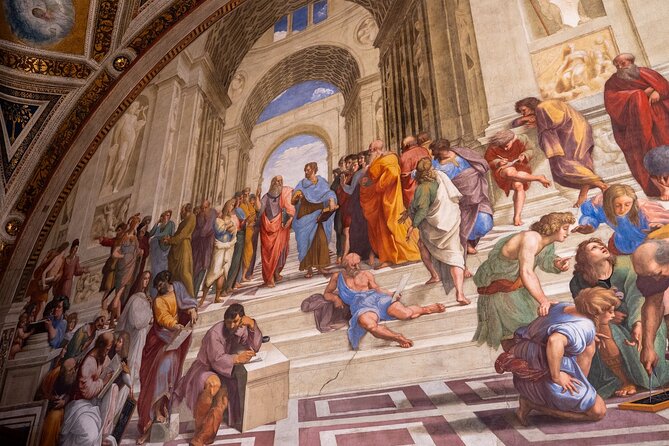
The four Raphael Rooms were part of the papal apartments chosen by Julius II. Raphael and his workshop decorated them between 1508 and 1524, creating some of the most important Renaissance interiors in the Vatican.
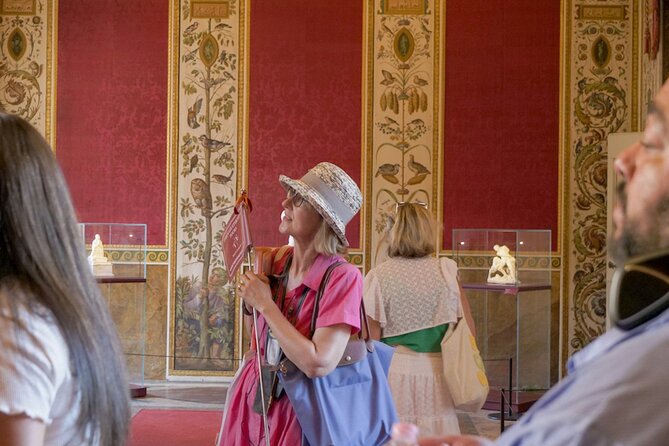
The rooms are included in the planned route and usually deserve attention. Their painted walls show how Renaissance art could turn an entire apartment into a statement about learning, faith, power, and political authority. You may find the rooms more rewarding after your guide explains how they fit into the papal residence.
There is an important catch. Vatican staff control crowd movement, and on some days the Raphael Rooms cannot be visited within the available time. Guides have also had to cut this section to keep the tour on schedule. If seeing Raphael is your top priority, ask at the start what route is possible that day, but understand that the guide may not control the decision.
This is a good example of the tour’s basic tradeoff. You get a carefully chosen introduction to the Vatican, but you do not get full control over the route or the length of every stop.
A few other Rome mornings to weigh against this
- Vatican Museums & Sistine Chapel Skip-the-Line Entry Ticket
★ 4.4 · 13,838 reviews - Rome: Vatican Museums, Sistine Chapel & Basilica Tour
★ 4.7 · 13,217 reviews - Skip-the-Line Group Tour of the Vatican, Sistine Chapel & St. Peter’s Basilica
★ 4.5 · 12,779 reviews - Rome: Vatican Museums & Sistine Chapel Guided Tour
★ 4.3 · 12,117 reviews
The Sistine Chapel in about 30 minutes
The Sistine Chapel is the tour’s headline stop. Michelangelo’s ceiling and The Last Judgment cover an immense surface, and the chapel’s fame can make it difficult to know where to begin.
Your guide will normally explain the chapel before or during the approach, since strict rules govern behavior inside. The chapel is a place for quiet observation, not a normal lecture room. You should be prepared to listen carefully, remember the main points, and then look up for yourself.
The ceiling is not a single image. It is a long sequence of biblical scenes, prophets, figures, and architectural illusions. The Last Judgment fills the altar wall with a powerful vision of the end of time. A guide can help you understand how the pictures connect, what details to seek, and why Michelangelo’s work changed the way people saw large-scale painting.
The planned visit lasts about 30 minutes. That is enough to appreciate the main works, but not enough for a slow study of every figure. The chapel is also one of the most crowded parts of the complex. You may need to weave through a moving crowd before reaching a place where you can pause.
The best advice is simple: wear comfortable shoes, carry water, and save some attention for looking rather than trying to photograph everything. The Sistine Chapel is a visual experience first. The guide’s explanation gives it structure, but you still need a few quiet moments to take in the ceiling.
Reaching St. Peter’s Basilica and Square
After the Sistine Chapel, the group is escorted toward St. Peter’s Basilica. When the special route is available, the shortcut down the Scala Regia can bypass the long public line. This is one of the most useful parts of the tour, since finding the correct route on your own can be confusing.
St. Peter’s Square is the tour’s finishing area. From here, you get the broad view of the basilica’s facade, Bernini’s colonnade, the Vatican Obelisk, and the two fountains. The older fountain was designed by Carlo Maderno, while Bernini created the later fountain on the opposite side.
The obelisk is especially interesting because it is the only ancient Egyptian obelisk in Rome that has remained standing since Roman times. It gives the center of the square a sense of age that reaches far beyond the modern Vatican.
The basilica itself is often the most powerful moment of the visit. The scale changes immediately when you enter, and the combination of architecture, sculpture, and ceremony can be overwhelming in the best sense. Several guides have been praised for making this section easy to reach and for explaining what you are seeing once inside.
The advertised end point is St. Peter’s Square, Piazza San Pietro. Depending on access and the day’s crowd controls, you may receive an escorted visit inside the basilica or an introduction followed by instructions to return independently.
Crowds, closures, and the Jubilee warning
The Vatican is rarely a calm place, and the tour does not remove that reality. Skip-the-line access helps with ticket queues, but it does not create empty galleries. You may still stand in security lines, move shoulder to shoulder through corridors, and follow a route set by Vatican staff.
Jubilee activity and major religious events can make conditions even harder. Some monuments may be under restoration, and the route can change. The basilica may close late or open late for ceremonies, with no advance warning.
There is also a specific booking restriction: for reservations made less than 72 hours before the visit, entry to St. Peter’s Basilica cannot be guaranteed. Even with more notice, an unexpected closure does not qualify for a refund. The guide will still provide an introduction if you want to return to the basilica later on your own.
One useful lesson comes from a reported late start of nearly 40 minutes. Waiting for people who had not arrived left the rest of the group with less time inside. That kind of delay may not happen, but it is a reminder to arrive early and to recognize that a tightly timed Vatican tour has little spare room.
Is $110.34 a fair price?
At $110.34 per person, this is not the cheapest way to enter the Vatican. You are paying for the guide, reserved museum and Sistine Chapel entry, escorted access, a small group, and help with a route that can be difficult to manage alone.
I think the price makes sense if you value context and time. The Vatican is so large that a self-guided visit can turn into a long walk past rooms you do not understand. A good guide helps you spend your limited energy on the major works, and the line-saving access can be worth a lot on a crowded day.
The value depends heavily on the guide. The strongest experiences came from guides who told stories, explained art clearly, kept the group moving, and knew how to handle the entrances. A monotone delivery or unclear English can make the same route feel much less worthwhile, especially through a headset and noisy galleries.
The tour is booked an average of 56 days ahead, which suggests that popular time slots fill early. If your Rome dates are fixed, booking well ahead gives you a better chance of securing the day and time you want.
Who will enjoy this Vatican tour?
I would choose this tour for a first visit to Rome, especially if you want the essential Vatican sights in one organized morning or afternoon. It suits you if you prefer explanations to wandering alone and want help with the confusing connection between the museums, Sistine Chapel, and basilica.
It is also a good fit if you have limited time. The route compresses the Vatican into three hours, then leaves you in St. Peter’s Square, where you can continue exploring on your own.
You may want another option if you prefer long, quiet art viewing. The pace is fixed, the crowds can be heavy, and Raphael’s rooms are not guaranteed. It is also not ideal for anyone who has difficulty with steps or extended walking unless the operator has discussed mobility needs in advance.
Wear walking shoes and bring water. Tell the operator about mobility concerns during booking so the route can be assessed. Most people can participate, but this is not a seated museum visit.
Should you book it?
Book this tour if you want a focused Vatican introduction, value skip-the-line access, and like having an English-speaking guide explain the key art and history as you move. The strongest guides, including Thomas, Leticia, Gracelyn, Erica, Brandon, Siriki, and Lora, have made the experience memorable through clear explanations and good crowd control.
Book with open eyes. The Vatican can be packed, the schedule can feel quick, Raphael’s rooms may be skipped, and St. Peter’s Basilica is never fully secure against last-minute closures. Still, for a first visit, the combination of the museums, Sistine Chapel, square, and basilica makes this a practical use of three hours and a fair choice for many people.
Free cancellation is available up to 24 hours before the start time. After that point, the fare is not refunded, and changes are not accepted.
FAQ
How long does the Vatican tour last?
The tour lasts approximately three hours. About 2 hours and 10 minutes are planned for the Vatican Museums, about 10 minutes for the Cortile della Pigna, and about 30 minutes for the Sistine Chapel, with time also allocated for the Raphael Rooms, St. Peter’s Basilica, and St. Peter’s Square.
Is St. Peter’s Basilica included?
Escorted entrance to St. Peter’s Basilica is included, but access is not guaranteed for bookings made less than 72 hours in advance. The basilica can also close unexpectedly for religious ceremonies.
Are the Raphael Rooms guaranteed?
No. The Raphael Rooms are part of the planned route, but crowding, timing, and directions set by Vatican Museum staff can prevent the group from reaching them.
How large is the tour group?
The tour has a maximum of 12 travelers listed. Headsets are provided for groups of six or more.
Where does the tour start and end?
The tour starts at Viale Giulio Cesare 237 in Rome. It ends at St. Peter’s Square, Piazza San Pietro.
Can I cancel for a full refund?
Yes. You can cancel at least 24 hours before the scheduled start time for a full refund. Cancellations or changes made less than 24 hours before the start time are not accepted.
Fresh on the Rome list
- Rome: Guided Catacombs Tour & Capuchin Crypt (Audio Guide)★ 4.3 · 191 reviews
- Guided tour of the Colosseum, Roman Forum and Palatine in Spanish★ 4.5 · 191 reviews
- Rome: Borghese Gallery Guided Tour with Skip-the-Line Ticket★ 4.5 · 192 reviews
- Rome: Arena Colosseum Tour with Arena Access★ 4.6 · 193 reviews
- Colosseum, Forum, Palatine Hill with audio guide and Arena or Bus option★ 4.0 · 193 reviews
- Rome: Colosseum & Roman Forum Guided Tour★ 5.0 · 194 reviews
- Rome: Domus Aurea Guided Tour and Virtual Reality Experience★ 4.7 · 194 reviews
- Rome Vintage Fiat 500 car Tour With Photographer★ 5.0 · 194 reviews
Vatican & Sistine Chapel Tours, compared.
Vatican: Museums & Sistine Chapel Entrance Ticket
Read our review →
Vatican Museums & Sistine Chapel Tour with Optional Basilica
Read our review →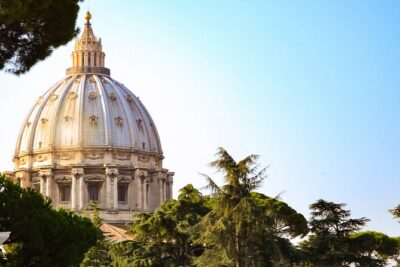
Vatican Museums, Sistine Chapel & St Peter’s Basilica Guided Tour
Read our review →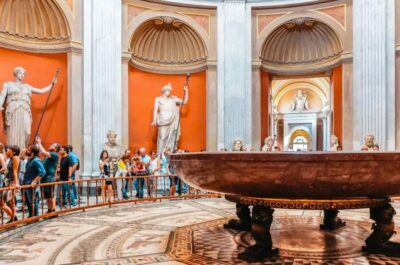
Vatican Museums, Sistine Chapel & Basilica Tour
Read our review →
Vatican Museums & Sistine Chapel Skip-the-Line Entry Ticket
Read our review →Vatican Museums, Sistine Chapel & Basilica Tour
Read our review →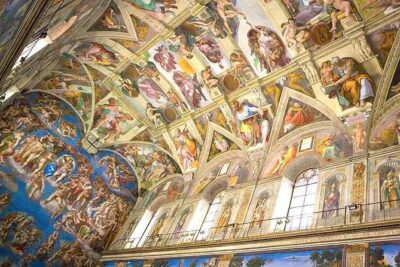
Skip-the-Line Group Tour of the Vatican, Sistine Chapel & St. Peter’s Basilica
Read our review →
Vatican Museums & Sistine Chapel Guided Tour
Read our review →Browse the lists this tour appears in