
Reviewed · MUSEUMS
Rome: Leonardo da Vinci Exhibition Entrance Ticket
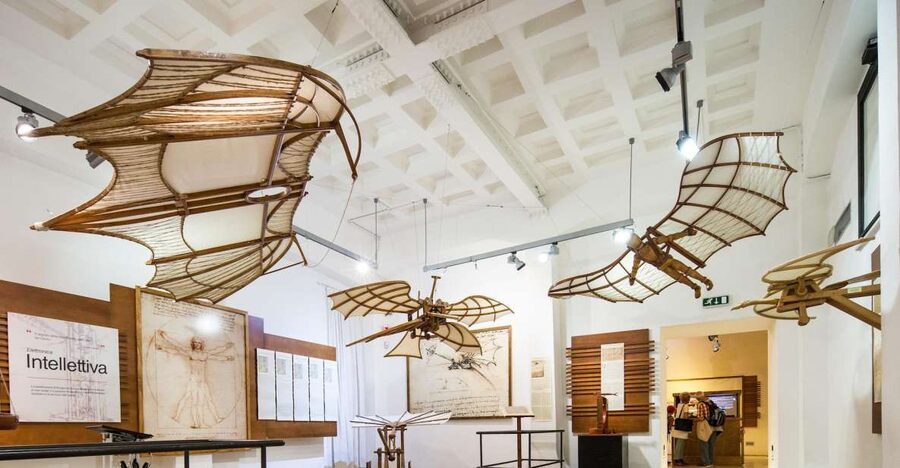
Leonardo da Vinci’s paper designs can feel distant in a book. Here, 65 full-scale working models bring his gears, bridges, flying machines, military devices, and water studies down to human scale. You can touch and test many of them, then see his ideas explained through holograms and interactive displays.
I like the exhibition’s hands-on approach, especially the chance to build your own version of one of Leonardo’s bridges. I also like its setting in Palazzo della Cancelleria, where a 43 BC tomb sits beside an underground natural pond. The main drawback is size: this is a compact museum, and the route through the rooms can be a little confusing.
Key points to know before you go
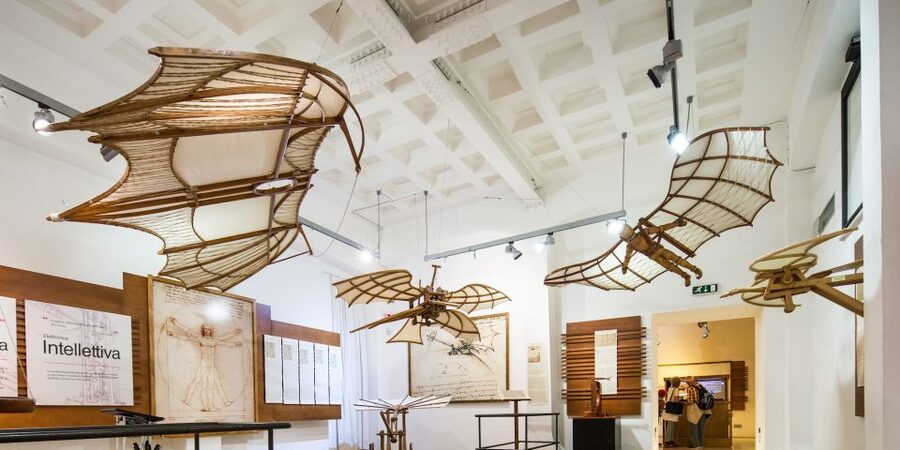
- 65 large-scale inventions: See physical reproductions based on Leonardo’s drawings, from engineering tools to flying machines.
- Nine holograms: Multimedia displays show Leonardo’s paintings and inventions in three dimensions.
- Four themed sections: The exhibition looks at Water, Air, Fire, and Earth, then connects those ideas to science and engineering.
- Hands-on design: You can operate many machines and construct a model of a Leonardo bridge.
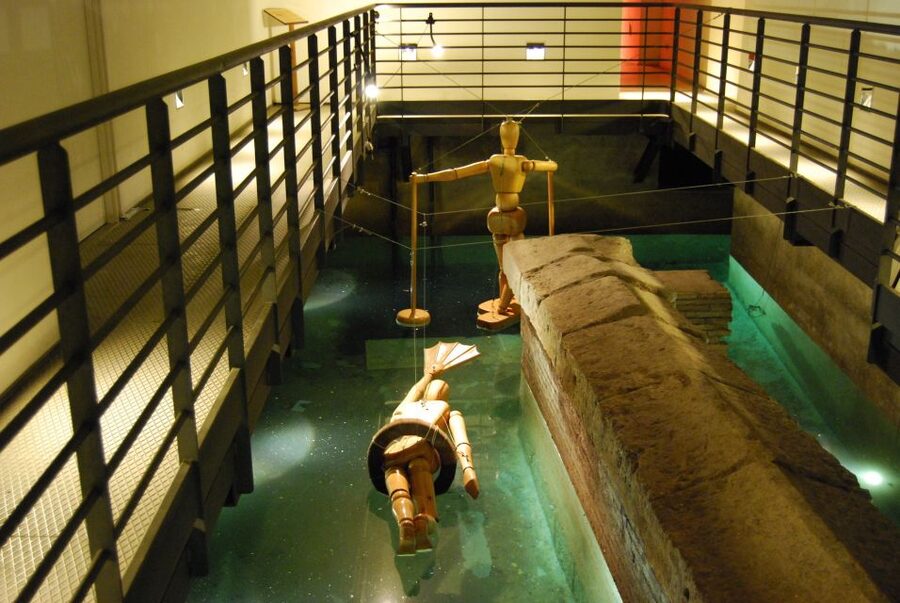
- A Roman surprise underground: The exhibition includes the tomb of architect Auro Irzio, dated to 43 BC, beside a natural underground pond.
- Short but flexible visit: Many people spend 45 to 60 minutes here, though careful readers and families may stay close to two hours.
Why Leonardo’s machines are the main event
This exhibition works best when you stop thinking of it as an art museum. Leonardo painted the Mona Lisa and studied anatomy, but the real focus here is his work as an engineer, inventor, scientist, architect, and observer of nature.
The models are built from his drawings and notes. That matters because a sketch of a gear or flying device can be hard to understand at a glance. A full-scale reconstruction lets you see the size, balance, moving parts, and practical problems behind the idea.
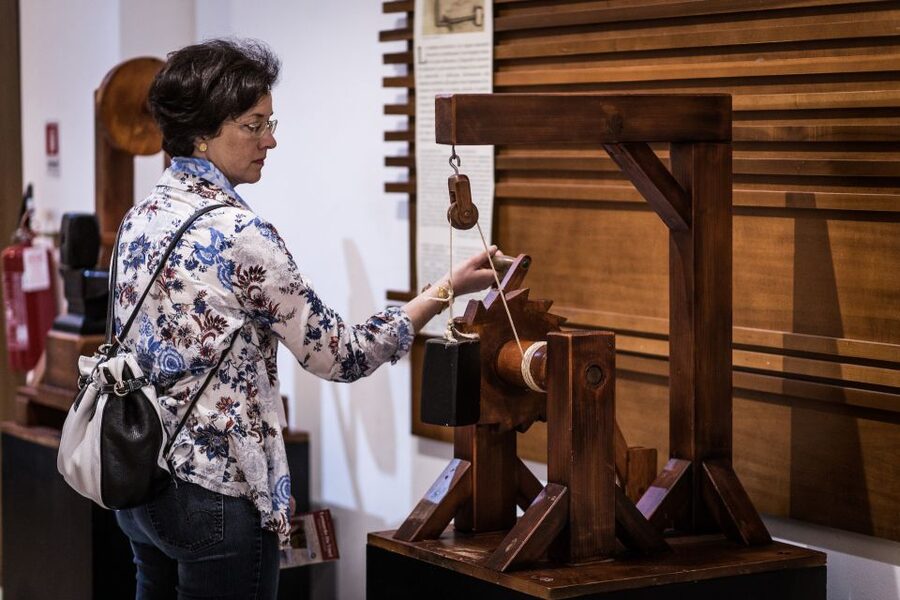
You can interact with almost all the machines on display. Some are designed to be turned, moved, or tested. The chance to handle a mechanism changes the visit from a silent look at old drawings into a small design lesson.
I especially like this setup for families and curious adults. A child can see how a machine moves, while an adult can think about why Leonardo arranged the parts in that way. The models also help explain how some of his ideas connect with modern transport, architecture, and mechanical design.
Do keep reasonable expectations. These are reproductions, not original Leonardo manuscripts or museum pieces from the Renaissance. A few machines may show signs of wear, and the exhibit is not a major fine-art collection. Its value comes from making engineering ideas clear and enjoyable.
More Museums in Rome
- Vatican Museums & Sistine Chapel Tour with Optional Basilica
★ 4.3 · 67,413 reviews - Vatican Museums, Sistine Chapel & St Peter’s Basilica Guided Tour
★ 4.5 · 39,149 reviews - Rome: Vatican Museums, Sistine Chapel & Basilica Tour
★ 4.3 · 13,872 reviews
Four sections built around Water, Air, Fire, and Earth
The exhibition is arranged in four sections linked to the elements: Water, Air, Fire, and Earth. This structure gives you a broad look at how Leonardo studied the natural world and tried to apply what he saw.
The Water section is a strong reminder that Leonardo was not only interested in machines. He studied currents, movement, flow, and the force of water. You may see devices related to water management and mechanical motion, with displays explaining how observation led to invention.
Air brings the flying machines into focus. Leonardo’s studies of flight were not successful aircraft in the modern sense, but his drawings show careful thought about wings, lift, and the movement of air. Full-scale models make the ambition of these designs easier to grasp.
Fire connects to force, energy, and military technology. The displays include devices linked to warfare and mechanical power. This part may appeal to visitors interested in the practical side of Renaissance engineering, though it is also worth remembering that Leonardo’s ideas were often studies and proposals rather than finished tools used in battle.
Earth brings the exhibition back to materials, structures, architecture, and mechanical devices. You see how Leonardo’s interest moved between subjects. A bridge, a gear system, and a building problem could all be part of the same habit of careful observation.
The four-part arrangement is useful, but you may not always move through it in a perfect narrative order. Room numbers and audio-guide stops can feel slightly out of sequence. If you use the audio guide, follow the device’s instructions carefully and pause to match each stop with the correct exhibit.
Seven interactive stations that make the drawings easier to read
Seven interactive installations add another layer to the exhibition. Instead of only reading a caption, you can use the displays to examine Leonardo’s drawings and ideas in a more active way.
This is where the exhibition earns its modest admission price. You are not simply looking at a case and moving on. You can compare a sketch with a physical machine, study how a mechanism might work, and see the thinking behind the design.
The bridge activity is a good example. You get to build your own version of a bridge Leonardo invented. It is a simple task, but it makes the principle memorable. You are testing balance and structure rather than just hearing a guide describe them.
The interactive elements also give younger visitors something clear to do. The exhibition suits children who like to handle objects, build things, and ask how machines work. Small children need closer attention, though. There are trip hazards in some areas, and the boundaries between touch and do not touch are not always obvious.
For adults, the stations help prevent the visit from becoming a quick parade of famous names. They encourage you to look closely at the drawings and ask what problem Leonardo was trying to solve.
Nine holograms and the multimedia side of the visit
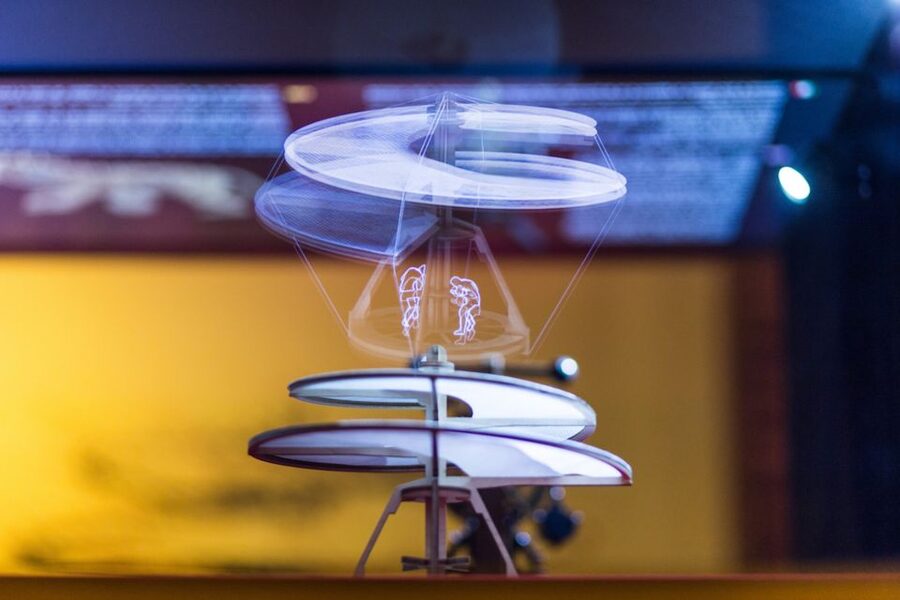
The nine holograms show Leonardo’s paintings and inventions in three dimensions. They add movement and visual drama to an exhibition built around static drawings and wooden models.
I find this especially useful for visitors who do not know Leonardo’s engineering work. The holograms provide a quick visual explanation of how an invention or painting relates to the wider exhibition. They also give the museum a modern feel without turning the whole experience into a screen show.
The multimedia presentation is not a substitute for the machines. The best sequence is to look at the model first, study the drawing or caption, and then use the hologram to reinforce the idea. If you rush from screen to screen, the visit can feel more like entertainment than history.
The exhibition also includes a copy of The Last Supper. It provides a familiar link to Leonardo the artist, but the physical models are the more distinctive part of the collection. If your main aim is to see original paintings, this is not the right museum. If you want to understand the range of his interests, the copy helps set up that contrast.
An optional audio guide is worth considering if you want more than basic labels. It gives extra information and detailed explanations in English, and it helps explain how some of Leonardo’s designs relate to modern life. The stops do not always match the room order neatly, so use it as a companion rather than expecting a perfectly directed tour.
No guide is included with the standard entry. Staff can provide information about an additional guide option, and the exhibition’s written explanations are available in English.
Same city, an entirely different afternoon:
- Colosseum, Roman Forum & Palatine Guided Tour
★ 4.7 · 63,148 reviews - Rome: Colosseum, Palatine Hill and Roman Forum Guided Tour
★ 4.8 · 32,814 reviews - Rome: Guided Tour of Colosseum, Roman Forum & Palatine Hill
★ 4.7 · 27,897 reviews - Rome: Colosseum & Forum with Audio Guide App -Optional Arena
★ 4.2 · 24,770 reviews
The underground tomb and Palazzo della Cancelleria
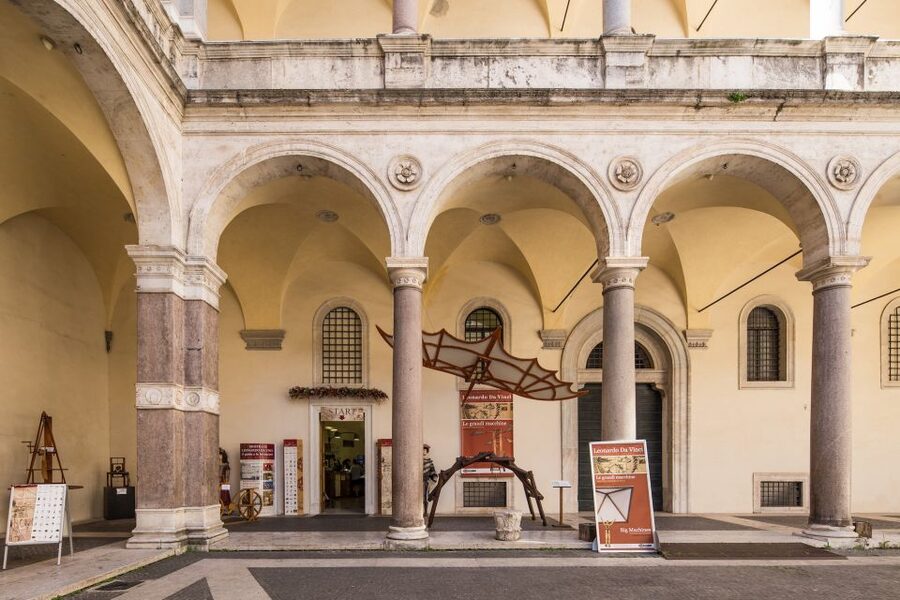
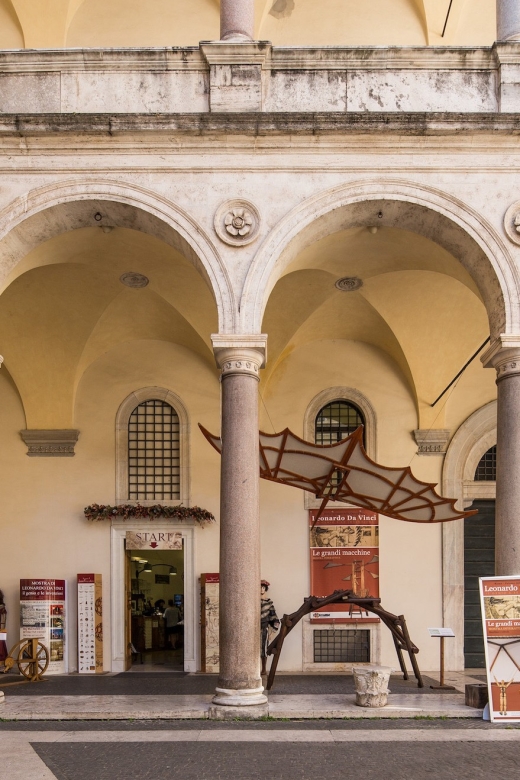
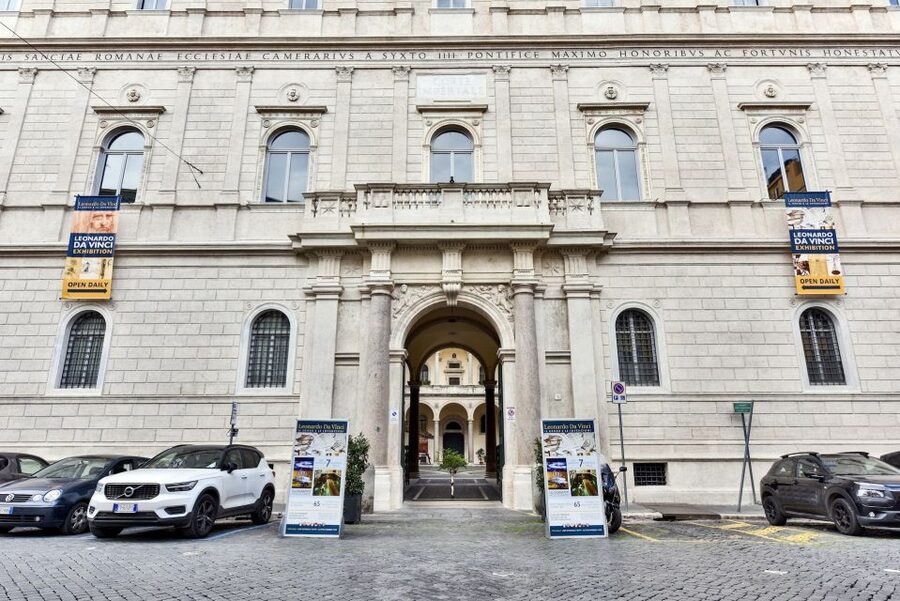
The building is part of the appeal. Palazzo della Cancelleria is owned by the Vatican and is worth noticing for its architecture, even before you focus on Leonardo’s inventions.
The exhibition is located at Piazza della Cancelleria 1, close to Campo de’ Fiori and Piazza Navona. That makes it easy to add to a walking day in central Rome. You can combine it with nearby squares, churches, cafés, and street life without setting aside half a day.
The underground area contains a tomb identified as belonging to the architect Auro Irzio and dated to 43 BC. It sits beside an underground natural pond, which is an unexpected Roman layer beneath the modern exhibition.
This detail gives the visit more character. You move from Renaissance machines to ancient Rome, then back to multimedia displays. The tomb is not the main reason to buy the ticket, but it is a memorable extra and a good reminder that Rome often places several periods in the same building.
The upper floor houses the Sacra Rota, where the church handles marriage dissolutions. That area is part of the building’s current use and is not simply another museum gallery. You should treat the palace as a working religious and historic site, not just a themed exhibition venue.
The underground rooms are also a practical refuge on a hot Roman afternoon. Several people find the cool interior welcome during summer sightseeing. At quieter times, the space can feel calm and unhurried.
How long to allow, and who will enjoy it most
The museum is small. A brisk visit can take about 45 minutes, while a more careful visit usually fits into 60 to 90 minutes. Families who stop at the machines, watch the short videos, and read the captions may spend close to two hours.
That range makes the ticket easy to fit between larger Rome sights. It is not a replacement for a full museum day, and you should not arrive expecting endless galleries. Its compact size is also a strength: you can see a wide range of Leonardo’s interests without becoming worn out.
I would recommend it most to:
- Families with school-age children who enjoy hands-on displays
- Adults interested in engineering, invention, architecture, or science
- Visitors looking for an indoor break from summer heat
- Leonardo fans who want to see drawings turned into physical models
- Anyone with an hour near Piazza Navona or Campo de’ Fiori
Art specialists seeking original Renaissance works may find the collection too basic. The exhibition gives a broad introduction to Leonardo’s ideas, but it does not offer the depth of a major research museum.
The displays are also suitable for a wide range of ages and interest levels. You can spend five minutes understanding a bridge or gear, or stay longer to think through the mechanics. That flexibility is one of the exhibition’s best features.
The $10 ticket and what you get for the money
At $10 per person, the entry price is low for central Rome. You receive exhibition admission and a gadget, while a guide is not included. The exact value depends on how much time you give the displays, but the interactive models make the ticket more than a quick look at posters.
If you only have 30 minutes, you can still see the main machines and holograms. If you stay for an hour or more, the price compares well with other paid activities in the historic center, especially because the visit includes both Leonardo material and the underground Roman tomb.
The gift shop is another small plus. It offers Leonardo-themed items and gifts that feel different from the usual Rome souvenirs. You do not need to buy anything, but it is a useful stop if you want a simple educational gift for a child or a design-minded friend.
The exhibition often feels quieter than Rome’s most famous sights. That can make the ticket particularly useful during the busiest parts of the day, though crowd levels naturally vary. Around 5 p.m., the galleries may be fairly calm, and midmorning can also be quiet on some weekdays.
Practical details for a smooth visit
The entrance is at Piazza della Cancelleria 1. Look for La Mostra Leonardo da Vinci near Campo de’ Fiori and Piazza Navona rather than treating it as a separate destination far from central Rome.
Entry is available until one hour before closing. Since the ticket is valid for one day, check the available starting times before booking and allow enough time before the final admission window.
The experience is wheelchair accessible. The underground displays and interactive stations may still require you to move carefully around the room, particularly when children are using the hands-on machines.
You can cancel up to 24 hours before the visit for a full refund, and reserve now while paying later. These policies are helpful if your Rome plans depend on weather or changing sightseeing times, but the key practical choice is still when to fit this compact visit into your day.
Bring patience for the room layout. The sequence through rooms 2, 3, and 4 may not feel immediately clear, and the audio-guide numbers may not follow the physical order. Take a moment at the entrance to understand the route, then use the exhibit labels as your main reference.
Should you book the Leonardo da Vinci exhibition?
I would book it if you want a short, affordable, hands-on museum near Piazza Navona. The best reasons are the full-scale machines, the chance to test many of them, and the unusual combination of Renaissance engineering with a Roman tomb underground.
I would skip it if your Rome schedule is already packed with major art museums and you only want original Leonardo paintings. This exhibition is about ideas made visible, not a large collection of original masterpieces.
For families, curious adults, and anyone needing a cool indoor stop, the $10 ticket is easy to justify. Add the audio guide if you want more context, and allow at least an hour so the models have time to do their work.
FAQ
Where is the Leonardo da Vinci exhibition in Rome?
The exhibition is at La Mostra Leonardo da Vinci, Piazza della Cancelleria 1, near Campo de’ Fiori and Piazza Navona.
How much does admission cost?
The listed price is $10 per person.
How long is the ticket valid?
The ticket is valid for one day. You should check availability for the available starting times.
How long does the exhibition visit take?
A quick visit can take about 45 minutes. Allow 60 to 90 minutes if you want to read the information and use the interactive displays, and families may stay close to two hours.
Is a guide included?
No guide is included with the entrance ticket. An audio guide or additional guide option may be available at extra cost.
Is an audio guide available?
Yes. An audio guide is available as an additional option and provides extra explanations, including information in English. Its stops may not follow the room order exactly.
Is the exhibition suitable for children?
Yes. The hands-on machines and interactive installations can work well for children, especially those interested in building and invention. Keep a close eye on small children because some areas have trip hazards and unclear touch instructions.
Is the exhibition wheelchair accessible?
Yes, the activity is listed as wheelchair accessible.
Can I cancel the ticket?
You can cancel up to 24 hours in advance for a full refund. A reserve-now, pay-later option is also available.
Fresh on the Rome list
- Exclusive Golf Tour Private VIP with Local & Gelato o Wine★ 5.0 · 500 reviews
- Colosseum, Palatine Hill and Roman Forum with Guided Tour★ 5.0 · 500 reviews
- Rome by Night Walking Tour★ 4.5 · 506 reviews
- Rome Trastevere Pasta Making Class with Eating Europe★ 5.0 · 505 reviews
- Rome: Colosseum Express Tour with Forum & Palatine Access★ 4.5 · 511 reviews
- Rome Food Experience Max 6 People Group Tour | w/Private Option★ 5.0 · 516 reviews
- Rome: Navona Square Underground Ticket with Audio Guide★ 4.0 · 518 reviews
- Rome: Escorted Papal Audience Experience with Entry Ticket★ 4.4 · 518 reviews
Museums, compared.
Vatican: Museums & Sistine Chapel Entrance Ticket
Read our review →
Vatican Museums & Sistine Chapel Tour with Optional Basilica
Read our review →
Vatican Museums, Sistine Chapel & St Peter’s Basilica Guided Tour
Read our review →
Skip-The-Line Uffizi Gallery Timed Entry Ticket
Read our review →
Vatican Museums, Sistine Chapel & Basilica Tour
Read our review →
Vatican Museums & Sistine Chapel Skip-the-Line Entry Ticket
Read our review →Vatican Museums, Sistine Chapel & Basilica Tour
Read our review →
Vatican Museums & Sistine Chapel Guided Tour
Read our review →Browse the lists this tour appears in