Reviewed · TICKETS
Rome: Catacombs of St. Callixtus Entry Ticket & Guided Tour
Rome’s Catacombs of St. Callixtus take you below the Appian Way, into narrow corridors lined with ancient burial chambers. The most moving stop is the Crypt of the Popes, where nine popes and three bishops were laid to rest.
I like the tour for two clear reasons: the guide brings structure to a confusing underground site, and the $16 price gives you access to a place that is difficult to understand on your own. I also like the cool, quiet setting, especially during Rome’s hot months.
The main drawback is the short running time and the out-of-the-way location. You may spend longer getting there than you spend underground, so plan your transport carefully and arrive at the ticket office at least 10 minutes early.
Key points to know before booking
- See the Crypt of the Popes, the burial place of nine popes and three bishops.
- Learn about early Christian Rome from a live guide in English, Italian, French, or German.
- Explore an ancient cemetery beneath the Appian Way, part of a vast underground complex.
- Expect a cool temperature of about 15°C, so bring a light jacket or sweater.
- Do not expect exposed bones or skeletons, since the visit focuses on burial chambers, art, and history.
- Allow extra time for transport, especially if you are coming from central Rome or traveling alone.
Why the Catacombs of St. Callixtus are worth your time
Rome is famous for its temples, fountains, churches, and grand ruins above ground. The Catacombs of St. Callixtus show another side of the city: the quiet, hidden world where early Christians buried their dead and remembered their martyrs.
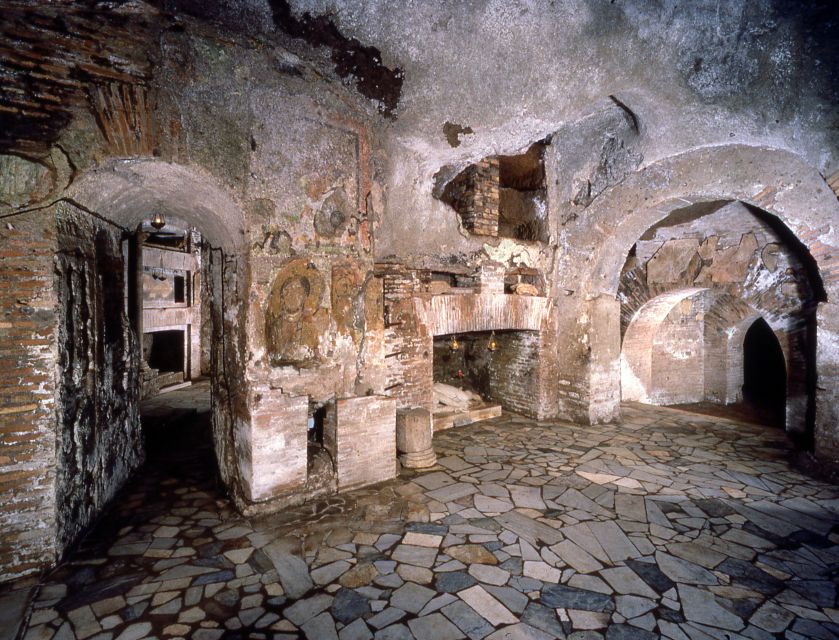
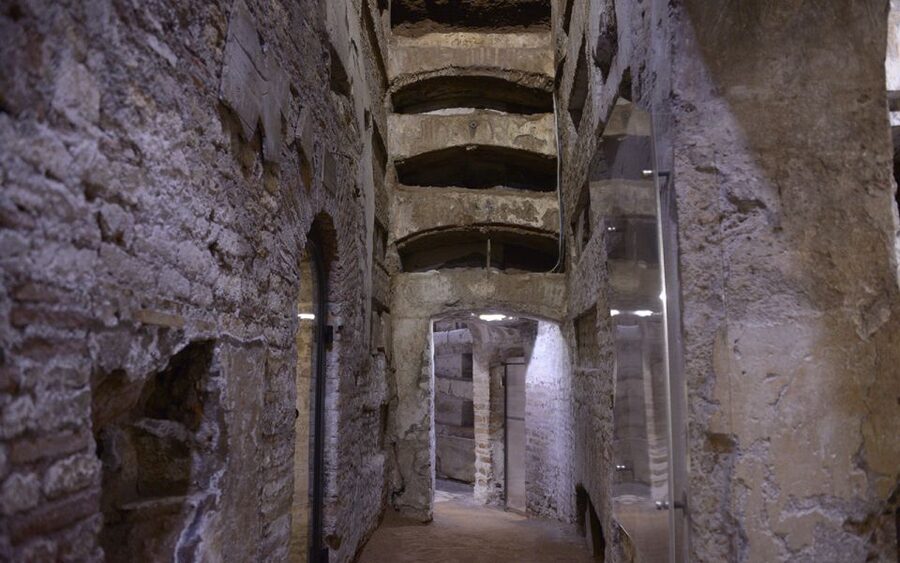
This is not a theatrical underground attraction. You will not find piles of bones or dramatic lighting. The experience is more restrained. You walk through corridors cut into the earth, listen to the guide explain the burial customs, and pause in small chambers where names, symbols, and faded paintings offer clues to an early Christian community.
The site is regarded as the oldest official cemetery of Rome’s Christian community. The wider complex is associated with an estimated half a million Christian burials, though the route you visit covers only a small part of that enormous network.
That scale matters. The corridors and rooms are not an isolated tomb. They are part of a carefully organized burial ground used over many generations. A guide helps you understand how the chambers fit together and why the site mattered to people who lived in Rome nearly two thousand years ago.
A few other Rome mornings to weigh against this
- Rome: Pantheon Fast-Track Ticket and Official Audio Guide
★ 4.3 · 21,008 reviews - Rome:Hop-On Hop-Off Panoramic Open Bus Ticket 3 Circuits x 1
★ 4.0 · 15,405 reviews - Vatican Museums & Sistine Chapel Skip-the-Line Entry Ticket
★ 4.4 · 13,838 reviews
Meeting your guide beneath the Appian Way
You go directly to the catacomb ticket office and show your voucher. This detail is important because the meeting point can be easy to misunderstand. The entrance is opposite the ticket counter, and the ticket office is not necessarily the same place as the nearby parking area.
Arrive at least 10 minutes before your scheduled start. One practical issue is that you may need to exchange or present your voucher for an entry ticket at the office before joining the tour. Give yourself time to find the right counter rather than arriving at the last second.
The catacombs are outside the historic center, near the Appian Way and the Fosse Ardeatine stop. From Termini Station, take Metro A toward Anagnina to San Giovanni, then bus 218 toward Ardeatina and get off at Fosse Ardeatine. The entrance should be in front of you.
Another route uses Metro B toward Laurentina. You can get off at Colosseo or Circo Massimo, walk to the Terme Caracalla or Porta Capena bus stop, and take bus 118 toward Appia or Villa Dei Quintili. Get off at Catacombe di San Callisto.
Public transport is possible, but it takes planning. Bus waits can add 20 minutes, and getting a taxi back into Rome may not be simple. If you are short on time, traveling with small children, or visiting alone, a taxi or ride service may be less stressful. The site is worth the trip, but it is not a casual five-minute walk from a central piazza.
The first underground corridors
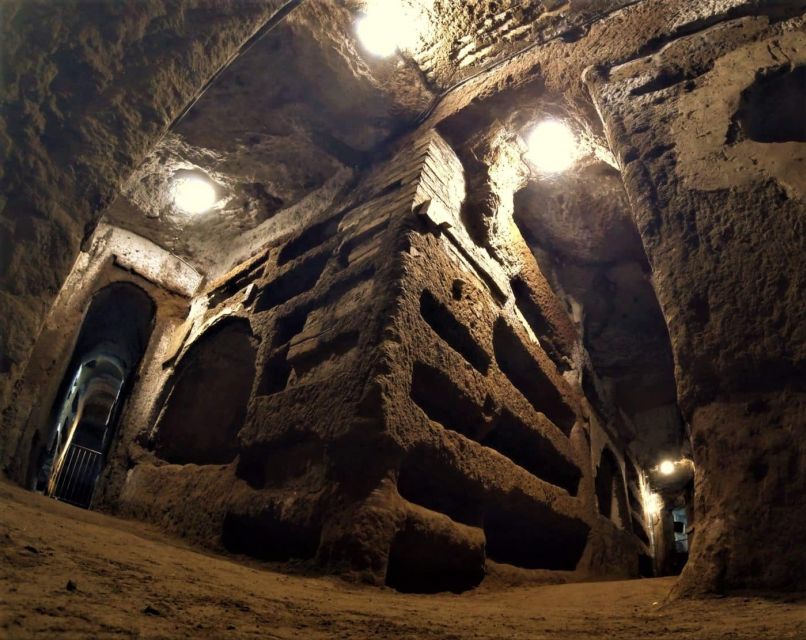
Once your group gathers, the guide leads you below ground. The tour is fully guided, so you stay with the group rather than wandering off independently. That arrangement keeps the visit orderly and helps protect the fragile site, but it also means you cannot set your own pace.
The first part gives you the basic story of the cemetery and explains where the name St. Callixtus comes from. You learn about the role of martyrs, popes, and ordinary Christians in the development of this burial ground.
The corridors can feel close, dark, and enclosed. For most people, that atmosphere is part of the appeal. It makes the setting feel genuine rather than polished for tourism. If you are uncomfortable in tight spaces or have serious mobility limits, take the warning seriously. This is not a suitable outing for people with claustrophobia or mobility impairments.
Wear comfortable shoes. The underground route is not the place for delicate footwear, and the lighting may be limited in some corners. A light sweater is useful even in August. Several parts of Rome can be hot and bright, while the chambers below remain cool, around 15°C.
The Crypt of the Popes
The central highlight is the Crypt of the Popes. Nine popes and three bishops were buried here, making the room an important reminder of how closely the early Christian community was tied to this cemetery.
The guide explains what you are seeing rather than leaving you to interpret an unmarked stone chamber. That context is the main reason to choose a guided visit. Without it, the narrow rooms and wall markings could blur together.
The crypt is not grand in the way St. Peter’s Basilica is grand. Its power comes from its simplicity and age. You are standing in a burial room connected with early Christian leaders, in a place where memory and ritual mattered more than decoration.
Photography is not allowed inside the catacombs. This may disappoint you if you like to document every stop, but it also keeps the visit quiet and respectful. Plan to enjoy the place without taking pictures. If you want a visual reminder, spend a few minutes on the property above ground before or after the tour.
Same city, an entirely different afternoon:
- Vatican Museums & Sistine Chapel Tour with Optional Basilica
★ 4.3 · 67,413 reviews - Colosseum, Roman Forum & Palatine Guided Tour
★ 4.7 · 63,148 reviews - Vatican Museums, Sistine Chapel & St Peter’s Basilica Guided Tour
★ 4.5 · 39,149 reviews - Rome: Colosseum, Palatine Hill and Roman Forum Guided Tour
★ 4.8 · 32,814 reviews
The Crypt of St. Cecilia
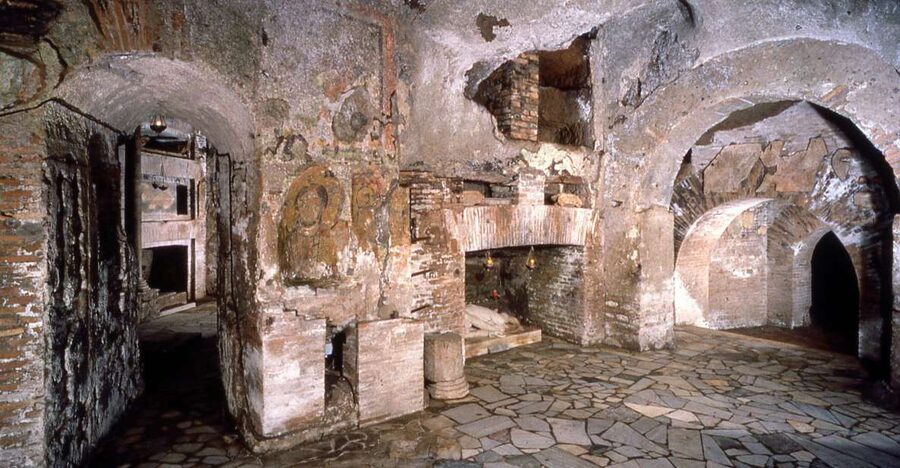
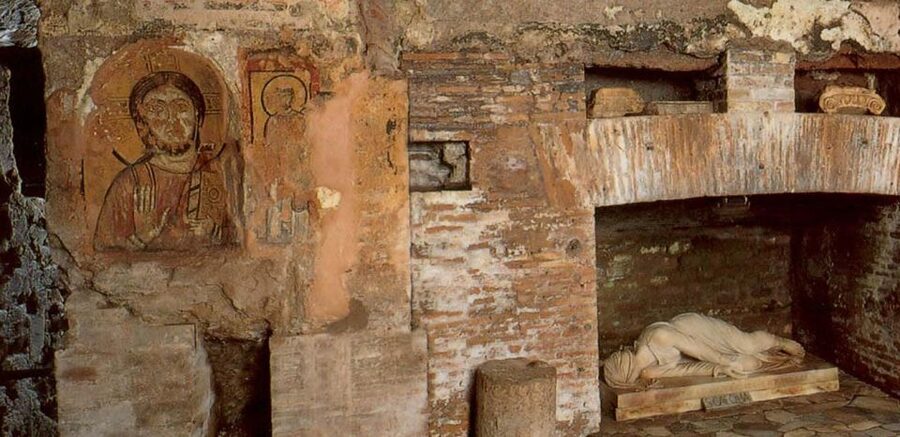
The adjoining Crypt of St. Cecilia introduces another important figure. St. Cecilia is remembered as a Roman matron who helped ensure that many martyrs received proper burial.
The guide connects her story with the wider customs of the cemetery. This gives the visit a human focus. Instead of hearing only dates and names, you learn about the people who cared for the dead and maintained the community’s traditions.
The chamber also helps explain why the catacombs are more than a collection of empty tunnels. They preserve evidence of belief, family ties, service, and the way early Christians marked important lives. You may find the tone especially moving if you have an interest in religious history, archaeology, or ancient burial practices.
The experience is reverent without requiring you to be religious. The focus is on the site, its preservation, and the people connected to it.
Early frescoes and the Cubicles of the Sacraments
The route continues to Area I, where the cubicles of the sacraments are located. These small burial rooms contain some of the oldest frescoes found in Rome’s catacombs.
The paintings are not large gallery works. Their value lies in their age and in the clues they offer about early Christian imagery. Some wall paintings remain surprisingly clear, while other parts of the site are darker and harder to read.
Your guide points out the details that matter. In a 30-minute visit, you do not have time to study every wall, so the explanations help you focus on the most significant areas. Some tours run a little longer than the advertised half hour, but you should still expect a compact route rather than an extended archaeological visit.
I like this section because it adds visual interest to the stone corridors. The Crypt of the Popes gives the tour its strongest historical focus, while the frescoes show how early Christians used symbols and decoration in spaces connected with death.
What the 30-minute format means
Thirty minutes sounds brief, and it is. You will not see every part of the catacomb complex, which extends across a much larger underground area. The visit works best as a focused introduction.
The short format can be an advantage in a busy Rome itinerary. You can fit it between other stops without giving up half a day. It also works well for families with older children and teenagers who may not have the patience for a long archaeological lecture.
The guide has to pack a great deal into a small amount of time. The strongest guides keep the story clear, pause so everyone can hear, and leave room for questions at the end. Guides named Arishba, Comfort, Sam, Francesca, Fr Peter, and Don Sam have received especially warm praise for clear explanations, humor, patience, and enthusiasm. Your assigned guide may be different, but the tour is offered with a live guide rather than an audio recording.
Some guides stay a little longer to answer questions or point out nearby places on the property. Treat that as a welcome extra, not as part of the guaranteed schedule.
Is $16 a fair price?
At $16 per person, this is one of the more affordable guided history experiences in Rome. The value comes from the combination of admission and interpretation. You are not simply paying to enter an underground site and read a few signs. A guide explains the burial customs, the Christian community, the popes, St. Cecilia, and the artwork.
The price is especially reasonable if you already plan to visit the Appian Way area. If you are making a separate journey from central Rome, add the cost and time of transport to your calculation. The ticket itself is inexpensive, but the outing takes more planning than the price suggests.
I would not book this expecting a huge underground spectacle. The route is short, photography is forbidden, and there are no visible skeletons on this visit. If your main goal is to see bones, choose another attraction. If you want a respectful look at ancient burial rooms and early Christian life, the price is fair.
The booking terms also make planning easier. You can reserve now and pay later, and cancellation is available up to 24 hours before the tour for a full refund. Check the available starting times before committing because the activity runs at scheduled times rather than as a free-flow visit.
Who will enjoy this visit most
I recommend the catacombs to you if you like archaeology, religious history, ancient Rome, or unusual sites away from the main city center. It is also a good choice if you have already seen the Colosseum and Forum and want a different kind of Roman experience.
Families with older children and teenagers can manage the short tour well. The subject may sound serious, but a lively guide can make the story accessible. Younger children may find the darkness and quiet less comfortable, and baby carriages are not allowed.
The tour suits solo visitors, but allow extra time to find the entrance and arrange your return. It also works for couples who want a calm break from Rome’s crowded streets. In summer, the cool underground temperature offers welcome relief from the heat, though you should still dress for the journey above ground.
I would skip it if you have mobility limitations, dislike enclosed spaces, or need a fully independent visit. The route is guided from start to finish, and the underground setting may feel restrictive.
Practical tips for a smoother visit
Bring comfortable shoes and comfortable clothing. Add a light jacket or sweater, even if the forecast calls for hot weather.
Keep your voucher ready at the ticket office and arrive 10 minutes early. The entrance instructions can be confusing, so look for the ticket counter and confirm where your group is forming.
Do not plan to take photographs underground. The no-photo rule is strict, so put your phone away and listen to the guide.
Allow more time than the 30-minute tour itself. Public transport is straightforward once you know the route, but bus waits and the distance from central Rome can make the full outing much longer.
If you want to combine the visit with nearby sights, ask your guide what else is worth seeing on the property or in the surrounding Appian Way area. Some guides offer useful suggestions after the formal tour ends.
Should you book the Catacombs of St. Callixtus?
Book this tour if you want a short, low-cost introduction to underground Rome and care more about history and atmosphere than dramatic displays. The Crypt of the Popes, the Crypt of St. Cecilia, and the early frescoes give the visit real substance.
Skip it if you expect exposed remains, extensive independent exploration, or an easy central location. The journey takes effort, the tour is compact, and the enclosed passages are not for everyone.
For the right visitor, this is a memorable change of pace. You leave Rome’s traffic and stone streets behind, then return with a clearer sense of how early Christian communities lived, worshipped, buried their dead, and remembered those who came before them.
FAQ
How long does the Catacombs of St. Callixtus tour last?
The scheduled tour lasts 30 minutes. Some visits may run slightly longer, especially if the guide answers questions at the end.
What does the ticket include?
The price includes entry to the Catacombs of Saint Callixtus and a guided tour.
Is the tour available in English?
Yes. Live tours are offered in English, Italian, French, and German.
Where do I meet the guide?
Go directly to the ticket office at the catacomb entrance and show your voucher. The entrance is opposite the ticket counter, so do not rely only on the nearby parking area as the meeting point.
How early should I arrive?
You should arrive at least 10 minutes before the scheduled tour.
Can I take photographs inside?
No. Photography is not allowed inside the catacombs.
Will I see skeletons or exposed bones?
No. The visit focuses on the burial chambers, history, frescoes, and burial traditions. Exposed skeletons are not part of this tour.
How do I reach the catacombs by public transport?
From Termini, take Metro A toward Anagnina to San Giovanni, then bus 218 toward Ardeatina and exit at Fosse Ardeatine. Another option is Metro B to Colosseo or Circo Massimo, followed by bus 118 toward Appia or Villa Dei Quintili, exiting at Catacombe di San Callisto.
Is the tour suitable for people with claustrophobia or mobility impairments?
No. The activity is not suitable for people with claustrophobia or mobility impairments. Baby carriages are also not allowed.
Can I cancel the booking?
Yes. You can cancel up to 24 hours before the activity for a full refund. Reserve now and pay later is also available.
Fresh on the Rome list
- Exclusive Golf Tour Private VIP with Local & Gelato o Wine★ 5.0 · 500 reviews
- Colosseum, Palatine Hill and Roman Forum with Guided Tour★ 5.0 · 500 reviews
- Rome by Night Walking Tour★ 4.5 · 506 reviews
- Rome Trastevere Pasta Making Class with Eating Europe★ 5.0 · 505 reviews
- Rome: Colosseum Express Tour with Forum & Palatine Access★ 4.5 · 511 reviews
- Rome Food Experience Max 6 People Group Tour | w/Private Option★ 5.0 · 516 reviews
- Rome: Navona Square Underground Ticket with Audio Guide★ 4.0 · 518 reviews
- Rome: Escorted Papal Audience Experience with Entry Ticket★ 4.4 · 518 reviews
Tickets, compared.
Vatican: Museums & Sistine Chapel Entrance Ticket
Read our review →
Cathedral and Duomo’s Terraces Entrance Ticket
Read our review →

Skip-The-Line Uffizi Gallery Timed Entry Ticket
Read our review →
Naples Underground Entry Ticket and Guided Tour
Read our review →
Pantheon Fast-Track Ticket and Official Audio Guide
Read our review →
Entry Ticket and Guided Tour with an Archaeologist
Read our review →