Reviewed · GUIDED
Rome: Castel Sant’Angelo Guided Tour
Castel Sant’Angelo is one of Rome’s most unusual time machines. It began as Emperor Hadrian’s tomb, then became a fortress, papal residence, treasury, prison, and site of public executions. This guided visit connects those very different chapters before taking you up to a panoramic terrace above the Tiber.
I like the included admission, which saves you from handling the entrance on your own, and I like having a guide explain why a grand imperial tomb ended up tied so closely to the papacy. The rooftop views are another strong point. The main drawback is the climb: reaching the terrace involves many stairs, with one visitor counting about 270, and a few sections have limited handrails.
Key points to know before booking
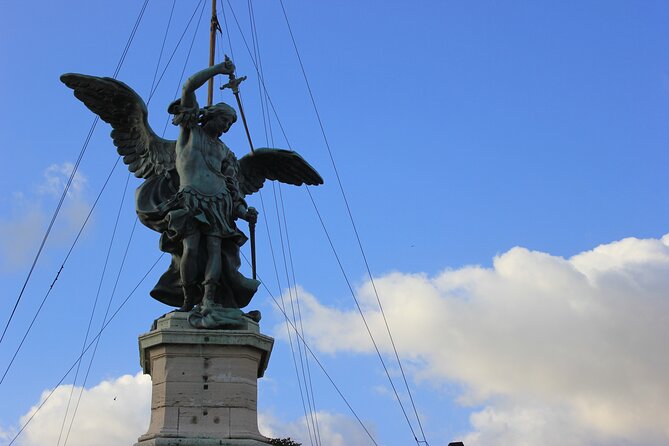
- Hadrian’s tomb became a papal stronghold: The tour explains the building’s shift from imperial mausoleum to fortress and papal retreat.
- The terrace is the payoff: You get broad views over Rome and the Tiber, with a useful sense of how the city fits together.
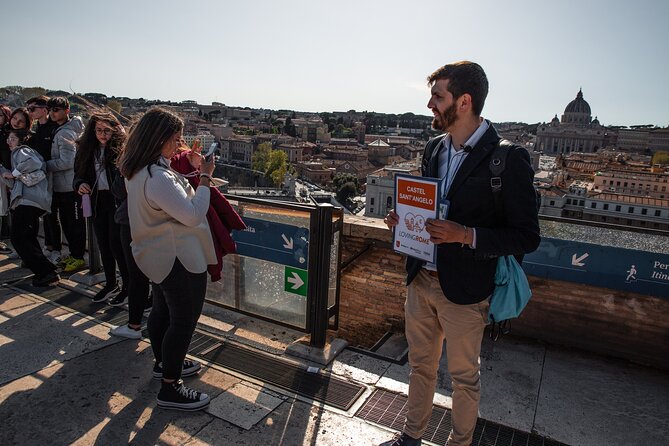
- Guided commentary adds context: The castle has signs, but a good guide ties together Roman, papal, military, and religious history.
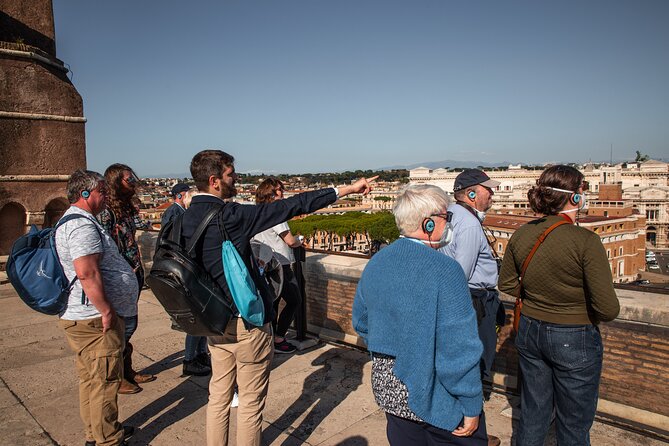
- Headsets help in crowded rooms: You can follow the guide without standing shoulder to shoulder at every stop.
- Expect serious stair climbing: The terrace is not reached by an easy lift ride, so wear firm, comfortable shoes.
- Small groups are possible, but guides vary: The advertised maximum is 20 people, and most praise goes to guides such as Alec, Agnes, Silvia, Clarissa, and Alessia.
Why Castel Sant’Angelo is worth your time
Castel Sant’Angelo can look like a bulky stone cylinder from the street. Inside, it is a layered record of Rome’s changing power. The original purpose was imperial and funerary. Later, popes adapted it into a fortified refuge, a residence, and a place to protect church wealth.
That mix makes the visit different from a standard palace tour. You are not simply walking through decorated rooms. You are following a building that had to survive political danger, military threats, and the changing needs of Rome’s rulers.
A guide is especially useful here because the rooms do not always explain their connections clearly. The tour links the emperor’s burial place with the papal apartments, the treasury, defensive spaces, and the route toward the roof. I like that larger story. It helps you understand why this fortress mattered, not just what each room looked like.
The visit lasts about two hours, depending on the option you choose. That is enough time for a guided route without turning the castle into an all-day commitment. It also fits neatly between other central Rome sights, particularly if you are already near the Tiber, Piazza Navona, or St. Peter’s Basilica.
A few other Rome mornings to weigh against this
- Colosseum, Roman Forum & Palatine Guided Tour
★ 4.7 · 63,148 reviews - Vatican Museums, Sistine Chapel & St Peter’s Basilica Guided Tour
★ 4.5 · 39,149 reviews - Rome: Colosseum, Palatine Hill and Roman Forum Guided Tour
★ 4.8 · 32,814 reviews
Meeting at Lungotevere Castello
The meeting point is Lungotevere Castello, 50, beside the castle. The activity begins and ends at the same location, so you do not need to arrange a separate return transfer. The site is near public transportation, but you are responsible for getting there yourself because hotel pickup and drop-off are not included.
Plan to arrive early. Tickets are valid only for the selected date and time, and late arrivals or no-shows are not accommodated or refunded. Rome traffic can slow down even short journeys, so leave a generous margin if you are coming from another part of the city.
Bring the passport or valid ID used for booking. The attraction requires the full name of every participant, exactly as it appears on the document, and staff may check identification at the entrance. This is a small detail, but getting it wrong can create a serious problem at a timed attraction.
The tour is offered in English. A maximum of 20 people is listed, though the actual size depends on the departure and option selected. Headsets are provided if needed, a useful touch when the rooms are crowded or when the guide is explaining something from several steps away.
From Hadrian’s tomb to the fortress of the popes
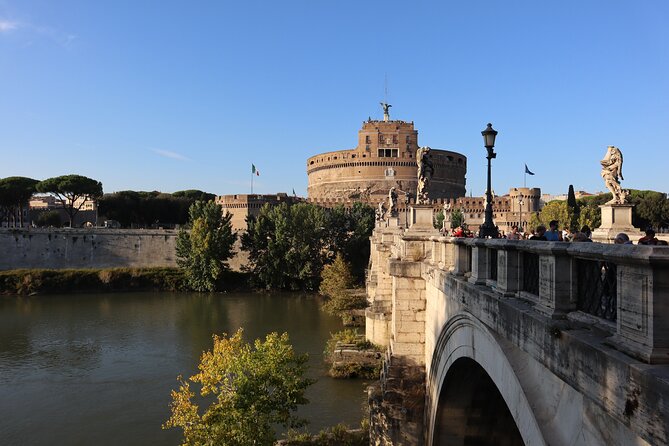
The first part of the visit focuses on the building’s Roman origin. Castel Sant’Angelo was created as the burial place of Emperor Hadrian, so the tour begins with a very different image of the structure than the one most people carry from the street. It was first a monumental tomb, not a papal palace.
From there, the story moves through the building’s later roles. The castle became a military stronghold and was used by popes as a private residence. It also held state treasure and served as a prison. The same thick walls that protected important people and valuables could also confine those who had fallen out of favor.
This is where a strong guide can make the visit memorable. Alec is praised for mixing humor with clear explanations, while Agnes and Agnese are noted for bringing the castle’s story to life. Silvia is described as both warm and well informed, and Alessia is praised for adjusting the pace for slower walkers.
Those names do not guarantee who will lead your tour, but they show the kind of guide you may receive. The best parts of the experience depend heavily on presentation. A skilled guide can make the transitions between emperor, pope, prisoner, and fortress feel logical rather than like a list of unrelated facts.
The papal apartments and decorated interiors
The papal apartments give you a look at the castle as a place of power and private life. You can expect to see grand architecture and paintings, with explanations about how the popes used the building. These rooms offer a sharp contrast to the castle’s defensive purpose.
The tour also includes the treasure room. This stop helps explain why the castle was more than a residence. It was a secure place for valuable belongings and state wealth, protected by the building’s heavy construction and strategic position.
The interiors are not simply about decoration. They show how the papacy used architecture to project authority while keeping a fortified escape point close to the Vatican. The route ties the castle to the wider story of Rome and the papal court, including the challenge of protecting religious and political power in an unstable city.
You will hear a great deal in two hours. One guide is praised for offering more detail than usual, while another is described as thorough and enthusiastic. That can be a major benefit if you enjoy historical context, but it may feel like a lot if you prefer a quick, visual visit.
Same city, an entirely different afternoon:
- Vatican Museums & Sistine Chapel Tour with Optional Basilica
★ 4.3 · 67,413 reviews - Rome: Guided Tour of Colosseum, Roman Forum & Palatine Hill
★ 4.7 · 27,897 reviews - Rome: Colosseum & Forum with Audio Guide App -Optional Arena
★ 4.2 · 24,770 reviews - Rome: Colosseum, Roman Forum and Palatine Hill Guided Tour
★ 4.5 · 23,903 reviews
The prison, executions, and harder chapters
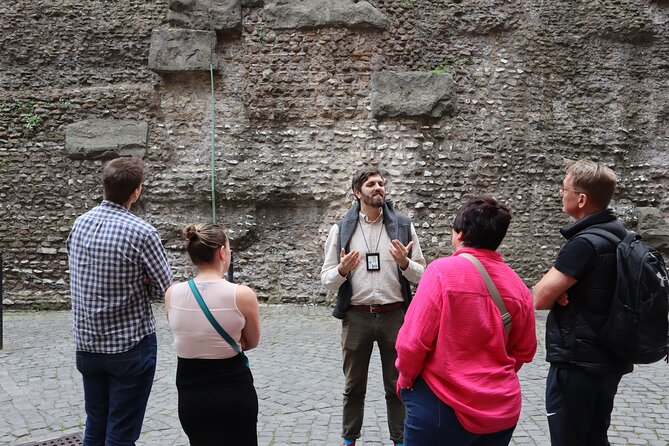
The castle’s story has a darker side. It was used as a prison and a site of public executions, so the visit is not only about emperors, art, and rooftop photographs. The guide brings attention to the building’s role in punishment and control.
I appreciate tours that do not polish away these parts of a monument. They help you see Castel Sant’Angelo as a working institution, not only a beautiful viewpoint. The fortress protected some people while imprisoning others, and its changing roles reflect the unequal nature of Roman power.
The religious side of the story can also invite strong opinions. One poor experience involved a guide repeatedly criticizing Christianity and people who believe in God. A guide may discuss the papacy and the church critically, which can add useful context, but the presentation should remain respectful. If you want a neutral, history-focused explanation, be aware that the guide’s personal approach can affect the tone.
The Bridge of Angels and the Tiber
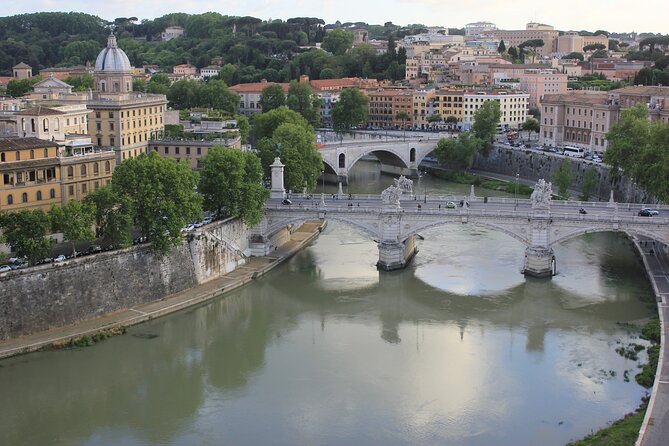
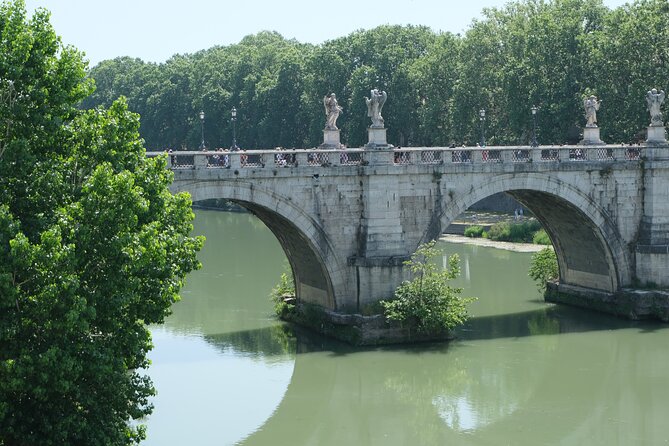
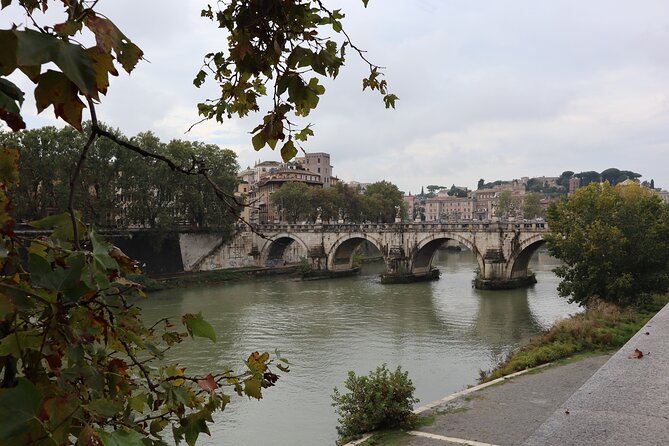
Before or after entering the castle, take time to notice Ponte Sant’Angelo, the Bridge of Angels. The bridge is lined with angel sculptures and creates one of the most memorable approaches to the fortress. It also gives you a clear sense of the castle’s position beside the Tiber.
The bridge and castle work together visually. The angels guide your eye toward the massive fortress, while the river opens the view on either side. The tour’s rooftop commentary may also help you understand Rome’s layout, with the guide pointing out major monuments and explaining how the city is arranged.
This is one reason I would not treat the castle as an isolated stop. Its setting matters. From the bridge, the building looks imposing. From inside, you see its practical defenses. From the terrace, you understand its commanding position above the river and surrounding city.
Climbing to the terrace
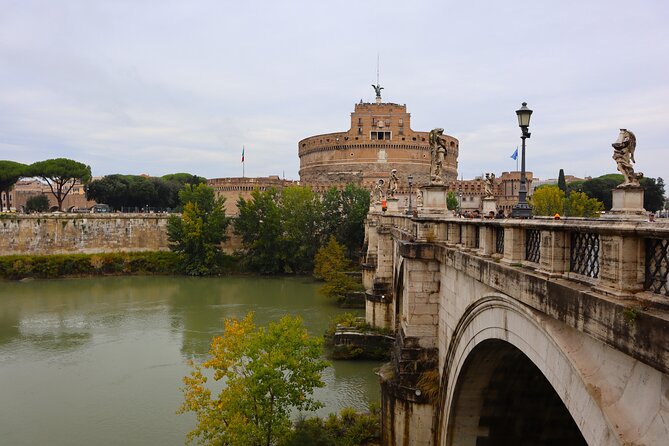
The terrace is the highlight for many people. From the top, you get wide views across Rome and the Tiber, with an angle that differs from the city’s usual church domes and piazzas. The guide can point out major landmarks and help you get oriented.
The climb is also the tour’s main physical challenge. The official information says you must climb a series of stairs, and one detailed account describes roughly 270 steps. Some sections may have little or no handrail and can feel more like old earthen passageways than polished museum stairs.
If you have a moderate fitness level and are comfortable with uneven historic interiors, the climb should be manageable at a steady pace. Still, do not assume a few stairs means a short climb. Wear shoes with good grip, take your time, and tell the guide if you need a slower pace. Alessia was specifically praised for accommodating slower walkers, but you should not count on every departure having the same style.
At the top, the effort pays off. Guides have taken photos for visitors, and the open view provides a calm pause after the enclosed rooms and stairways. One option even led to a drink at the castle café afterward, but that should not be treated as a guaranteed inclusion because the stated inclusions list does not promise a beverage.
How much is the $70.17 price worth?
At $70.17 per person, this is not the cheapest way to enter Castel Sant’Angelo. You are paying for admission, a local guide, the panoramic terrace visit, and headsets when needed. The value depends on how much you want interpretation rather than simple access.
If you already know the story of Hadrian’s tomb and the papal fortress, buying entry and exploring independently may be enough. The castle has English signage, and one unhappy participant felt a self-guided visit would have been better after a short tour. The audio guide is not included either, so independent visitors would need to decide how much explanation they want.
I think the guided price makes more sense for a first visit, especially if Roman and papal history are new to you. A good guide can connect details that are easy to miss, such as the shift from imperial burial site to papal refuge and the role of the treasury and prison.
The cost is also easier to justify for people who value time. Included admission means you do not have to sort out the entrance yourself, and a two-hour route gives you a clear structure. The experience is less worthwhile if your guide rushes, loses the group, or stops guiding before the advertised end. One severe complaint described a guide running ahead and leaving the group after less than an hour, while another report described a delayed start followed by an excellent tour. Those uneven experiences are important to keep in mind.
Group size, pace, and guide quality
The maximum group size is 20 people. That is small enough for a guide to speak directly to you, though a full group can still stretch across stairways and rooms. The headsets matter most in those moments.
Guide quality is the biggest variable. Alec is praised for humor and for keeping a child engaged. Agnes and Agnese receive repeated praise for storytelling, warmth, and enthusiasm. Clarissa, Federico, Teresa, and Silvia are also described as clear, friendly, and well prepared.
Most importantly, the positive accounts praise guides who make the facts easy to follow. That is more useful than a guide who simply recites dates. You want someone who explains why the castle changed, what the rooms were for, and how the building fits into Rome’s political story.
There are two cautions. One complaint describes poor group control, with the guide failing to check whether everyone was together. Another describes repetitive commentary and a guide ending the guided portion after one hour. These are not minor issues on a paid, timed experience. Stay close to the guide, pay attention when the group moves, and speak up quickly if you cannot hear or see what is happening.
Who should book this castle tour?
I would choose this tour if you want the castle’s story explained in person, enjoy seeing historic interiors, and care about reaching the terrace. It suits first-time visitors to Castel Sant’Angelo who might otherwise miss the links between the Roman tomb, papal apartments, treasury, prison, and fortress.
It also works well for families if you get an engaging guide. Alec was praised for holding a daughter’s attention, which matters in a building with plenty of history but no shortage of stairs. The visit can be a good choice for older children who enjoy stories of emperors, popes, secretive fortresses, and dramatic power shifts.
I would think twice if you have trouble with stairs, need a very quiet pace, or want complete control over how long you spend in each room. The terrace requires a real climb, and a guided group moves according to its schedule. Anyone carrying large luggage should also make other arrangements, since luggage and large bags are not allowed.
Book only when you can commit to the selected time. Cancellation is free up to 24 hours before the start, but changes or cancellations inside that window are not refunded. The experience also requires a minimum number of participants, and if that minimum is not met, you are offered another date or experience, or a full refund.
Should you book Castel Sant’Angelo Guided Tour?
Yes, if the price fits your budget and you want a clear historical explanation rather than a quick walk through the rooms. The best parts are the building’s unusual transformation, the papal apartments and treasury, the Bridge of Angels setting, and the broad rooftop views.
Before booking, accept two conditions: guide quality can vary, and the terrace climb is substantial. If you are fit enough for the stairs and stay close to the group, this is a worthwhile way to see one of Rome’s most layered monuments. If you prefer to move slowly and read every sign, buy entry on your own instead.
FAQ
How long does the Castel Sant’Angelo tour last?
The tour lasts approximately two hours. A one-hour option is also available, depending on the option selected during booking.
What is included in the price?
The price includes access to Castel Sant’Angelo, a local guide, the panoramic terrace visit, and headsets if needed. Hotel pickup, hotel drop-off, and an audio guide are not included.
Where does the tour begin and end?
The tour begins at Lungotevere Castello, 50, 00193 Rome, Italy. It ends back at the same meeting point.
Is the tour offered in English?
Yes. The tour is offered in English.
Do I need to bring identification?
Yes. Bring your passport or valid ID on the day of the visit. The full name of each participant must be provided during booking exactly as it appears on the passport or valid ID.
How many stairs are there to the terrace?
You must climb a series of stairs to reach the panoramic terrace. One detailed account describes about 270 stairs, with some sections having limited handrails. A moderate level of physical fitness is recommended.
Fresh on the Rome list
- Guided tour of the Colosseum, Roman Forum and Palatine in Spanish★ 4.5 · 191 reviews
- Rome: Guided Catacombs Tour & Capuchin Crypt (Audio Guide)★ 4.3 · 191 reviews
- Rome: Borghese Gallery Guided Tour with Skip-the-Line Ticket★ 4.5 · 192 reviews
- Rome: Arena Colosseum Tour with Arena Access★ 4.6 · 193 reviews
- Rome: Colosseum & Roman Forum Guided Tour★ 5.0 · 194 reviews
- Colosseum, Forum, Palatine Hill with audio guide and Arena or Bus option★ 4.0 · 193 reviews
- Rome: Domus Aurea Guided Tour and Virtual Reality Experience★ 4.7 · 194 reviews
- Rome Vintage Fiat 500 car Tour With Photographer★ 5.0 · 194 reviews
Guided, compared.
Colosseum, Roman Forum & Palatine Guided Tour
Read our review →
Vatican Museums, Sistine Chapel & St Peter’s Basilica Guided Tour
Read our review →
Colosseum, Palatine Hill and Roman Forum Guided Tour
Read our review →
Guided Tour of Colosseum, Roman Forum & Palatine Hill
Read our review →
Colosseum & Forum with Audio Guide App -Optional Arena
Read our review →
Colosseum, Roman Forum and Palatine Hill Guided Tour
Read our review →
Naples Underground Entry Ticket and Guided Tour
Read our review →