
Reviewed · LECCE TOURS
Discovering Lecce
Lecce is the kind of city that rewards a guide who can read its stonework. This two-hour walk brings you from the theatrical Piazza del Duomo to Roman ruins and the carved façade of Santa Croce, with local guide Lorenzo explaining how religion, politics, war, and art shaped the city.
I like the tour’s easy pace and compact route. You cover the main sights without being marched across town, and Lorenzo’s background in art gives the Baroque details real meaning. I also like the human touch: several tours have included a stop for cake and a Caffè Leccese, the local iced sweet-almond coffee.
The main point to consider is that the four stops are viewed from outside, and church or museum admission is not included. If you want to study interiors at length, you will need to return on your own. The tour is also weather-dependent, so rain can affect the plan.
Key points to know before booking
- Piazza del Duomo opens like a Baroque stage, with a tall bell tower, cathedral, bishop’s palace, and seminary palace gathered in one grand space.
- Lorenzo is the central strength of the walk, combining local knowledge, art history, humor, and clear English.
- Roman Lecce appears beside Baroque Lecce, with the ancient theater and half-exposed amphitheater woven into the modern center.
- The pace is relaxed and the group is capped at 15, making it easier to hear the guide and ask questions.
- Coffee or tea is included, and the break may feature cake and Caffè Leccese.
- The route ends at Santa Croce, but entrance tickets to churches and museums are extra.
Why this short Lecce walk works
Lecce can feel confusing at first. Its old center is a mix of Roman remains, churches, aristocratic palaces, Venetian touches, and elaborate local Baroque. A self-guided stroll will show you plenty of pretty stone, but it may not explain why one façade is covered in angels while another carries a military or religious message.
This tour gives you that framework in about two hours. You move through a small section of the historic center, stopping at four major sites. The route is not built around long museum visits. Instead, it helps you understand Lecce from its streets and squares, then leaves you with a clear list of places to revisit.
Lorenzo is especially well suited to this approach. He presents a lot of material without turning the walk into a lecture. His humor keeps the tone light, while his interest in architecture gives the route more substance than a simple photo stop.
The group limit of 15 matters here. Lecce’s old streets and squares are made for walking, not for a large crowd gathered around a flag. A smaller group also gives you a better chance to ask about a carved figure, a Roman fragment, or a restaurant suggestion.
A few other Lecce mornings to weigh against this
- Lecce: Baroque Architecture and Underground Walking Tour
★ 4.7 · 842 reviews - Small group tour of the caves of Santa Maria di Leuca
★ 5.0 · 806 reviews - 3 Hour Group Tour by Boat to the Caves of Santa Maria di Leuca
★ 5.0 · 472 reviews
Piazza del Duomo, Lecce’s Baroque stage
The tour begins near the Accademia di Belle Arti on Via Giuseppe Libertini and heads to Piazza del Duomo. This is one of Lecce’s most impressive urban spaces because the square feels enclosed, almost like an outdoor theater.
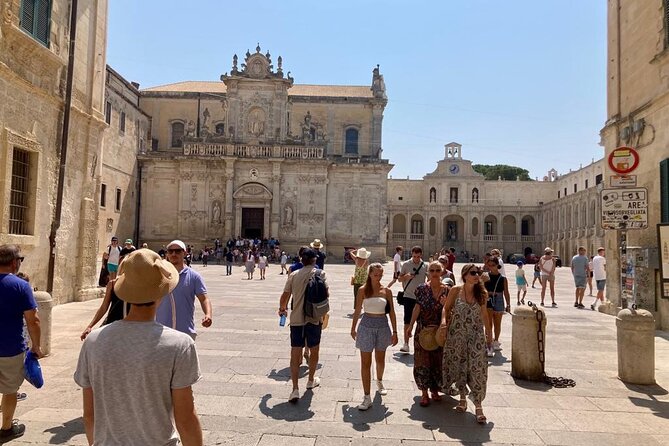
The cathedral occupies the center of the view, with a façade decorated by a balustrade, flowers, angels, and pointed details. Above it is a statue of Sant’Oronzo, the city’s protector. The design is a fine example of the ornate Baroque style associated with Lecce, where local limestone could be carved into unusually fine shapes.
The bell tower draws your eye upward. Built in the late 17th century by Giuseppe Zimbalo, it rises above the square and ends in a majolica dome. Zimbalo is one of the names you will hear again and again when studying Lecce’s churches and decorative stonework.
On the other side of the square, the Episcopio has a portico with a formal, columned entrance. The Palazzo del Seminario adds another architectural layer, with rusticated stone and an eclectic Baroque design linked to Giuseppe Cino.
This stop lasts about 20 minutes and is viewed from outside. That is enough time to understand the layout and hear the main story, but not enough for a detailed look at every sculpture. If the cathedral is open and you want to enter, plan to do so later, since admission is not part of the tour.
I find this a smart first stop because it teaches you how to look at Lecce. Instead of seeing decoration as visual overload, you begin to notice the competing lines, symbols, and theatrical effects.
The Roman Theater and Lecce beneath the Baroque
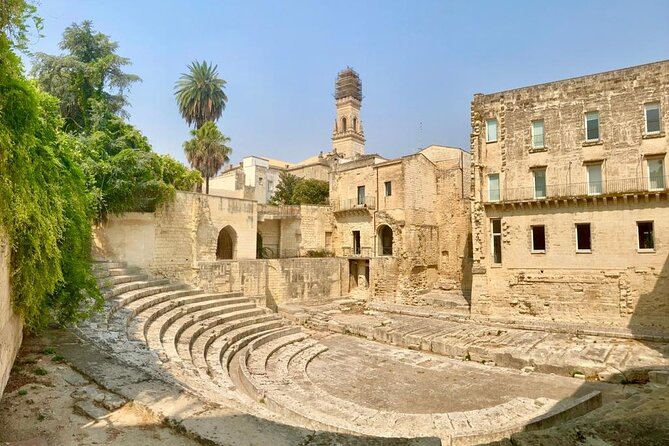
Next comes the Teatro Romano di Lecce, seen from outside for about 15 minutes. The theater dates from the Augustan age, when Roman building projects shaped much of the city.
Over time, the theater disappeared beneath later construction. Excavation in the 19th century revealed its orchestra, proscenium, terraces, and open seating areas. Today, it is a quiet archaeological space framed by Baroque gardens.
This stop is valuable because it corrects a common first impression of Lecce. The city is famous for its 17th-century façades, but its story reaches back much further. The Roman theater helps you picture the city before the churches, palaces, and elaborate stone carving took over the streets.
The setting also creates a useful contrast. Roman theaters were built for public performance and civic life, while the later Baroque buildings around Lecce expressed religious devotion, civic pride, and the power of local institutions.
Again, you are not buying an archaeological site ticket as part of the experience. The guide gives you a view and context from the public route. If Roman remains are your main interest, you may want to return afterward for a closer visit if access is available.
Piazza Sant’Oronzo and two thousand years of city life
Piazza Sant’Oronzo is the heart of the walk. The square was once called Piazza dei Mercadanti, or the Merchants’ Square, and still carries signs of its commercial past.
Here, Lorenzo connects Lecce to the influence of the Maritime Republic of Venice. The Palazzo del Sedile, once used for exhibitions and city assemblies, shares the square with the Church of Saint Mark. These buildings help explain that Lecce was not isolated from wider Mediterranean currents.
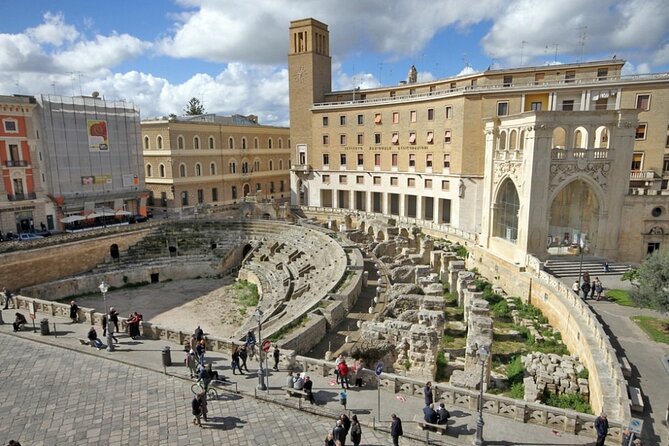
The square also borders the ancient Roman Amphitheater. Only part of the amphitheater has been uncovered, leaving it half revealed among buildings from several eras. Baroque, Art Nouveau, Rationalist, and Venetian styles all appear around the same public space.
That mixture is one of Lecce’s most interesting features. You are not walking through a perfectly preserved single-period set. You are seeing a working city built layer upon layer, with Roman stone below and later civic, religious, and residential buildings around it.
The amphitheater is a particularly strong visual lesson. Its curved remains sit right in the center of modern Lecce rather than behind a distant archaeological fence. The partial excavation makes the site less complete than a fully exposed arena, but it also shows how much of the ancient city remains under later streets.
This stop takes about 20 minutes and is free. It is a good place to pause, take photographs, and ask Lorenzo about the city’s long changes. His storytelling style is reportedly light, with enough humor to keep the chronology from becoming a list of dates.
Same city, an entirely different afternoon:
- Snorkelling-Tour in Porto Cesareo with typical aperitif
★ 5.0 · 452 reviews - Lecce: Pasta Making Class in 1400s-Era Courtyard with Wine
★ 4.7 · 369 reviews - Lecce: City Highlights Guided Tour by Bike
★ 4.8 · 362 reviews - Tour to 4 Towns of Salento: Otranto, Leuca, Gallipoli, Galatina
★ 5.0 · 360 reviews
Santa Croce and the meaning behind the stone
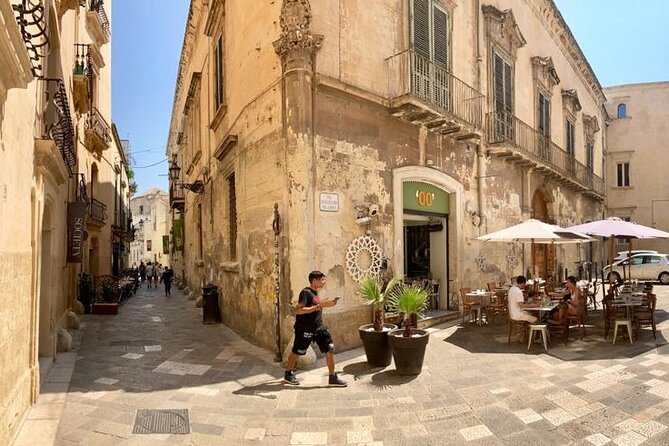
The final stop is the Basilica di Santa Croce, where the walk ends. The façade is one of Lecce’s great Baroque creations, and it is easy to spend several minutes simply taking in the carved surface.
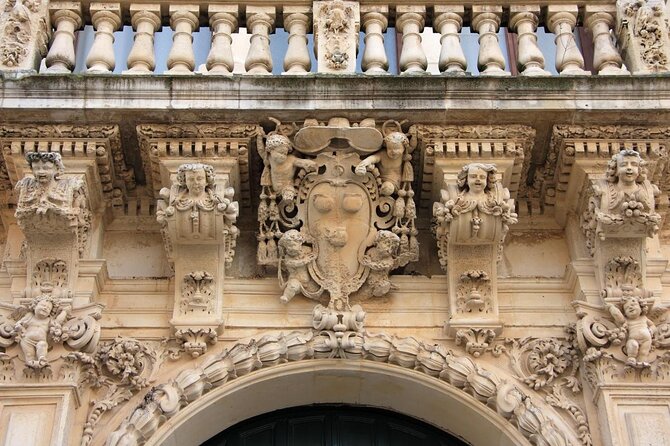
The church’s decoration is connected to the Battle of Lepanto and presents the triumph of the Christian and Western European world. That message gives the façade more weight than a collection of beautiful ornaments. The symbols were meant to communicate faith, victory, protection, and political identity.
Look closely at the contrast between the lower and upper sections. The façade combines strong architectural lines with an abundance of carved figures and decorative forms. This is the moment when the tour’s earlier discussion of Lecce stone and Baroque visual language comes together.
The basilica is viewed from outside during the tour, and admission is not included. That is a drawback if you hoped to see the interior as part of the two-hour route. On the other hand, ending here gives you a useful next step. You can decide if the church deserves a separate visit rather than trying to squeeze an interior tour into an already full walk.
Santa Croce is on Via Umberto I, and the tour finishes there rather than returning to the starting point. Keep that in mind when planning your next stop.
Lorenzo’s guiding style
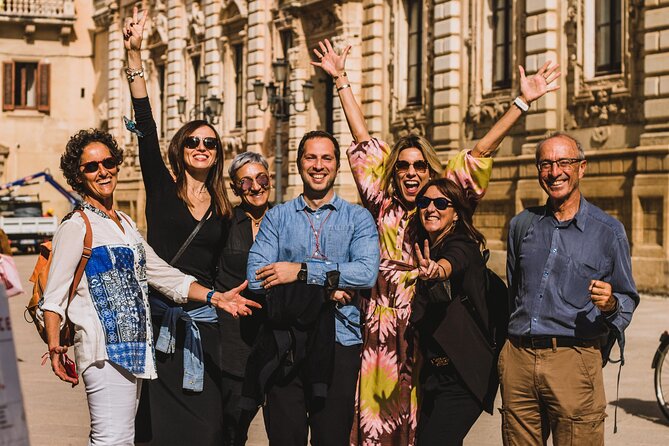
The strongest part of this experience is Lorenzo’s delivery. He is described as a native of Lecce with a background in art, and that combination fits the route well. He can discuss architecture and religious symbolism, but he also knows how to make the material easy to follow.
I like guides who explain what I am looking at without making me feel I am sitting an exam. Lorenzo’s style appears to be animated, friendly, and occasionally quirky. He uses humor, but the jokes do not replace the substance.
His English is described as very good, and he takes time to speak with people in the group. That matters on a walking tour with several centuries of history packed into a short period. You need clear explanations and a guide willing to repeat or reframe a point when the architecture gets complicated.
The tour also seems flexible in spirit. On one occasion, Lorenzo offered to postpone because of heavy rain, then went ahead when the group chose to continue. That does not mean poor weather should be ignored. The route is outdoors, and the operator requires suitable conditions.
The coffee break and what it adds
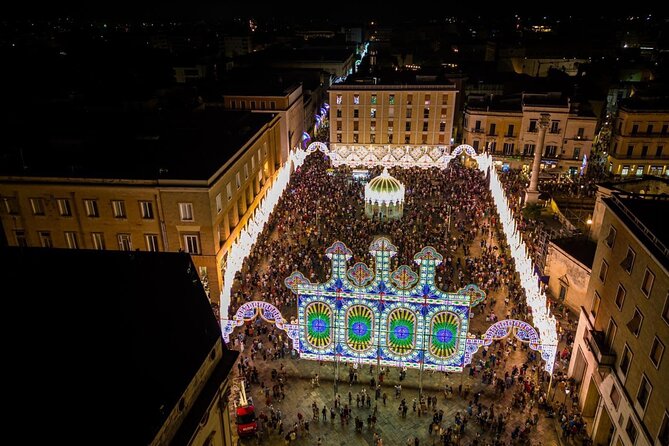
Coffee or tea is included, which is a pleasant extra at this price. The break has also included a stop at 00 Doppiozero for cake and Caffè Leccese, an iced coffee made with sweet almond flavoring.
Because the published route does not assign a formal time or location for the refreshment, you should treat the pastry and almond coffee as a possible feature rather than a guaranteed menu. Still, it fits the tour well. A short café pause gives you a chance to process what you have seen and ask about local food or places to visit later.
The coffee stop also keeps the walk from feeling too packed. Two hours can pass quickly when a guide is discussing Roman archaeology, medieval Catholicism, Baroque architecture, and the role of religion in warfare. A brief pause helps the experience feel like a morning in Lecce rather than a race through a checklist.
Price, timing, and practical value
At $35.09 per person, the tour offers solid value if you want an introduction rather than a series of paid admissions. The price covers the guided walk and coffee or tea, but not entry to churches or museums.
That distinction is important. You are paying for interpretation, local perspective, and a well-planned route through the center. If you were hoping for included access to several interiors, this is not the right product. If you want to understand what you are seeing before exploring independently, the cost is reasonable.
The advertised length is about two hours. The four stops receive roughly 20 minutes at Piazza del Duomo, 15 minutes at the Roman Theater, 20 minutes at Piazza Sant’Oronzo, and 20 minutes at Santa Croce. The remaining time allows for walking, explanation, questions, and the coffee break.
The tour is offered in English and uses a mobile ticket. Confirmation arrives when you book. Most people can take part, and service animals are allowed.
It is best for someone staying in Lecce who wants a first look at the old center, especially if you care about architecture and local stories. It also suits people who prefer a small group and a calm walking pace. Families and older adults may appreciate the short duration, though the tour is still an outdoor walk and weather can affect comfort.
How to get the most from the route
Start at the Accademia di Belle Arti, Via Giuseppe Libertini 3. The finish is at the Basilica of the Holy Cross, Via Umberto I 1, so do not assume you will return to the starting point.
Wear shoes suited to city walking and check the forecast. The experience depends on good weather, with a different date or full refund offered if poor conditions cause cancellation.
Bring your own plan for the interiors. Since the cathedral, Santa Croce, and other churches or museums are not included, note their opening hours separately if you want to go inside.
I would also keep the rest of the morning or afternoon somewhat open. The guide’s local suggestions may tempt you to linger, and the café break can point you toward more food stops. A tour like this works best as an orientation, not as the only thing you do in Lecce.
Who should book Discovering Lecce?
Book it if you want a clear introduction to Lecce’s Baroque center in two hours, with Roman remains, civic squares, church façades, and local context all in one route. Lorenzo’s mix of art knowledge, warmth, humor, and passion is the main reason to choose this walk over simply following a map.
It is less suitable if your priority is entering several churches or spending a long time at archaeological sites. In that case, use the walk to learn the layout, then return independently with admission money and extra time.
For most first-time visitors to Lecce, I would book it early in the stay. The route gives you a better eye for the city’s carved limestone, and the guide’s recommendations can help shape the rest of your visit.
FAQ
Where does the tour start?
The tour starts at the Accademia di Belle Arti di Lecce, Via Giuseppe Libertini 3, 73100 Lecce, Italy.
Where does the tour end?
The tour ends at the Basilica of the Holy Cross, Via Umberto I 1, 73100 Lecce, Italy.
How long does the walking tour last?
The tour lasts approximately two hours.
What language is the tour offered in?
The tour is offered in English.
Which main sights are included?
The route includes Piazza del Duomo, the Roman Theater of Lecce, Piazza Sant’Oronzo, and the Basilica di Santa Croce.
Are entrance tickets included?
No. Entrance tickets to churches and museums are not included, and the listed stops are visited from outside.
Is coffee included?
Yes. Coffee or tea is included. A café stop with cake and Caffè Leccese has also been part of some tours.
How many people can join the tour?
The tour has a maximum group size of 15 people.
Can service animals take part?
Yes. Service animals are allowed.
What happens if the weather is poor?
The experience requires good weather. If it is canceled because of poor weather, you will be offered another date or a full refund. You can also cancel up to 24 hours before the start time for a full refund.
Fresh on the Lecce list
- Ostuni, Alberobello and Polignano a Mare. Departing from Lecce★ 5.0 · 195 reviews
- Lecce: Street Food Tasting and Sightseeing Tour★ 4.8 · 197 reviews
- Orecchiette Cooking Class and Wine Pairing in Lecce★ 4.5 · 205 reviews
- Porto Selvaggio kayak tour + cliff diving + cold spring immersion★ 5.0 · 227 reviews
- Lecce guided tour with underground discoveries★ 4.5 · 230 reviews
- 3-hour Boat Tour in Santa Maria di Leuca★ 5.0 · 233 reviews
- Lecce: City Highlights Guided Tour by Rickshaw★ 4.8 · 236 reviews
- Santa Maria di Leuca: Capo di Leuca Boat Tour★ 4.8 · 245 reviews
Lecce Tours, compared.
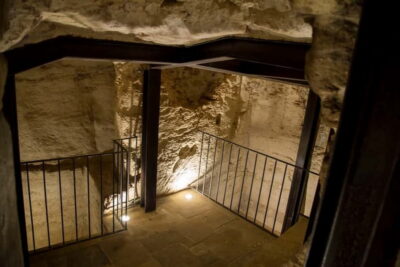
Baroque Architecture and Underground Walking Tour
Read our review →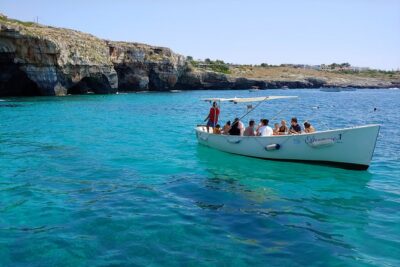
Small group tour of the caves of Santa Maria di Leuca
Read our review →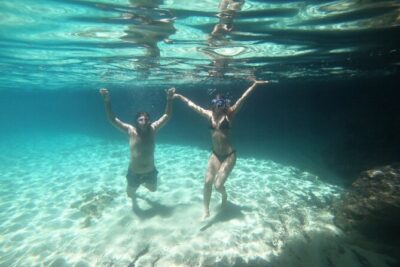
3 Hour Group Tour by Boat to the Caves of Santa Maria di Leuca
Read our review →Snorkelling-Tour in Porto Cesareo with typical aperitif
Read our review →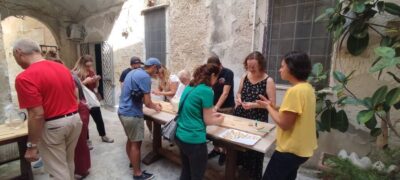
Pasta Making Class in 1400s-Era Courtyard with Wine
Read our review →
Tour to 4 Towns of Salento: Otranto, Leuca, Gallipoli, Galatina
Read our review →
Cooking class, dinner and wine tasting near Lecce
Read our review →Browse the lists this tour appears in