
Reviewed · MUSEUMS
Da Vinci Museum: Discover a World of Genius in the Heart of Rome
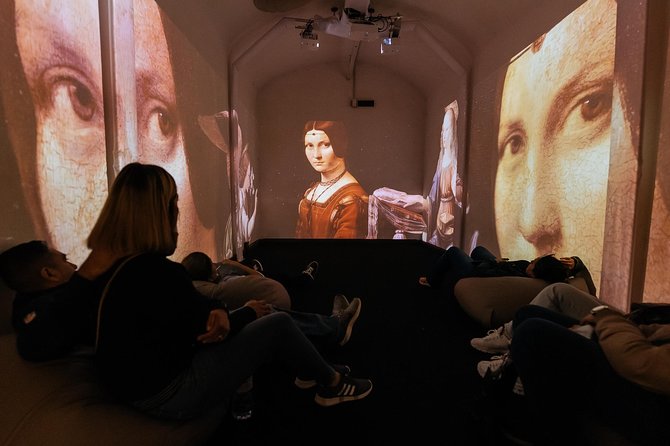
Leonardo da Vinci’s genius comes alive through working models, anatomical studies, art displays, and short films at this small museum inside Basilica Santa Maria del Popolo. It is a smart stop for anyone curious about how one Renaissance man connected art, science, engineering, and the human body.
I like the hands-on machines, which let you test the basic ideas behind Leonardo’s designs, and I like the central location near Piazza del Popolo, the Spanish Steps, and Villa Borghese. The main drawback is size: you may finish in 30 minutes, though a careful visit with the audio guide can take close to two hours.
Key points to know
- Working machine models: Turn, lift, test, and examine recreations based on Leonardo’s codices.
- A useful family stop: Children and older students can connect art and science through hands-on displays.
- Inside a major church: The museum sits in Basilica Santa Maria del Popolo, near one of Rome’s best-known squares.
- Plan for a short visit: Most people need 1 to 2 hours, but a quick look can take about 30 minutes.
- Audio guide costs extra: An optional audio guide is available for about €3 per person.
- Good location pairing: Visit Piazza del Popolo, Villa Borghese, or the Spanish Steps before or after the museum.
Leonardo’s ideas, rebuilt in a small Roman museum
Museo Leonardo da Vinci is not a gallery filled with original masterpieces. It is a teaching museum built around reproductions, models, drawings, films, and interactive stations.
That difference matters. If you arrive expecting to see original Leonardo paintings or a vast collection of Renaissance objects, you may feel let down. If you want to understand how his mind worked, the museum offers a clear and approachable introduction.
I like the way the exhibits connect several sides of Leonardo’s work. One room or display can lead you from a machine to an engineering sketch, then to a study of the human body or an explanation of a famous painting.
The museum presents Leonardo as an inventor, artist, scientist, anatomist, engineer, and architect. That broad view is its real strength. You do not see only the painter of the Mona Lisa. You see a man who studied motion, flight, war machines, anatomy, construction, and the mechanics of everyday life.
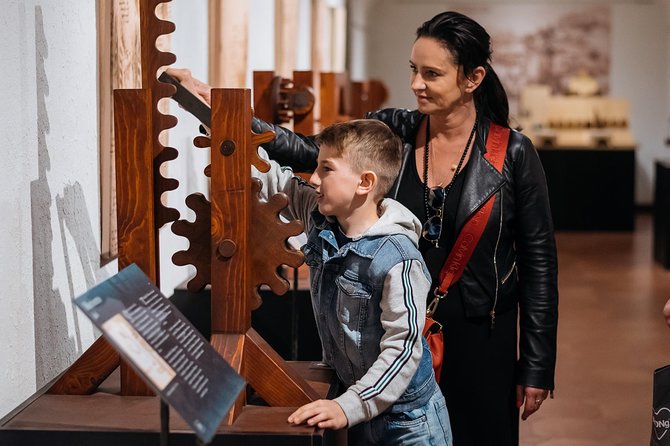
The displays use life-size or medium-scale reconstructions made by Italian artisans from plans in Leonardo’s codices. Some are simple enough to understand at once. Others need a close look, a written explanation, or the audio guide to make sense.
More Museums in Rome
- Vatican Museums & Sistine Chapel Tour with Optional Basilica
★ 4.3 · 67,413 reviews - Vatican Museums, Sistine Chapel & St Peter’s Basilica Guided Tour
★ 4.5 · 39,149 reviews - Rome: Vatican Museums, Sistine Chapel & Basilica Tour
★ 4.3 · 13,872 reviews
What you see during the 1 to 2 hour visit
Your visit is self-guided. There is no named guide leading a group, and you can move at your own pace.
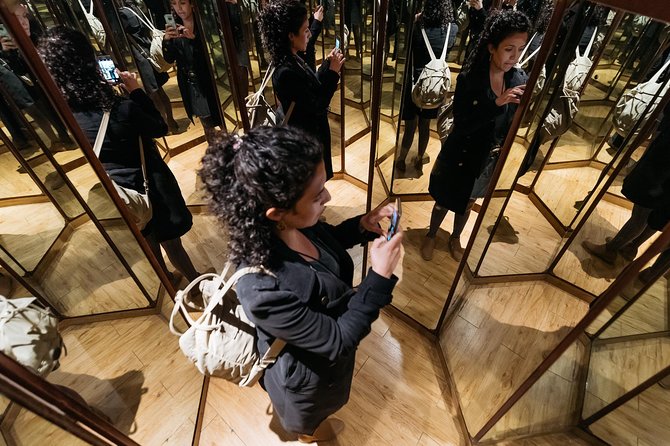
The first part introduces Leonardo’s ideas through models and visual material. You will find machines linked to movement, lifting, construction, flight, and military design. Some can be touched or operated, which gives the museum a useful physical quality.
A drawing of a machine can seem abstract on a page. Turning a handle or watching gears move makes the principle easier to grasp. The models do not prove that every design was practical or ever built by Leonardo. They show the idea behind the drawing.
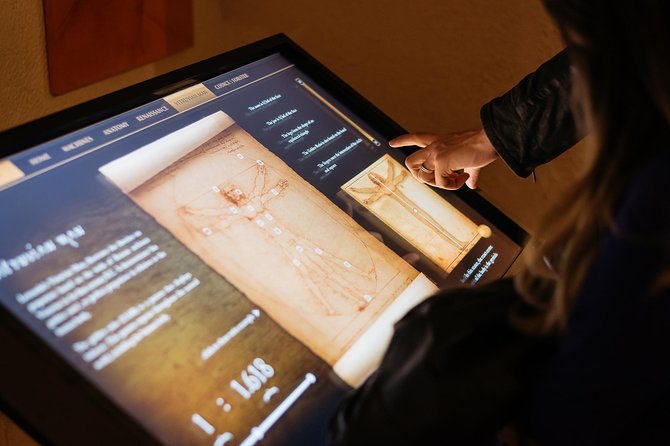
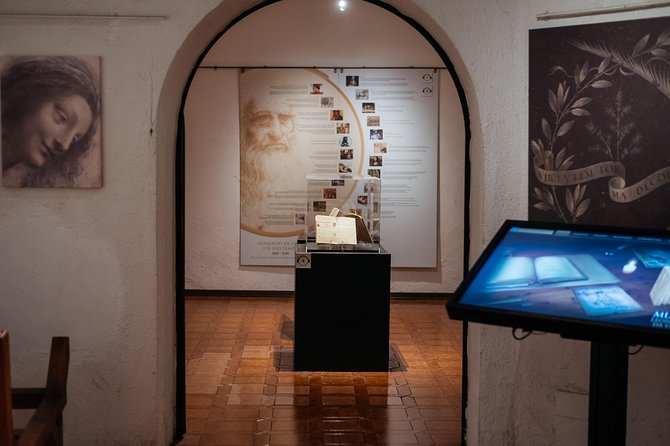
The museum also includes studies of Leonardo’s best-known artistic work. Displays and multimedia material explain subjects linked to The Last Supper, the Vitruvian Man, and the Sforza equestrian sculpture.
The Vitruvian Man section receives particular attention. It is a good example of Leonardo’s habit of joining art, measurement, and anatomy. Instead of treating the drawing as a famous image only, the museum helps you see the research behind it.
The anatomy section is another strong point. Leonardo’s studies of the human body show how closely he observed muscles, bones, and proportions. For many visitors, this is the part that changes the usual picture of him from painter to investigator.
Short films and multimedia animations add context. They explain major works and ideas in a format that is easier to follow than a wall of text. This helps younger visitors, though the quality of your visit depends partly on how much time you give each display.
The hands-on machines are the main reason to go
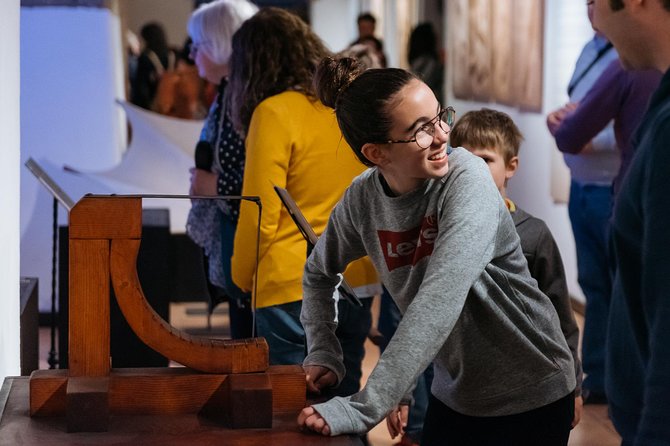
The interactive models are the museum’s biggest draw. You can manipulate some inventions and see how their parts work together.
This is not a modern science center with large experimental stations throughout. The museum is small, and the word interactive can set expectations too high. Still, the hands-on elements are more useful than simply looking at labels beside glass cases.
I especially like this format for families with older children. A child who does not want to read a long panel may still understand a pulley, gear system, or lifting device by trying it. Adults get something from the machines too, since they reveal the practical side of Leonardo’s drawings.
The exhibits also help you appreciate the detail in his plans. A machine may look simple after it has been rebuilt, but the design shows how carefully Leonardo considered force, balance, motion, and structure.
Some military ideas may be new to you. They add a less familiar side of his work, though the subject may not appeal to every family. The museum presents these designs as part of Leonardo’s wide-ranging studies, not as a separate military history attraction.
Do not expect every model to operate perfectly or explain itself. Read the text, watch the film, and ask staff for help if needed. Staff are described as friendly and professional, which is useful in a self-guided museum where a quick explanation can save time.
The audio guide can make the difference
An audio guide is available for about €3 per person. I would consider buying it if you want more than a quick look.
Without the guide, you can read the English descriptions and work through the displays yourself. Several visitors found the written material sufficient, especially because the machines are fairly direct to understand.
The audio guide adds background to Leonardo’s paintings, inventions, and research. It can also give the exhibits a clearer order and explain connections that are not obvious at first glance.
There is one practical nuisance. The listening system uses a handset, and holding it for a long time can become tiring. Headphones would make the experience easier, but you should not assume they are included.
The audio system may not always correspond perfectly with the exhibit in front of you. The displays can also feel arranged in a somewhat random order rather than following a neat timeline. If you use the guide, keep your eyes open and match the number or topic carefully.
For a short visit, skip the audio guide and focus on the machines and major displays. For a full 1 to 2 hour visit, the extra €3 is easier to justify.
Same city, an entirely different afternoon:
- Colosseum, Roman Forum & Palatine Guided Tour
★ 4.7 · 63,148 reviews - Rome: Colosseum, Palatine Hill and Roman Forum Guided Tour
★ 4.8 · 32,814 reviews - Rome: Guided Tour of Colosseum, Roman Forum & Palatine Hill
★ 4.7 · 27,897 reviews - Rome: Colosseum & Forum with Audio Guide App -Optional Arena
★ 4.2 · 24,770 reviews
A small museum with a big subject
The word museum can suggest grand rooms and an extensive collection. This place is much smaller.
That is not automatically bad. The compact size works well after a long day in Rome, when you want something quiet and indoors rather than another huge site. You can see the main material without spending half a day.
I would allow 60 to 90 minutes for a normal visit. Give yourself up to two hours if you use the audio guide, watch the films, and try the machines. A quick visitor who reads little may be finished in around 30 minutes.
The small scale is also the main reason some people leave disappointed. You will not find a large number of original works, and there are no original Leonardo paintings on display. The museum uses replicas and reconstructions, with a small number of actual notebook pages included among the displays.
That distinction should be clear before you book. The museum is about access and explanation, not rarity. It gives you a way to see how a Renaissance design might work, even though the object in front of you is a recreation.
The displays can feel warm inside, so bring water, particularly in hot weather. There are no restroom facilities in the museum or nearby according to the supplied visitor information. Plan ahead before entering.
Why the location near Piazza del Popolo matters
The setting makes this an easy add-on rather than a destination that requires a separate trip across Rome.
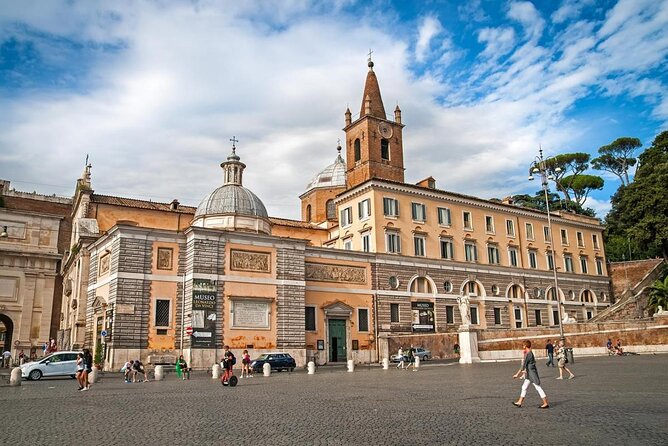
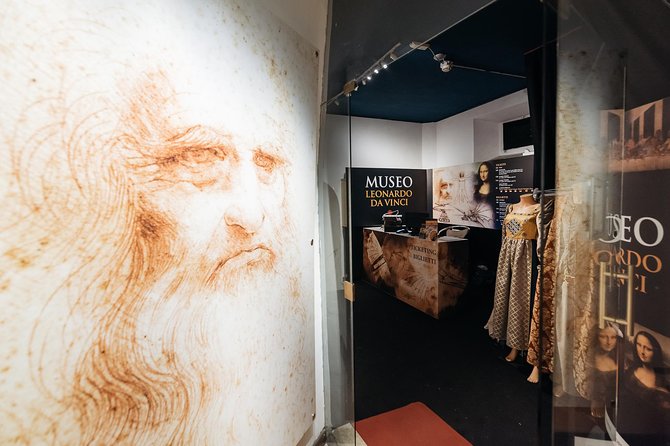
The museum is in Basilica Santa Maria del Popolo, at Piazza del Popolo. It is about a five-minute walk from the Spanish Steps and Villa Borghese, and public transportation is nearby.
After your visit, you can cross to the piazza and continue with a walk, shops, and restaurants. Piazza del Popolo is especially useful for filling a spare hour in your schedule. You can also pair the museum with Villa Borghese or the Spanish Steps.
The church itself is an important part of the location, but its condition can affect your impression. Renovation work has sometimes covered parts of the basilica, so do not count on seeing every church detail clearly during your visit.
The museum entrance can also be easy to confuse with other nearby sights. Check that you are going to Museo Leonardo da Vinci inside the basilica, not simply to another Leonardo-related location in Rome. Directions supplied through booking services have not always been reliable.
A visit in the evening may feel calmer, with fewer people inside and a pleasant chance to walk around Piazza del Popolo afterward. Opening hours and availability can change, so confirm the time shown with your booking.
Is the $14.38 ticket good value?
At about $14.38 per person, admission is reasonably priced for a central Rome attraction, especially if you spend 60 to 90 minutes inside.
The value depends on your expectations. For a short educational stop with hands-on models, films, and art studies, the price is fair. The location adds value because you can combine it with other sights without losing much travel time.
Pre-booking may save time and give you a ticket ready for entry, but do not assume it always means a long line is avoided. Some visits have had no queue, and people could simply walk in and buy tickets. The main benefit is convenience and having the admission arranged in advance.
The audio guide costs about €3 extra. Add it if you want more explanation about Leonardo’s art, anatomy, and inventions. Skip it if you prefer to move quickly or read the English panels.
An optional virtual reality flight experience has also been offered. It can add to the visit, but one report found it overpriced and noted that the single station created a wait. Treat it as an extra, not as part of the basic ticket value.
Who will enjoy this museum most?
I would recommend the museum to adults who want a focused introduction to Leonardo, families with older children, and anyone with an interest in machines, art, or anatomy.
It suits a rainy day, a quiet evening, or a gap between major Rome sights. It also works well after a demanding guided tour, since you can explore at your own pace without keeping up with a group.
Older children are likely to get the most from the interactive displays. Very young children may enjoy touching the models, but the museum’s explanations and historical subjects may not hold their attention for long.
Art specialists may find the lack of original paintings limiting. Visitors with only a short time in Rome should also think carefully. If you have one day and still need to see major ancient and Renaissance sites, this museum is not essential.
I would rank it as a worthwhile small attraction rather than one of Rome’s top must-see museums. Its appeal comes from the connection between ideas, not from the size or fame of the collection.
Practical details before you visit
Admission is included with the booking, and confirmation is received at the time of booking. The experience is offered in English, and service animals are allowed.
Most people can participate, and the venue is near public transportation. The booking information lists a maximum of one traveler, which appears to describe the ticket arrangement rather than a guided group experience. In practical terms, expect to explore independently.
Free cancellation is available until 24 hours before the start time for a full refund. Cancellations or changes inside that 24-hour window are not refunded or accepted, and the cutoff uses local Rome time.
Bring water, use a restroom before you arrive, and allow extra time if you want the audio guide. Pairing the museum with Piazza del Popolo is the easiest way to make the visit feel like part of a larger afternoon or evening.
Should you book Museo Leonardo da Vinci?
Book it if you want a short, affordable, hands-on look at Leonardo’s inventions and research in a convenient central location. The working models, anatomy material, and clear multimedia displays give you a better sense of his range than a single famous painting can.
Skip it if you are seeking original Leonardo artwork, a large museum, or a major Rome sight that deserves priority over the Colosseum, Vatican Museums, or other headline attractions.
For most people, I would plan 1 to 1.5 hours, add the audio guide if you enjoy historical explanation, and visit Piazza del Popolo afterward. That approach gives you a useful glimpse into Leonardo’s mind without asking too much time from a packed Rome itinerary.
FAQ
Where is Museo Leonardo da Vinci located?
The museum is inside Basilica Santa Maria del Popolo at Piazza del Popolo in Rome. It is about a five-minute walk from the Spanish Steps and Villa Borghese.
How long does a visit take?
The expected visit lasts about 1 to 2 hours. A quick visit may take around 30 minutes, while a slower visit with the audio guide and films can take closer to two hours.
Is the admission ticket included?
Yes. The booking includes admission to Museo Leonardo da Vinci.
Is an audio guide included?
No. An audio guide is available to purchase for approximately €3 per person.
Is the museum offered in English?
Yes. The experience is offered in English, and written descriptions are available in English according to the supplied information.
Are there original Leonardo paintings in the museum?
The museum presents studies and reproductions of famous works, including material related to The Last Supper and the Vitruvian Man. The available information does not describe original paintings as part of the display.
Is the museum suitable for children?
Yes. The museum is suitable for families, and several displays allow children to touch or operate parts of the recreated machines. Older children with an interest in art or science may get the most from the visit.
Can I cancel for a refund?
You can cancel at least 24 hours before the experience start time for a full refund. Cancellations or changes made less than 24 hours in advance are not accepted and are not refunded.
Fresh on the Rome list
- Rome: Guided Catacombs Tour & Capuchin Crypt (Audio Guide)★ 4.3 · 191 reviews
- Guided tour of the Colosseum, Roman Forum and Palatine in Spanish★ 4.5 · 191 reviews
- Rome: Borghese Gallery Guided Tour with Skip-the-Line Ticket★ 4.5 · 192 reviews
- Rome: Arena Colosseum Tour with Arena Access★ 4.6 · 193 reviews
- Colosseum, Forum, Palatine Hill with audio guide and Arena or Bus option★ 4.0 · 193 reviews
- Rome: Colosseum & Roman Forum Guided Tour★ 5.0 · 194 reviews
- Rome: Domus Aurea Guided Tour and Virtual Reality Experience★ 4.7 · 194 reviews
- Rome Vintage Fiat 500 car Tour With Photographer★ 5.0 · 194 reviews
Museums, compared.
Vatican: Museums & Sistine Chapel Entrance Ticket
Read our review →
Vatican Museums & Sistine Chapel Tour with Optional Basilica
Read our review →
Vatican Museums, Sistine Chapel & St Peter’s Basilica Guided Tour
Read our review →
Skip-The-Line Uffizi Gallery Timed Entry Ticket
Read our review →
Vatican Museums, Sistine Chapel & Basilica Tour
Read our review →
Vatican Museums & Sistine Chapel Skip-the-Line Entry Ticket
Read our review →Vatican Museums, Sistine Chapel & Basilica Tour
Read our review →
Vatican Museums & Sistine Chapel Guided Tour
Read our review →Browse the lists this tour appears in