
Reviewed · CYCLING TOURS
Appian Way, Catacombs and Aqueducts Park Tour with Top E-Bike
Rome’s ancient side opens up when you leave the center by electric-assist bike. This tour links the Appian Way, catacombs, imperial ruins, and the great aqueducts across about 17 miles, much more ground than you could cover on foot. I like the chance to see sheep grazing among Roman ruins, and I like that guides such as Arina, Fabio, Claudia, Bita, and David bring the sites to life without leaving you to puzzle over scattered stones.
I also like the small groups, capped at 10 people, and the well-planned mix of city streets and park paths. The catch is that this is not a gentle pedal through a garden. About 40 percent of the route uses city roads, and the remaining 60 percent includes bumpy, narrow, off-road sections. You need to feel steady on a bike, especially on busy Sundays or when riding with a child seat.
Key things to know before booking
- The six-hour route covers more ancient Rome: It adds a guided catacomb visit, Villa dei Quintili, Santa Maria Nova, and a view of the Baths of Caracalla.
- The e-bike saves your legs, not your attention: You still need to steer, brake, watch pedestrians, and handle uneven ground.
- The route reaches places that are awkward on foot: The Appian Way and Aqueducts Park sit well beyond the usual Colosseum and Vatican circuit.
- The catacombs are handled differently by tour length: The four-hour version includes only a short pause, while the six-hour version includes a 45-minute guided visit.
- Small groups make a real difference: A maximum of 10 people gives the guide a better chance to watch the group and answer questions.
- Weekdays are likely the calmer choice: Sunday crowds can make the park paths harder and more nerve-wracking to ride.
Why an e-bike works so well on the Appian Way
The Appian Way is one of Rome’s great outdoor sights, but it is spread across a wide area. Walking from the city center to the catacombs, then onward to the aqueducts, would eat up much of your day and leave little time for looking around.
The e-bike changes the math. Its electric motor helps on longer stretches and makes the 27-kilometer route manageable for people who ride competently but do not cycle every day. You can use the assistance to conserve energy, and the bikes come with anti-puncture tires, helmets, a front bag, and a biodegradable water bottle.
Do not read electric bike as effortless sightseeing. You are still on two wheels for several hours. The route includes uneven Roman paving, narrow paths, city traffic, and sections where other bikes and pedestrians may share the way. One rider found the pace too slow, while others appreciated the careful group riding. Both points are useful: the motor helps with exertion, but the tour moves at a controlled pace for safety.
The equipment has a 300-pound, or 136-kilogram, weight limit. Helmets are mandatory and provided at no extra cost. The activity is not recommended if you lack confidence on a bike.
More Bike Tours in Rome
- Rome EBike Tour: Appian Way, Catacombs & Roman Aqueducts
★ 5.0 · 1,766 reviews - Rome: Top Highlights & Hidden Gems Tour by Cannondale E-Bike
★ 4.9 · 1,760 reviews - Rome: Appian Way, Catacombs, & Roman Aqueducts E-bike Tour
★ 4.9 · 1,421 reviews
From Via Labicana to Porta San Sebastiano
The tour begins at Via Labicana 49, near public transportation. From there, you leave central Rome and head toward Porta San Sebastiano, a major gate in the third-century Aurelian Walls.
This opening ride gives you a quick change of scene. Rome’s dense center fades, and the monumental walls provide the first clear signal that this is not a standard city sightseeing route. The gate itself is a brief stop, about 10 minutes, but it sets up the story of roads, defenses, and movement around ancient Rome.
The city portion requires care. Around 40 percent of the full route uses carefully selected streets, but traffic cannot be avoided completely. Your guide leads the group through these connections, and the maximum group size of 10 helps keep the ride together.
The Appian Way, where Rome turns rural
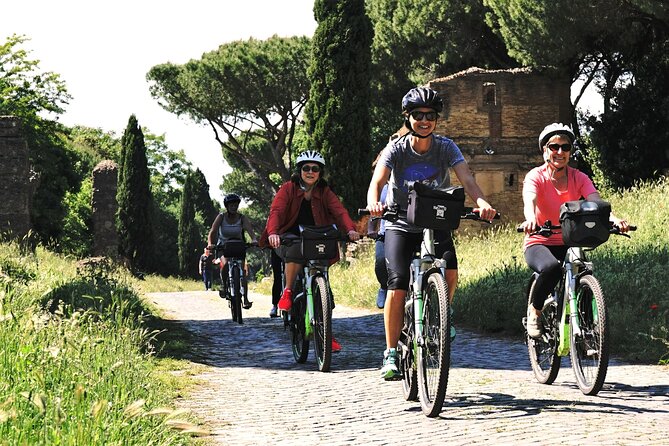
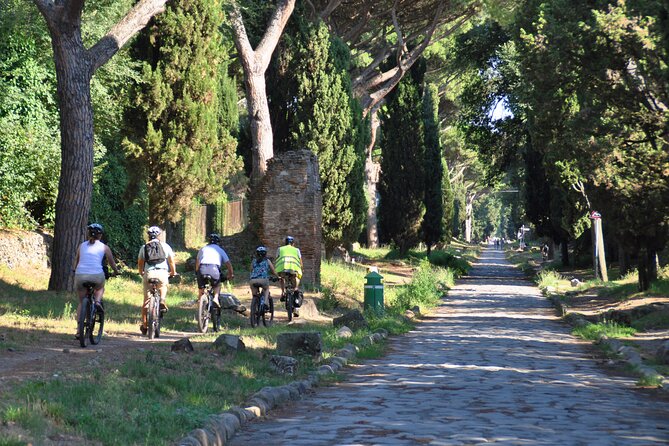
The Via Appia Antica begins as a road that can feel almost anonymous. Then the ancient paving, ruins, open fields, and low hills gradually take over. This is the most distinctive part of the outing, not because every ruin is fully reconstructed, but because the road still connects the countryside to the city in a way that feels remarkably direct.
The Appian Way Park gives you a break from Rome’s crowds and traffic. Sheep graze in the open spaces, and the route passes through green valleys and hills on the edge of the modern city. You get a view of Rome that most first-time itineraries miss: less marble spectacle, more old road, pasture, stone, and silence.
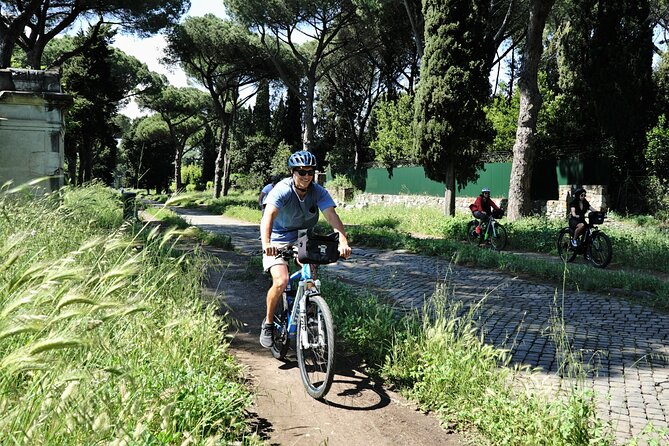
The tradeoff is the surface. The off-road sections can be bumpy, and the ancient route is not designed like a modern cycle path. If you have back or neck problems, this ride may be uncomfortable. A family with teenagers may find it a welcome break from walking, but young children or anyone uneasy on a bike will need extra thought.
Children aged 9 and above can ride an appropriately sized e-bike independently. For children aged 5 to 8, a child extension is available. The difficulty is listed as intermediate, and it becomes harder with a child seat or extension attached.
Catacombs of San Callisto and San Sebastiano
The catacombs add a different mood to the day. San Callisto is associated with a vast underground burial complex and is described as the resting place of roughly half a million people. In the six-hour option, you get a 45-minute guided visit through the second-century catacombs, with their tunnels, burial chambers, and early Christian setting.
This is the point where the two tour options differ most. The four-hour outing includes a brief pause to contemplate the catacomb area, but not the full guided underground visit. If the catacombs are a main reason for booking, choose the six-hour version.
On Wednesdays, the route changes. The six-hour tour visits the Catacombs of San Sebastiano instead of San Callisto, and the four-hour tour does not include the catacomb stop. Wednesday departures can also run about 30 minutes longer, making the expected duration roughly four and a half hours or six and a half hours.
The underground visit may not suit everyone. The provided information describes it as complex and mysterious, but you should also consider that catacomb passages can feel confined. One complaint concerned the size of the group waiting for a catacomb visit at the park. The six-hour bike group itself is limited to 10, but the catacomb visit may involve a larger organized queue or visiting group.
More bike days in Rome:
- Rome City Small Group Bike Tour with quality Cannondale EBike
★ 5.0 · 1,380 reviews - Rome by Night – Ebike Small Group Tour – Food and Wine (Option)
★ 5.0 · 1,275 reviews - Rome:Appian Way E-bike Tour with Catacombs, Aqueducts & Food
★ 4.9 · 1,210 reviews - Rome: E-Bike Night Tour with Food and Wine Tasting
★ 4.9 · 1,131 reviews
Circus of Maxentius and Cecilia Metella
After the catacombs, the route continues past the Circus of Maxentius, a fourth-century imperial complex containing a villa, mausoleum, and circus. The circus was built for chariot racing, so the site offers more than a single ruin. It shows how an imperial estate could combine residence, burial, and public spectacle.
The stop is short, around five minutes, which means you should expect an outdoor introduction and a chance to look rather than a long archaeological visit. That rhythm continues at the Mausoleum of Cecilia Metella and the Castrum Caetani.
The mausoleum is one of the best-preserved and largest monuments along the Appian Way. Built in the first century AD for Cecilia Metella, a young woman from a patrician family, it gives the ancient road a strong visual anchor. Its size also makes a useful point: this was a prestigious route lined with major tombs, villas, and monuments, not simply an old transport corridor.
Villa dei Quintili on the six-hour route
The longer tour adds Villa dei Quintili and Santa Maria Nova. This sprawling second-century private villa belonged to two of the wealthiest brothers of the Roman imperial era.
You will not get a full archaeological visit in five minutes, but you do gain a glimpse of the scale of elite Roman life beyond the city walls. The villa helps connect the smaller roadside ruins with the larger pattern of estates, power, and leisure that shaped the outskirts of Rome.
This extra stop is one reason I see the six-hour option as the better choice for anyone with enough time. The route is already long, and the added sites give you a broader picture of how ancient Rome extended into the countryside.
Aqueducts Park and Rome’s water system
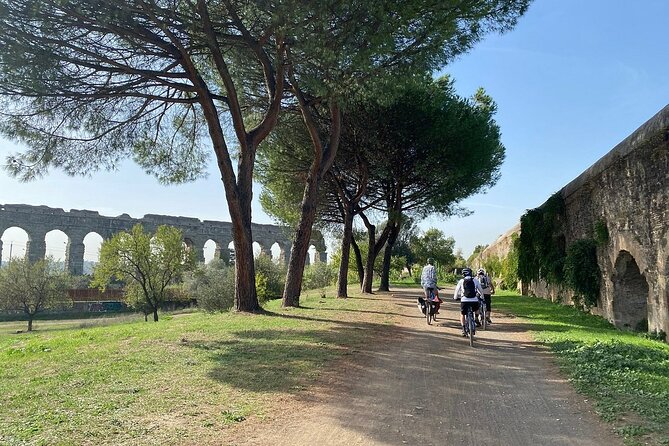
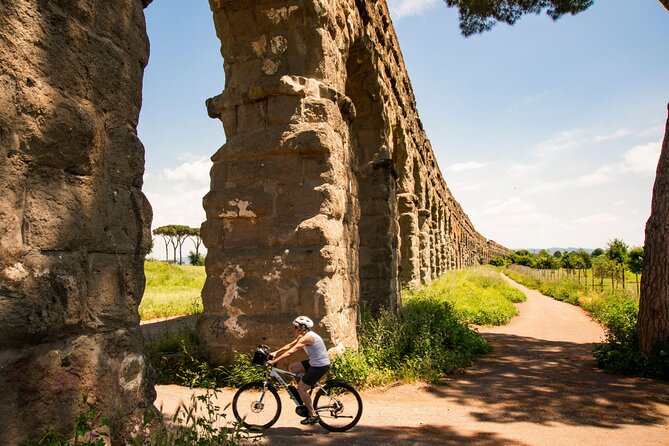
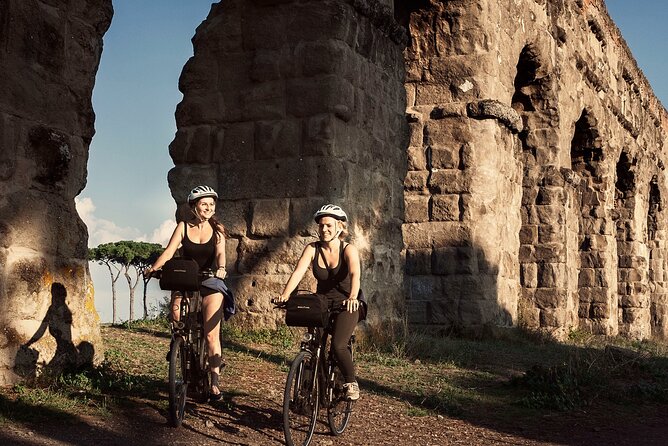
Aqueducts Park is the visual high point for many riders. Here, huge arches cross open ground, and the remains of Rome’s water network become easy to understand at a glance.
Your guide explains the underground channels and raised arches that carried water into the city. The scale is the lesson. Rome’s baths, fountains, homes, and public buildings depended on an engineered water supply that stretched across the countryside.
The park also provides some of the best photo opportunities of the day. You may have time for a food or drink purchase along the route, but nothing is included, so bring water and plan to buy or carry any food you need. A picnic-style break among the aqueducts can be memorable, provided you arrange your own provisions.
The paths here can be crowded, especially on Sundays, when local people and other cyclists use the park. A weekday departure should give you more room to manage the bike and look up at the arches instead of concentrating entirely on who is ahead.
The six-hour finish and Baths of Caracalla
The six-hour tour includes a view of the Baths of Caracalla, one of Rome’s most impressive ancient bathing complexes. You see the baths from a useful vantage point and hear how central bathing was to Roman social life.
The baths were not simply places to wash. They were part of daily public culture, and the complex helps explain how Romans spent time together, exercised, socialized, and used monumental public facilities. The stop itself is brief, about five minutes, but it rounds out the day by returning you toward the city and adding another major imperial site.
The four-hour tour skips this stop, along with Villa dei Quintili. That shorter route is a sensible fit if you have limited time, prefer a lighter day, or mainly want the Appian Way and aqueducts. The six-hour version is the stronger choice if you want the catacomb visit and a fuller route through ancient Rome’s outer districts.
What the pace and group size feel like
A small group is one of the tour’s practical strengths. With no more than 10 people, the guide can keep an eye on the riders, explain sites along the way, and adjust the pace to the group. Guides including Stefan, Lorenzo, Han, Ali, Christian, Khalid, and Francesca have been praised for combining historical detail with a friendly manner.
The pace is deliberately controlled. One rider felt that the group moved too slowly, especially on the e-bike, and disliked riding with tires close together. That is a fair concern if you want a fast, independent cycle. This is a guided outing, not a bike rental with a loose route suggestion.
The benefit of the slower pace is safety and access. You can follow a leader through unfamiliar city streets, stop for explanations, and avoid getting lost across several parks. The guide also handles the transition between traffic and rough park paths, which is not always easy to manage on your own.
Is $102.79 a good value?
At $102.79 per person, the tour costs more than renting an e-bike for the day. You are paying for the bike, helmet, bottle, route planning, guide, group supervision, and, on the six-hour version, the guided catacomb visit.
The value is strongest if you want to combine several far-flung areas in one day. A self-guided ride may cost less, but you would need to plan the route, navigate city connections, judge the rough paths, and arrange your own timing at the catacombs. The guide also gives meaning to places that can otherwise look like isolated ruins.
The price is less attractive if you want plenty of time at each stop or the freedom to set your own speed. Most site visits are short, often five to 15 minutes, apart from the guided catacomb visit. You are covering a large area, so this is a moving overview rather than a series of long archaeological tours.
Free cancellation is available up to 24 hours before the start time. The tour needs at least four participants, and if that minimum is not reached, you will be offered another option or a full refund.
Four hours or six hours?
Choose the four-hour tour if you want the main route with less time in the saddle. You will ride through the Appian Way area, see the catacombs area, Circus of Maxentius, Cecilia Metella, and Aqueducts Park, but the catacomb portion is only a short pause rather than a guided underground visit.
Choose six hours if the catacombs matter to you. You also add Villa dei Quintili, Santa Maria Nova, and the Baths of Caracalla, making the day more varied and better suited to anyone with at least two or three days in Rome.
The longer option is not automatically better for every person. Six hours on a bike, including uneven ground and city connections, is a substantial outing. If your group has mixed ability, the shorter route may be more enjoyable.
Who should book this Rome bike tour?
I would choose this for confident cyclists, active families with older children, and anyone who has already seen the central sights and wants a different side of Rome. It works particularly well for teenagers who may lose patience with a full day of indoor museums and for adults who want history with fresh air and movement.
It is not a good match if you are a novice cyclist, dislike traffic, need a completely smooth route, or want to stop for long stretches at every monument. The tour is safe by design, but safe does not mean passive. You must stay alert and control your bike.
Book a weekday if your schedule allows. The parks can be crowded on Sundays, and narrow paths are more demanding when filled with pedestrians and other bikes. Wear comfortable clothing, bring any food you want, and expect some bumps.
FAQ
Where does the tour begin and end?
It begins at Via Labicana 49, 00184 Rome, and ends back at the same meeting point.
How long is the tour?
You can choose a four-hour or six-hour version. On Wednesdays, the route may take about 30 minutes longer. The same 30-minute extension applies from January 14 to February 11, 2026.
How far do you ride?
The route covers approximately 17 miles, or 27 kilometers. About 60 percent takes place off-road in parks.
Is the tour suitable for beginners?
The tour is rated intermediate and is not recommended for people who lack confidence on a bike. You need to handle city streets, narrow paths, and bumpy surfaces.
Are helmets provided?
Yes. Helmets are provided and must be worn throughout the tour.
Can children join?
Children aged 9 and above can ride an appropriately sized e-bike independently. For children aged 5 to 8, a child extension is provided. The route is more difficult with a child seat or extension attached.
Is the catacomb visit included?
The six-hour version includes a 45-minute guided catacomb visit. The four-hour version includes only a short pause near the catacombs. On Wednesdays, the four-hour route does not include this stop, and the six-hour route visits San Sebastiano instead of San Callisto.
Is food included?
No. Food and drinks are not included, though there are some opportunities to buy them along the route and eat during a suitable break.
Should you book it?
Book this tour if you want to connect the Appian Way, catacombs, aqueducts, and imperial ruins without spending the day walking between distant sites. The e-bike makes a long route practical, and the small group gives you useful guidance through both city traffic and park paths.
I would pick the six-hour version for the guided catacombs and extra ruins, provided you are comfortable riding for most of a day. Choose four hours for a lighter outing. Either way, this is one of Rome’s better choices for seeing ancient sites beyond the usual center, as long as you arrive ready to ride, steer, and accept a few bumps along the way.
More E-bike Rides in Rome
- Rome: Appian Way E-Bike Tour Catacombs, Aqueducts & Picnic
★ 4.6 · 727 reviews - Rome: Appian Way & Catacomb Sunset E-bike Tour with Aperitif
★ 4.5 · 682 reviews - Appian Way & Aqueducts small group e-bike tour(catacombs & food)
★ 5.0 · 531 reviews - Florence: E-Bike Tour with Michelangelo Square
★ 4.5 · 1,035 reviews
Fresh on the Rome list
- Exclusive Golf Tour Private VIP with Local & Gelato o Wine★ 5.0 · 500 reviews
- Colosseum, Palatine Hill and Roman Forum with Guided Tour★ 5.0 · 500 reviews
- Rome by Night Walking Tour★ 4.5 · 506 reviews
- Rome Trastevere Pasta Making Class with Eating Europe★ 5.0 · 505 reviews
- Rome: Colosseum Express Tour with Forum & Palatine Access★ 4.5 · 511 reviews
- Rome Food Experience Max 6 People Group Tour | w/Private Option★ 5.0 · 516 reviews
- Rome: Navona Square Underground Ticket with Audio Guide★ 4.0 · 518 reviews
- Rome: Escorted Papal Audience Experience with Entry Ticket★ 4.4 · 518 reviews
Cycling Tours, compared.
Rome EBike Tour: Appian Way, Catacombs & Roman Aqueducts
Read our review →
Top Highlights & Hidden Gems Tour by Cannondale E-Bike
Read our review →
Appian Way, Catacombs, & Roman Aqueducts E-bike Tour
Read our review →
Rome City Small Group Bike Tour with quality Cannondale EBike
Read our review →
Tuscany Bike Tours Through the Chianti Hills with Wine Tasting
Read our review →
Rome by Night – Ebike Small Group Tour – Food and Wine (Option)
Read our review →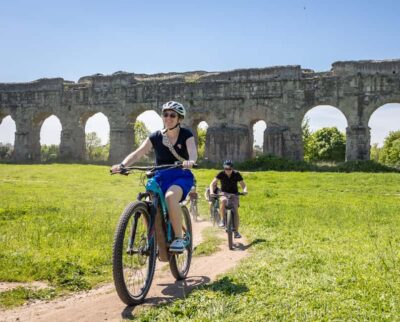
Appian Way E-bike Tour with Catacombs, Aqueducts & Food
Read our review →
Browse the lists this tour appears in