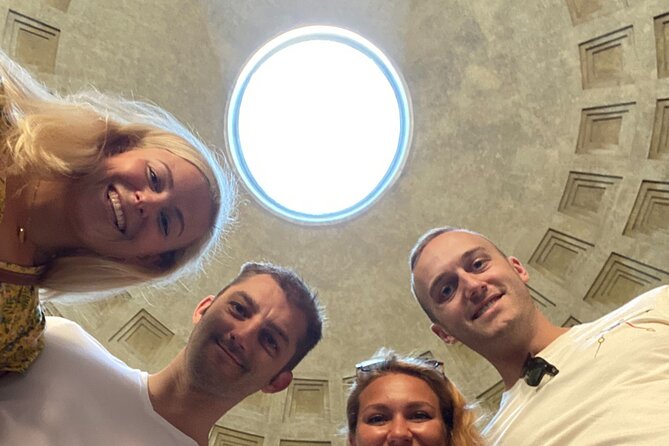
Reviewed · GUIDED
Pantheon Elite Guided Tour – Rome’s Iconic Ancient Temple
Rome’s Pantheon is one of those buildings that can look simple from the outside and astonishing once you step beneath its dome. This one-hour tour explains how a Roman temple became a Christian church, why the oculus is open to the sky, and how the building has survived for roughly two thousand years.
I like the short format, which fits neatly between larger Rome sights, and I like the guides’ focus on details you could easily miss alone, from water drainage beneath the oculus to the building’s shifting religious role. Guides including Elena, Amanda, Nina, Silvia, and Samantha have been praised for clear explanations and lively storytelling.
The main drawback is the setting. The piazza and interior can be crowded, and a group of up to 20 people is not the same as a private visit. You receive a timed, named admission rather than a magical no-line promise, so entry may still take a little patience on a busy day.
Key points to know before booking
- The oculus is open to the sky: Look straight up through the dome’s round opening and watch changing light and weather from inside the building.
- The tour lasts about one hour: You spend roughly 40 minutes inside and 15 minutes examining the exterior, with a little time around the meeting point.
- The guide adds the essential context: The visit connects Roman religion, imperial building, Christian worship, royal burials, and Raphael’s tomb.
- Timed admission helps with entry: Your ticket is booked for a specific time and is individually named, though busy conditions can still create a wait.
- Headsets help in a crowded interior: The system lets you hear the guide while standing apart from the group, although audio equipment has occasionally caused problems.
- Dress for a church visit: Knees and shoulders must be covered before entering.
Why the Pantheon deserves a guided visit
The Pantheon is more than an old Roman building with a famous dome. It is a compact lesson in how Rome keeps reusing its past. A sacred site connected with the early city and the Campus Martius became an imperial monument, then a Christian basilica, and finally one of Rome’s most visited historic interiors.
That sequence matters because the building has not been preserved as a dead ruin. It remains a functioning church, and its present appearance reflects both pagan Rome and Christian Rome. You can look at ancient concrete, later altars, religious paintings, royal tombs, and Raphael’s burial place within the same circular room.
A guide gives you a better chance of understanding those layers in the short time available. Alone, you might admire the scale and take photographs. With an informed guide, you can follow the story of why the structure was made, how its design works, and what happened after the ancient Roman world changed.
The tour is especially useful if this is your first visit to Rome or if you have limited time in the historic center. It does not try to cover all of ancient Rome. Instead, it keeps its attention on one building and uses that building to explain a large part of Roman history.
A few other Rome mornings to weigh against this
- Colosseum, Roman Forum & Palatine Guided Tour
★ 4.7 · 63,148 reviews - Vatican Museums, Sistine Chapel & St Peter’s Basilica Guided Tour
★ 4.5 · 39,149 reviews - Rome: Colosseum, Palatine Hill and Roman Forum Guided Tour
★ 4.8 · 32,814 reviews
Meeting at Antica Salumeria on Piazza della Rotonda
The tour begins at Antica Salumeria, at Piazza della Rotonda, 4. This puts you directly beside the Pantheon, in the square that serves as the monument’s outdoor introduction.
Give yourself enough time to find the meeting point. The piazza can be packed, especially on Sundays and during popular periods of the year. The group may be easy to spot, but it is still wise to arrive early rather than search for the guide at the last minute.
The area is near public transportation, and the tour ends back at the same meeting point. That makes it easy to continue on foot through central Rome after the visit. If you are driving, take the warning from one unfortunate late arrival seriously: parking delays caused one group member to miss the scheduled tour and repeat it later. For this part of Rome, public transportation is the safer choice.
The maximum group size is 20 people. That is small enough for a guide to address questions, but it is not a quiet private experience. The square itself may feel more crowded than the group, and the entrance area can be difficult to enjoy when several groups are gathering at once.
Inside the Pantheon: one room with many eras
The interior is a single great circular space, not a sprawling complex. That simplicity can surprise you. If you expect a series of rooms, galleries, or archaeological paths, you may find the visit more compact than imagined.
The reward is the room’s proportions. The dome and the space below it create a strong sense of order, and the guide helps you notice how the architecture controls your attention. You will hear about the building’s construction, its former use as a temple, and its later life as a church.
The tour also points out the major art and memorials inside. The tombs of an Italian king and queen give the building a modern national role, while Raphael’s tomb connects the Pantheon with one of the best-known artists of the Renaissance. These burials are easy to overlook when your eyes are fixed on the dome.
The Christian interior may seem familiar if you have already visited several Roman churches. That is a fair reason to question the price, especially if your main interest is decorative art. The Pantheon’s appeal is different. Here, the architecture is the star, and the guide helps you see how a pagan temple became a Christian place of worship without losing its ancient form.
Guides such as Amanda, who has studied archaeology and Roman history, have been especially effective for visitors wanting more than a basic date-and-name explanation. Elena has also been praised for connecting the Pantheon with the wider story of Rome, while Nina is known for presenting the building’s key points clearly and concisely.
The dome and oculus: the tour’s best moment
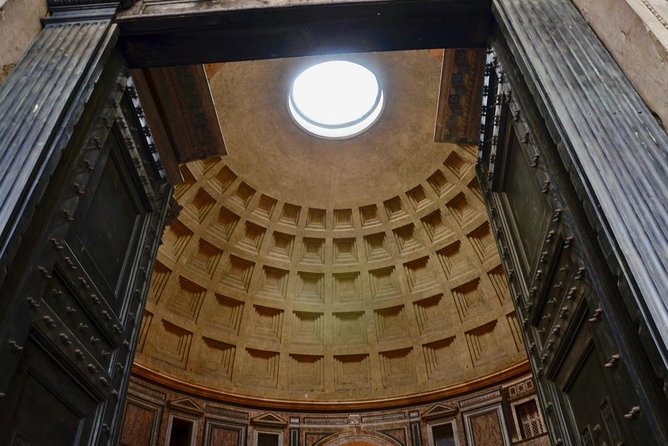
The oculus is the feature you should make time to study. It is a round opening at the top of the dome, exposed to the sky. Sunlight enters through it and moves across the interior as the day changes.
The opening also lets rain fall inside. The floor is designed to deal with the water, and the guide may explain both airflow and drainage. Those practical details turn the dome from a pretty photograph into an example of Roman engineering.
The oculus carries religious and legendary associations, too. One old story connects the opening with Romulus, the mythical founder of Rome, and says he was taken or struck by lightning at this site. The guide places such stories in the wider relationship between Roman myth, sacred ground, and the city’s origin story.
Look up from different parts of the room. The dome’s effect changes with your position, the light, and the number of people around you. A headset is useful here because the guide can continue speaking while the group spreads out to look upward.
Audio equipment has not been perfect for every group. One past visit was badly affected by a poor connection, while other equipment problems were corrected by replacing the headset system. If you cannot hear, tell the guide immediately. Backup headsets and earpieces are available, and waiting until the end will not help you recover what you missed.
Same city, an entirely different afternoon:
- Vatican Museums & Sistine Chapel Tour with Optional Basilica
★ 4.3 · 67,413 reviews - Rome: Guided Tour of Colosseum, Roman Forum & Palatine Hill
★ 4.7 · 27,897 reviews - Rome: Colosseum & Forum with Audio Guide App -Optional Arena
★ 4.2 · 24,770 reviews - Rome: Colosseum, Roman Forum and Palatine Hill Guided Tour
★ 4.5 · 23,903 reviews
The exterior: columns, layers, and a different view
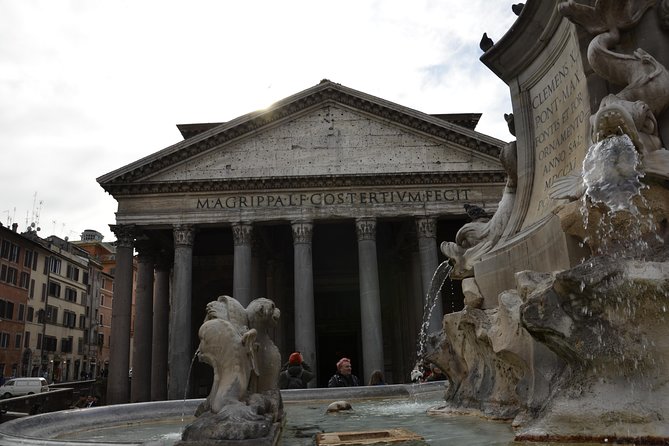
About 15 minutes are devoted to the outside. This part is easy to underestimate, since the interior receives most of the attention.
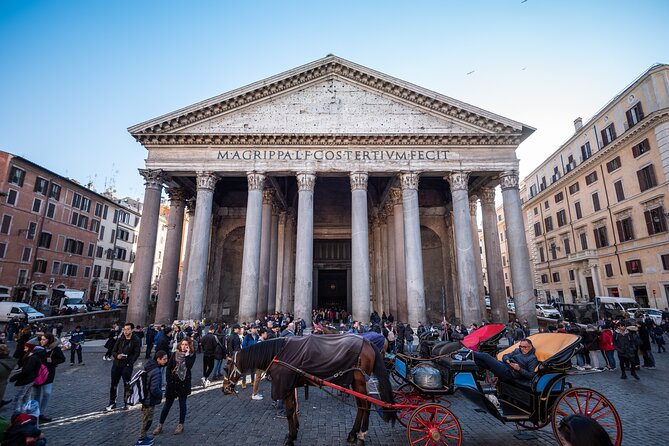
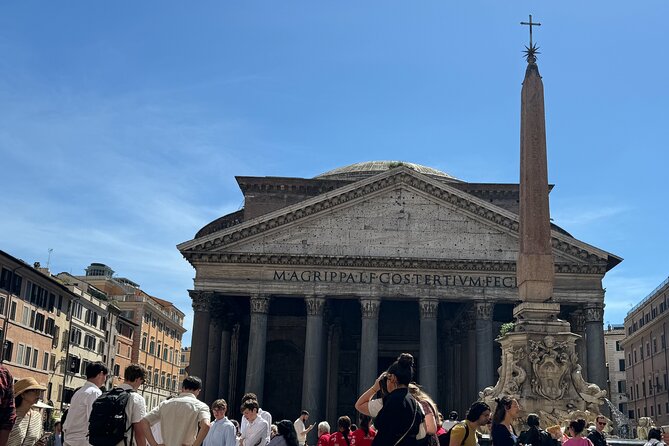
From the piazza, you can study the large columns, the front portico, and the contrast between the rectangular entrance and the round temple behind it. The guide explains the building’s layers and helps you picture how the monument related to the ancient fields of Mars, once outside Rome’s earliest city walls.
The exterior also gives you a chance to understand the Pantheon as a complete architectural composition. The front looks like a traditional temple, but it leads into a huge circular space topped by the dome. That combination is one reason the building feels so surprising when you enter.
The outdoor explanation can be harder to follow if the piazza is noisy. Stay close enough to the guide, and use the headset rather than relying on the crowd to remain quiet. This section is not a separate attraction, but it makes the interior easier to understand.
How the timed entry really works
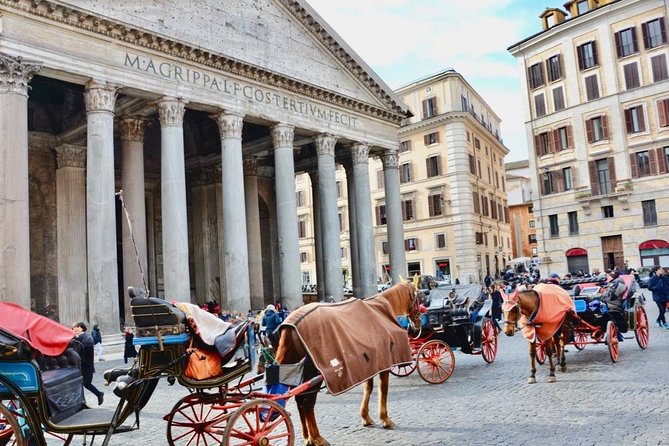
The tour uses pre-booked, individually named tickets for specific entry times. That is helpful because you are not simply arriving and hoping the door situation works in your favor.
Still, you should not read timed admission as a guarantee of instant entry. The Pantheon can be very busy, and the entrance may move slowly even when your group has a scheduled time. Some visitors have described the line as moving fairly quickly, but not disappearing altogether.
This distinction matters when comparing tours. A claim of skipping every line would set the wrong expectation. Here, the practical benefit is organized access at a booked time, with a guide managing the group.
The first Sunday of each month is a special case because admission is free museum day. The usual ticket arrangements may not apply in the same way, and the site can be especially busy. If you want the calmest possible visit, avoid assuming that a Sunday afternoon will feel relaxed. The 2 p.m. time has been particularly busy for at least some groups.
Crowds, headsets, and group size
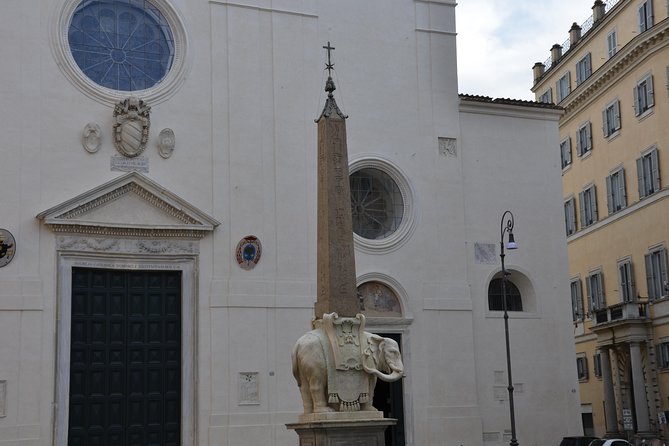
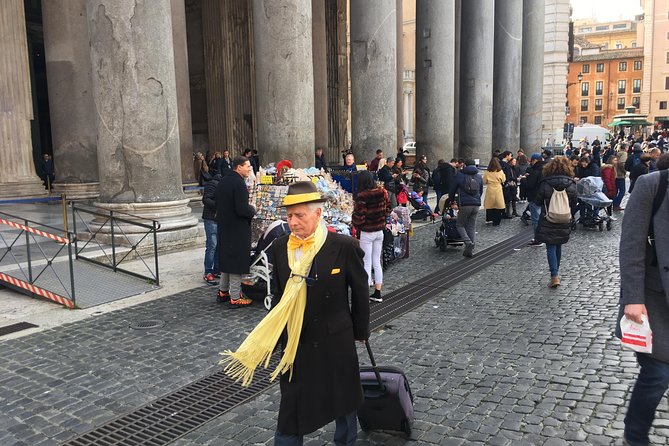
The Pantheon is not an isolated archaeological site. It sits in the middle of Rome’s active center, and the square outside can be full of people. Inside, visitors are sharing one circular room, so the number of people affects how easily you can step back, take in the dome, or hear a guide without audio support.
The headset system is therefore useful, not merely an accessory. You can listen while looking at the architecture instead of standing shoulder to shoulder with the guide. It also helps when the group needs to spread out.
The group limit of 20 is reasonable for a general visit, but you should book a private option elsewhere if your first priority is silence, personal attention, or flexible pacing. This tour suits you better if you can accept some movement around the group and want a clear, efficient introduction.
Guides are required to be licensed, and one positive experience specifically noted that the guide wore her license visibly. That is a useful practical sign in a city where many tour groups gather around the same monuments.
Is $41.08 good value for one hour?
At $41.08 per person, this is not the cheapest way to enter the Pantheon. The value depends on what you want from the visit.
If you are content to walk in, look around, and read whatever information is available, the price may seem high for a single room and about an hour. The Pantheon is compact, and you can see its basic visual appeal quickly.
I find the price easier to justify if you care about architecture, ancient religion, or the mechanics of Roman construction. The guide adds a framework that helps you understand why the building matters, not just what it looks like. You are also paying for a reserved time, group coordination, and the chance to ask questions.
The short duration works in the tour’s favor. You are not committing half a day, and you can place this visit between the Trevi Fountain, Piazza Navona, or another central Rome stop. It is a focused purchase rather than a large package of sights.
The value is strongest when the guide is able to connect the building’s engineering, myths, art, and later Christian use. Guides such as Amanda, Elena, Silvia, Samantha, and Nina have been singled out for warmth, clear explanations, patience, and enthusiasm. The exact guide on your date will affect the tone, but the format gives a capable guide plenty to work with.
Who will enjoy this Pantheon tour most?
I would choose this tour for a first-time Rome visit, a short city break, or anyone who wants context without spending hours indoors. It is also a good match for you if ancient history and architecture matter more than a long art tour.
Families and mixed-interest groups may appreciate the one-hour length. The building offers a strong visual payoff, while the guide’s stories give children and adults different ways into the visit. Most people can participate, and the Pantheon is described as accessible for people with disabilities, though the supplied details do not specify particular arrangements or equipment.
You should think twice if you dislike crowds, audio headsets, or group touring. You may also feel underwhelmed if you have already seen many Roman churches and mainly want decorative interiors. The operator and guide can be excellent while the monument itself simply does not match your personal taste.
Plan your clothing before leaving the hotel. Knees and shoulders must be covered at entry because the Pantheon is a church. This is an easy rule to meet, but ignoring it can disrupt an otherwise well-timed visit.
Cancellation and booking basics
You receive confirmation when you book, and free cancellation is available up to 24 hours before the local start time. Cancellations or changes made inside that 24-hour window are not refunded or accepted.
The activity requires good weather and a minimum number of participants. If poor weather or insufficient participation causes cancellation, you are offered another date or experience, or a full refund.
Several morning and afternoon departure times are available. Since the tour averages being booked 48 days ahead, I would reserve early if your Rome dates are fixed, especially if you need a particular time.
Should you book the Pantheon Elite Guided Tour?
Book it if you want the Pantheon to make sense, not just appear in your photo album. The one-hour visit gives you the dome, oculus, Roman engineering, myths, Christian transformation, royal tombs, and Raphael’s burial place without taking over your day.
I would not book it expecting an empty monument or instant passage through every crowd. The group can reach 20 people, the piazza can be noisy, and audio equipment may need attention. But with a good guide, the building becomes far more than a quick look at an old dome.
For most first-time visitors, the timed admission and focused explanation make this a sensible Rome add-on. Arrive early, dress for church entry, keep your expectations realistic about queues, and tell the guide at once if the headset fails. That is the best way to get full value from this compact but remarkable visit.
FAQ
Where does the Pantheon tour begin?
It begins at Antica Salumeria, Piazza della Rotonda, 4, 00186 Rome, Italy.
Where does the tour end?
The activity ends back at the meeting point.
How long does the tour last?
The tour lasts approximately one hour. About 40 minutes are allocated inside the Pantheon, followed by about 15 minutes outside.
What language is the tour offered in?
The tour is offered in English.
How much does the tour cost?
The listed price is $41.08 per person.
Do I need to cover my knees and shoulders?
Yes. Knees and shoulders must be covered to enter the Pantheon.
How many people can join the group?
The activity has a maximum group size of 20 people.
Can I cancel for a full refund?
Yes, if you cancel at least 24 hours before the experience start time. Cancellations made less than 24 hours in advance are not refunded.
Fresh on the Rome list
- Exclusive Golf Tour Private VIP with Local & Gelato o Wine★ 5.0 · 500 reviews
- Colosseum, Palatine Hill and Roman Forum with Guided Tour★ 5.0 · 500 reviews
- Rome Trastevere Pasta Making Class with Eating Europe★ 5.0 · 505 reviews
- Rome by Night Walking Tour★ 4.5 · 506 reviews
- Rome: Colosseum Express Tour with Forum & Palatine Access★ 4.5 · 511 reviews
- Rome Food Experience Max 6 People Group Tour | w/Private Option★ 5.0 · 516 reviews
- Rome: Navona Square Underground Ticket with Audio Guide★ 4.0 · 518 reviews
- Rome: Escorted Papal Audience Experience with Entry Ticket★ 4.4 · 518 reviews
Guided, compared.
Colosseum, Roman Forum & Palatine Guided Tour
Read our review →
Vatican Museums, Sistine Chapel & St Peter’s Basilica Guided Tour
Read our review →
Colosseum, Palatine Hill and Roman Forum Guided Tour
Read our review →
Guided Tour of Colosseum, Roman Forum & Palatine Hill
Read our review →
Colosseum & Forum with Audio Guide App -Optional Arena
Read our review →
Colosseum, Roman Forum and Palatine Hill Guided Tour
Read our review →
Naples Underground Entry Ticket and Guided Tour
Read our review →