
Reviewed · WALKING TOURS
Venice: Walking tour, Doge Palace, & St. Mark’s Basilica
The golden mosaics of St. Mark’s Basilica and the grand halls of the Doge’s Palace are the heart of this Venice tour, but the walking route adds the real sense of place. You move from famous monuments into church squares, shopping lanes, Marco Polo’s neighborhood, and the corners where Venice’s political and commercial life took shape.
I like the combination of skip-the-line entry and an expert-led visit. I also like that the tour does not stop at the two headline buildings: S. Maria Formosa, SS. Giovanni e Paolo, the Mercerie, Marco Polo’s house, and Teatro Malibran give you a broader look at Venice.
The main consideration is time. This can run from four to eight hours, and the group may contain up to 35 people. Security checks can still cause queues, and the Basilica can become crowded even when your entry is organized.
Key points to know before booking
- Two essential interiors: Visit Doge’s Palace and St. Mark’s Basilica with entry arranged through a separate entrance.
- A wider San Marco walk: See S. Maria Formosa, SS. Giovanni e Paolo, the Mercerie, Marco Polo’s house, and Teatro Malibran.
- Strong guide element: Guides such as Diana, Felipe, and Nadia have led tours praised for clear English, humor, local insight, and family-friendly presentation.
- Long but useful outing: Allow at least four hours, and possibly much longer depending on the selected schedule and pace.
- Skip-the-line does not mean no waiting: Security checks and internal bottlenecks can still slow the group.
- Practical booking terms: English and Spanish are offered, with bilingual tours possible from November through March. Cancellation is free up to 24 hours before the tour.
Why this tour works for a first day in Venice
Venice can feel confusing at first. The streets twist, canals interrupt every route, and important buildings often appear without much explanation. This tour gives you a clear introduction to the city’s political power, religious art, shopping streets, and public squares in one long outing.
The route begins around St. Mark’s, Venice’s grandest stage. From there, you get both major monuments and smaller urban details. That balance matters. A tour made only of palace rooms and church mosaics can feel sealed off from daily Venice. A tour made only of lanes and squares can leave you waiting in lines later. This one joins the two.
I would consider it especially useful if you have limited time in Venice, or if you want a historical framework before exploring alone. It also suits first-time visitors who would rather not work out the entry systems at two of Italy’s busiest sights.
The supplied price is $142.74 per person. That is not a budget walking tour, but the value depends on how much use you make of the guide. You are paying for both admission, route planning, and interpretation at two difficult-to-understand monuments. If you only want to look around quickly, the cost may feel high. If you want the art and architecture explained, the package makes more sense.
More Walking Tours in Venice
- Venice Walking Tour and Gondola Ride
★ 3.5 · 3,630 reviews - Venice: Rialto Bridge & Offbeat Unusual Venice Walking Tour
★ 4.2 · 3,538 reviews - Private 3 hrs Venice Tour: St Mark’s, Walking tour & Boat tour
★ 4.0 · 3,372 reviews
Starting at the Doge’s Palace
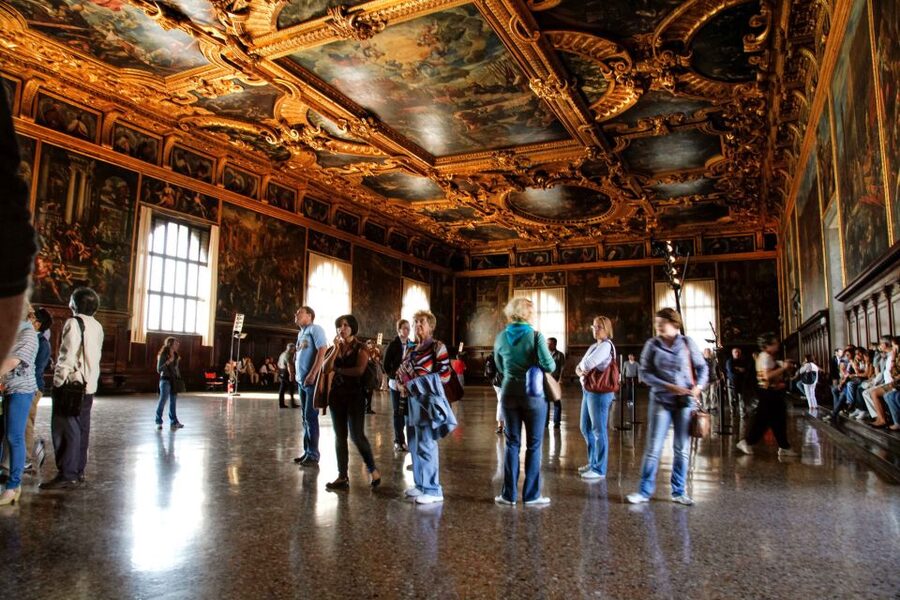
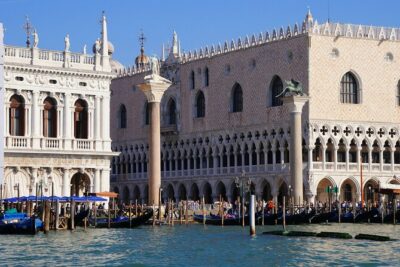
The Doge’s Palace was the seat of Venetian political power for centuries. This is where the duke and his council made decisions for the Venetian Republic, a state that lasted roughly 1,000 years. The palace is not simply a beautiful residence. It was a working center of government, law, diplomacy, and punishment.
Inside, expect grand rooms decorated with major works of art. The scale can be overwhelming without a guide, since the building presents one decorated hall after another. A good explanation helps you understand who used each room, how decisions were made, and why Venice placed so much ceremony around its rulers and councils.
The tour also brings the story down from the grand rooms to the prison areas. You cross the Bridge of Sighs, the enclosed passage associated with prisoners being moved from judgment to confinement. The route includes the prison cell linked with Giacomo Casanova, one of Venice’s most famous escape artists and personalities.
This part gives the palace a useful contrast. One moment you are looking at power expressed through painted ceilings and formal chambers. The next, you are considering the lives of people who passed through the legal system at the bottom of Venetian society.
A small caution is worth noting. The advertised experience specifically highlights Casanova’s cell, but it does not promise access to every prison level or every restricted section. It also does not promise a visit to every upper area connected with the Basilica. If a particular cell, roof, or dome matters to you, check the exact tour details before paying.
Reading the gold of St. Mark’s Basilica
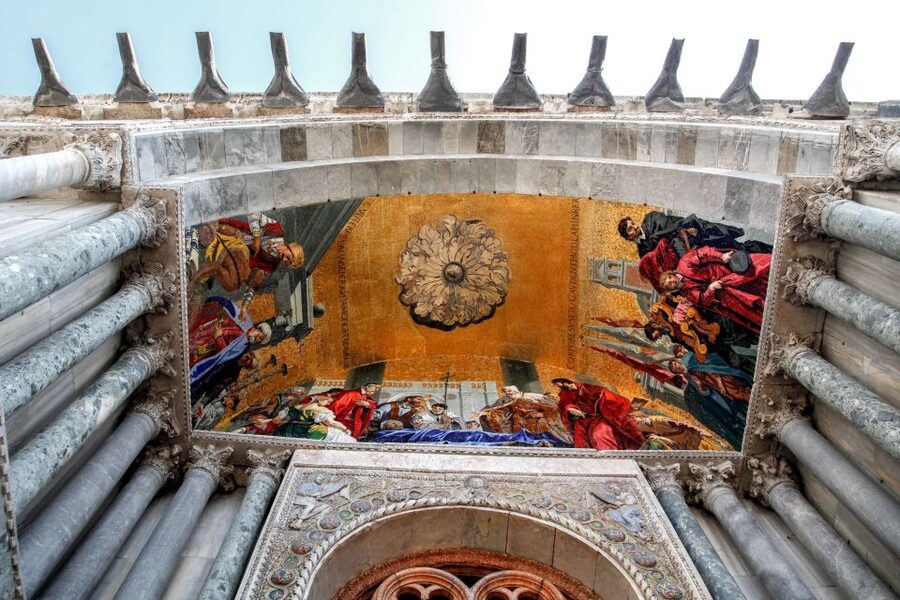
After the palace, the tour moves into St. Mark’s Basilica. This cathedral is famous for its Byzantine character, and the interior is unlike the usual Italian church. Instead of relying mainly on frescoed walls, the Basilica surrounds you with golden mosaics, marble inlays, domes, and images filled with biblical meaning.
The gold is not just decoration. Your guide explains the stories and symbols shown across the church, helping you read the scenes rather than simply admire the shine. That is where guided access earns its keep. Without context, the Basilica can become a beautiful blur of color and pattern.
The Pala d’Oro, the high altar, is another major highlight. It is decorated with thousands of gems and precious stones, and its small scale compared with the surrounding architecture makes it easy to miss when you are looking upward. A guide can direct your attention to details that you might otherwise pass without noticing.
The Basilica can be much busier than the Doge’s Palace. Even with a separate entrance, security checks may create a wait. Inside, the group may need to pause or compress as other visitors move through the building. One practical benefit of a guided visit is group management. The guide keeps people together and points out where to look, rather than leaving you to guess which details matter.
Some guided groups may also receive better lighting for viewing artwork and decoration. This is not guaranteed at every departure, but it can make a real difference in a dim interior.
Keep your expectations sensible about the phrase skip the line. It refers to a separate entrance, not a magic passage past every security check. One person described waiting for access to the dome area, while another reported a traffic jam near the altar. Those slow spots are part of visiting a major working monument, not necessarily a failure of the tour.
Walking beyond the postcard views
The walking portion gives the tour its character. You explore St. Mark’s Square, then continue through parts of the San Marco and Castello areas. The route includes S. Maria Formosa and its lively Campo, one of Venice’s popular squares.
A campo is more than a smaller version of St. Mark’s Square. These open spaces have long served as neighborhood gathering points, and they let you see how Venice works away from its grand ceremonial center. S. Maria Formosa also brings a church and public square together, giving the walk an architectural focus.
The Church and Campo of SS. Giovanni e Paolo is another important stop. The church is known as the Pantheon of Venice because of its connection with prominent Venetian figures. The area also recalls the city’s charitable Scuola institutions and the celebrated captains of fortune who shaped Venice’s military story.
This is the kind of stop that benefits from local explanation. From the outside, a church square may look like another attractive corner. With context, you begin to see memorials, civic pride, military memory, and charity as parts of the city’s public identity.
The tour also passes Marco Polo’s house and Teatro Malibran. The point is not necessarily to spend long periods inside each site. Instead, these places connect older and newer layers of Venice, showing how the city’s famous names sit within an ordinary network of lanes and buildings.
Same city, an entirely different afternoon:
- Venice: Doge’s Palace Reserved Entry Ticket
★ 4.6 · 42,716 reviews - Venice: Grand Canal Gondola Ride with App Commentary
★ 4.1 · 18,908 reviews - Boat Trip: Glimpse of Murano, Torcello & Burano Islands
★ 4.3 · 15,699 reviews - Venice: Grand Canal by Gondola with Live Commentary
★ 4.1 · 13,681 reviews
The Mercerie and Venice’s commercial side
The Mercerie is Venice’s main shopping district and links the area around St. Mark’s with the Rialto direction. It is one of the city’s busiest pedestrian routes, lined with shops and dense with movement.
The Mercerie can feel crowded, especially near St. Mark’s Square. That is both its appeal and its drawback. You see Venice as a living commercial city, but you should not expect a quiet stroll. Stay close to your guide, since a group of up to 35 people can spread out quickly in a narrow street.
This section also helps explain Venice’s historic role as a trading power. The palaces and churches show wealth, but streets such as the Mercerie show where commerce met public life. You get a better sense of the city when you connect the grand buildings with the routes people used to buy, sell, meet, and move through Venice.
What the guides add
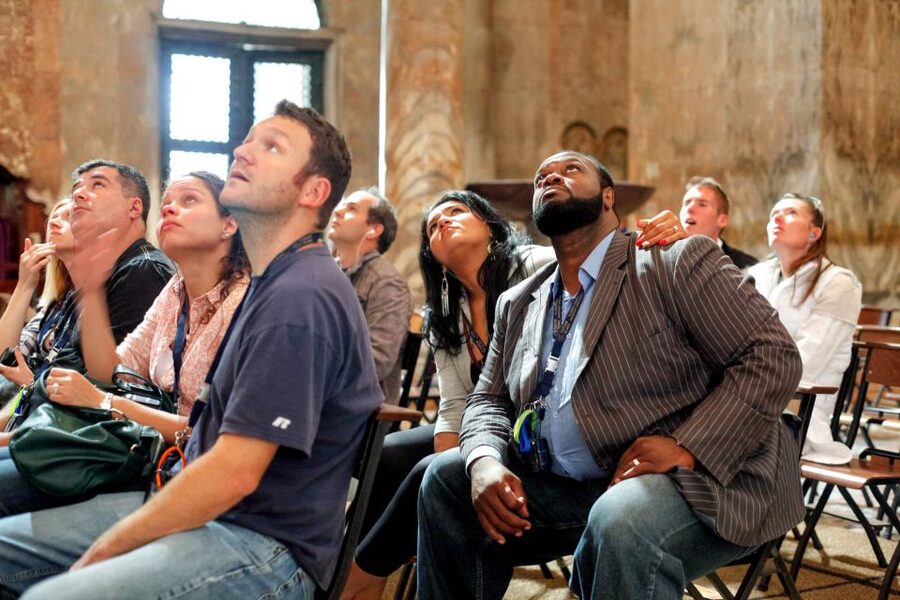
The guide is the deciding factor here. The strongest feedback centers on clear explanations, humor, strong English, and the ability to keep a mixed group together. Guides named Diana, Felipe, and Nadia have been praised for making the history easy to follow and for handling questions well.
That matters because the tour covers a lot. The guide has to move from medieval government to Byzantine art, from prison stories to Venetian churches, then back to shopping streets and local landmarks. The best guides make those subjects feel connected rather than delivering a string of unrelated facts.
Families should take note. One guide was especially effective with a seven-year-old, keeping the child involved without flattening the history for adults. That does not mean every child will enjoy several hours of art and architecture, but the route has enough stories, movement, and unusual details to hold attention better than a static museum visit.
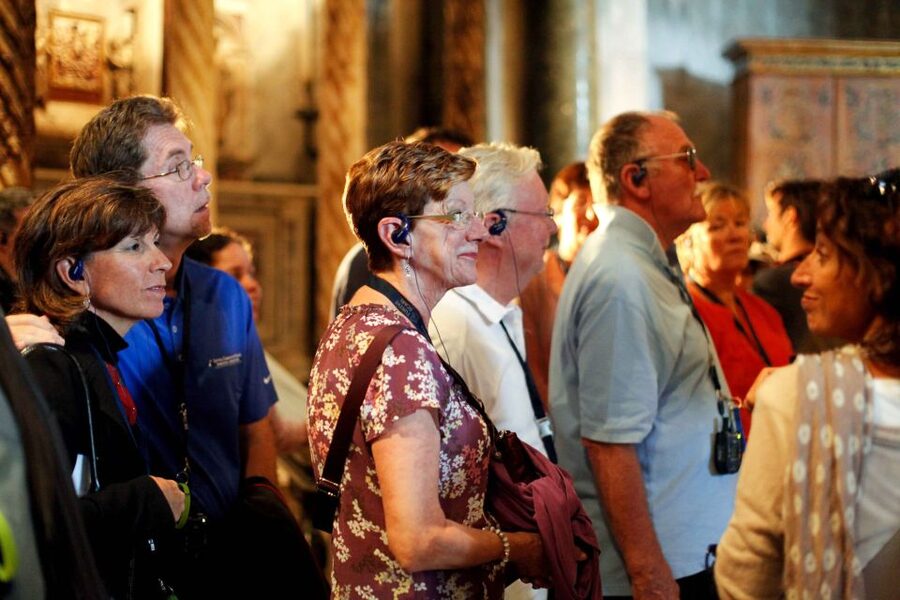
The equipment provided for hearing the guide has also been praised, though large groups and thick palace walls can affect sound. If you are standing around a corner or at the back of the group, move closer when possible. Clear audio matters in rooms where voices echo and the guide cannot always stop everyone beside each artwork.
The tour is offered in English and Spanish. From November through March, it may be bilingual, so the commentary can take longer. If you prefer a faster, single-language experience, check the departure details for your date.
Pace, group size, and practical comfort
This is a walking-heavy experience. You may spend around four hours on a shorter departure, while some versions can run much longer. One practical report found that three and a half to four hours was enough for a morning visit to both major sights and the walking route, especially in warm weather.
Bring water. The route has several substantial sections, and you may not get a scheduled coffee or rest stop. One useful improvement would be a short break, but you should plan as if none is included.
Weather affects the walk. Venice can be cold, and high water can affect passages around the city. One guide carefully watched the tide so the group could avoid wet feet. That sort of local awareness is useful, but it is still sensible to wear comfortable shoes and dress for changing conditions.
The meeting point is inside a shop marked Meeting Point, in front of the church. The activity ends back there. Look for the sign rather than relying only on the street number, since the entrance number may be incomplete or hard to spot. The meeting sign may not be displayed until shortly before departure, so arrive with enough time and confirm the location if you are unsure.
Who should book it?
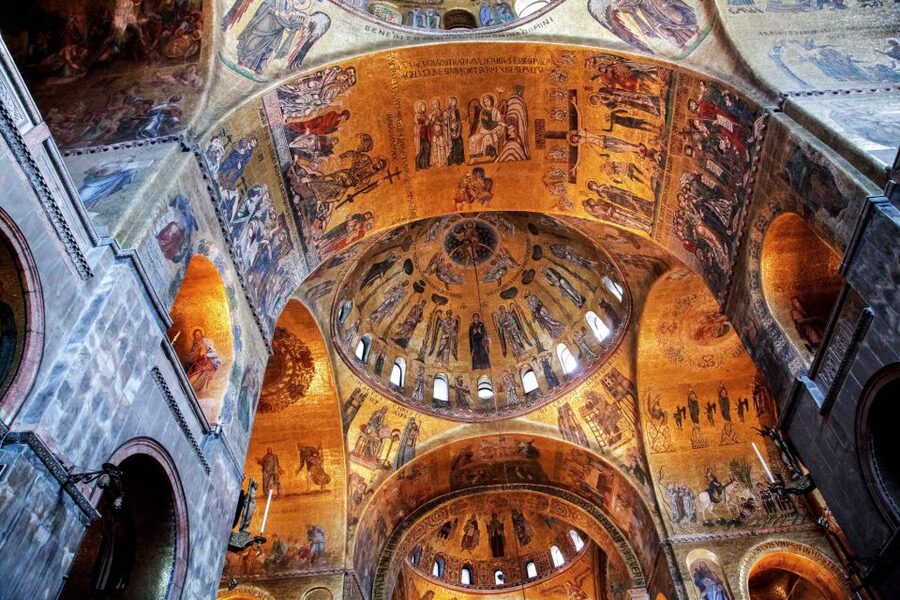
I would choose this tour if you want Venice’s two most important monuments explained in one organized visit. It is also a good fit if long entry lines worry you, if you are visiting for a short stay, or if you want help finding significant churches and landmarks beyond the main square.
It suits families and history-minded visitors particularly well. The stories of Casanova, Venetian government, the Bridge of Sighs, Byzantine art, and Marco Polo give the guide plenty to work with.
I would hesitate if you dislike group touring, need a quiet pace, or want a highly specialized art visit. A group of up to 35 people can feel large, and the total duration may be tiring. You also need to accept that security checks and crowded interior bottlenecks can still slow the itinerary.
At $142.74, the tour is best judged as a full half-day or longer introduction, not as a simple entrance ticket. If you would otherwise buy admission separately and wander without context, the guide and route add useful value. If you already know Venice well and prefer to set your own pace, book only if the included access and compact itinerary outweigh the loss of independence.
FAQ
How long does the Venice tour last?
The stated duration is four to eight hours. Starting times and the exact length depend on availability for your chosen date.
Which attractions are included?
Entry to Doge’s Palace and St. Mark’s Basilica is included, along with the walking tour and a live guide.
Does the tour skip all queues?
The tour uses a separate entrance for the two attractions, but security checks can still require you to wait. Crowding inside the Basilica may also cause delays.
What languages are available?
The tour is offered in English and Spanish. From November through March, it may be bilingual.
Where does the tour start and finish?
Check in inside the shop marked Meeting Point, located in front of the church. The activity ends back at the meeting point.
Can I cancel the booking?
You can cancel up to 24 hours in advance for a full refund. A reserve-now, pay-later option is also available.
Fresh on the Venice list
- Murano: Glass Blowing Demonstration and Artistic Glass Gift★ 4.6 · 507 reviews
- From Venice: Dolomites, Lake Misurina, and Cortina Day Trip★ 4.6 · 508 reviews
- Venice Islands: Murano Glass & Burano Colors Guided Visit★ 4.5 · 510 reviews
- The Majestic Teatro La Fenice: Guided Tour in Venice★ 4.3 · 513 reviews
- Real Venetian Kayak – Tour of Venice Canals with a Local Guide★ 4.5 · 518 reviews
- Venetian Carnival Mask Making Class in Venice, Italy★ 4.5 · 525 reviews
- Half Day Murano and Burano Island Tour by Private Boat★ 4.5 · 529 reviews
- Venice Trilogy: Murano, Burano & Torcello by Lagoon Boat★ 4.5 · 532 reviews
Walking Tours, compared.
Guided Walking Tour & Last Supper Visit with Ticket
Read our review →

Rialto Bridge & Offbeat Unusual Venice Walking Tour
Read our review →
Private 3 hrs Venice Tour: St Mark’s, Walking tour & Boat tour
Read our review →
Skip the line: Uffizi and Accademia Small Group Walking Tour
Read our review →Browse the lists this tour appears in