Reviewed · ROME TOURS
Rome: Jewish Ghetto and Trastevere Tour
Rome’s Jewish Ghetto and Trastevere are separated by the Tiber, but this walk shows how closely their stories connect. In just 2.5 hours, you move from ancient ruins and Jewish community history to Tiber Island and the crooked lanes of Trastevere. It is a smart route for seeing a side of Rome beyond the Colosseum circuit.
I like the range of history packed into a short walk, and I like the guides’ storytelling style. Ben, Guido, Alethea, Alithia, Ariel, and others are praised for making difficult subjects clear without turning the tour into a lecture. The walk also ends in a useful place, Piazza Trilussa, where you can continue into Trastevere for food or drinks.
The main limitation is focus. The synagogue is seen only from outside, and the tour covers several eras and neighborhoods rather than exploring Jewish life in Rome in great depth. You also need comfortable shoes, since the route uses cobbled streets and lasts more than two hours.
Key points at a glance
- Ancient Rome meets modern memory: The route begins near the Theatre of Marcellus and then traces Jewish and Christian stories through the old quarter.
- A thoughtful Jewish Ghetto visit: Expect attention to community life, hardship, resilience, and the area’s role in Rome’s past.
- Tiber Island provides the link: A short stop on the island helps explain the geography between the two neighborhoods.
- Story-led guiding: Ben, Guido, Alethea, and other guides are praised for clear English, humor, patience, and strong historical storytelling.
- A useful finish in Trastevere: The tour ends at Piazza Trilussa, close to the district’s restaurants, bars, and lanes.
- Good value at $35: The price covers a live English-speaking guide for 2.5 hours, but not food, drinks, or entry to the synagogue.
Why this route works so well in Rome
Rome can feel like a stack of separate attractions. You see an ancient monument in the morning, a church after lunch, and a neighborhood at night, but the connections between them can be hard to spot. This tour helps join those pieces.
The walk starts at Santa Rita da Cascia in Campitelli, close to the Theatre of Marcellus. From there, you enter the Jewish Ghetto, cross Tiber Island, and continue into Trastevere. The path is not just a parade of photo stops. It shows how Rome’s geography, religious communities, ruins, and daily life sit on top of one another.
I especially like the contrast. The Jewish Ghetto feels tied to memory and community, while Trastevere is more social and easygoing. Tiber Island forms the physical bridge between them. That simple structure gives the tour a clear rhythm: ancient Rome, Jewish Rome, the river, then neighborhood Rome.
The route also avoids making the whole experience about grand monuments. You will see important buildings and churches, but much of the appeal comes from streets, piazzas, facades, and stories that are easy to miss when you walk alone.
A few other Rome mornings to weigh against this
- Vatican Museums & Sistine Chapel Tour with Optional Basilica
★ 4.3 · 67,413 reviews - Colosseum, Roman Forum & Palatine Guided Tour
★ 4.7 · 63,148 reviews - Vatican Museums, Sistine Chapel & St Peter’s Basilica Guided Tour
★ 4.5 · 39,149 reviews
Starting near the Theatre of Marcellus
Meet outside Santa Rita da Cascia in Campitelli, on Via Montanara, beside Antico Caffè del Teatro Marcello. The guide waits with a sign reading Jewish Ghetto & Trastevere Stroll. Arrive 10 minutes early. Late arrivals cannot count on the group waiting.
The first formal stop is the Theatre of Marcellus, with about 10 minutes of guided explanation. This is a useful opening because it places the neighborhood in Rome’s ancient setting before the tour turns toward Jewish history.
You should not expect a long archaeological visit or interior access here. The stop is brief, so think of it as context and orientation. Your guide uses the surrounding ruins to show how many layers of Rome occupy the same small area.
This beginning also makes the meeting point practical. If you are already near Campitelli or the Teatro Marcello area, you can reach it easily on foot. Check the map link before leaving, since the meeting point is a street location rather than a major attraction entrance.
Portico d’Ottavia and the entrance to the Jewish Ghetto
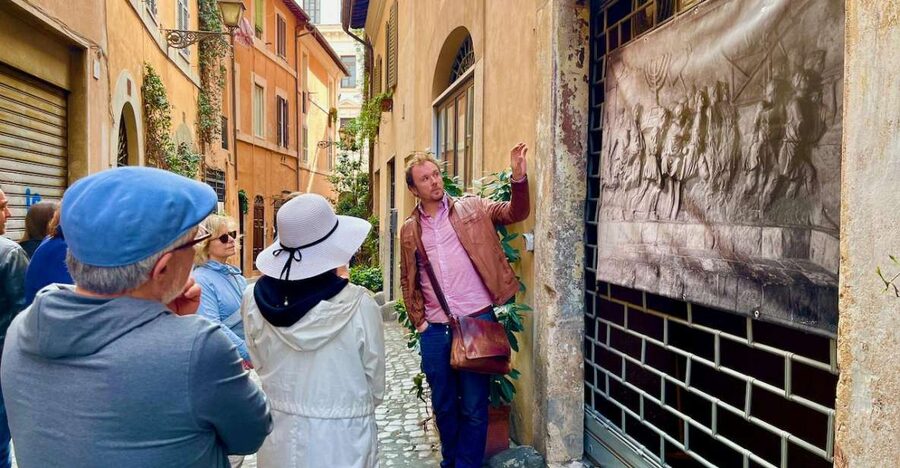
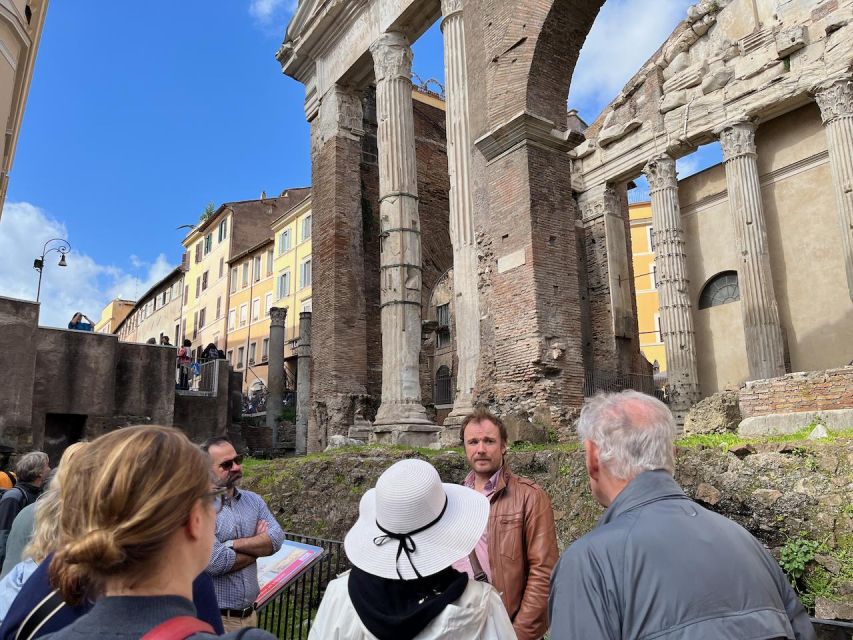
After the Theatre of Marcellus, the group moves to the Portico d’Ottavia for about five minutes of explanation. The stop is short, but it helps frame the transition into the Jewish Ghetto.
The route then spends a total of about 50 minutes in the Jewish Ghetto, divided between two guided sections. You first get roughly 30 minutes in the neighborhood, visit Piazza Mattei for about 10 minutes, and then return to the Ghetto for another 20 minutes.
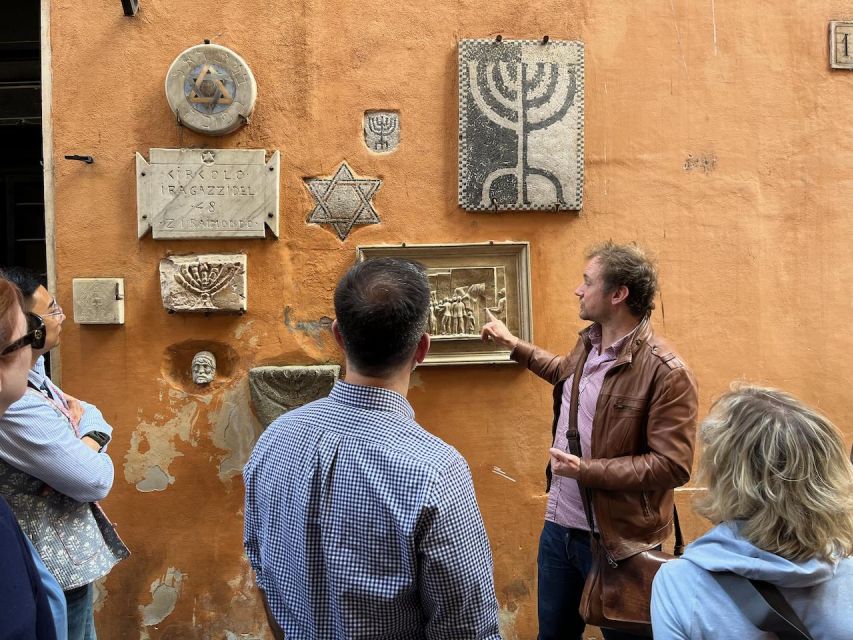
That structure matters. Instead of rushing through one block, the guide can show you the quarter from more than one angle. You hear about the community’s long presence in Rome, the pressures it faced, and the resilience that helped it endure. The stories include painful chapters as well as examples of courage and human decency.
This is the part of the walk where the guide makes the biggest difference. Several guides, including Ben, Guido, Alethea, and Alithia, are praised for balancing facts with anecdotes and humor. That balance is useful here. The subject can be emotionally heavy, but a good guide keeps the tone respectful without making the hour feel grim from start to finish.
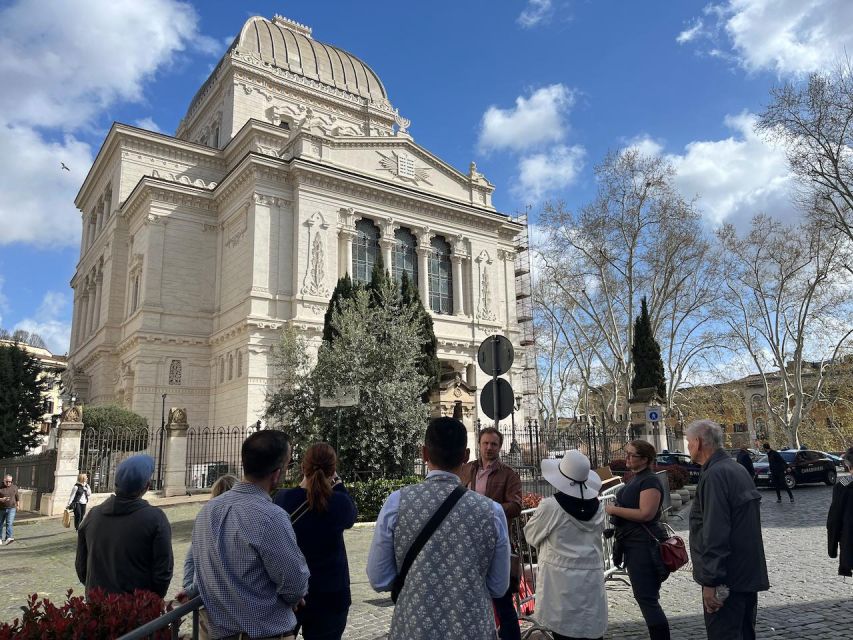
You will view the synagogue from outside rather than go in. That is an important point for anyone booking mainly for religious architecture or Jewish cultural sites. The tour offers historical explanation and neighborhood context, but it is not a synagogue interior visit.
Piazza Mattei and the value of slowing down
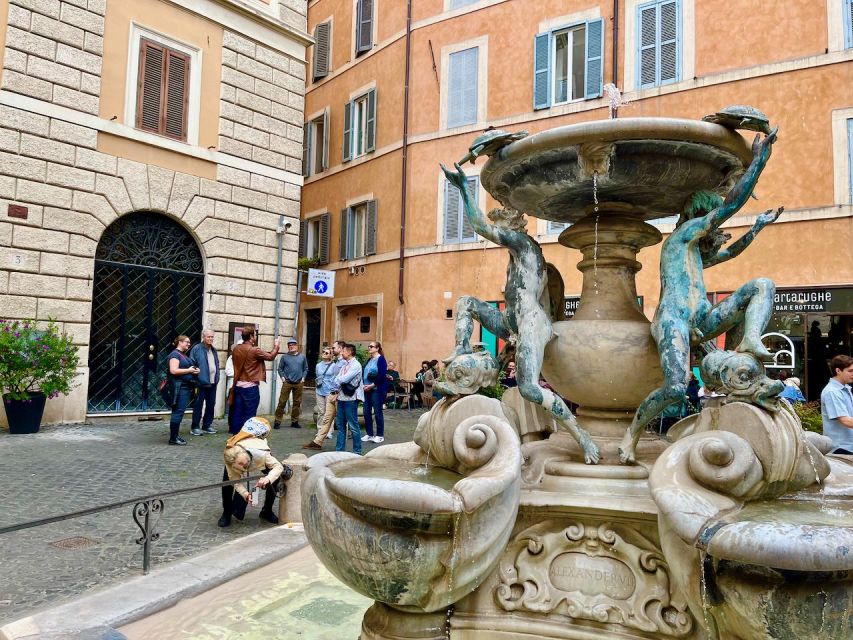
Piazza Mattei receives a 10-minute guided stop. Its role in the walk is more than a pause for photographs. Small Roman squares often reveal how a neighborhood functions, and your guide can use this setting to connect public space with the people who lived around it.
A short stop like this also gives the group a chance to catch its breath. The tour is well paced according to the information available, but it remains a walking experience with several changes of direction. The break is welcome, especially in summer.
Do not expect a long seated rest. The itinerary calls for a 10-minute break later on Tiber Island, while most of the route is spent standing or walking. Wear shoes with good support, and bring water in warm weather. Rome’s public fountains can be used for refills.
Same city, an entirely different afternoon:
- Rome: Colosseum, Palatine Hill and Roman Forum Guided Tour
★ 4.8 · 32,814 reviews - Rome: Guided Tour of Colosseum, Roman Forum & Palatine Hill
★ 4.7 · 27,897 reviews - Rome: Colosseum & Forum with Audio Guide App -Optional Arena
★ 4.2 · 24,770 reviews - Rome: Colosseum, Roman Forum and Palatine Hill Guided Tour
★ 4.5 · 23,903 reviews
Tiber Island, the small link between two districts
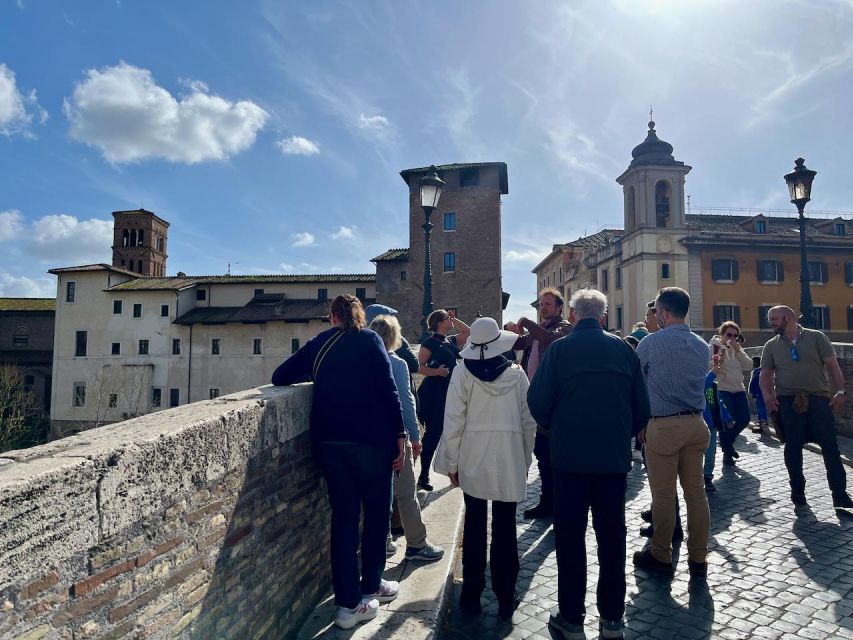
The group then heads to Tiber Island for about 15 minutes of guided touring, followed by a 10-minute break. This is one of the route’s most useful stops because the island explains why the Jewish Ghetto and Trastevere belong in the same tour.
The island is small, but its position in the river gives it an outsized role in the walk. Your guide explains its place in Roman society and history, then uses it as a natural transition. You are no longer in the Ghetto, but you are not yet in Trastevere either. The river becomes the dividing line and the connection.
I like this middle section because it changes the pace. After the close streets and serious stories of the Ghetto, the river offers a little breathing room. The 10-minute break is also the only planned pause, so use it for water, a quick snack if you have one, or a chance to ask your guide a question.
The tour does not include food or drinks. An optional stop at a gelateria or cafe may be made, but you should not depend on that as a full refreshment break. If you need a particular drink or meal, plan to eat after the tour.
Entering Trastevere through its back streets
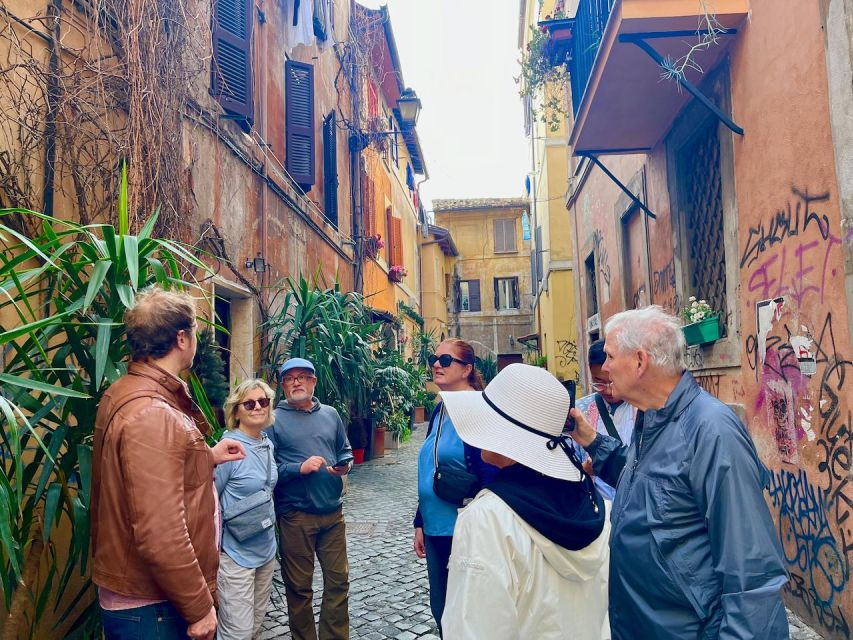
The Trastevere section lasts about 50 minutes in total. You spend around 30 minutes exploring the district, 10 minutes at Santa Maria in Trastevere, then another 20 minutes in Trastevere before finishing at Piazza Trilussa.
This part feels different from the Ghetto. The guide takes you through narrow lanes, ivy-covered houses, old churches, and streets with a more traditional Roman character. The appeal is not a single grand sight. It is the sense of seeing how the district fits together.
You will learn about Trastevere’s place in Rome’s story while also getting useful orientation for your own evening. Several guides give restaurant and bar suggestions, and that advice is especially helpful here because the tour ends in the middle of the neighborhood rather than returning you to the starting point.
The walk through Trastevere is also where the tour becomes most relaxed. After discussing community history and difficult events, the route turns toward architecture, local habits, and the atmosphere of the streets. The change in mood is welcome, though it means the Jewish Ghetto remains the stronger focus if that is your main interest.
Santa Maria in Trastevere and the final walk to Piazza Trilussa
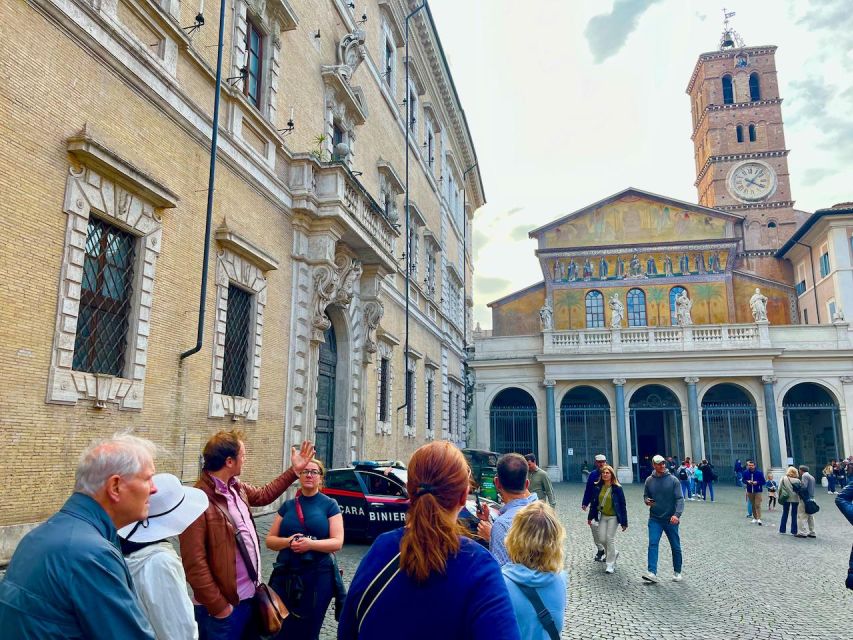
Santa Maria in Trastevere gets about 10 minutes of guided attention. This gives you a chance to understand why the church matters within the district and how religious buildings shaped the neighborhood.
Again, this is a guided exterior-oriented walk rather than a church-focused interior tour. If you want extended time inside churches, this experience may feel too brief. Its purpose is to place Santa Maria in Trastevere within the wider story of the area.
The final 20-minute stroll through Trastevere leads to Piazza Trilussa, where the tour ends after a brief five-minute stop. This is a good finish for independent exploring. You can remain in the neighborhood for dinner, follow your guide’s food suggestions, or simply keep walking through the lanes.
Because the ending is not near the starting point, plan your evening around Trastevere. That is an advantage if you want dinner here, but less convenient if you have a timed reservation elsewhere in Rome.
The guides make or break the experience
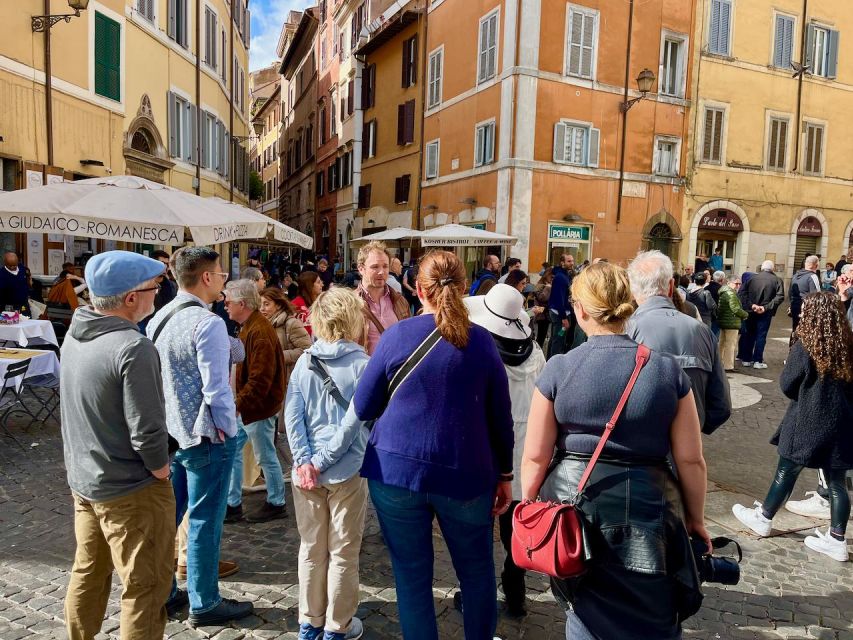
The strongest feature is the live guide. The tour is offered in English, and the guides are repeatedly praised for clear delivery, humor, patience, and the ability to answer questions.
Ben is especially noted for explaining a large span of Roman history without firing too many facts at you at once. Guido is praised for making each stop come alive and for mixing architecture with history. Alethea and Alithia are described as energetic, prepared, and good at adding unusual details and jokes.
Guide assignments can change, so you should not book on the assumption that one particular person will lead your group. Still, the range of strong comments suggests a consistent focus on storytelling rather than simple fact recitation.
The small-group setting is another plus. A smaller group makes it easier to hear on narrow streets and gives you a better chance to ask questions. It also lets the guide adjust the explanation to the group’s interests. The tradeoff is that the tour depends on everyone staying together, so arriving late can create a real problem.
Is $35 a fair price?
At $35 per person, this is a reasonable price for a 2.5-hour walking tour with a live English-speaking guide. You are paying for interpretation, route planning, and local orientation rather than admission tickets.
The value is strongest if you are new to Rome, interested in Jewish history, or want a guided introduction to Trastevere before returning on your own. A guide can point out connections that would be easy to miss and give you restaurant ideas for later.
The price is less attractive if you want a synagogue visit, a food tour, or a long stop inside major monuments. Food and drinks are extra, and the synagogue is viewed only from outside. You are also covering a fair amount of ground, so the experience is about walking and explanation, not extended time at each site.
Free cancellation up to 24 hours before the start and the reserve-now, pay-later option add useful flexibility. The tour runs rain or shine, so check the forecast and bring suitable protection.
Who should book this walk?
I would recommend it to first-time Rome visitors who want more than the standard ancient sights. It also suits anyone curious about the Jewish community of Rome, especially if you value historical context and personal stories over museum displays.
Families with older children and teenagers can do well here, since the guides use humor and anecdotes to keep the material moving. People who enjoy architecture will also find plenty to notice, from ruins and churches to old houses and neighborhood streets.
You should think twice if you dislike cobblestones, standing, or changing neighborhoods at a steady pace. The tour is listed as wheelchair accessible, but the route still includes historic streets and should be checked against your personal mobility needs before booking.
Should you book the Jewish Ghetto and Trastevere Tour?
Book it if you want a compact, story-led walk that connects ancient Rome, Jewish community history, Tiber Island, and Trastevere. At $35, it offers good value for an English-speaking guide and a well-planned route, especially when you use the ending at Piazza Trilussa to continue your evening.
Skip it if your priority is entering the synagogue, spending a long time inside churches, or focusing only on Jewish history. For most visitors, though, the mix is the point. You get serious history, local streets, practical food tips, and a clear sense of how two very different Roman neighborhoods relate to each other.
FAQ
How long does the Rome Jewish Ghetto and Trastevere Tour last?
The tour lasts 2.5 hours, although one published experience note says a particular walk finished just over two hours.
What language is the tour offered in?
The tour is conducted in English with a live guide.
Where does the tour start?
The meeting point is outside Santa Rita da Cascia in Campitelli on Via Montanara, next to Antico Caffè del Teatro Marcello.
Where does the tour finish?
The tour finishes at Piazza Trilussa in Trastevere.
What sites are included?
The route includes the Theatre of Marcellus, Portico d’Ottavia, Rome’s Jewish Ghetto, Piazza Mattei, Tiber Island, Trastevere, Santa Maria in Trastevere, and Piazza Trilussa.
Is entry to the synagogue included?
No. The synagogue is viewed from outside, and synagogue entrance is not included.
Are food and drinks included?
No. An optional stop may be made at a gelateria or cafe, but food and drinks are not included in the price.
What should I bring?
Bring comfortable shoes and suitable protection for the weather. In summer, bring a water bottle, since public fountains are available for refills.
Is the tour wheelchair accessible?
Yes, the activity is listed as wheelchair accessible.
What happens if it rains?
The tour runs rain or shine. Bring appropriate weather protection.
Can I cancel the booking?
You can cancel up to 24 hours in advance for a full refund. A reserve-now, pay-later option is also available.
Fresh on the Rome list
- Rome: Guided Catacombs Tour & Capuchin Crypt (Audio Guide)★ 4.3 · 191 reviews
- Guided tour of the Colosseum, Roman Forum and Palatine in Spanish★ 4.5 · 191 reviews
- Rome: Borghese Gallery Guided Tour with Skip-the-Line Ticket★ 4.5 · 192 reviews
- Rome: Arena Colosseum Tour with Arena Access★ 4.6 · 193 reviews
- Rome: Colosseum & Roman Forum Guided Tour★ 5.0 · 194 reviews
- Colosseum, Forum, Palatine Hill with audio guide and Arena or Bus option★ 4.0 · 193 reviews
- Rome: Domus Aurea Guided Tour and Virtual Reality Experience★ 4.7 · 194 reviews
- Rome Vintage Fiat 500 car Tour With Photographer★ 5.0 · 194 reviews
Rome Tours, compared.

Vatican Museums & Sistine Chapel Tour with Optional Basilica
Read our review →
Colosseum, Roman Forum & Palatine Guided Tour
Read our review →
Vatican Museums, Sistine Chapel & St Peter’s Basilica Guided Tour
Read our review →
Colosseum, Palatine Hill and Roman Forum Guided Tour
Read our review →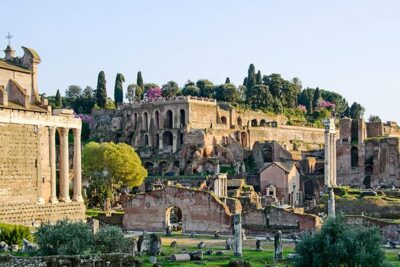
Guided Tour of Colosseum, Roman Forum & Palatine Hill
Read our review →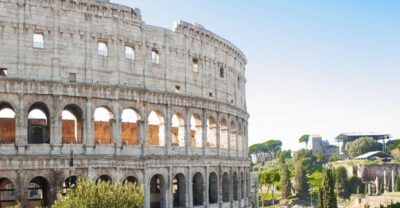
Colosseum & Forum with Audio Guide App -Optional Arena
Read our review →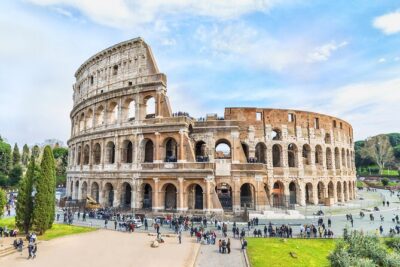
Colosseum, Roman Forum and Palatine Hill Guided Tour
Read our review →