
Reviewed · VENICE TOURS
Venice: Doge’s Palace Prisons & Secret Itineraries Guided Tour
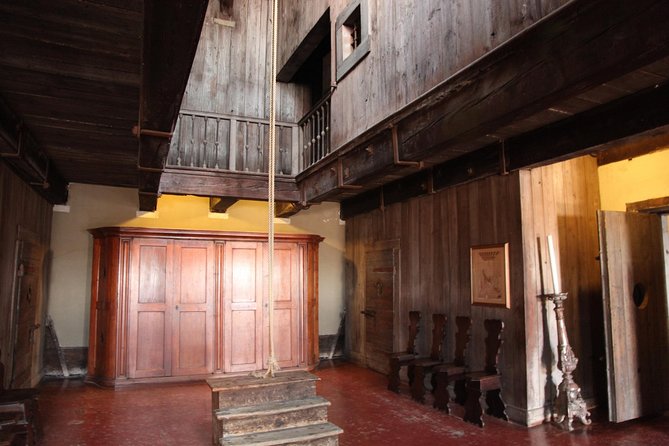
The most unusual part of Doge’s Palace is not its grand staircase or enormous halls. It is the cramped world above and behind them: attic rooms, restricted chambers, interrogation spaces, and the Piombi prison beneath the palace roof. This tour takes you into those less familiar corners, then leads you across the Bridge of Sighs to Venice’s New Prison.
I like the skip-the-line entry, especially at a landmark as busy as St. Mark’s Square. I also like the focus on Casanova, political prisoners, and the working machinery of Venetian government. The main caution is simple: this is more a secret-rooms and prison tour than a full guided tour of the palace. After the guided portion, you explore much of the public palace by yourself.
Key points at a glance
- The Piombi prison sits beneath the palace roof, where upper-class and political prisoners were held.
- Casanova’s escape story gives the darker rooms a memorable human connection.
- The guide leads the secret itineraries section, an area you would not reach with a standard palace visit.
- The Bridge of Sighs connects the palace to the New Prison, where you have free time to look around.
- The tour lasts about 90 minutes, with a maximum group size of 24 people.
- Expect stairs, standing, heat, and tight rooms, with little seating along the route.
What You Are Really Buying for $91.04
At $91.04 per person, this is not the cheapest way to enter Doge’s Palace. The price makes sense if you place a high value on a guide, faster entry, and access to the secret itineraries. It is less convincing if your main goal is simply to see the palace’s famous public rooms at your own pace.
The important distinction is the tour’s shape. Your guide explains the palace’s government rooms and takes you through the restricted areas, but the experience does not provide a full guided walk through every major public gallery. Once the guided section ends, you can continue exploring the palace independently.
I see the price as paying for access and context rather than for a long guided visit. A standard admission gives you the grand halls, paintings, Bridge of Sighs, and prison areas open to the public. This tour adds the parts most independent visitors cannot reach, along with an English-speaking guide who explains how Venice’s government and prisons worked.
The tour is also short by Venice sightseeing standards. At around 1 hour and 30 minutes, it fits neatly into a busy day, perhaps before lunch or between St. Mark’s Basilica and another central sight. If you want a three-hour art and architecture lesson, choose a longer palace tour instead.
A few other Venice mornings to weigh against this
- Venice: La Fenice Opera House Entry Ticket with Audio Guide
★ 4.6 · 11,742 reviews - Murano & Burano Islands Guided Small-Group Tour by Private Boat
★ 4.5 · 7,580 reviews - Venice Islands: Murano Glass & Burano Colors Guided Visit
★ 4.5 · 4,581 reviews
Meeting Near St. Mark’s Square
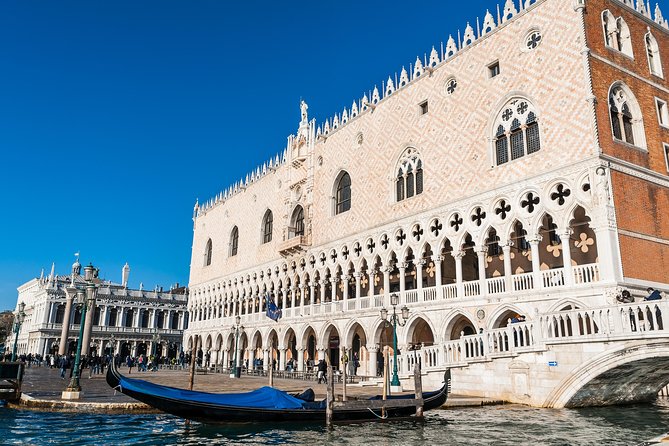
The tour begins near Riva degli Schiavoni, by St. Mark’s Square. The square itself is one of Venice’s great stages, framed by Doge’s Palace, St. Mark’s Basilica, and the Campanile. It is also a place where directions can become confusing fast.
Give yourself extra time to find the guide. The written address has caused confusion because it can lead you farther along the waterfront than the actual meeting spot near the palace. Check the precise meeting instructions and look carefully around the palace entrance area rather than relying only on the street address.
Arriving late is a serious risk. One booking party reported reaching the meeting point only minutes before departure in heavy rain and finding that the guide had already left. The tour operator may not wait, so I would arrive at least 15 minutes early, especially if you are crossing Venice on foot with luggage or navigating from a vaporetto stop.
There is no hotel pickup or drop-off. That is normal for central Venice tours, but it means you must plan your own route to the square. The area is served by public transportation, and the tour ends back at the starting point.
The Palace Rooms: Gold, Paint, and Political Power
Doge’s Palace was built in the 14th century as the residence of Venice’s doge and the center of the Venetian Republic’s government. Its Venetian Gothic exterior is immediately impressive, with pale stone arcades and elaborate decoration facing the water and the square.
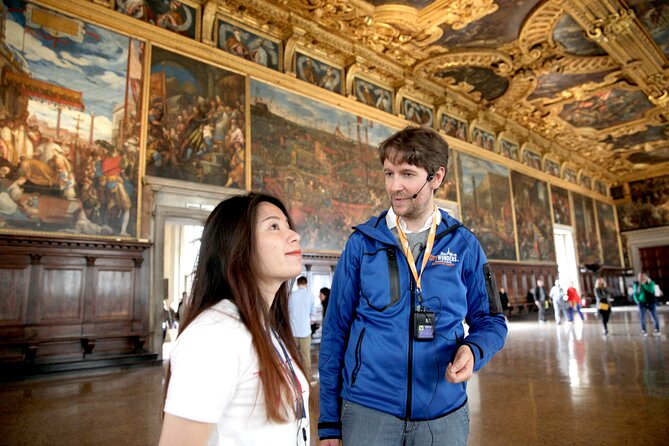
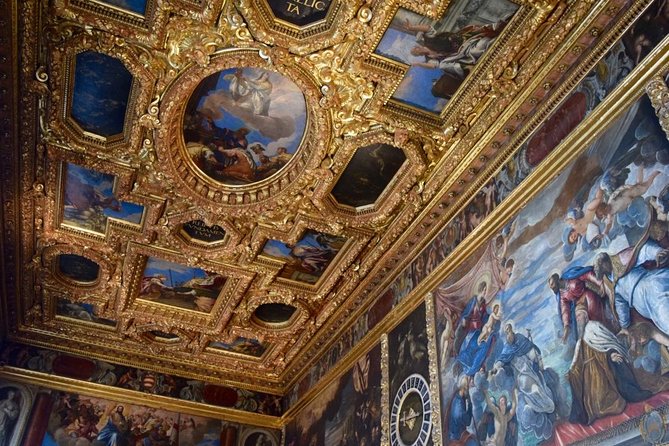
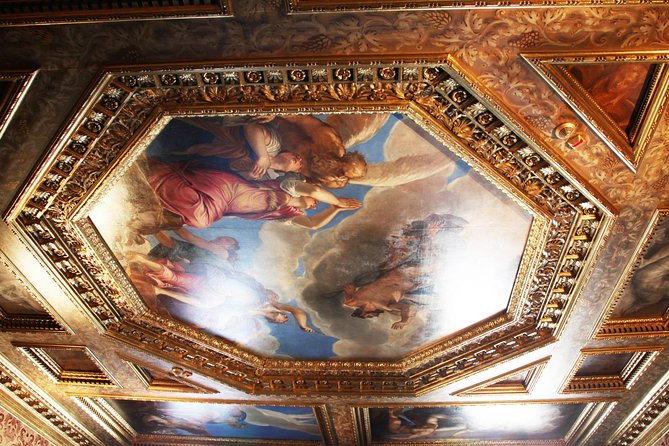
Inside, the scale changes. Public rooms are lined with gilded carving, murals, painted ceilings, and formal decoration designed to project the strength of the republic. Works by Tintoretto and Veronese show how art served political purpose as much as beauty.
One highlighted work is Juno Bestowing Her Gifts on Venice, a ceiling fresco that presents Venice as a favored and powerful city. Your guide points out such details and supplies the political setting behind them. That explanation matters because the palace can otherwise become a parade of grand rooms without much sense of how they functioned.
Still, do not expect the guide to lead you through every public room in detail. The main emphasis is on the lesser-seen spaces, and after the guided section you can return to the public areas on your own. This arrangement works well for independent sightseers who enjoy wandering, but it can disappoint if you booked a guide specifically to explain every famous painting.
The Secret Itineraries Above the Palace
The heart of the experience is the restricted section known as the secret itineraries. You head upward into attic-level areas and rooms connected to the administration of Venetian justice and government.
These are not polished ceremonial chambers. You might see narrow passageways, private work areas, storage and archive spaces, and rooms that reveal the practical side of a government housed inside a palace. The contrast is the point. One moment you are surrounded by grand public art, and the next you are looking at cramped rooms built for paperwork, interrogation, and control.
The guide’s storytelling is especially useful here. Without explanation, the rooms can seem like a series of bare chambers. With context, they show how a powerful republic gathered information, questioned suspects, kept records, and guarded its authority.
The group can include up to 24 people. That is not enormous by tour standards, but secret rooms are small, and a full group can feel crowded. Audio headsets are supplied when appropriate, which helps you hear the guide even when the party spreads through a tight space.
Several strong guide experiences are reflected in the tour’s feedback. Rita is singled out for bringing the palace to life with energy and detail, while other guides are praised for humor, clear English, and animated explanations. The quality of any live tour depends on the individual guide and the pace of the group, so you should expect an informative experience but not a perfectly uniform one.
Same city, an entirely different afternoon:
- Venice: Doge’s Palace Reserved Entry Ticket
★ 4.6 · 42,716 reviews - Venice: Grand Canal Gondola Ride with App Commentary
★ 4.1 · 18,908 reviews - Boat Trip: Glimpse of Murano, Torcello & Burano Islands
★ 4.3 · 15,699 reviews - Venice: Grand Canal by Gondola with Live Commentary
★ 4.1 · 13,681 reviews
Inside the Piombi Prison
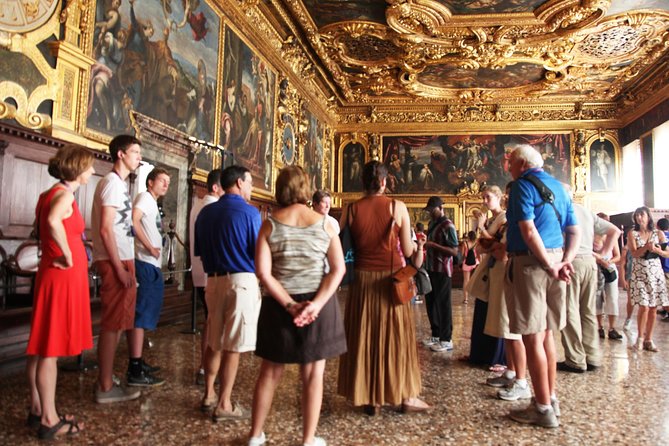
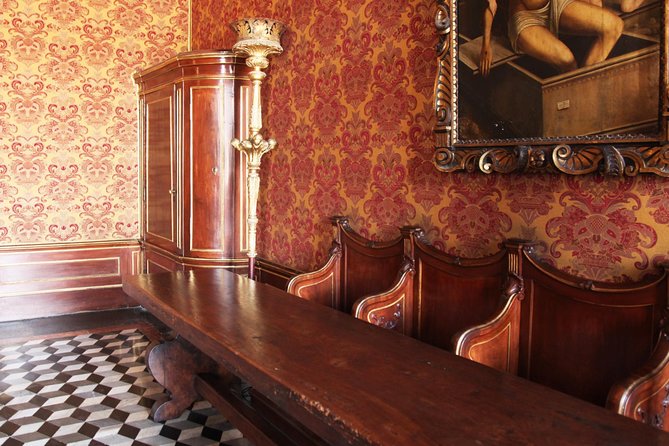
The Piombi prison occupies attic spaces directly beneath Doge’s Palace’s lead roof. Its name comes from the lead roofing material, which made the area particularly harsh. These cells were generally used for upper-class prisoners and political inmates, rather than only ordinary criminals.
The prison section changes the mood of the visit. The ceremonial halls are open, decorative, and designed for display. The Piombi rooms are cramped and severe. You may find yourself standing close to the walls while the guide explains how inmates were held and why this part of the palace was kept apart from the main public and administrative rooms.
Casanova is the best-known prisoner connected with the Piombi. His imprisonment and daring escape give the tour a strong narrative thread. The story is not just a colorful anecdote. It helps you understand the prison’s layout, its security, and the gap between the republic’s public image and its secret justice system.
This portion is a good fit if you like political history, famous escape stories, and the less polished side of historic buildings. It is not ideal for anyone expecting a comfortable museum route. Rooms can be hot and stuffy, and there are many stairs. Seating is limited or unavailable along much of the route.
Crossing the Bridge of Sighs
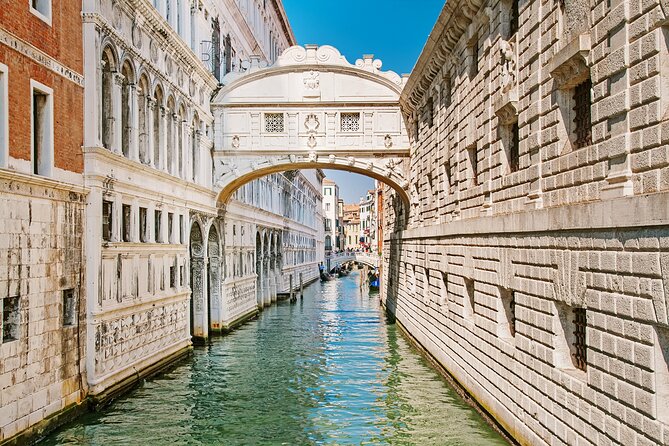
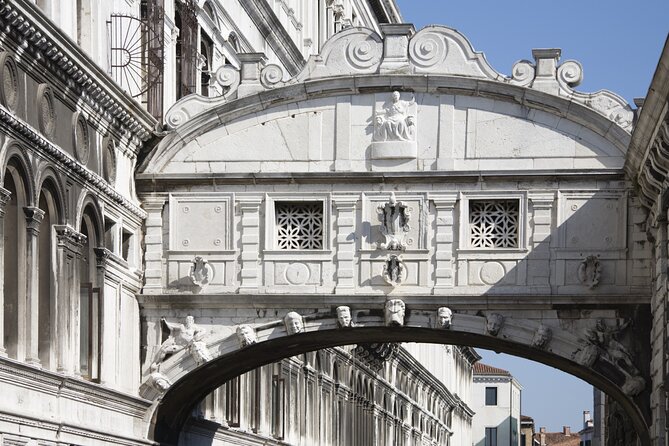
The Bridge of Sighs connects Doge’s Palace with the New Prison. Built around 1600, the enclosed limestone bridge has small windows with stone bars and ornate Baroque decoration.
Its famous name comes from the traditional story that prisoners sighed as they took one last look at Venice through the barred windows. The story may be romanticized, but the bridge remains a powerful piece of the justice system. It was not built as a scenic overlook. It was a controlled passage between the palace courts and the prison complex.
On this tour, you cross the bridge to enter the New Prison. The crossing takes only a few minutes, but it connects the two halves of the experience in a clear way. The palace was where Venice’s rulers debated and judged. The prison was where those decisions became daily life for inmates.
The bridge is also one of Venice’s most photographed sights, so expect the area to be busy at times. The skip-the-line benefit helps with entry to the palace, but it does not turn the whole of St. Mark’s Square into a private space.
The New Prison and Your Independent Time
Across the bridge, the Palazzo delle Prigioni, or New Prison, offers a different look at Venetian justice. It was built in the late 16th century, partly to improve conditions compared with earlier facilities, but its cells and narrow corridors remain stark.
You have free time to explore this section independently. That gives you freedom to move at your own pace, pause in the cells, and take in the contrast between the prison and the palace. It also means there is no continuing guided explanation for every room.
This self-guided ending is one of the tour’s strengths for independent visitors and one of its weaknesses for people who want constant commentary. I would pay close attention during the secret itineraries section, then use the New Prison time to look around quietly rather than expect another formal lecture.
The tour ends back near the starting point after you return to the open air of St. Mark’s Square. Depending on the route and the guide’s pace, you may still have time to continue through the public palace afterward. Several people appreciate being able to remain inside and explore at leisure once the guided portion is over.
Stairs, Heat, and Practical Comfort
The physical demands deserve more attention than they usually receive in a short city tour. There are a lot of stairs, and much of the route involves standing. Some rooms are warm and stuffy, with no air conditioning, and the group can feel close together in narrow spaces.
Most people can participate, but this is not a smooth, step-free museum visit. Older or frail visitors may find the stairs tiring. If you are pregnant, traveling with a small child, or managing a mobility concern, consider the route carefully before booking. The supplied information does not promise a fully accessible path.
Wear comfortable shoes with good grip. Carry water, but keep your belongings compact because Doge’s Palace does not admit bulky luggage if the total of its three sides exceeds one linear meter. There is a water fountain along the route.
The audio headsets are a welcome touch. In large palace rooms, a guide’s voice can disappear quickly, and headsets help you follow the explanation without standing directly beside the guide. They are used when appropriate, not necessarily for every moment.
Timing, Crowds, and Group Size
The tour runs for about 90 minutes, with roughly 1 hour and 10 minutes inside Doge’s Palace, a short crossing of the Bridge of Sighs, and about 10 minutes in the New Prison. The actual pace can vary slightly with group size and questions.
It is often booked well ahead, with an average booking lead time of 51 days. That suggests planning early if your Venice dates are fixed, especially for a preferred morning departure. A morning tour can also help you see the palace before the day feels fully crowded, although no central Venice attraction is guaranteed to be quiet.
A group of up to 24 is manageable, but it is not intimate. In cramped prison spaces, people at the back may feel removed from the action. The headset reduces that problem, though it cannot create more room.
Guides vary in style. Some move briskly and keep the story focused. Others spend longer on background and questions, which can be useful if you want detail but frustrating if you prefer more time inside each room. The strongest experiences seem to come when the guide combines clear history with a lively presentation and avoids long introductions about what the tour is about to cover.
Who Will Get the Most From This Tour
I would choose this tour if you have already seen plenty of grand European palaces and want the parts most independent visitors miss. The prison cells, attic rooms, interrogation spaces, and Casanova story give Doge’s Palace a sharper edge than a standard art-focused visit.
It also suits you if your Venice schedule is tight. The 90-minute format gives you a guided framework without taking half a day. Afterward, you can continue through the public rooms, visit another sight, or return to St. Mark’s Square.
Families with teenagers may find the prison and escape story more gripping than a long sequence of painted ceilings. History fans will appreciate the political setting. First-time visitors should book it only if they are comfortable exploring the palace’s major public rooms independently after the guided portion.
I would look elsewhere if you want a full, continuous commentary on the palace’s art collection. I would also think twice if stairs, standing, hot rooms, or tight corridors are a concern. The tour is not a relaxed stroll.
Booking, Cancellation, and the Venice Access Fee
Confirmation arrives when you book, and free cancellation is available until 24 hours before the local start time. Changes or cancellations inside that 24-hour window are not accepted for a refund.
Venice also has an access fee on specific dates in 2025. Check the municipality’s official guidance before your visit to see if the fee and registration rules apply to your day. This is separate from the tour price.
Because the meeting instructions can be easy to misread, save the exact starting details to your phone and allow time to locate the guide. A mobile ticket is convenient, but it does not remove the need to be at the right point before departure.
Should You Book It?
Book this Doge’s Palace tour if your priority is restricted rooms, prisons, and expert context, not a complete guided survey of every public gallery. The skip-the-line access and secret itineraries make the $91.04 price easier to justify, especially during a busy Venice visit.
Go in knowing the tradeoff. You receive a compact guided visit through the palace’s darker and less familiar spaces, then explore the New Prison and much of the public palace on your own. For me, that is a worthwhile choice for curious history fans, short-stay visitors, and anyone who wants more than the usual postcard view of Venice. It is a weaker value for visitors seeking a long, fully guided art tour.
FAQ
How long does the Doge’s Palace prisons tour last?
The experience lasts approximately 1 hour and 30 minutes. The Doge’s Palace portion takes about 1 hour and 10 minutes, the Bridge of Sighs crossing about 5 minutes, and the New Prison about 10 minutes.
What is included in the tour price?
The price includes an English-speaking guide, skip-the-line access to Doge’s Palace, access to the secret rooms, free time in the New Prison, and audio headsets when appropriate.
Does the guide lead me through the entire public palace?
No. The guide focuses on the secret itineraries and prison-related areas. You can explore the public sections of Doge’s Palace independently after the guided portion.
Is the tour suitable for people with limited mobility?
Most people can participate, but the route includes many stairs, standing, narrow rooms, and limited seating. The supplied information does not describe the experience as fully accessible.
Can I bring luggage into Doge’s Palace?
Doge’s Palace does not admit bulky luggage when the total of the three sides exceeds one linear meter. Keep your belongings compact.
Where does the tour start and end?
The meeting point is on Riva degli Schiavoni near St. Mark’s Square in Venice. The activity ends back at the meeting point. There is no hotel pickup or drop-off.
Fresh on the Venice list
- Murano: Glass Blowing Demonstration and Artistic Glass Gift★ 4.6 · 507 reviews
- From Venice: Dolomites, Lake Misurina, and Cortina Day Trip★ 4.6 · 508 reviews
- Venice Islands: Murano Glass & Burano Colors Guided Visit★ 4.5 · 510 reviews
- The Majestic Teatro La Fenice: Guided Tour in Venice★ 4.3 · 513 reviews
- Real Venetian Kayak – Tour of Venice Canals with a Local Guide★ 4.5 · 518 reviews
- Venetian Carnival Mask Making Class in Venice, Italy★ 4.5 · 525 reviews
- Half Day Murano and Burano Island Tour by Private Boat★ 4.5 · 529 reviews
- Venice Trilogy: Murano, Burano & Torcello by Lagoon Boat★ 4.5 · 532 reviews
Venice Tours, compared.


Grand Canal Gondola Ride with App Commentary
Read our review →
Boat Trip: Glimpse of Murano, Torcello & Burano Islands
Read our review →
La Fenice Opera House Entry Ticket with Audio Guide
Read our review →
Doge’s Palace & St. Mark’s Basilica with Terrace Access Tour
Read our review →
Burano, Torcello & Murano Boat Tour w/Glassblowing
Read our review →
Murano and Burano Boat Tour with Glass Factory Visit
Read our review →Browse the lists this tour appears in