Reviewed · TICKETS
Ravenna: UNESCO Mosaics Entry Tickets
Ravenna’s great attraction is not one grand monument, but a series of quiet buildings lined with mosaics that still glow after 1,500 years. This ticket lets you see the core sights at your own pace, including San Vitale’s imperial mosaics and the early Christian scenes at Sant’Apollinare Nuovo.
I like the seven-day validity, which removes the pressure to race from church to church. I also like the choice between a three-monument ticket and a five-monument version, especially if you want Galla Placidia’s Mausoleum and the Neoniano Baptistery. The main drawback is simple: this is an entry ticket, not a guided visit, so you must bring your own context or arrange a guide separately.
Key points
- San Vitale’s octagonal interior combines Roman design with Byzantine decoration, including Justinian and Theodora in glittering wall mosaics.
- Sant’Apollinare Nuovo contains a long Byzantine mosaic cycle, including some of the oldest surviving scenes linked to the life of Christ.
- St. Andrew’s Chapel sits inside the Archiepiscopal Museum and offers a small, intimate look at Ravenna’s early Byzantine religious world.
- The five-monument option adds the Mausoleum of Galla Placidia and the Neoniano Baptistery.
- Seven days of validity lets you spread the visits across your stay, with one entry permitted at each monument.
- A 20 percent bookshop discount adds a little value for anyone who wants a guidebook or art book after seeing the mosaics.
Why Ravenna’s mosaics deserve your time
Ravenna can look modest at street level. Its treasures are often tucked behind plain brick walls, in churches that give little warning of what waits inside. Then you enter, look up, and find entire surfaces covered with tiny pieces of colored glass and stone.
The city’s mosaics come from several periods, but the most famous works date from the fifth and sixth centuries, when Ravenna was tied to Roman, Ostrogothic, and Byzantine power. That mixture explains the unusual feel of the monuments. You see Roman architectural forms, Christian stories, eastern imperial imagery, and local religious traditions sharing the same buildings.
I recommend treating the ticket as a small museum route rather than a quick church visit. The buildings are close enough to connect on foot, and the seven-day validity means you can stop when your eyes need a break. Mosaics reward patience. A few quiet minutes can reveal faces, gestures, and small details that disappear if you hurry.
At $14 per person, the ticket offers good value if you visit the included monuments. The five-monument version makes an even stronger case for itself because the added sites are among Ravenna’s most important early Christian interiors. The value drops only if you plan to see one building and move on.
A few other Italy mornings to weigh against this
- Vatican: Museums & Sistine Chapel Entrance Ticket
★ 4.5 · 144,003 reviews - Milan: Cathedral and Duomo’s Terraces Entrance Ticket
★ 4.6 · 61,054 reviews - Venice: Doge’s Palace Reserved Entry Ticket
★ 4.6 · 42,716 reviews
San Vitale and the glittering world of Justinian
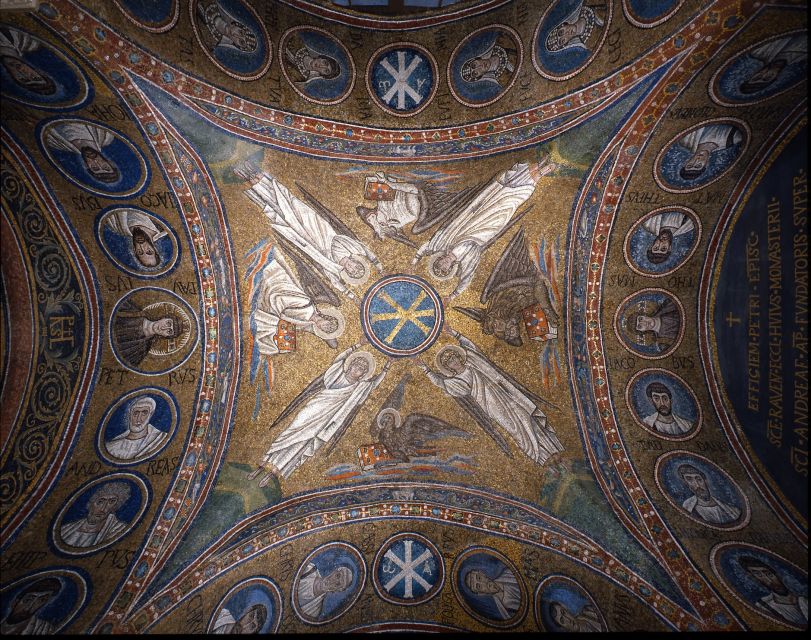
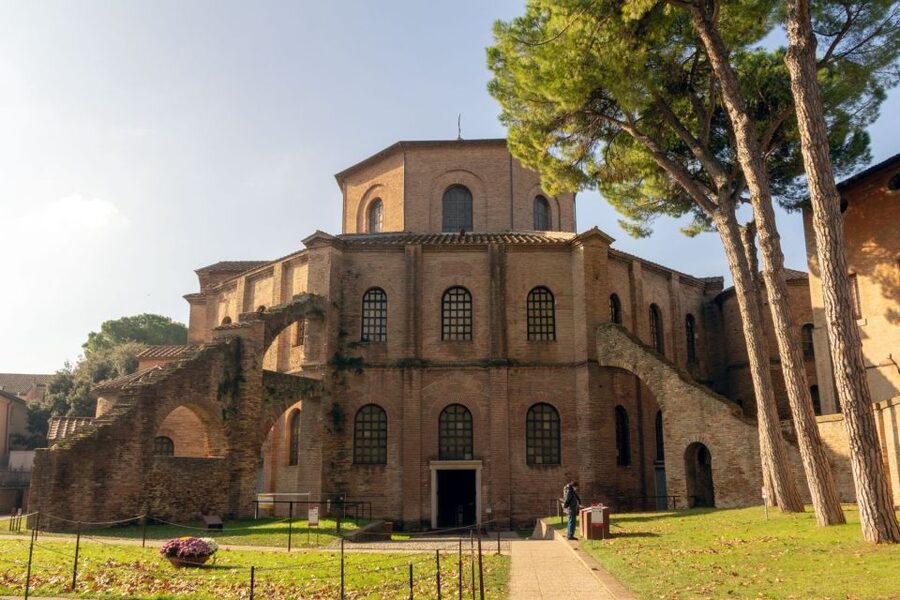
Begin with the Basilica of San Vitale, an octagonal sixth-century church and the strongest reason many people come to Ravenna. Its architecture uses a central plan associated with Roman buildings, while the decoration reflects the Byzantine world.
Inside, look first at the structure. The octagonal form gives you a changing view as you move around the building. Arches, galleries, and curved surfaces guide your eye upward toward the sanctuary. The building feels more complex than its plain exterior suggests.
Then give the mosaics time. Biblical scenes from the Old Testament fill the walls with figures, architecture, trees, and patterned backgrounds. The small tiles create a surface that shifts as the light changes. From a distance, the images read as a single glowing field. Up close, you can see how color and angle do the work.
The imperial panels are the famous stars. Emperor Justinian appears with his attendants, while Empress Theodora arrives with her own richly dressed group. These are not casual portraits. They connect the imperial court with the church and show how religious power and political power worked together in Ravenna.
You do not need to be an art expert to enjoy San Vitale, but a little preparation helps. Look for the contrast between the formal, frontal imperial figures and the more narrative biblical scenes. Notice how the mosaics make people look timeless and ceremonial, while the architecture in the stories adds movement and place.
San Vitale can be busy at certain times, but the ticket’s long validity gives you a useful option: visit once to see the main effect, then return to a detail if your schedule allows. The ticket permits one visit per monument, so plan that return carefully rather than assuming you can enter repeatedly.
Galla Placidia’s Mausoleum, small room, huge effect
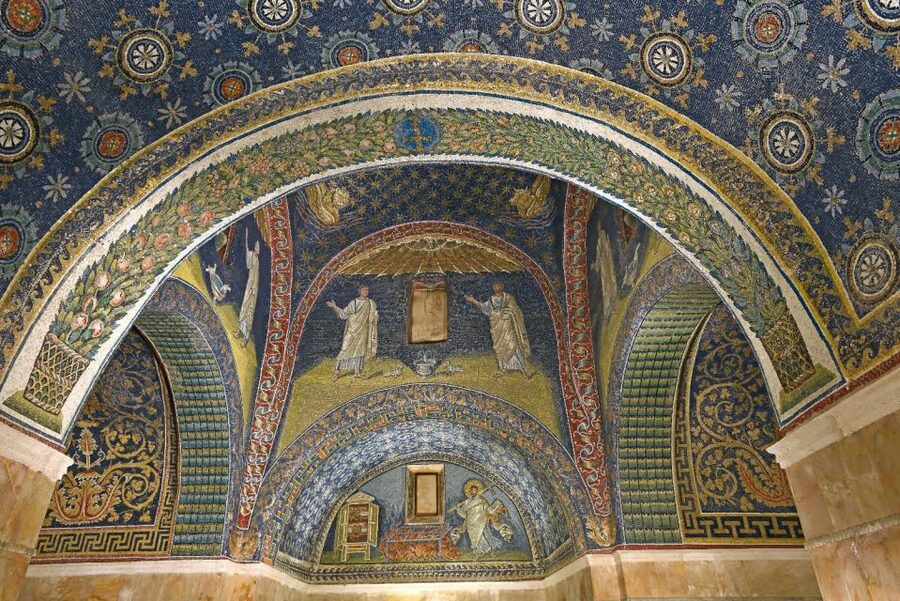
If you choose the five-monument option, add the Mausoleum of Galla Placidia near San Vitale. It dates from the first half of the fifth century and is much smaller than the basilica.
That change in scale matters. San Vitale presents a grand public statement. Galla Placidia’s Mausoleum feels enclosed and personal, with its decoration concentrated in a compact interior. The ceiling is famous for its deep blue field and starry pattern, while the walls carry Christian symbols and figures.
This is the sort of place where you should pause before taking photographs. Let your eyes adjust, then look from the center toward the ceiling and corners. The small space can feel almost jewel-like without needing any grand gesture.
The building is close to San Vitale, so adding it does not create a major transport problem. The main consideration is ticket selection. Access is included only with the five-monument option, so check what you have selected before you arrive.
Sant’Apollinare Nuovo and its long mosaic procession
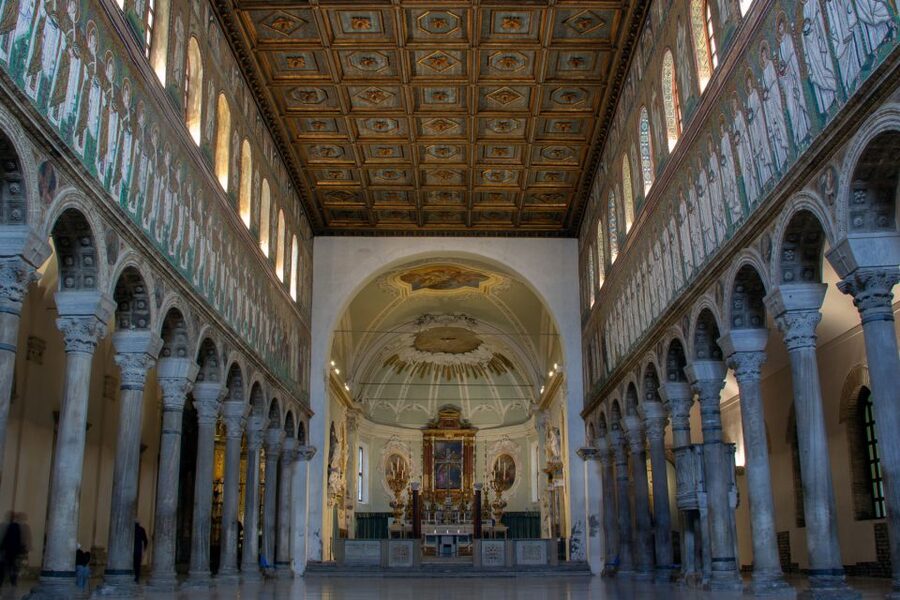
Sant’Apollinare Nuovo gives you a different experience from San Vitale. The church was built in the sixth century by Ostrogothic king Theodoric the Great, and its interior contains a long sequence of floor-to-ceiling mosaics.
The upper walls carry scenes connected with the life of Christ. The cycle is especially valuable for anyone interested in early Christian art because it includes some of the oldest mosaic scenes related to Christ’s life. You can follow the images along the nave, reading them as a visual sequence rather than as isolated pictures.
Below, processions of figures move along the walls. Their repeated forms create order and rhythm. Look closely at clothing, gestures, crowns, and backgrounds. Small changes help distinguish one figure from another, and the procession also shows how religious art can guide your attention through a building.
The church’s story includes later alterations. Pope Gregory the Great had the mosaics painted black at one point, reportedly to keep parishioners focused on prayer. They were later restored, and damage from World War I required further reconstruction. That history gives the building an extra layer of interest: what you see today is ancient work that has also survived changing ideas about worship, war, and preservation.
Sant’Apollinare Nuovo is sometimes described as discreet, and that is fair. It does not announce itself from the outside as loudly as the mosaics inside deserve. I like that contrast. You walk in expecting a church, then discover a long visual program running above you.
Same city, an entirely different afternoon:
- Vatican Museums & Sistine Chapel Tour with Optional Basilica
★ 4.3 · 67,413 reviews - Colosseum, Roman Forum & Palatine Guided Tour
★ 4.7 · 63,148 reviews - Vatican Museums, Sistine Chapel & St Peter’s Basilica Guided Tour
★ 4.5 · 39,149 reviews - Rome: Colosseum, Palatine Hill and Roman Forum Guided Tour
★ 4.8 · 32,814 reviews
St. Andrew’s Chapel inside the Archiepiscopal Museum
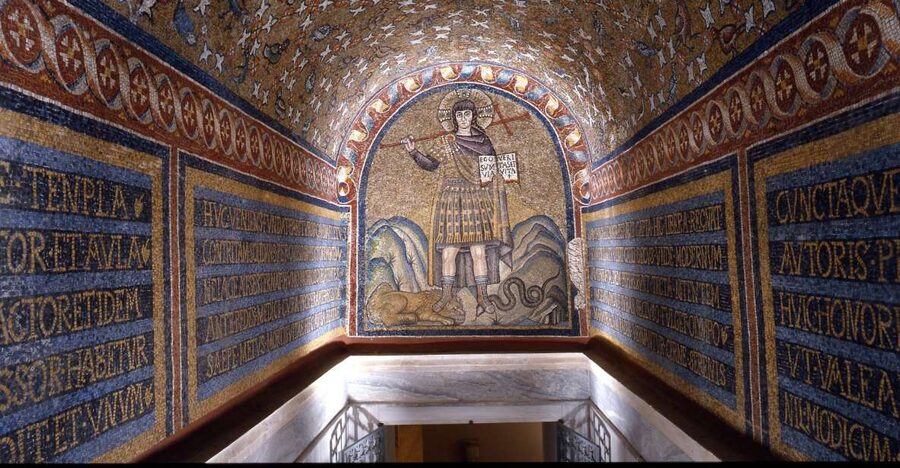
The Archiepiscopal Museum adds a smaller-scale stop to the route. Its most important room for this ticket is St. Andrew’s Chapel, the private chapel of Ravenna’s bishops.
The chapel offers evidence of the religious divisions of the early Byzantine period. Its mosaics tell stories linked to important people and places in Ravenna, but the setting is more intimate than the major basilicas. That makes it a useful counterpoint to San Vitale and Sant’Apollinare Nuovo.
The museum also contains epigraphs, the cathedral treasure, and an ivory throne associated with Bishop Maximian. These objects help you connect the walls and mosaics with the people who used, commissioned, and guarded them.
Do not treat St. Andrew’s Chapel as a quick add-on. It is smaller than the basilicas, but its importance comes from the setting and the surviving decoration. If you only look for enormous walls of mosaic, you may spend too little time here. I would allow room for the details and for the museum objects around it.
Access to the Archiepiscopal Museum and St. Andrew’s Chapel is part of the core ticket. This is one reason the ticket is more than a pass to two churches. It gives you several different ways to understand Ravenna’s art, from imperial public display to a bishop’s private chapel.
The Neoniano Baptistery completes the five-site route
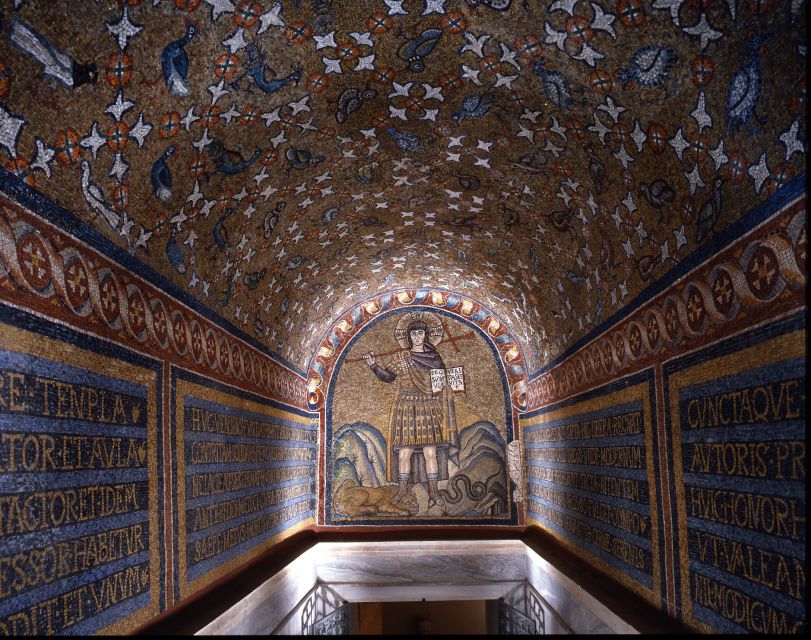
The Neoniano Baptistery is included with the five-monument option. It takes its name from Bishop Neon, who continued construction after his predecessor, Ursus.
The key feature is the mosaic decoration of the dome. Baptisteries were designed around the act of baptism, and the decoration gives the building a clear religious focus. The dome is the part to study most carefully, since the whole upper surface is covered with mosaic work dating to the time of Bishop Neon.
The baptistery is not a large building, so the visit can be brief in duration but dense in detail. One practical point matters: allow yourself enough time inside. A visitor who had time for each of eight sites still wished for a longer look at the Neoniano Baptistery. That is a good warning for anyone building a tight schedule.
The baptistery also shows why the five-monument option can be worthwhile. The extra charge, if applicable to your selected ticket, adds a site with a different purpose and shape rather than another version of the same basilica visit.
A flexible ticket, not a guided tour
The ticket is valid for seven days, with one visit to each monument. That is unusually useful in Ravenna because the sites are best seen at different speeds.
You can visit San Vitale and Galla Placidia together, then see Sant’Apollinare Nuovo later. The museum and chapel fit well into another short walk. All five sites are within walking distance of one another, making this a practical route for a day in the center or a relaxed two-day plan.
There is no guided visit included. You show the official ticket at the entrance and explore independently. That keeps the cost down and gives you control, but it also means the mosaics may not explain themselves fully.
If you want to get more from the art, read a little before entering or use a guidebook from one of the site bookshops. The ticket includes a 20 percent discount on bookshop purchases, which is a useful extra for anyone planning to buy a visual guide or history book.
A guide can add names, dates, and interpretations that are hard to pick up from the rooms alone. One guide named Cinzia has been praised for offering an informative and accommodating visit, but that refers to a guided experience, not a feature included with this entry ticket. Do not purchase this product expecting a guide to meet you.
Practical details that affect your visit
Wear comfortable shoes. The route is walkable, but you will be on your feet across several churches and museum spaces. The ticket is wheelchair accessible, which is important for anyone planning a longer cultural day.
Dress for religious sites. Knees and shoulders must be covered, and clothing with rips, holes, or transparent material is not allowed. This is worth checking before you leave your hotel, since a casual summer outfit may not meet the rules.
Flash photography is prohibited. Follow that rule carefully. Flash can disturb other people and is not helpful for photographing mosaics, where reflections and glass surfaces already make pictures difficult.
The booking ticket is sent in a separate email. Check for it before heading to the first monument. There has also been an entry problem in which a door did not recognize the ticket issuer, requiring a return to the ticket office. This appears to be an occasional practical snag rather than the normal experience, but keep the ticket office details and your booking email available.
The activity allows free cancellation up to 24 hours before the visit for a full refund. The ticket’s starting time is tied to availability, but its actual use extends across seven days. Check the selected option closely, especially if Galla Placidia’s Mausoleum and the Neoniano Baptistery matter to you.
Who should buy this Ravenna ticket?
I would choose it for an independent visitor who wants the major mosaic sites without paying for a full guided tour. It works particularly well for art lovers, church architecture fans, and anyone with enough time to spend at least a full day in Ravenna.
It is also a good fit if your schedule may change. Seven days of validity means rain, fatigue, or a crowded first stop does not have to spoil the whole plan. The sites are close enough to divide into manageable visits.
Families with older children may like the visual variety, though younger children may lose interest if you attempt all five monuments in one stretch. The churches are beautiful, but the experience is quiet and observation-based rather than interactive.
I would think twice if you want a strong narrative from a guide. The ticket gives you access, not explanation. It is also less useful for a very short stop when you can realistically see only one building.
Should you book it?
Yes, if you want to see Ravenna’s best-known mosaics independently and can visit at least the three core sites. San Vitale, Sant’Apollinare Nuovo, and St. Andrew’s Chapel offer three different experiences, and the seven-day period gives you room to enjoy them rather than rush.
Choose the five-monument option if you care about early Christian art and want Galla Placidia’s Mausoleum and the Neoniano Baptistery. Skip it only if your time is too short or you prefer a guided explanation from start to finish. For $14 per person, the core ticket is a strong cultural value, and the five-site route is the better choice for a serious look at Ravenna’s mosaics.
FAQ
How long is the ticket valid?
The ticket is valid for seven days.
How many times can I enter each monument?
You can visit each monument once during the ticket’s seven-day validity.
What sites are included in the core ticket?
The core ticket includes San Vitale Basilica, Sant’Apollinare Nuovo Basilica, the Archiepiscopal Museum, and St. Andrew’s Chapel.
Which sites are included with the five-monument option?
The five-monument option also includes the Mausoleum of Galla Placidia and the Neoniano Baptistery.
Is a guide included?
No. This is an entry ticket and does not include a guided visit.
Is the ticket wheelchair accessible?
Yes, the activity is wheelchair accessible.
What clothing and photography rules apply?
Your knees and shoulders must be covered, and clothing with rips, holes, or transparent material is not allowed. Flash photography is prohibited.
Fresh on the Italy list
- Rome: Guided Catacombs Tour & Capuchin Crypt (Audio Guide)★ 4.3 · 191 reviews
- Guided tour of the Colosseum, Roman Forum and Palatine in Spanish★ 4.5 · 191 reviews
- Bolgheri: Winery Tour with Wine Tasting★ 4.7 · 191 reviews
- Stories of Pompeii: Small Group tour with archeology expert guide★ 5.0 · 191 reviews
- Palinuro: Costa del Mito Boat Tour★ 4.9 · 191 reviews
- From Palau/La Maddalena: All inclusive Yacht Tour★ 4.8 · 191 reviews
- Small-Group Cooking Class in Positano: Gnocchi, Tiramisù & Drinks★ 5.0 · 191 reviews
- Semi Private Deep Wine Chianti and San Gimignano from Florence★ 5.0 · 191 reviews
Tickets, compared.
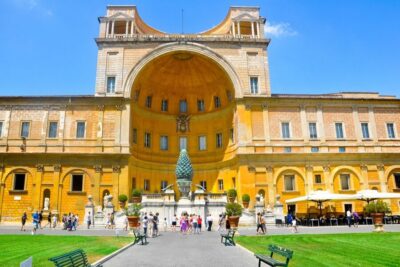
Vatican: Museums & Sistine Chapel Entrance Ticket
Read our review →
Cathedral and Duomo’s Terraces Entrance Ticket
Read our review →
Skip-The-Line Uffizi Gallery Timed Entry Ticket
Read our review →
Naples Underground Entry Ticket and Guided Tour
Read our review →
Pantheon Fast-Track Ticket and Official Audio Guide
Read our review →
Entry Ticket and Guided Tour with an Archaeologist
Read our review →