
Reviewed · CYCLING TOURS
Florence: 2-Hour Guided Bike Tour
Florence reveals itself quickly from a bicycle. In two hours, you can roll from the Medici quarter to the Duomo, cross the Arno, pass Pitti Palace and Ponte Vecchio, and reach Santa Croce and Dante’s district. I like the way this tour joins major sights with lesser-known corners, instead of keeping you in one postcard-perfect square.
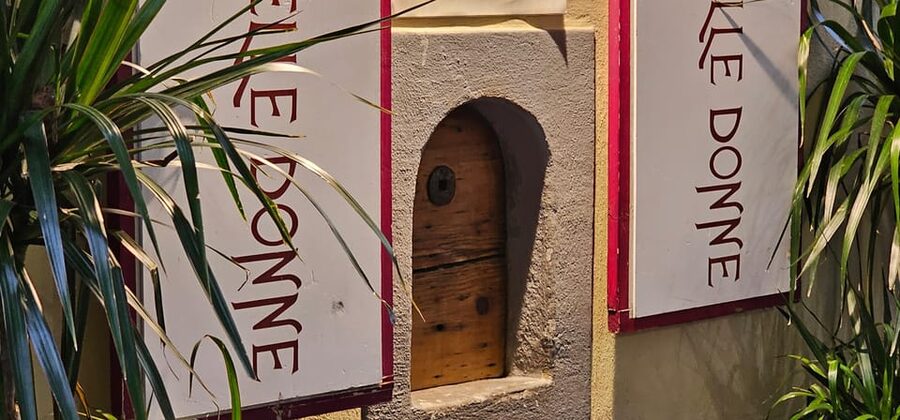
I also like the practical local advice. Guides such as Raffaello, Julia, and Lorenzo explain where to find good gelato, Florence’s wine windows, bistecca alla Fiorentina, and an affogato al caffè. The drawback is clear: Florence traffic and crowds require confident bike handling, especially on cobblestones and around pedestrians.
Key points at a glance
- Covers a remarkable stretch of Florence: See the Duomo, Piazza della Signoria, Santa Croce, Pitti Palace, and both sides of the Arno.
- Local storytelling is the main attraction: Raffaello, Julia, Lorenzo, and other guides bring in city history, architecture, food, and present-day life.
- Headsets help in noisy streets: The English audio system lets you hear the guide while riding between stops.
- Expect city cycling, not a gentle park ride: Crowds, traffic, uneven paving, and narrow streets demand attention.
- A useful first-day orientation: You can mark places to revisit later, from the Medici churches to Santo Spirito.
- Good value at $41: Bike, helmet, headset, and guide are included, but food, drinks, entries, and hotel transfers cost extra.
Why a bicycle works so well in Florence
Florence’s historic center is compact, but it is packed with pedestrians and famous buildings. Walking works beautifully for one square or museum at a time. It becomes less efficient when you want to connect the Duomo, the Oltrarno, Santa Croce, and the river viewpoints in one outing.
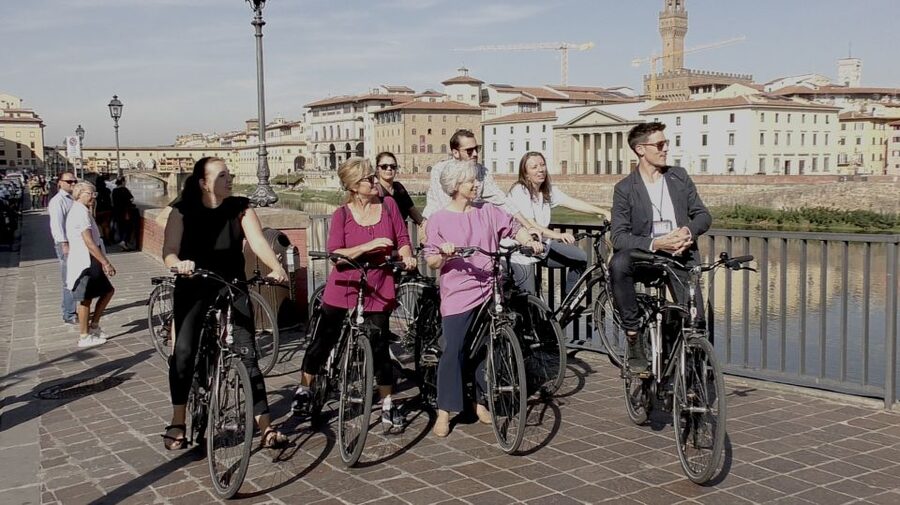
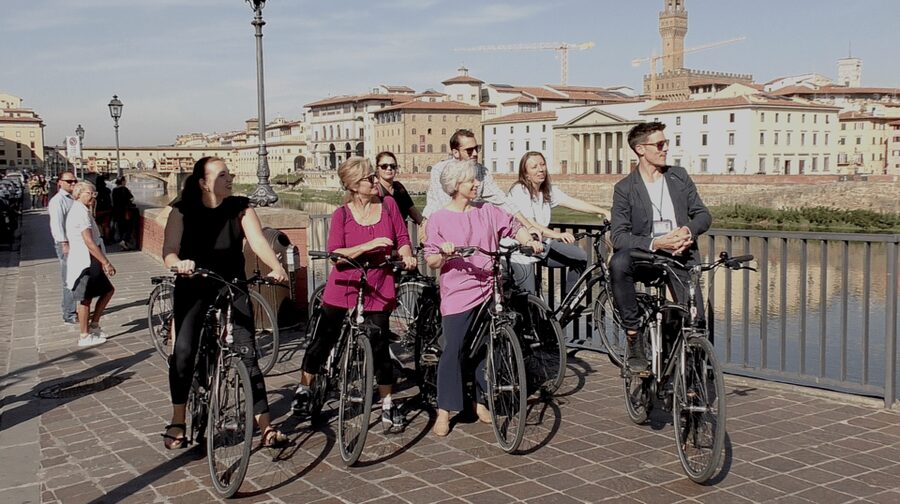
A bicycle bridges that gap. You cover more ground than on foot, and you can use narrow lanes that are not suitable for buses. The ride is not a race. The route mixes short stretches of cycling with stops for photos and explanations, so you get a city tour rather than a workout with a few landmarks attached.
The included headsets are useful. Florence can be noisy, and a guide speaking from several bike lengths away would be easy to lose. With the audio system, you can keep moving and still hear the explanation.
You should also understand the trade-off. Florence is not a car-free cycling village. You may need to steer around foot traffic, watch for vehicles, and keep your balance over uneven streets. One practical point comes up again and again in the experience: you do not need to be an expert cyclist, but you should be stable, alert, and comfortable braking in a crowd.
More Bike Tours in Florence
- Tuscany Bike Tours Through the Chianti Hills with Wine Tasting
★ 5.0 · 1,300 reviews - Florence: E-Bike Tour with Michelangelo Square
★ 4.5 · 1,035 reviews - Florence: 2-Hour Guided Sightseeing Bike Tour
★ 4.5 · 1,004 reviews
Starting near Via Cavour and the Medici quarter
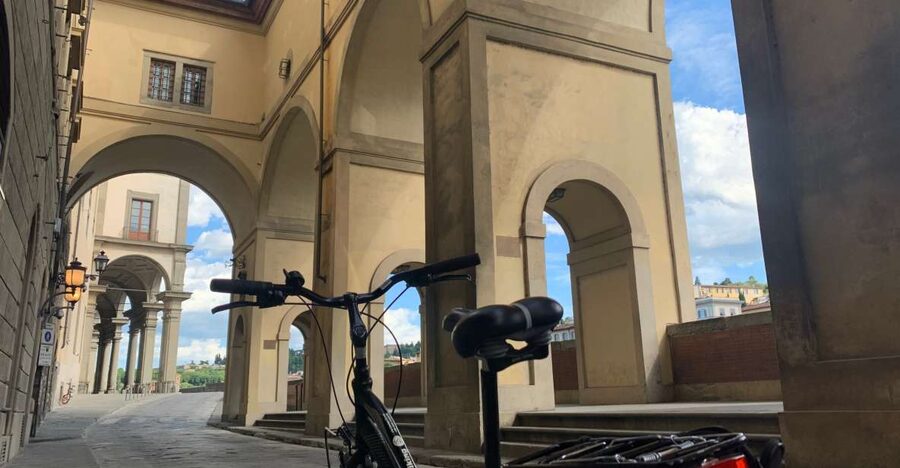
The meeting point is Florence Tours Enjoy Biking at Via Cavour 21R. The address can be confusing because Italian street numbers use red numbers for businesses. Look for 21 red, positioned between 11 black and 13 black.
From there, the ride begins near Palazzo Medici Riccardi. This is a smart place to start because the Medici family shaped Florence’s politics, banking, art, and architecture. Your guide uses the building and nearby streets to set the scene for the city’s power struggles and artistic growth.
The next stop is the Basilica of San Lorenzo. The church is closely tied to the Medici family, and the surrounding market area gives you an immediate sense of how grand monuments sit beside ordinary city life. You do not enter the basilica during this experience, so plan a separate visit if you want to see the interior.
The early part of the route is useful for orientation. You are not simply being driven past buildings. You begin to understand how the central streets connect, which makes later independent exploring easier.
The Duomo and Piazza della Repubblica
The Florence Duomo complex is the route’s first major visual stop. You pause for photographs and hear about the cathedral area, including the relationship between the cathedral, bell tower, and baptistery. From street level, the scale and decoration are impressive, but the crowds can make this one of the more demanding places to cycle.
The tour does not include entry to the cathedral, dome, bell tower, or museum. That is not a flaw for a two-hour orientation, but it matters when you compare prices with a museum-focused tour. You are paying for movement, guidance, and city coverage, not admission.
From the Duomo, the route continues to Piazza della Repubblica. Its open shape offers a welcome change after the tight streets around the cathedral. Your guide may use the square to explain how Florence changed over time and how later city planning reshaped parts of the medieval center.
I find this pairing effective. The Duomo gives you Florence at its grandest, while Piazza della Repubblica helps you see that the city is made from several periods rather than one frozen medieval scene.
Crossing the Arno at Santa Trinita
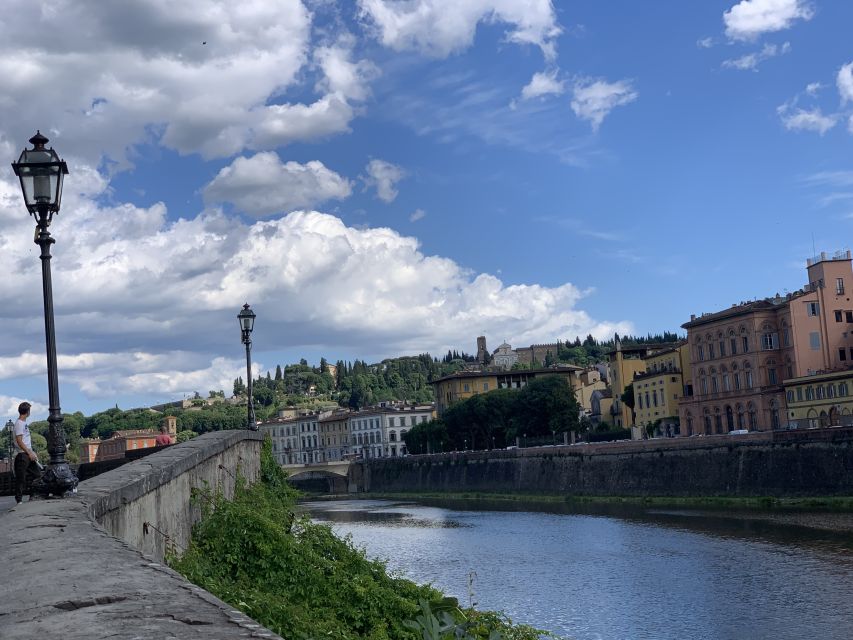
Ponte Santa Trinita is one of the prettiest places on the route for a photo stop. It offers views toward the river and Ponte Vecchio, with the historic façades rising along the water. If your departure is timed near sunset, this section can be especially attractive, since the light softens the stone buildings and river scene.
The bridge is also a reminder that Florence’s story is not confined to the north bank. After crossing the Arno, you enter the Oltrarno, the area on the opposite side of the river. Here the tone changes. Streets near Santo Spirito feel more local and less dominated by the cathedral circuit.
At Santo Spirito, the guide points out the square and surrounding district. This is one of the tour’s better changes of pace. Instead of stopping only at famous monuments, you get a look at an area associated with neighborhood life, small restaurants, and artisan traditions.
The route is not a food tour, so tastings are not included. Still, the guide’s advice about gelato, wine windows, bistecca alla Fiorentina, and affogato al caffè can help you plan your meals after the ride.
A few other Florence mornings to weigh against this
- Lucca: 2-Hour City Center Walking Tour
★ 4.7 · 1,314 reviews - Milan Duomo and Rooftop 2-Hour Guided Tour
★ 4.6 · 1,076 reviews - Vatican Museums & Sistine Chapel Express 2-Hour Guided Tour
★ 4.5 · 1,037 reviews - Alberobello: 2-Hour Guided Trulli Tour
★ 4.6 · 727 reviews
Pitti Palace and the Oltrarno
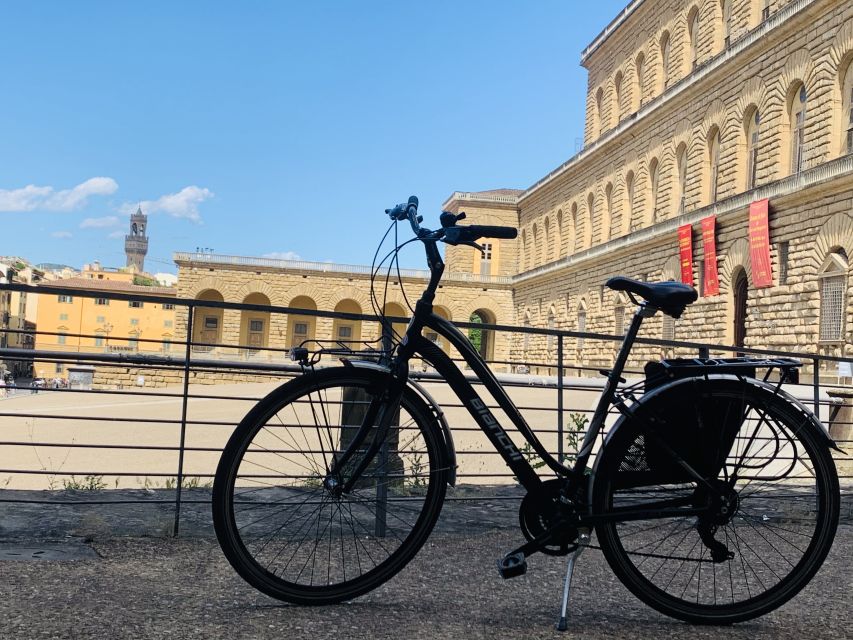
Pitti Palace is the Oltrarno’s grand statement. Its broad façade and immense scale show how powerful families extended their reach across the river. You receive an exterior explanation and continue by bike, without an entrance ticket.
That distinction is useful. Pitti Palace contains collections and gardens that can take hours to visit properly. The bike tour gives you the setting and historical context, then lets you decide if you want to return for a longer visit.
The Oltrarno segment is also where the bicycle earns its price. You can link Santo Spirito, Pitti Palace, and the river bridges without spending much of your short tour simply walking between them. The pace remains manageable because the guide stops often.
Still, do not expect a quiet countryside ride. Streets near the central sights can be full of people, and cobblestones require a relaxed grip and steady speed. If you are bringing children, the tour can work well for confident riders, but the guide needs to know that the group includes younger cyclists. Families have found the route enjoyable for children and teenagers, while less secure riders may feel tense.
Ponte Vecchio and the river views
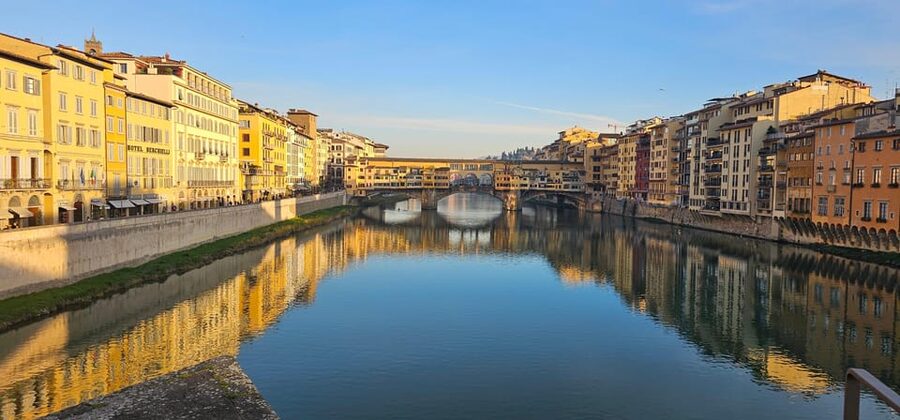
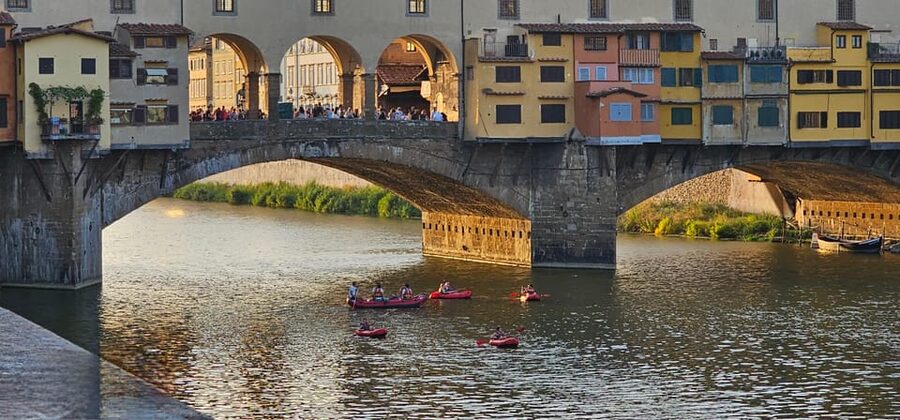
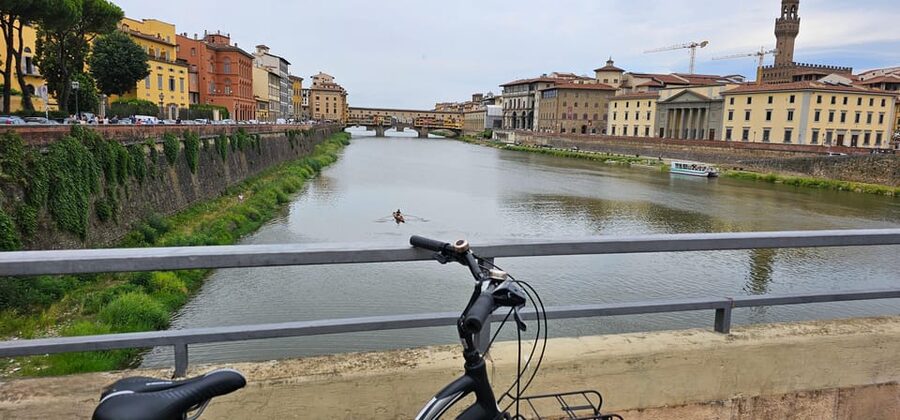
Ponte Vecchio is the best-known bridge in Florence, lined with shops and packed with people. The tour stops for photographs and an explanation of its place in the city. You may ride near it rather than cruise freely across the bridge, since pedestrian traffic can be heavy.
This is a good example of why the tour combines riding with walking-speed sections. A bicycle helps you reach the bridge, but the bridge itself is not a place for fast cycling. Keep your eyes up, follow the guide, and expect to slow down.
The route then reaches Ponte alle Grazie. This bridge gives you a different view back toward the historic center and Ponte Vecchio. It is also one of the route’s scenic points, particularly around sunset.
The two bridges work as a pair. Ponte Vecchio gives you the famous close-up, while Ponte alle Grazie offers space to look back at the riverfront. You get both the crowded symbol and the broader city view.
Santa Croce, Piazza della Signoria, and Dante’s district
After the river, the tour continues toward the Basilica of Santa Croce. The church and square are among Florence’s important public spaces, and the guide explains their role in the city’s religious and civic life. Again, this is an exterior stop, not an interior visit.
The route then returns to Piazza della Signoria. This is Florence’s great outdoor political stage, framed by Palazzo Vecchio and a remarkable collection of public sculpture. It is one of the most rewarding places to hear how art and power worked together in Florence.
The final sightseeing stop is the House of Dante and the surrounding medieval district. This part of the route adds a literary and neighborhood layer to the tour. You see streets that can be missed if you only follow the path between the Duomo and the Uffizi.
By the time you return to Via Cavour, you have crossed several distinct parts of the city. You have also built a useful mental map. That is the real strength of this experience: it gives you enough context to choose where to spend the next day or two.
The guides make the difference
The tour’s strongest feature is the guide. English-speaking guides include Raffaello, Julia, Lorenzo, Luigi, Francesco, Daniele, and others. The exact person depends on the departure, but the best guides do more than recite dates.
Raffaello is repeatedly praised for telling stories that connect ancient Florence with modern city life. He is described as a native Florentine with a warm sense of humor and a personal feel for the city. Julia is noted for being patient, friendly, attentive to families, and helpful with photographs. Lorenzo is especially good at explaining architecture and giving an engaging overview without making the ride feel like a lecture.
That style matters on a bicycle. You need short explanations that work outdoors, with enough time to look around and keep moving. A good guide also controls the pace through traffic and helps the group stay together.
The headsets support this, but they do not replace a good guide. You should expect a live tour in English, with an English audio system included.
Is $41 a fair price?
At $41 per person, the tour is fairly priced for Florence. The fee includes the bicycle, helmet, headset, and professional guide. You are also buying access to a route that would be difficult to reproduce on foot in only two hours.
The value is strongest if this is your first visit or you have limited time. You can see the main districts, note restaurants and sights for later, and avoid spending your first afternoon trying to understand the city map.
The value is weaker if you want detailed museum visits. No entrance tickets are included, and the stops are designed for exterior views and explanations. Food and drinks are also extra, as are hotel pickup and drop-off.
I would think of this as an orientation tour with a fun transport method. It is not a replacement for the Uffizi, the Duomo interior, Pitti Palace, or Santa Croce. It can, however, help you decide which of those deserves your limited time.
Free cancellation is available up to 24 hours before departure, and you can reserve now and pay later. Check the available starting times carefully, especially if you want daylight or sunset views.
Who should book this ride?
I would recommend it to first-time visitors, active couples, families with confident young cyclists, and anyone staying in Florence for only a short time. It is also a good choice for people who like learning the layout of a city before choosing their museums and restaurants.
You should be comfortable riding near pedestrians and traffic. The route includes uneven paving and crowded streets, and it is not suitable for people with mobility impairments. If you are nervous on a bike, a standard walking tour may be more relaxing.
For the best experience, wear shoes that feel secure on pedals, arrive ready to listen while moving, and keep expectations realistic. This is urban cycling, with real city conditions. The reward is speed, range, and a close look at Florence’s streets that a bus cannot provide.
Should you book the Florence bike tour?
Book it if you want to get your bearings fast and enjoy a lively introduction to Florence’s famous sights and side streets. The two-hour route covers an impressive amount, and the local storytelling gives the buildings more meaning than a quick photo stop would.
Skip it if you dislike cycling in crowds, need long quiet stops, or mainly want interior visits. For everyone else, $41 buys a useful first look at Florence, plus practical food tips and a better sense of where to return on foot.
FAQ
How long is the Florence bike tour?
The tour lasts two hours and returns to the starting point at Florence Tours Enjoy Biking.
What sights does the route visit?
The route includes Palazzo Medici Riccardi, San Lorenzo, the Duomo complex, Piazza della Repubblica, Ponte Santa Trinita, Santo Spirito, Pitti Palace, Ponte Vecchio, Ponte alle Grazie, Santa Croce, Piazza della Signoria, and the House of Dante.
Is a bicycle included?
Yes. The price includes a bicycle, helmet, headset, and professional guide.
Is the tour offered in English?
Yes. The live guide and included audio system are in English.
Are entrance tickets or food included?
No. Entrance tickets, food, and drinks are not included. Hotel pickup and drop-off are also not included.
Is the tour suitable for people with mobility impairments?
No. The activity is not suitable for people with mobility impairments. You should also be comfortable riding through traffic, crowds, and uneven streets.
More Bike Days in Florence
- Private Self-Guided E-Bike Ride in Tuscany with Vineyard Visit
★ 5.0 · 775 reviews - Florence Vintage Bike Tour–guided, small group or private option
★ 4.5 · 524 reviews - Rome EBike Tour: Appian Way, Catacombs & Roman Aqueducts
★ 5.0 · 1,766 reviews - Rome: Top Highlights & Hidden Gems Tour by Cannondale E-Bike
★ 4.9 · 1,760 reviews
Fresh on the Florence list
- Florence: Uffizi Guided Tour with Skip-the-Line Entry Ticket★ 4.8 · 499 reviews
- The Best of Florence Walking Tour in a Small Group★ 5.0 · 503 reviews
- Florence: Uffizi Gallery Tickets with Optional Audio Guide★ 4.1 · 503 reviews
- Premium Pasta and Gelato Cooking Class in Florence★ 5.0 · 508 reviews
- From Florence: Tuscany & San Gimignano Tour with 2 Tastings★ 4.8 · 511 reviews
- Florence: Guided Tour of Medici Family Secrets and Chapels★ 4.7 · 512 reviews
- Tuscany Vespa Tours Through the Hills of Chianti★ 5.0 · 515 reviews
- Pasta and Tiramisu Cooking Class with optional Local Market Tour★ 5.0 · 515 reviews
Cycling Tours, compared.
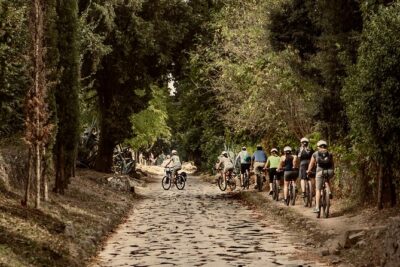
Rome EBike Tour: Appian Way, Catacombs & Roman Aqueducts
Read our review →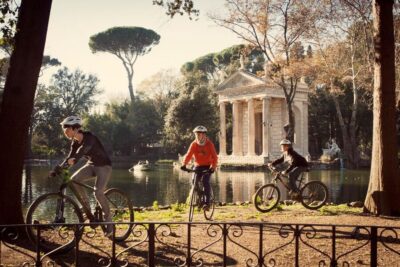
Top Highlights & Hidden Gems Tour by Cannondale E-Bike
Read our review →
Appian Way, Catacombs, & Roman Aqueducts E-bike Tour
Read our review →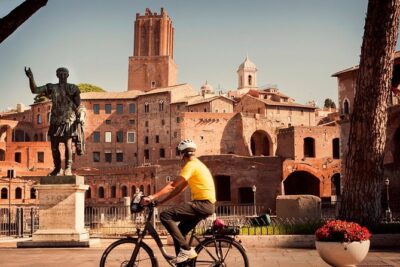
Rome City Small Group Bike Tour with quality Cannondale EBike
Read our review →
Tuscany Bike Tours Through the Chianti Hills with Wine Tasting
Read our review →
Rome by Night – Ebike Small Group Tour – Food and Wine (Option)
Read our review →
Appian Way E-bike Tour with Catacombs, Aqueducts & Food
Read our review →
Browse the lists this tour appears in