
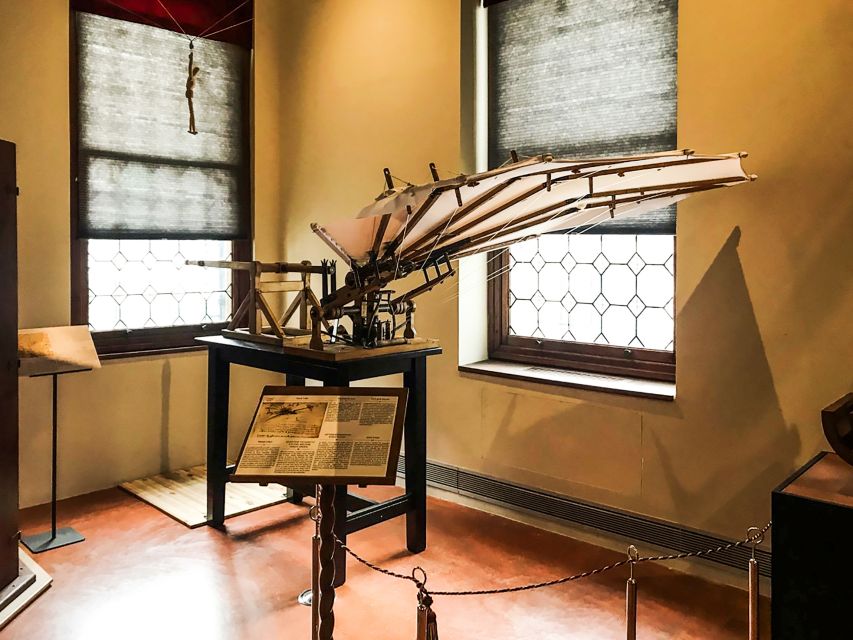
Reviewed · MUSEUMS
Venice: Leonardo Da Vinci Museum Entrance Ticket
Leonardo da Vinci’s ideas are easiest to grasp when you can turn a crank, test a bridge, or watch a machine move. This compact museum near San Rocco brings his sketches into the real world with working reproductions arranged around Earth, Water, Fire, and Air.
I like the hands-on design, which gives children and adults a reason to look closely rather than simply walk past display cases. I also like the sensible price, about $10 per person, and the fact that you can fit the visit into a busy Venice day. The drawback is size: you may finish in 30 minutes if you read quickly, while curious families can spend 90 minutes or more.
Key points to know
- Operate Leonardo’s machines: Turn, pull, build, and test reproductions based on his original designs.
- Four themed sections: Earth, Water, Fire, and Air organize the exhibition and show the wide range of his interests.
- Good family stop: Hands-on puzzles, drawing activities, and mechanical models work for young children, teenagers, and adults.
- More than machines: See anatomy studies, manuscripts, and backlit reproductions of major paintings.
- Easy to fit into Venice plans: Most visits last about an hour, though you can stay longer if you try every activity.
- Useful booking terms: Children under three enter free, children under 15 need an accompanying adult, and cancellation is free up to 24 hours ahead.
A small museum with a very active floor
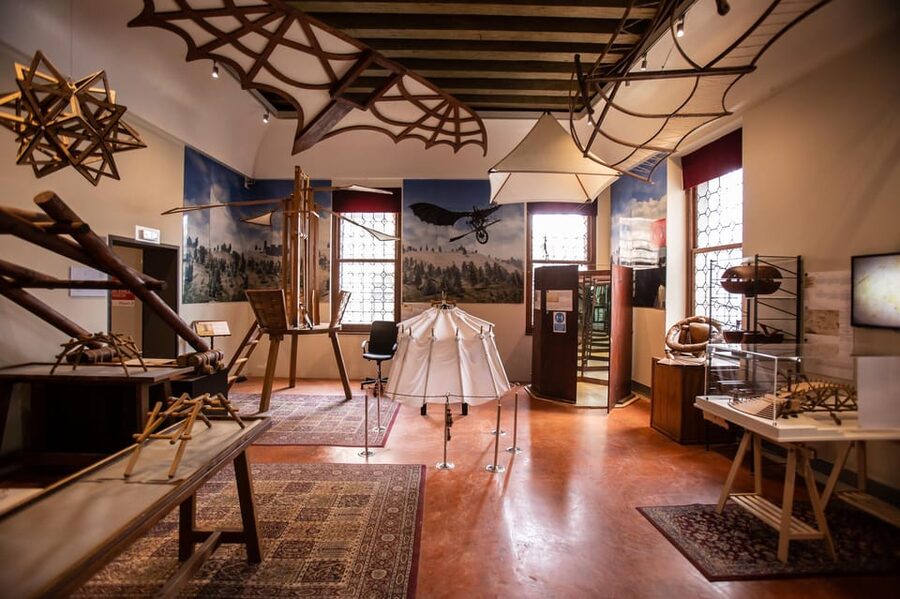
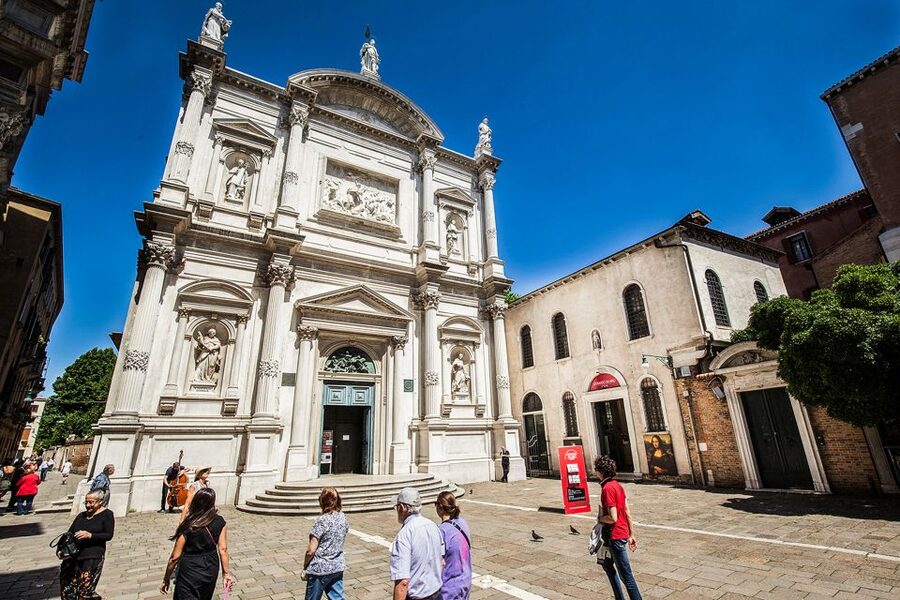
This is not a grand art museum with endless rooms. It is a focused exhibition in the Scoletta di San Rocco, across from the Scuola Grande di San Rocco and behind the Church of the Frari.
That smaller size is part of the appeal. Venice can wear you out with churches, bridges, and crowded lanes. Here, you can step inside, slow down, and spend an hour thinking about pulleys, gears, water movement, flight, and the human body.
I would plan on 60 to 90 minutes if you are visiting with children or enjoy trying each model. If you are pressed for time, you can see the main displays in roughly 30 to 60 minutes. The ticket is valid for one day, so you are not buying an all-day attraction. You are buying a compact, flexible stop that works well between larger sights.
More Museums in Venice
- Venice: St. Mark Basilica Ticket, Audioguide+History Gallery
★ 3.9 · 4,780 reviews - Venice’s Best: Basilica, Doge’s Palace, Gondola & History Gallery
★ 4.5 · 2,478 reviews - Venice: Vivaldi’s Four Seasons Concert & Music Museum Visit
★ 4.8 · 2,065 reviews
Finding the entrance at Campo San Rocco
The meeting point is the museum itself at Campo San Rocco, 3052, Venice. Look for the building called the Scoletta di San Rocco. It is opposite the Scuola Grande di San Rocco and behind the Church of the Frari.
You do not meet a guide for a walking tour. Present your ticket at reception and enter. This matters because the word meeting point can make some people expect a group or a tour leader. This is a self-guided museum visit.
The museum is in a quieter part of Venice, yet it is within an easy walk of the main tourist areas. I like that contrast. You get a practical reason to wander beyond the most crowded streets, without committing half a day to a distant attraction.
Earth, Water, Fire, and Air
The exhibition is divided into four sections based on the classical elements. This is more than a decorative theme. It helps you see how far Leonardo’s interests reached.
The Earth section focuses on mechanical ideas and structures. Expect models that show how simple parts can solve difficult problems. Wooden construction activities and bridge puzzles make this area especially useful for families. One wooden bridge puzzle is easier with a second person, so do not be shy about working as a team.
The Water displays connect Leonardo’s study of movement, channels, and hydraulic ideas with machines built to demonstrate those principles. You can test selected models and see how an idea on paper becomes a physical system.
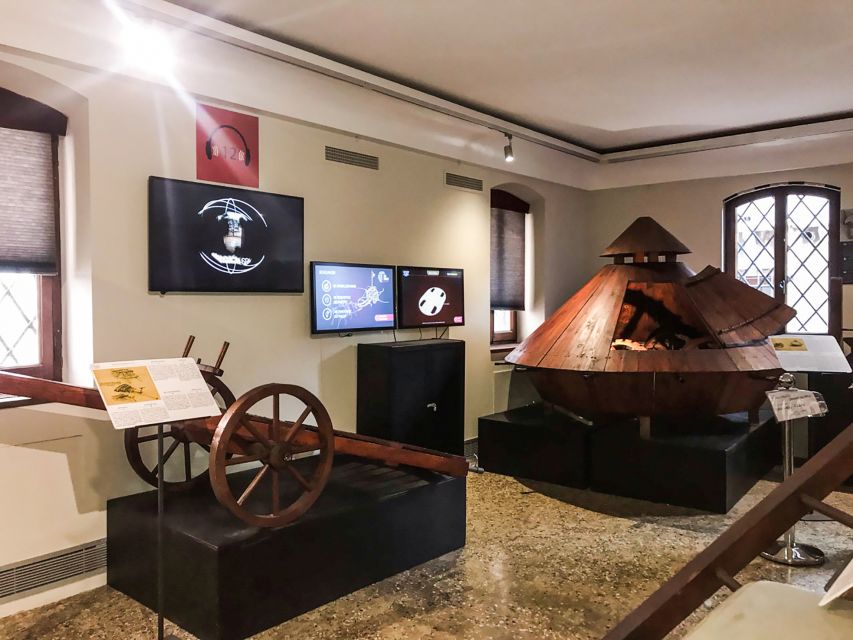
The Fire section includes machines tied to force, motion, and military or mechanical thinking. The point is not to present a full technical history of Renaissance engineering. Instead, the models let you understand the basic problem Leonardo was trying to solve.
The Air section gives you a chance to consider his fascination with flight. Leonardo never had a modern aircraft, but his sketches show how carefully he watched birds and thought about lift, wings, and movement. A working model can make those old drawings far easier to understand than a paragraph of text.
The exact experience depends on how long you spend at each station. Some visitors move quickly through the museum, while others stop to test every mechanism. I recommend trying the models yourself before reading the explanation. You will understand the text better once you have felt the resistance of a gear or seen a structure hold together.
The machines are the main reason to come
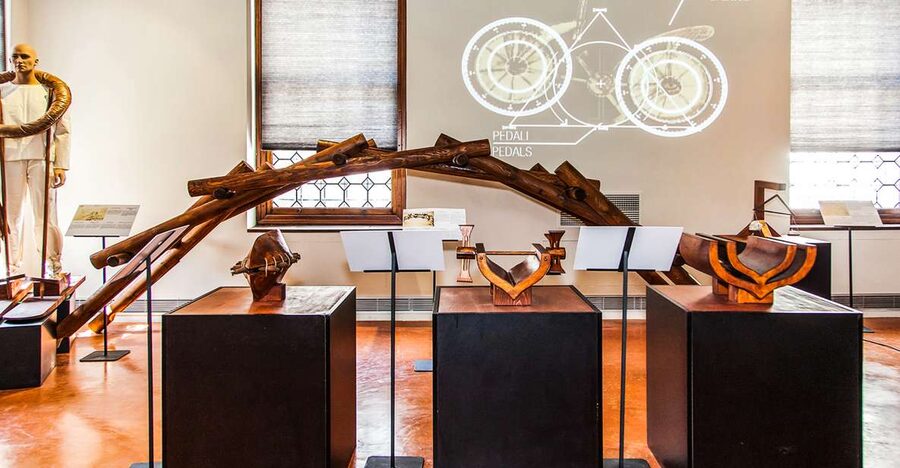
The museum’s central attraction is its collection of reproductions built from Leonardo’s designs. They are not original Renaissance objects. They are reconstructions, and changes have been made where the original proportions required it.
That distinction is important. You are not seeing a rare machine that Leonardo personally built. You are seeing an educational version of an idea, made so you can understand how it might work.
The best displays are the ones you can operate. A model that looks simple on a wall becomes much more interesting when you must push, turn, balance, or assemble something. This approach also shows why Leonardo’s work mattered. He was not only making attractive drawings. He was examining force, balance, movement, anatomy, and practical design.
Some machines will feel familiar because modern technology still uses similar principles. That is one of the museum’s strongest teaching points. You begin to recognize how old mechanical ideas continue in modern tools and structures.
The machines also give adults something to do. This is not only a children’s attraction with a few buttons added for parents. Curious adults can spend a good deal of time working through the mechanisms and asking why each one functions as it does.
Same city, an entirely different afternoon:
- Venice: Doge’s Palace Reserved Entry Ticket
★ 4.6 · 42,716 reviews - Venice: Grand Canal Gondola Ride with App Commentary
★ 4.1 · 18,908 reviews - Boat Trip: Glimpse of Murano, Torcello & Burano Islands
★ 4.3 · 15,699 reviews - Venice: Grand Canal by Gondola with Live Commentary
★ 4.1 · 13,681 reviews
Anatomy, paintings, and the wider Leonardo
It would be easy for a museum about Leonardo to focus only on flying machines and mechanical inventions. This one also gives space to his work as an anatomist and artist.
The anatomy section introduces major studies of the human body. These displays help correct the narrow idea of Leonardo as simply the painter of the Mona Lisa and The Last Supper. His curiosity crossed art, science, engineering, and medicine.
You will also see high-resolution backlit reproductions of major paintings. These are reproductions rather than original artworks, but the format allows you to examine details clearly. They provide visual context for the mechanical and medical material.
Manuscripts and explanatory displays add another layer. The museum aims to show how Leonardo observed the world and recorded what he saw. If you know little about him, this section gives you a useful outline of his life and work without demanding specialist knowledge.
A multimedia film explains his life in a concise way. It is a helpful pause between the more active displays, especially if you want a clear introduction before returning to the machines.
Why children and teenagers tend to enjoy it
Venice has plenty of attractions that ask children to stand quietly and look. This museum asks them to participate.
Young visitors can test mechanical models, work on puzzles, and use iPads to draw in a style inspired by Leonardo. The activities give children a way to connect with ideas that might otherwise feel remote. A machine from the 1500s can seem abstract until a child turns a handle and sees the result.
Teenagers may appreciate the practical side more than a traditional art display. One teenager was especially enthusiastic about the museum during a wider tour of Italian museums, which makes sense: the exhibits offer something to do while still carrying real historical content.
Adults should set a good example around the machines. The objects are interactive, but they are not toys. Careful use makes the visit better for everyone and protects the working parts.
For a mixed-age group, this is one of the safer Venice choices. A five-year-old can enjoy the moving parts, while an adult can think about anatomy, engineering, or the limits of Renaissance technology.
The mirror box and other memorable activities
Among the smaller activities, the 360-degree mirror room gets particular attention. It shows your reflection from several angles and offers a short, playful change of pace from the historical material.
The wooden structures and bridge puzzles are also worth seeking out. They turn engineering into a group activity. You may need another person to help with the bridge challenge, and it is more satisfying when you solve it together rather than simply watch someone else do it.
The invention room is a favorite stop for many people because it brings the museum’s main idea together. Here, Leonardo’s imagination feels practical. You can move between machines, compare designs, and see how many problems he tried to address.
Do not rush past the drawing stations. They are aimed partly at children, but adults can enjoy them too. They reinforce the link between observation and invention, which is central to understanding Leonardo.
How long should you allow?
For a quick visit, allow 30 to 60 minutes. That gives you time to see the main machines, look at the paintings and anatomy displays, and try several interactive stations.
For a normal family visit, plan on about 1 to 1.5 hours. This is the most useful amount of time if you want children to test models and if you intend to watch the film.
You might stay longer if the museum is quiet and you want to read every panel. The layout includes a long room, two smaller spaces downstairs, and four rooms upstairs. It is not large, but the hands-on exhibits slow your pace.
The last entrance is one hour before closing. Since specific starting times depend on availability, check the schedule before you go. The ticket is valid for one day, which gives you some flexibility in arranging the visit.
Languages, audio help, and the bookshop
Descriptions are provided in Italian, English, French, German, Spanish, and Russian. Multimedia displays add visual and recorded material, so you do not need a guide to follow the basic story.
One practical tip: look for the QR code at the front of the shop if you want the audio guide. Scan it before moving through the museum. It may not be available at every point inside, so starting there saves you a return trip.
The bookshop sells Leonardo-themed books, gifts, and souvenirs. A 10 percent discount on bookshop purchases is included with the ticket. That can be useful if you want a small educational gift rather than another generic Venice souvenir.
Is the $10 ticket good value?
At about $10 per person, I consider this a good-value short attraction. You are not paying for a long guided program or an original masterpiece. You are paying for a practical exhibition where you can handle working reproductions, see clear displays, and learn about several sides of Leonardo’s career.
The value is strongest for families and curious adults. If you are interested in how things work, the hands-on models make the price easy to justify. The ticket also works well on a hot day, since the museum offers an indoor break from Venice’s streets. Air conditioning was specifically appreciated during summer visits.
The value is weaker if you want original Renaissance art or a large collection. The paintings are backlit reproductions, and the museum can feel small if you expect a major national museum. It is better to think of this as an interactive learning exhibition than as a conventional fine-art gallery.
Children under three enter free. Children under 15 must be accompanied by an adult. The ticket includes photography, and cancellation is free up to 24 hours before the visit. You can also reserve now and pay later, which helps if your Venice plans are still shifting.
Who should book this Venice museum?
I would choose this for families with children, adults who like puzzles and machines, and anyone who wants a break from churches and picture-taking. It also suits a short stay in Venice because the visit does not take over your day.
It is a good pick for a group with different interests. One person can study the anatomy material, another can watch the film, and children can test the machines. The museum’s size makes it less tiring than a major gallery.
Art specialists who want original Leonardo paintings should adjust expectations. This is not the place to see an authentic Last Supper or a rare manuscript. It is the place to understand the ideas behind Leonardo’s work through models, reproductions, and activities.
I also recommend it if you are visiting several Italian cities and want a different angle on Leonardo. After seeing his paintings elsewhere, the machines and anatomy displays help you understand the range of his mind.
Should you book the Leonardo da Vinci Museum?
Book it if you want an affordable, interactive hour in Venice and enjoy learning by doing. The working reproductions, four themed sections, mirror activity, puzzles, and multilingual displays offer more substance than the modest size suggests.
Skip it if you are looking only for original art or a large museum with a full day of galleries. For most families, short-stay visitors, and inquisitive adults, the $10 ticket is an easy addition to a Venice itinerary. Plan for an hour, allow extra time if you want to try everything, and scan the audio-guide QR code before you start.
FAQ
Where is the Leonardo da Vinci Interactive Museum in Venice?
The museum is at Campo San Rocco, 3052, Venice, in the Scoletta di San Rocco building. It is opposite the Scuola Grande di San Rocco and behind the Church of the Frari.
Is this a guided tour?
No. The ticket provides entry to a self-guided museum. Present your ticket at reception when you arrive.
How long does a visit take?
A quick visit can take 30 to 60 minutes. If you try the interactive exhibits, watch the film, and read the displays, allow about 1 to 1.5 hours.
What languages are available?
Descriptions are available in Italian, English, French, German, Spanish, and Russian. Multimedia displays also explain Leonardo’s life and work.
Can children visit the museum?
Yes. Children under three enter free. Anyone under 15 must be accompanied by an adult.
Can I cancel the ticket?
Yes. You can cancel up to 24 hours in advance for a full refund. The ticket is valid for one day, and reserve-now, pay-later booking is available.
Fresh on the Venice list
- Murano: Glass Blowing Demonstration and Artistic Glass Gift★ 4.6 · 507 reviews
- From Venice: Dolomites, Lake Misurina, and Cortina Day Trip★ 4.6 · 508 reviews
- Venice Islands: Murano Glass & Burano Colors Guided Visit★ 4.5 · 510 reviews
- The Majestic Teatro La Fenice: Guided Tour in Venice★ 4.3 · 513 reviews
- Real Venetian Kayak – Tour of Venice Canals with a Local Guide★ 4.5 · 518 reviews
- Venetian Carnival Mask Making Class in Venice, Italy★ 4.5 · 525 reviews
- Half Day Murano and Burano Island Tour by Private Boat★ 4.5 · 529 reviews
- Venice Trilogy: Murano, Burano & Torcello by Lagoon Boat★ 4.5 · 532 reviews
Museums, compared.
Vatican: Museums & Sistine Chapel Entrance Ticket
Read our review →
Vatican Museums & Sistine Chapel Tour with Optional Basilica
Read our review →
Vatican Museums, Sistine Chapel & St Peter’s Basilica Guided Tour
Read our review →
Skip-The-Line Uffizi Gallery Timed Entry Ticket
Read our review →
Vatican Museums, Sistine Chapel & Basilica Tour
Read our review →
Vatican Museums & Sistine Chapel Skip-the-Line Entry Ticket
Read our review →Vatican Museums, Sistine Chapel & Basilica Tour
Read our review →
Vatican Museums & Sistine Chapel Guided Tour
Read our review →Browse the lists this tour appears in