Reviewed · TICKETS
Siena: Palazzo Pubblico Entry Ticket
The real prize inside Siena’s Palazzo Pubblico is the art on the walls. Simone Martini’s Maestà is the star, while room after room presents frescoes, carved woodwork, and civic history in the very building where Siena’s government once met.
I like the low $7 price and the freedom to explore without being tied to a guide. I also like the Loggia dei Nove, where you get a fine view over the Sienese countryside. The main drawback is important: Ambrogio Lorenzetti’s famous Good and Bad Government frescoes may be closed for restoration, and they are not always clearly noted before you arrive.
Key points to know before you go
- Simone Martini’s Maestà: See one of Gothic Siena’s most important paintings in the Sala del Mappamondo.
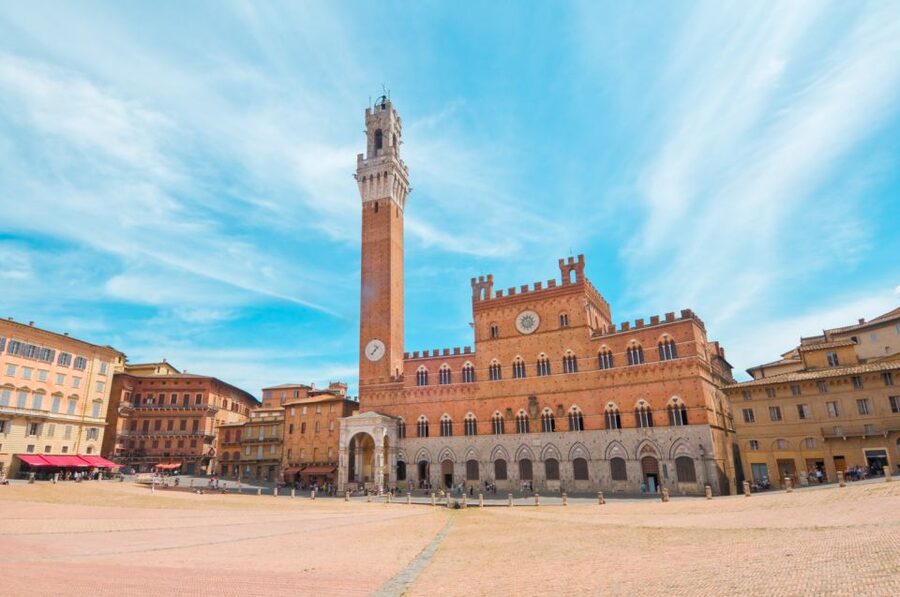
- A working palace turned museum: The 13th-century Palazzo Pubblico explains Siena through its government rooms, art, and religious objects.
- The Loggia dei Nove: Step onto the 14th-century gallery for a beautiful view beyond the palace.
- One-hour visit: The ticket works well for a focused stop, though art lovers may want more time.
- Torre del Mangia is separate: The tower is not included, but you can buy its ticket at the palace ticket office.
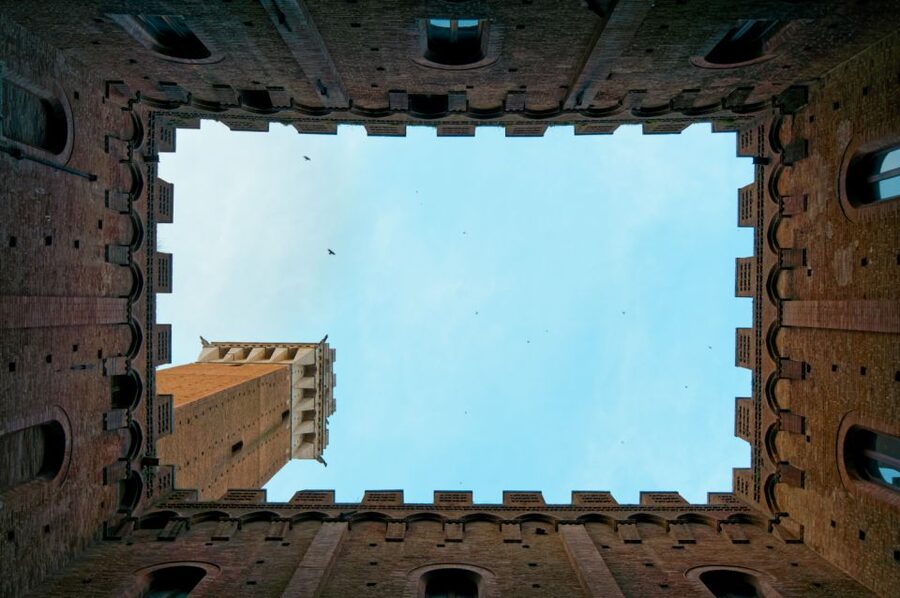
- Use the inner courtyard: Enter the Cortile del Podestà to find the ticket office and exchange your voucher.
Why Palazzo Pubblico belongs on your Siena plan
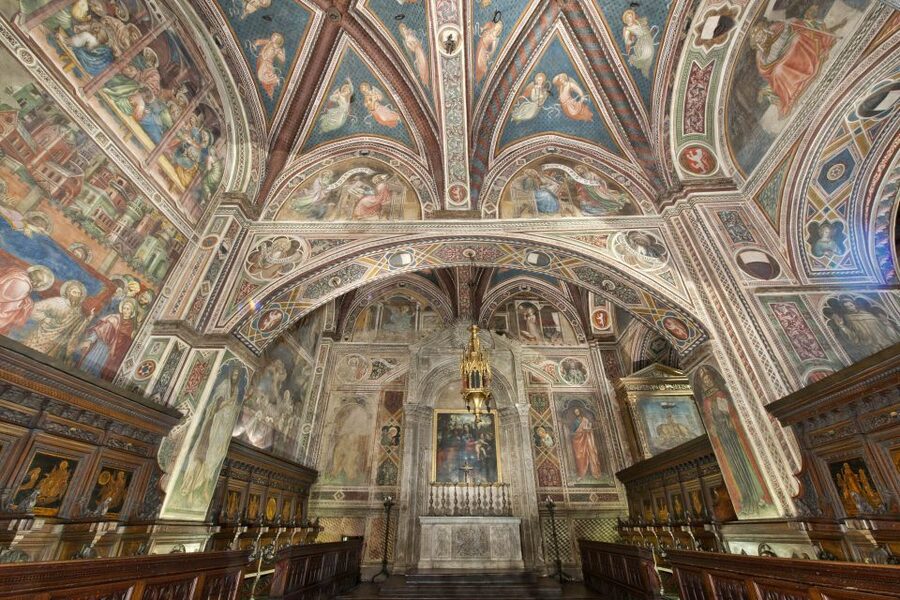
Siena’s Palazzo Pubblico is not simply an art museum placed inside an old building. The building itself explains how the city saw its political life. Its halls were designed for councils, officials, religious ceremonies, and public business, then covered with paintings that linked good government, faith, duty, and civic pride.
That setting gives the art extra force. You are not walking through a neutral gallery with paintings taken out of context. You are moving through the rooms where Siena’s rulers and councils worked. The frescoes were made for these spaces, and their scale and placement make more sense here than they would in a modern museum.
The visit costs about $7 per person, which is strong value for a central Siena sight. The ticket covers the Civic Museum and the Loggia dei Nove, though not the Torre del Mangia, an audio guide, or a guided tour.
The experience is self-guided. That suits you if you like to set your own pace and pause in front of a painting without keeping up with a group. It also means you should read a little about the major works beforehand if you want more than a visual visit.
A few other Italy mornings to weigh against this
- Vatican: Museums & Sistine Chapel Entrance Ticket
★ 4.5 · 144,003 reviews - Milan: Cathedral and Duomo’s Terraces Entrance Ticket
★ 4.6 · 61,054 reviews - Venice: Doge’s Palace Reserved Entry Ticket
★ 4.6 · 42,716 reviews
Finding the ticket office in the Cortile del Podestà
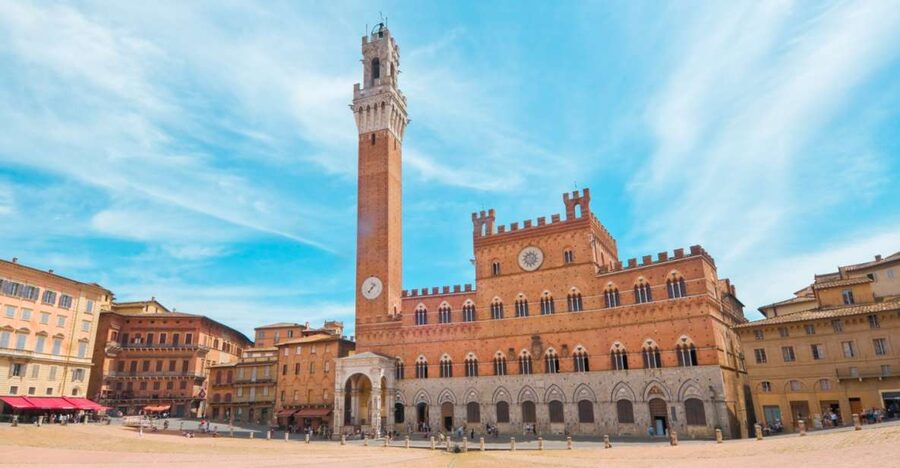
The most useful practical detail is also the easiest to miss. Do not stop at the exterior of the Palazzo Pubblico or follow map directions that lead you along Via di Salicotto. Enter the inner Cortile del Podestà, where the ticket office is located.
You must exchange your voucher for an entry ticket there. Arrive about 10 minutes before your booked time, and bring a passport or identity card. The process is straightforward once you are in the courtyard, but the wording can make it sound as if the courtyard is a separate building. It is simply the inner court of the palace.
The museum visit lasts about one hour. That is enough for a good first look at the main rooms, especially if you keep moving, but the number of works deserves more time if you enjoy medieval and Renaissance art.
Large bags and luggage are not allowed. Flash photography is also forbidden, and pets cannot enter, apart from assistance dogs. Opening hours can change, and access may be suspended during an extraordinary event, so keep a little flexibility in your day.
Sala del Risorgimento and the story of Italian unification
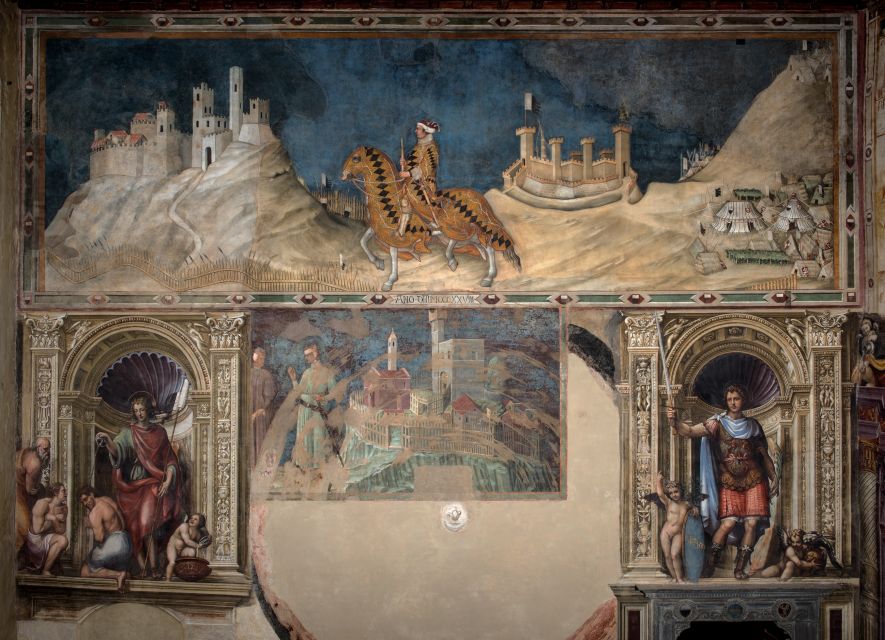
Your route begins in the Sala del Risorgimento. This room is different from the medieval halls that follow because its frescoes tell the life of Vittorio Emanuele II, the first king of Italy.
The paintings connect the palace to a later chapter of national history. Siena’s civic story did not end with the medieval republic. This room shows how the building continued to serve as a place where political memory was displayed.
If your main interest is medieval art, the Sala del Risorgimento may feel like a brief prelude. Still, it gives the museum a broader time span and reminds you that Palazzo Pubblico was used and reshaped long after the first frescoes were painted.
Sala di Balìa and the painted walls of the 1400s
The Sala di Balìa brings you back to the palace’s earlier artistic world. Its wall paintings date from the 15th century and are associated with Spinello Aretino and Martino di Bartolomeo.
Here, look beyond individual figures and notice how thoroughly the room is decorated. The wall paintings were not added as small ornaments. They create an enclosed visual world, with very little plain surface to interrupt the story.
This is one of the pleasures of the museum: you are often studying the room as much as the framed or named artwork. The decoration works at different distances. From across the hall, you see the overall pattern. Up close, you can spend time with faces, gestures, borders, and small painted details.
Same city, an entirely different afternoon:
- Vatican Museums & Sistine Chapel Tour with Optional Basilica
★ 4.3 · 67,413 reviews - Colosseum, Roman Forum & Palatine Guided Tour
★ 4.7 · 63,148 reviews - Vatican Museums, Sistine Chapel & St Peter’s Basilica Guided Tour
★ 4.5 · 39,149 reviews - Rome: Colosseum, Palatine Hill and Roman Forum Guided Tour
★ 4.8 · 32,814 reviews
Sala dei Cardinali and the carved coffers
The Sala dei Cardinali offers a change of texture. Precious carved coffers hold reliquaries, bringing together decorative woodwork and religious objects.
The room helps you see how civic and sacred life overlapped in medieval Siena. The palace was a political center, but the objects and decoration also reflect the importance of faith, ceremony, and relics.
For many people, this will be a quieter stop than the Maestà. I would not rush through it. The carved coffers are easy to overlook when your attention is fixed on frescoes, yet they give the visit useful variety and show the care given to objects as well as walls.
Sala del Concistoro and Beccafumi’s vault
In the Sala del Concistoro, look upward. The room is famous for its vault by Domenico Beccafumi, one of Siena’s leading 16th-century painters.
A ceiling can be a tough place to study art. Your neck gets tired, and the lighting may not reveal every detail. Even so, Beccafumi’s vault is one of the room’s central attractions, and it rewards a slow look from different points in the hall.
The Sala del Concistoro also demonstrates that Palazzo Pubblico was decorated across several centuries. Siena’s artistic identity did not belong to one period alone. Medieval Gothic painting and later Renaissance work share the same palace, allowing you to compare changing styles as you move through the route.
Taddeo di Bartolo’s Cappella
The next stop is the Cappella by Taddeo di Bartolo, with 15th-century decoration that gives the visit a more intimate character.
Compared with the broad council rooms, a chapel naturally feels more focused. The setting encourages you to pay attention to devotion and ceremony rather than government and public debate.
The chapel is also part of the larger lesson of the palace. Siena’s leaders did not separate political life from spiritual life in the modern way. The building’s rooms express both responsibilities, and the chapel makes that connection visible.
Sala del Mappamondo and Simone Martini’s Maestà
The Sala del Mappamondo is the widest room in the Palazzo Pubblico. It served as the meeting place of the General Council, so its size had a practical political purpose as well as a visual one.
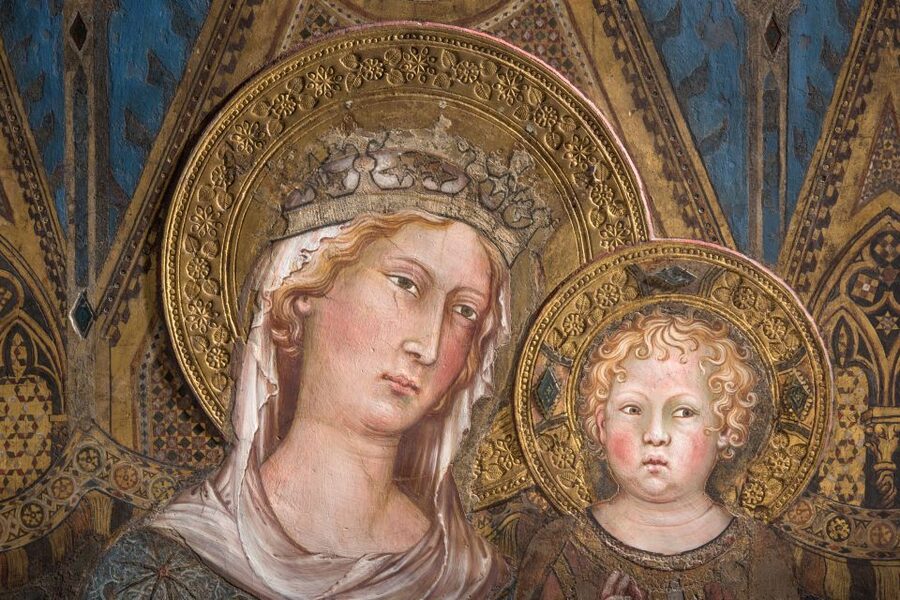
This is where you find Simone Martini’s Maestà, a Gothic masterpiece and one of the visit’s essential sights. The painting is not just important because of its maker or date. Its placement in a government hall matters. The image of the Virgin and Child, surrounded by saints and angels, occupied a room where civic decisions were made.
Take a moment to compare the Maestà with the other wall paintings around you. Siena’s art is often praised for its elegance, fine lines, and attention to decorative detail. In this room, the work also feels tied to the city’s public identity.
If your time is short, give the Sala del Mappamondo the largest share of it. The room is broad, the painting is significant, and the connection between art and government is at its clearest here.
One caution concerns Ambrogio Lorenzetti’s Allegory and Effects of Good and Bad Government. This famous cycle may be closed while restoration work is underway. Its absence can be a real disappointment, particularly if you are visiting because of the painting’s connection with Siena’s political ideals or have read about it beforehand.
The palace still offers plenty to see, but I would check the current display status if the Lorenzetti frescoes are the main reason for your visit. Do not assume the standard museum ticket guarantees access to every celebrated room.
The Loggia dei Nove and the view beyond Siena
The ticket also includes the Loggia dei Nove, a 14th-century gallery with a view over the countryside behind Palazzo Pubblico.
This is a welcome change after the enclosed halls. You move from painted walls and historic objects to open air and a broad view. The terrace is one of the visit’s most satisfying moments because it lets you see the setting that shaped Siena’s identity.
The view is especially useful after studying the palace’s civic art. The paintings speak about government and the city’s well-being, while the Loggia shows the territory beyond the walls. You get a clearer sense of Siena as a hill town surrounded by the Tuscan countryside rather than just a series of famous buildings in a busy square.
Do not confuse this gallery with the Torre del Mangia. The loggia is included with the Civic Museum ticket, but the tower requires a separate ticket. If you want both, ask at the ticket office about buying Torre del Mangia admission directly there.
What the $7 ticket really gives you
At $7, this is one of the easier Siena purchases to justify. You receive access to a major historic building, several decorated halls, important works by Simone Martini and Beccafumi, religious artifacts, and the Loggia dei Nove.
The value is strongest if you already have an interest in art, medieval cities, or Siena’s political past. You will see enough in an hour to make the visit worthwhile, and the low price leaves room in your budget for the tower or another sight.
The ticket is less useful if you only want a quick look at the famous square outside. The museum requires attention. The paintings are not presented as a short list of photo stops, and the absence of an audio guide means you need to bring your own context or accept a quieter, more visual visit.
Prebooking can make sense during a busy day, especially if you want a fixed time. The reservation system allows cancellation up to 24 hours before the visit for a full refund, and you can reserve now and pay later. Those terms are helpful if your Siena schedule is still shifting.
Accessibility, timing, and small details
The museum is wheelchair accessible. The elevator door is 69 centimeters wide, and the elevator is 83 centimeters deep, so check those measurements against your chair or mobility equipment before booking.
The experience is listed as a small group, limited to 10 participants, though this remains an entry visit rather than a guided tour. You should not expect a guide, commentary, or audio equipment to be included.
Plan on one hour inside, plus time to find the courtyard and exchange your voucher. If you want to study every fresco, add extra time where possible, but remember that the stated activity duration is about one hour.
The museum may suspend access during an extraordinary event, and opening times can change. Carry your ID, leave large luggage elsewhere, and keep your camera flash switched off.
Who will enjoy this visit most
I would recommend Palazzo Pubblico to anyone who wants to understand why Siena is more than a pretty medieval center. The museum links architecture, painting, faith, and civic government in one compact stop.
It is especially good for:
- Art lovers interested in Simone Martini, Beccafumi, Spinello Aretino, and Martino di Bartolomeo
- First-time visitors who want a clear introduction to Siena’s public history
- Anyone looking for a reasonably priced indoor sight
- Visitors who want a countryside view without committing to the separate tower ticket
- Independent explorers who prefer to set their own pace
Families may appreciate the one-hour length, though younger children could find the rooms less engaging without a guide or audio commentary. Visitors whose sole goal is the Lorenzetti cycle should confirm its availability first.
Should you book the Palazzo Pubblico ticket?
Yes, if you want a short, affordable visit with serious art and a strong sense of place. The Maestà, decorated government rooms, and Loggia dei Nove make the $7 ticket good value, even when one major fresco cycle is closed.
Book it with realistic expectations. This is not a guided tour, Torre del Mangia is extra, and the palace may have fewer rooms open than its size suggests. Still, the rooms you can enter are packed with important art, and the view from the loggia adds something a conventional museum cannot.
If your schedule allows only one indoor sight in Siena, I would put this high on the list. Just exchange your voucher in the Cortile del Podestà, arrive early, and check whether the Lorenzetti frescoes are available before you commit.
FAQ
How long does the Palazzo Pubblico visit take?
The activity lasts about one hour. You may need extra time if you want to study the frescoes and artifacts carefully.
What does the ticket include?
The ticket includes entrance to Siena’s Civic Museum inside the Palazzo Pubblico and access to the Loggia dei Nove.
Is the Torre del Mangia included?
No. The Torre del Mangia requires a separate ticket, which can be purchased directly at the ticket office.
Where do I exchange my voucher?
Enter the Cortile del Podestà, the palace’s inner courtyard, and find the ticket office there. Arrive about 10 minutes before your booked time.
Is the museum wheelchair accessible?
Yes. The museum is wheelchair accessible. The elevator door is 69 centimeters wide, and the elevator is 83 centimeters deep.
Is a guided tour or audio guide included?
No. The ticket provides entry only. A guided tour and audio guide are not included.
Fresh on the Italy list
- Florence: Uffizi Guided Tour with Skip-the-Line Entry Ticket★ 4.8 · 499 reviews
- Milan: Last Supper and Sforza Castle Guided Tour★ 4.6 · 498 reviews
- Boat trip La Maddalena Archipelago – Departure from Palau★ 4.5 · 499 reviews
- Exclusive Golf Tour Private VIP with Local & Gelato o Wine★ 5.0 · 500 reviews
- Turin: Egyptian Museum Skip-the-Line Group Tour★ 4.7 · 500 reviews
- Itria Valley: Polignano, Ostuni, and Locorotondo, from Bari★ 4.6 · 502 reviews
- Colosseum, Palatine Hill and Roman Forum with Guided Tour★ 5.0 · 500 reviews
- Catania: Etna Nature Tour with Hiking, Cave Visit, & Tasting★ 4.7 · 502 reviews
Tickets, compared.
Vatican: Museums & Sistine Chapel Entrance Ticket
Read our review →
Cathedral and Duomo’s Terraces Entrance Ticket
Read our review →
Skip-The-Line Uffizi Gallery Timed Entry Ticket
Read our review →
Naples Underground Entry Ticket and Guided Tour
Read our review →
Pantheon Fast-Track Ticket and Official Audio Guide
Read our review →
Entry Ticket and Guided Tour with an Archaeologist
Read our review →