Reviewed · TICKETS
Rome: Leonardo Da Vinci Experience Entry Ticket
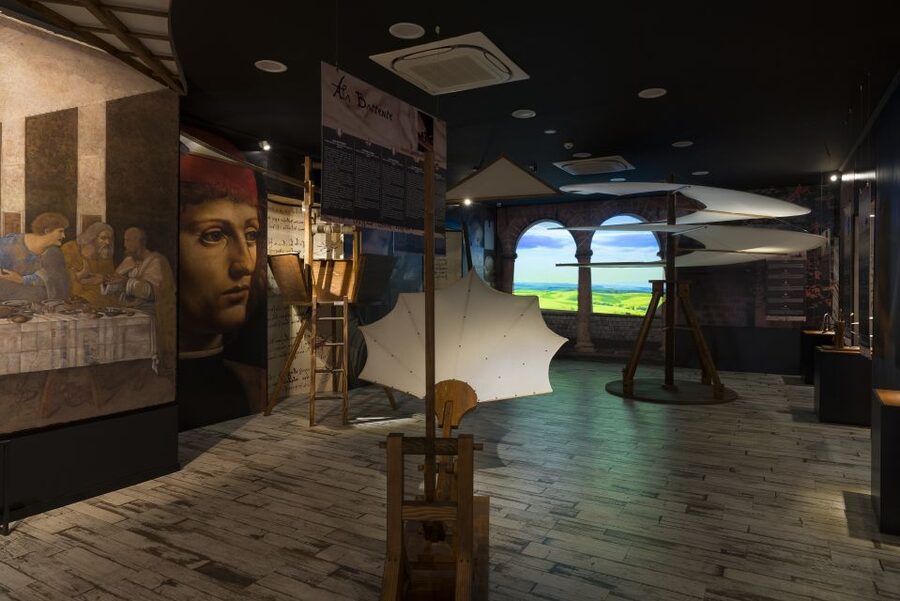
Leonardo da Vinci’s genius is easier to grasp when you can turn a crank, test a bridge, or stand beside a full-sized model of his helicopter. This small museum near St. Peter’s Square puts his flying machines, war machines, engineering ideas, and art in one walk-through experience. The interactive models make it more than a display of old drawings.
I like the freedom to set your own pace, and I like the clear audio guide, which explains both the machines and the paintings. The air-conditioning is a real help on a hot Roman afternoon, too. The main drawback is size: this is not a grand national museum, and some visitors finish in under an hour. At $18, the value depends on whether you use the audio guide and try the hands-on exhibits rather than simply walk past them.
Key points at a glance
- Fifty working inventions: Try models based on Leonardo’s designs, including lifting machines, a bridge, a bicycle, water skis, and flying devices.
- Five exhibition halls: The route covers engineering, flight, warfare, water, optics, and art in a compact setting.
- A short walk from St. Peter’s Square: The entrance is at Via della Conciliazione 19, about 150 meters from the square.
- Audio guide included: Choose from English, Spanish, French, Italian, German, Portuguese, Russian, and Chinese.
- Good for families: Children and teenagers can experiment with several models instead of only looking at framed objects.
- Flexible visit length: Plan on about one to two hours, though a careful visit with the audio guide can take two to three hours.
Leonardo’s ideas, brought down from the page
Leonardo is often reduced to the Mona Lisa and The Last Supper. This exhibition makes a useful correction. It shows the restless inventor who sketched flying machines, submarines, robots, underwater breathing gear, solar-powered devices, and an unsupported suspension bridge centuries before modern versions became practical.
You are not looking at original inventions. You are seeing full-sized reproductions built from his designs. That distinction matters, but it does not make the models dull. The working mechanisms help you understand how Leonardo thought: he studied movement, balance, pressure, light, and human anatomy, then turned those observations into machines.
The exhibits are strongest when you can operate them. Cranks, levers, and simple structures show the basic force behind an idea. A drawing of a lifting device can seem abstract. A model you can move gives the idea weight and purpose.
The museum is compact, so you will not spend half a day wandering through endless galleries. That is a benefit if you are fitting it between St. Peter’s Basilica and another appointment. It is also the main limitation if you expect a large science museum.
A few other Italy mornings to weigh against this
- Vatican: Museums & Sistine Chapel Entrance Ticket
★ 4.5 · 144,003 reviews - Milan: Cathedral and Duomo’s Terraces Entrance Ticket
★ 4.6 · 61,054 reviews - Venice: Doge’s Palace Reserved Entry Ticket
★ 4.6 · 42,716 reviews
Five halls of machines, from flight to warfare
The visit moves through five exhibition halls. The precise order can depend on how busy the rooms are and how you choose to move around, but the broad themes are consistent: machines for work, war, flight, water, optics, and artistic study.
The engineering displays are a good place to begin. Leonardo designed equipment for digging, lifting, and moving heavy material. These models show his interest in making difficult physical work more efficient. You can also see the design behind a sewing machine and a bicycle, inventions that feel familiar today but look surprisingly inventive when viewed through his sketches.
The Leonardo bridge is one of the most satisfying hands-on pieces. You can build it yourself, which turns a lesson in weight and balance into a small puzzle. It is especially useful with children, but adults who enjoy mechanical problems will find it just as appealing.
The war machines bring a different mood. The collection includes models of weapons and a machine gun, along with an armored tank. Do not expect a military museum or polished modern replicas. The point is to see how Leonardo applied engineering to defense, and how his drawings combined practical mechanics with imaginative design.
The armored tank makes one of the better photo stops. You can also take a picture beside the helicopter model. These displays help show the scale of his ideas, even though the models are not working vehicles in the modern sense.
Flying machines and Leonardo’s early engineering
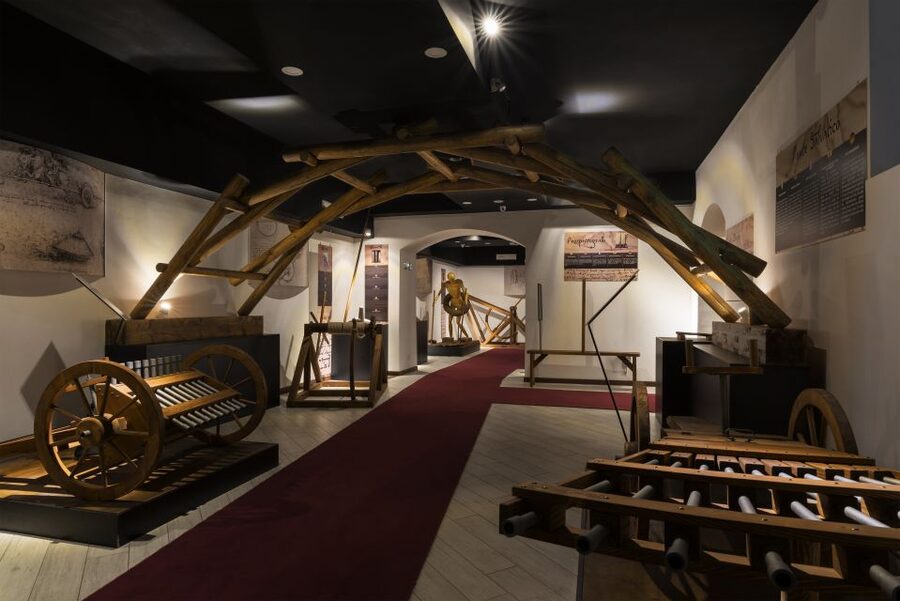
Leonardo’s flying machines are among the exhibition’s main draws. His designs came from close observation of birds and the mechanics of wings. The models let you see how he tried to translate natural movement into human flight.
You will find flying devices among the reproductions, including the helicopter model. The exhibit does not suggest that Leonardo built a modern helicopter or airplane. Instead, it shows the early stages of a question that engineers would keep asking for centuries: how can a machine lift a person and control movement in the air?
This section works best with the audio guide. The written labels identify the objects, but the audio explanations add the reasoning behind the sketches. Bring your own headphones, as they are specifically recommended for use with the audio equipment. That small bit of preparation can make the listening experience more comfortable.
Water, bridges, and machines you can test
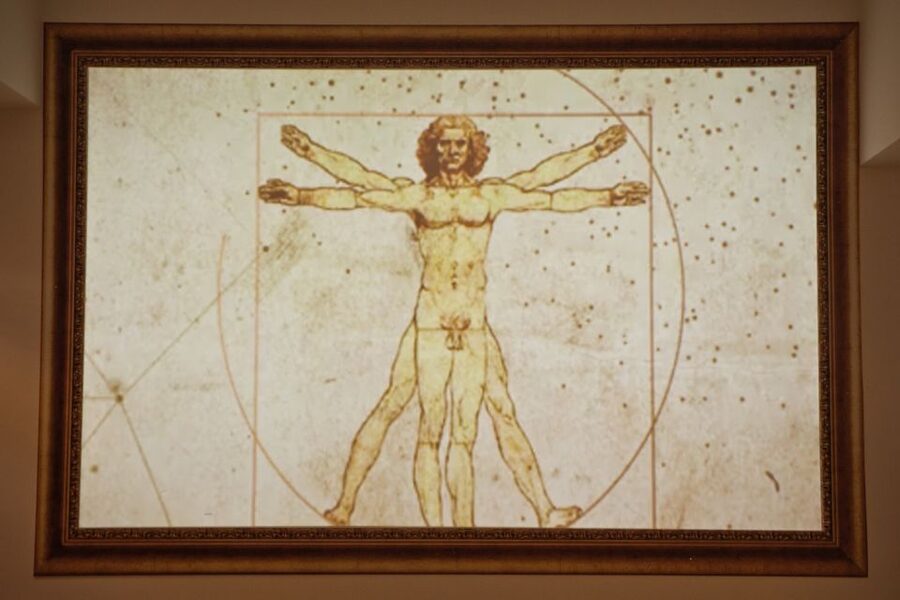
Leonardo’s interest in water appears in designs for submarines, underwater breathing equipment, water skis, and related devices. These models show that his curiosity was not limited to painting or warfare. He was constantly asking how people could move through difficult environments.
The water skis are an amusing example. They look simple, but they reveal Leonardo’s instinct for adapting tools to the body and to natural conditions. The underwater designs are more serious, showing his interest in exploration and the challenge of breathing below the surface.
The suspension bridge gives you another chance to see how a simple structure can carry weight without conventional supports. If you visit with children, allow time for them to handle the interactive sections. The museum is not a place where every object must be protected behind glass, and that makes the visit more active than a standard art gallery.
Still, some machines are reproductions intended for demonstration, not full operation. You should expect to manipulate selected parts, not run complete devices or see a live engineering show.
Same city, an entirely different afternoon:
- Vatican Museums & Sistine Chapel Tour with Optional Basilica
★ 4.3 · 67,413 reviews - Colosseum, Roman Forum & Palatine Guided Tour
★ 4.7 · 63,148 reviews - Vatican Museums, Sistine Chapel & St Peter’s Basilica Guided Tour
★ 4.5 · 39,149 reviews - Rome: Colosseum, Palatine Hill and Roman Forum Guided Tour
★ 4.8 · 32,814 reviews
The Room of Mirrors and the science of light
The Room of Mirrors is one of the museum’s most memorable spaces. It connects Leonardo’s studies of light and reflection with later developments in photography and projection.
This room is also a natural pause in the visit. After the mechanical displays, the mirrors shift your attention from force and movement to perception. The effect is visual and playful, making it a good stop for a photo as well as a short lesson.
The exhibit does not turn Leonardo into the inventor of every later technology. Instead, it shows how his studies helped build a way of thinking about light, images, and reflection. The audio guide is useful here because the connection between optical experiments and later image-making is easier to understand when explained in sequence.
The paintings gallery and The Last Supper
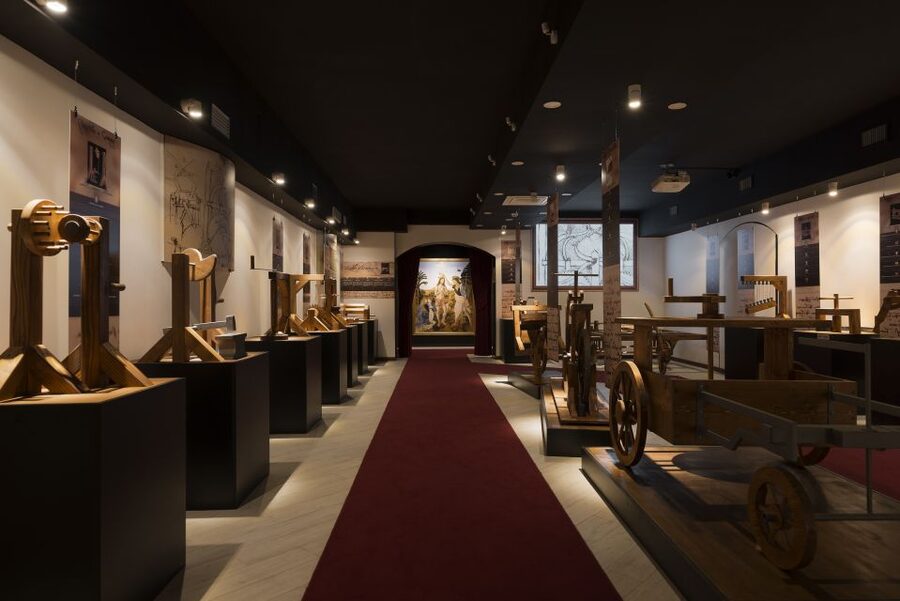
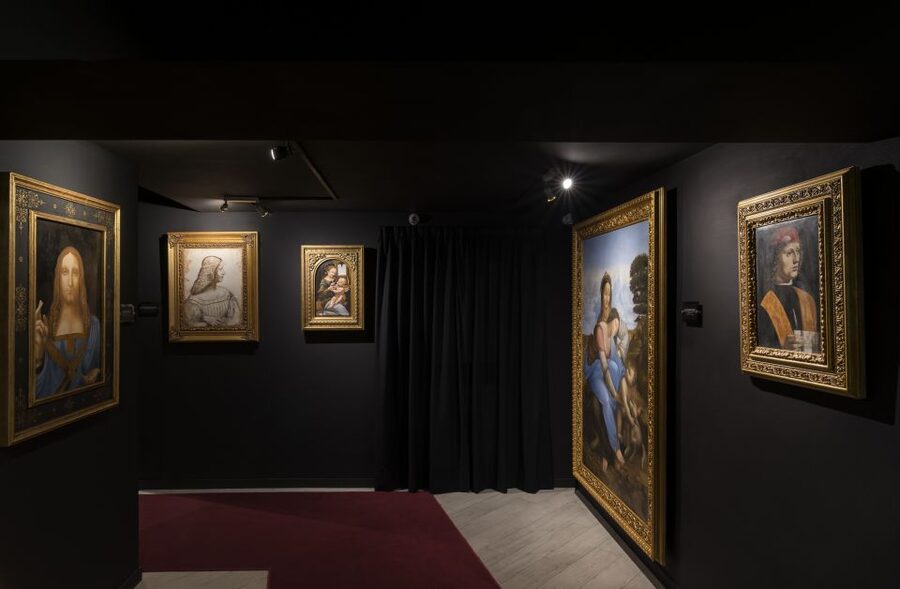
The art section contains 20 certified reproductions painted by prominent Vatican Museum restoration artists. These are not Leonardo’s original paintings, and the museum does not replace a visit to the Louvre, the National Gallery in London, or Milan. What you get is a chance to see several major works gathered in one place and hear how Leonardo’s technique changed painting.
Two versions of The Virgin of the Rocks are displayed. The originals are held in Paris and London, so seeing both reproductions together gives you a useful comparison. The audio guide explains the paintings and helps you notice differences that can be easy to miss in a quick glance.
The Lady with an Ermine shows Leonardo’s approach to portraiture. The pose, the animal, and the treatment of the sitter all help explain why the work was so different from more formal portraits of its time.
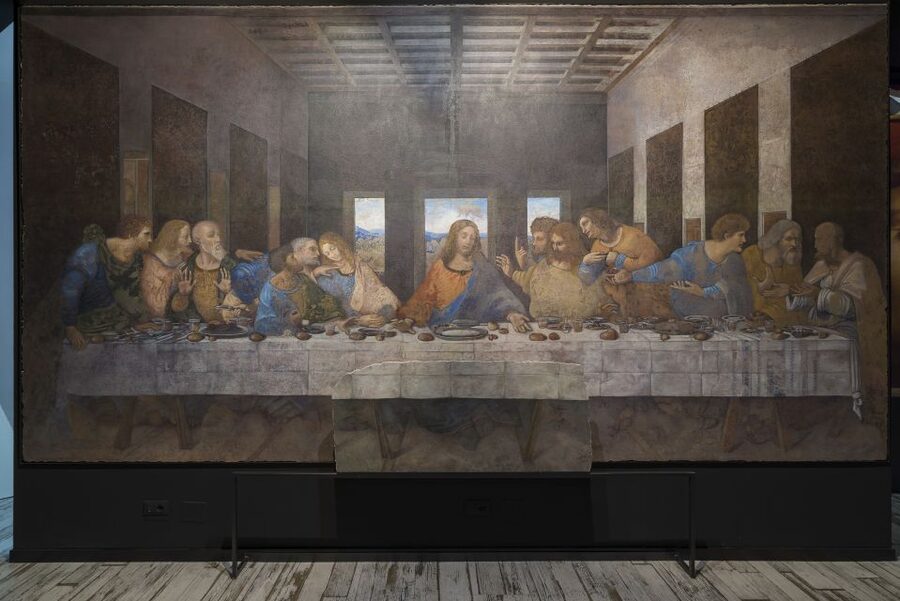
You will also see a full-sized reproduction of The Last Supper, the painting made famous again by Dan Brown’s novel The Da Vinci Code. Keep expectations clear: this is a reproduction, not the fragile original in Milan. Its value here is educational. You can study the composition, hear the background story, and connect the artwork with the engineering displays in the rest of the museum.
That combination is the real strength of the gallery. Leonardo was not simply an artist who happened to sketch machines. The paintings and inventions show the same close study of bodies, motion, light, proportion, and space.
Why the audio guide matters
The included audio guide is the backbone of the visit. Without it, you can still look at the models, but the museum may feel like a small room of unusual objects. With it, each machine has a reason for being there.
The guide is available in English, Spanish, French, Italian, German, Portuguese, Russian, and Chinese. It explains the inventions, gives background on the paintings, and helps you understand how some of Leonardo’s ideas relate to modern equipment.
You move from exhibit to exhibit independently. There is no guided tour included, so you do not need to keep up with a group or wait for a scheduled explanation. That arrangement suits you if you like to stop for photos, skip a section, or spend extra time on a machine that catches your attention.
The one practical nuisance is the headset setup. It can take a little time to get used to, so bring headphones and allow a few minutes at the entrance. If you arrive tired after a long day of sightseeing, you may not absorb as much as you would in the morning. The audio guide rewards a focused visit.
How long you should allow
The advertised ticket is valid for one day, but most people visit once and spend roughly an hour to two hours inside. A quick look can take less than an hour. A careful route with the audio guide, interactive machines, photos, and paintings can stretch to two or three hours.
I would allow 90 minutes for a comfortable first visit. That gives you time to listen to the main explanations without turning the museum into a race. Families may need longer because children tend to return to the hands-on displays.
This is a useful stop when you are staying near the Vatican or have a gap before another activity. It is only about 150 meters from St. Peter’s Square, so the location makes it easy to add to a Vatican-area day. It is also a sensible indoor break during Rome’s hotter months, thanks to the air-conditioning.
The museum can become busier around opening periods, and one visit required a wait when the entrance was crowded. If you want a calmer experience, an early start is sensible. The space is not large, so a busy room can make the interactive exhibits harder to use.
What $18 gets you
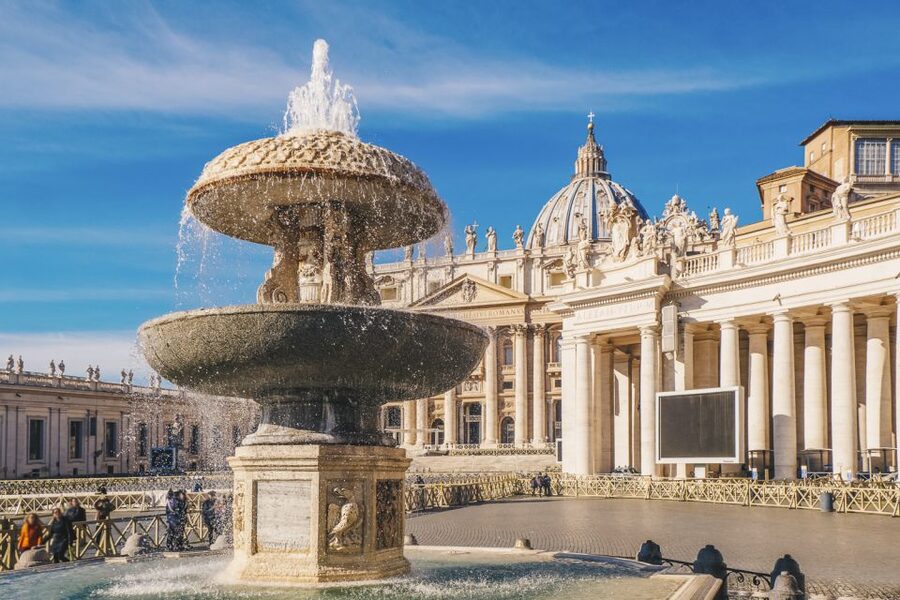
At $18 per person, this is not Rome’s cheapest small museum. The value comes from the combination of the audio guide, the hands-on reproductions, the painting gallery, and the central location.
I think the price works best for three types of visitors. Families get an activity that mixes play and learning. Art lovers get a compact introduction to several major Leonardo works. Curious adults get a practical look at machines that are often easier to admire in drawings than to understand.
The value is weaker if you only want to see famous paintings. The works here are certified reproductions, not originals, and the exhibition is modest in size. You might finish quickly if you skip the audio guide and do not use the interactive pieces.
There is a gift shop with books, models, and children’s building sets. It adds a pleasant final stop, especially if you are visiting with young people, though purchases are not part of the ticket.
The ticket includes free WiFi, restrooms, and an air-conditioned setting. Cancellation is free up to 24 hours before the visit, and you can reserve now and pay later, useful if your Rome schedule is still changing.
Who will enjoy this most
I would recommend it to families with school-age children and teenagers, particularly those who learn better by handling a model than by reading a long label. The bridge-building activity and working machines give young visitors something to do while the adults listen.
It also suits adults who want a short, focused museum close to the Vatican. You do not need specialist knowledge of art or engineering. The audio guide explains the main ideas in approachable terms.
Art experts may find the reproductions less satisfying than original works in Rome’s major museums. Likewise, anyone expecting a large technology museum should adjust their expectations. This is a compact exhibition built around Leonardo’s range, not a full survey of Renaissance science.
The self-guided format is a strong fit if you dislike group tours. You can linger over the machines, move quickly through familiar paintings, and take photos without worrying about a guide keeping the group together.
My verdict: book it if you want more than the Mona Lisa
Book this experience if you have an hour or two near St. Peter’s Square and want an indoor attraction with real hands-on elements. I especially recommend it for families, curious first-time visitors, and anyone who wants to understand Leonardo as an engineer as well as a painter.
Skip it if your schedule is packed with original artworks or if reproductions are a deal-breaker. At $18, it is not a must-see for every Rome itinerary. But with the audio guide, the working models, the Room of Mirrors, and the chance to build Leonardo’s bridge, it offers a lively change from Rome’s crowded ancient sites and formal galleries.
FAQ
Where is the Leonardo da Vinci Experience in Rome?
It is at Leonardo da Vinci Experience, Via della Conciliazione 19, about 150 meters from St. Peter’s Square.
How much does admission cost?
The listed price is $18 per person.
How long is the ticket valid?
The ticket is valid for one day. You should check availability for the available starting times.
How long does a visit usually take?
You can see the exhibition in under an hour, but allowing about 90 minutes to two hours gives you time for the audio guide and interactive models. A very careful visit can take two to three hours.
Is a guided tour included?
No. The ticket includes a self-guided audio experience, not a guided tour.
Which audio guide languages are available?
The audio guide is available in English, Spanish, French, Italian, German, Portuguese, Russian, and Chinese.
Should I bring headphones?
Yes. Headphones are listed among the recommended items to bring, and they can make the audio guide easier to use.
Is the museum suitable for children?
Yes. Children and teenagers can try selected inventions and experiment with interactive models. The bridge-building activity is one of the hands-on features.
Are Leonardo’s original paintings displayed?
No. The exhibition contains certified reproductions. It includes works such as The Virgin of the Rocks, The Lady with an Ermine, and a full-sized reproduction of The Last Supper.
Can I cancel the booking?
Yes. You can cancel up to 24 hours in advance for a full refund. You can also reserve now and pay later.
Fresh on the Italy list
- Florence: Uffizi Guided Tour with Skip-the-Line Entry Ticket★ 4.8 · 499 reviews
- Milan: Last Supper and Sforza Castle Guided Tour★ 4.6 · 498 reviews
- Boat trip La Maddalena Archipelago – Departure from Palau★ 4.5 · 499 reviews
- Exclusive Golf Tour Private VIP with Local & Gelato o Wine★ 5.0 · 500 reviews
- Turin: Egyptian Museum Skip-the-Line Group Tour★ 4.7 · 500 reviews
- Itria Valley: Polignano, Ostuni, and Locorotondo, from Bari★ 4.6 · 502 reviews
- Colosseum, Palatine Hill and Roman Forum with Guided Tour★ 5.0 · 500 reviews
- Catania: Etna Nature Tour with Hiking, Cave Visit, & Tasting★ 4.7 · 502 reviews
Tickets, compared.
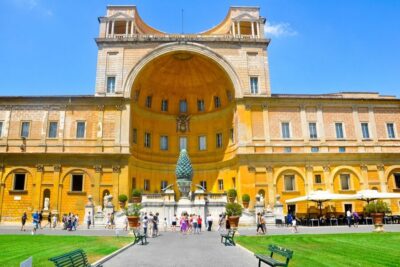
Vatican: Museums & Sistine Chapel Entrance Ticket
Read our review →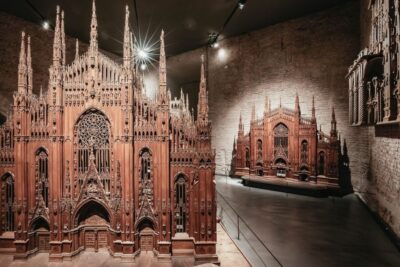
Cathedral and Duomo’s Terraces Entrance Ticket
Read our review →
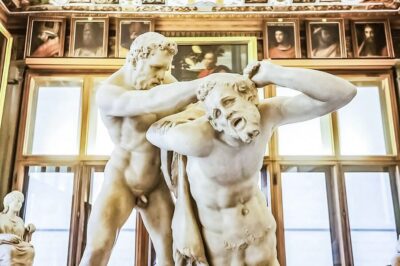
Skip-The-Line Uffizi Gallery Timed Entry Ticket
Read our review →
Naples Underground Entry Ticket and Guided Tour
Read our review →
Pantheon Fast-Track Ticket and Official Audio Guide
Read our review →
Entry Ticket and Guided Tour with an Archaeologist
Read our review →